World
Home · Gameplay · Enemies · Graphics
The world is a set of eight selectable low-poly combat maps. Each map has a terrain profile, palette, density settings, fog, lighting, weather climate, and gameplay-facing visibility/spawn-radius tuning. Maps are arenas for survival combat; no quest locations, story regions, or collectible lore systems were found.
This source-faithful map sheet uses the implemented map names, icons, biome classes, sky colours, ground colours, and selection descriptions. It gives every selectable map an equal visual slot; it is not a claim that the cards are in-game terrain screenshots.
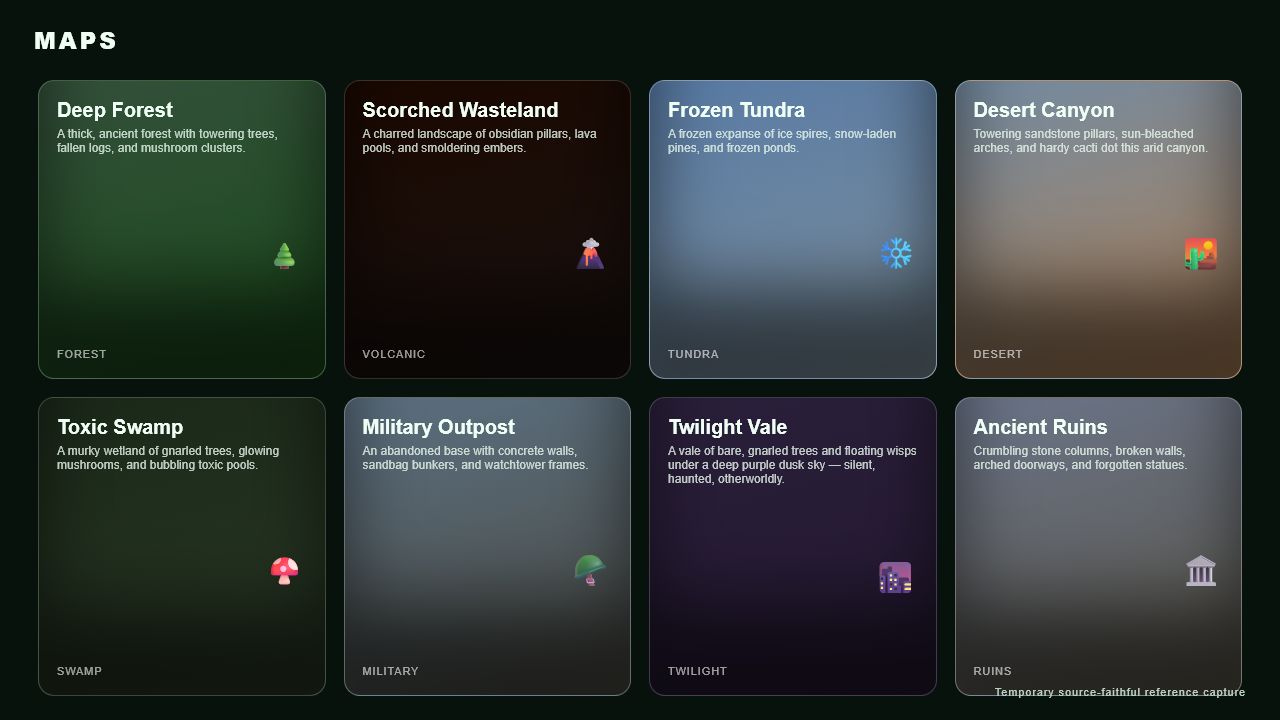
| Map | Implementation ID | Environment | Climate / special atmosphere |
|---|---|---|---|
| Deep Forest | deep_forest |
Dense trees, logs, mushroom clusters | Clear-dominant forest climate; rain can wet the forest ground. |
| Scorched Wasteland | scorched_wasteland |
Obsidian pillars, lava pools, embers | Ashfall climate; elevated barrel density. |
| Frozen Tundra | frozen_tundra |
Ice spires, snow pines, frozen ponds | Snow / blizzard climate and open sightlines. |
| Desert Canyon | desert_canyon |
Sandstone pillars, arches, cacti | Sandstorm climate and the longest standard visibility multiplier. |
| Toxic Swamp | toxic_swamp |
Gnarled trees, glowing mushrooms, pools | Fog / spore climate and low visibility. |
| Military Outpost | military_outpost |
Concrete walls, sandbags, watchtower frames | No special weather override; highest barrel density. |
| Twilight Vale | autumn_grove |
Bare gnarled trees and floating wisps | Dusk-oriented atmosphere. The public-facing name is Twilight Vale even though the ID is autumn_grove. |
| Ancient Ruins | ancient_ruins |
Columns, broken walls, arches, statues | Rain climate. |
The immediate combat envelope stays flat, while mid/far terrain uses GPU vertex displacement for hills, dunes, ridges, snow drifts, or map-specific surface character. Ground shader layers include macro tint variation, normal-like micro relief, slope/rock blending, and map-specific effects such as lava cracks, snow sparkle, sand ripples, and wetness.
The world streams a 5×5 grid of terrain chunks around the player. New chunks are budgeted over multiple frames and static props are GPU-instanced to reduce crossing hitches. Fog and a sky dome conceal the streamed boundary.
| Object | Interaction |
|---|---|
| Trees, rocks, boulders, props | Collision for player movement; they can block enemy and Sentinel line of sight. |
| Bushes | Apply a movement wade/slow multiplier. |
| Hazard pools | Lava, toxic sludge, and ice apply damage and/or movement effects to the player and enemies alike. See below. |
| Explosive barrels | Solid cover and destructible hazards; bullets, explosives, abilities, and nearby power activations can trigger them. |
| Ranged Sentinels | Stationary destroyable turrets; present outside Tutorial and Easy, then active from wave 3. |
| Pickup crates / airdrops | Nearby collectible objects for held powers and streak rewards. |
The scene clears collidable props within six units beyond the player's starting position to guarantee a safe initial spawn. Enemy spawn candidates attempt to avoid collision objects and fan around the player at roughly 42–68 units, adjusted by map spawn reach.
There is no named safe-zone mechanic. Safety is provided by cleared spawn space, terrain cover, and line-of-sight blocking.
Explosive barrels are the principal map hazard. Each has 28 HP, a 0.85 hit radius, 7.5-unit blast radius, and 150 enemy-facing center damage. The player takes reduced blast damage but can still be badly hurt; standing at the center is intentionally dangerous. Chain reactions queue nearby barrels and unfold across frames.
Lava, toxic sludge, and frozen ponds are mechanical hazards. They were previously non-collidable decoration that did nothing, which was a large part of why the eight maps differed mainly by colour grade — the terrain carried no rule.
| Pool | Found on | Effect |
|---|---|---|
| Lava | Scorched Wasteland | 26 damage/second on a 400 ms tick and a 45% movement slow. Crossing costs real health; standing in it kills. |
| Toxic sludge | Toxic Swamp | 9 damage/second on a 600 ms tick and a 22% slow. Survivable to cross, not somewhere to fight. |
| Frozen pond | Frozen Tundra | No damage. Movement is roughly 15% faster but far less controlled — a mobility hazard rather than a damage one. |
Damage scales with how deep into the pool you stand, so skirting the rim is a real and rewarded option, and the damaging radius is set slightly inside the visual edge so brushing past a pool is free. Enemies take the same damage on the same terms, which makes kiting a pack through a lava field a deliberate play rather than a one-sided tax. Pools are indexed in their own spatial grid, so the per-frame "am I standing in one?" test stays proportional to nearby props rather than to the whole map.
The game does not implement confirmed fall damage, drowning, storm damage, destructible buildings, or terrain deformation. Map descriptions and visuals should not be interpreted as mechanical hazards unless listed above.
Weather is automatic, clear-dominant, and driven by a map climate profile. The director can create rain, sandstorm, blizzard, ashfall, spores, or wisps depending on map. It is not selected from a gameplay menu.
Weather now carries gameplay consequences as well as atmosphere. The numbers are deliberately small — weather should colour a fight, not decide one the player never chose:
| Condition | Effect |
|---|---|
| Sandstorm / blizzard | Thick air cuts enemy engagement range by up to 32%, so a heavy storm genuinely conceals the player. This is the first situation in which a weather roll is an advantage. Floored so weather can never make a wave trivial. |
| Other storms | A milder engagement-range reduction of up to 12%. |
| Blizzard | Up to 10% movement slow from deep snow; sandstorm up to 6% from loose sand. |
| Heavy rain | Footstep audio is masked by up to 50%. |
Classic, Tutorial, and Multiplayer setup can choose day, night, or automatic time. Automatic time runs a continuously blended day/night cycle with day, dawn, dusk, twilight, and night lighting anchors. A full automatic day cycle is approximately two minutes at default speed.
Implementation references: src/utils/MapSystem.ts, src/utils/BiomeSystem.ts, src/utils/TerrainSystem.ts, src/utils/TerrainInstancer.ts, src/utils/WeatherSystem.ts, src/utils/DayCycleSystem.ts, src/utils/HazardSystem.ts, src/App.tsx.