Either your top-10 is real, or #10 beat #11 by a rounding error. This tells you which.
Invented by Teerth Sharma · teerths57@gmail.com · github.com/teerthsharma/separatrix
pip install separatrix
separatrix demo --frame preview   # the 3 rankings rounding chose, named from one run
0 of 1,116 certified sets moved across nine engines; all 8 that moved were refused. → §2


You asked for the ten nearest matches and got ten back. Most of them are not in doubt. But the last one or two can sit so close to the eleventh that which one made your list was settled by the computer's rounding rather than by your data — which is why the same query over the same data hands back a different tenth result on a different machine, or after somebody changes a batch size.
separatrix reads your results and marks them. Either this list came from your data and
nothing else could have produced it, or these two items are too close for it to tell
apart — here are their two id numbers, and here is how far apart they would have needed to
be. It never guesses, and it never quietly picks one.
- It scores your query against every item, the same way you already do, and takes the best ten.
- In the same pass it works out how far each score could possibly be off, because a computer keeps only so many digits (a rigorous error bound worked out in advance — not a sample, not a second run, not a statistic).
- Each score stops being one number and becomes a small range: somewhere between here and here.
- It compares the worst case of everything inside the ten against the best case of everything outside it (comparing only the 10th against the 11th is a shortcut, and it is unsound — see the false theorem).
- If those two sides do not touch, rounding could not have moved anything across the line, so the ten are certified — and any other machine computing the same formula on the same stored bytes returns the same ten.
- If they do touch, it refuses: it names the two items it cannot separate, prints both ranges, and says how far apart they would have needed to be.
How can a batch size have no effect, when it visibly changes floating-point results? It does change them. Every engine below returns different numbers on the same bytes. What step 5 rules out is a change to the set: once the two sides are known to be separated by more than any of them can move a score, they all have to return the same ten. That is why the answer is a proof and not a measurement over reruns — running it twice and getting the same list tells you nothing about the rows where both runs were equally lucky.
And here is rounding actually choosing a ranking, so the claim is not only a negative
one. On a corpus seeded with near-duplicate pairs, two evaluations of one formula on one set
of bytes disagreed on 3 of 60 queries. separatrix named 9 candidates from the first
evaluation alone, and all 3 were among them:
  corpus 400 x 64 float32, 60 queries, k = 5, 40 near-duplicate pairs at 3e-07
  named undetermined, from one evaluation:  9 of 60  [5, 13, 14, 22, 37, 39, 40, 54, 57]
  actually differed, over two evaluations:   3 of 60  [14, 22, 54]
  differed and NOT named:                    0  []
differed and NOT named is the only line that is evidence, and it is a soundness check: a
row two evaluations decided differently that was not named in advance is a counterexample
to the whole certificate, and the frame exits non-zero on one. The control is in the corpus
— an all-near-duplicate corpus refuses every row and makes the claim true by construction,
so 51 of these 60 rows are certified and had something to lose.
→ RESULTS.md §5.3
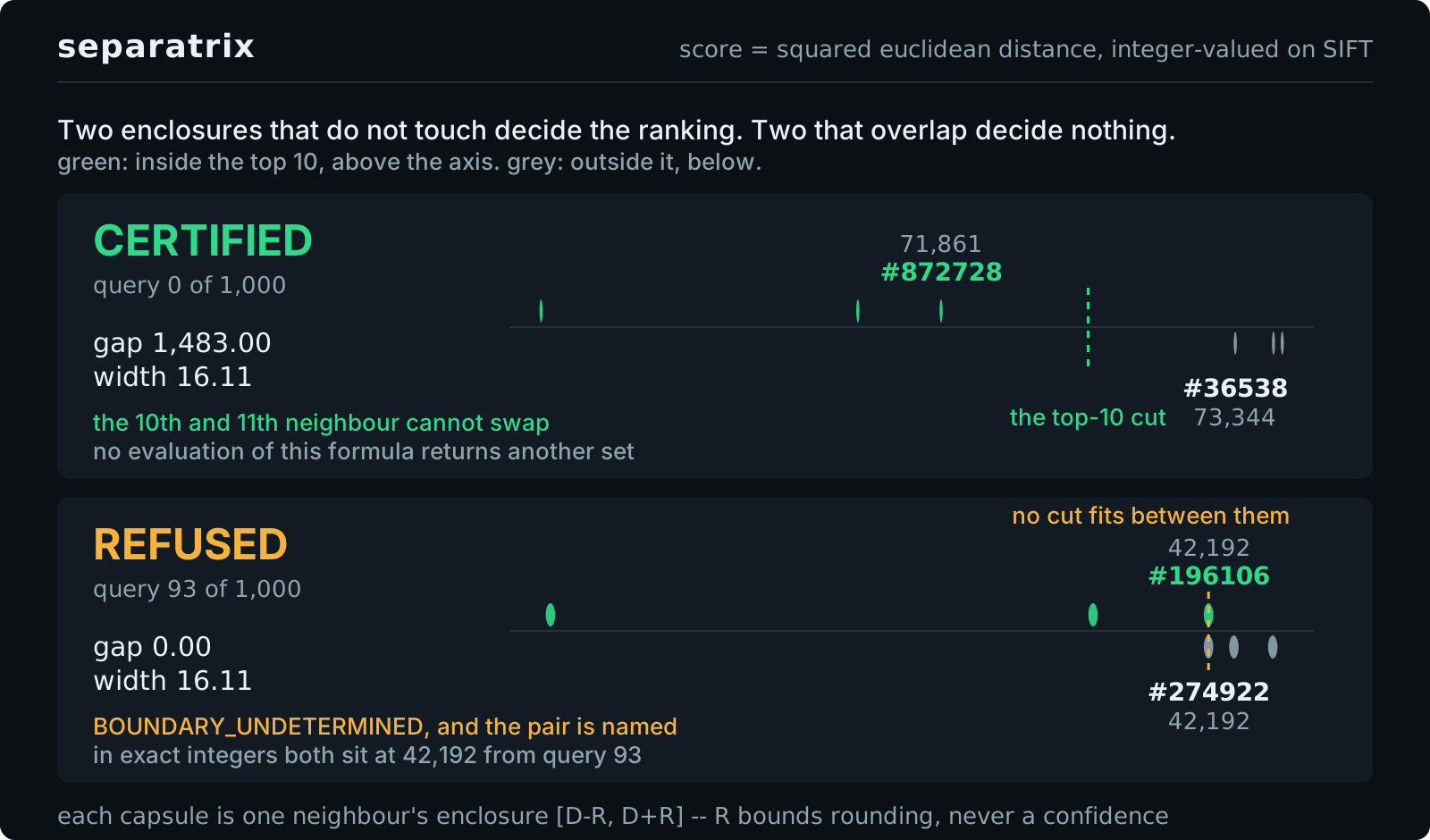
It says no whenever two items are closer together than its own error bound is wide. That is a statement about the arithmetic, not a finding about your data. Most refusals are caution: the bound is worked out in advance for the worst input, and your input is usually not the worst one. On a 100-query run against the million-row corpus, 11 rows were refused; running exact whole-number arithmetic on those 11 decided 9 of them and left 2 genuine ties, where two items are at exactly the same distance and no amount of precision helps.
A refusal is a return value, not an exception and not a crash. It looks like this:
==============================================================================
  REFUSED (BOUNDARY_UNDETERMINED)                         285/300 determined
==============================================================================
  detail      15 of 300 rows have a rank-10 boundary this enclosure does not
              decide; the direct kernel separates 7 of those 15 frontier
              pairs
  computed    kernel gram   bound cheap   per-row   k 10
------------------------------------------------------------------------------
  boundary    row 12: in #1046 [1.721866e+00, 1.722050e+00]  out #1342
              [1.721932e+00, 1.722116e+00]  gap 6.616116e-05  width
              1.840634e-04  deficit -1.179022e-04
              14 further boundaries not shown (--max-report 1)
------------------------------------------------------------------------------
  next        The two enclosures at the rank-k boundary overlap. Pass
              escalate=True to decide it exactly, or bound='tight', or
              per_pair=True, or recompute in a wider dtype.
==============================================================================
Four things you can do about one, with what each costs, measured:
| what you do | what it costs | measured |
|---|---|---|
Settle the boundary exactly — escalate=True |
exact arithmetic on the named pair only | decided 9 of 11 refused rows for 22 exact dot products (§10.4) |
Change the formula, when the refusal says the formula is the problem — kernel="direct" |
a slower kernel | took 2 of 100 refusals to 0 of 100, at 8.7× the time (§10.5) |
| Ask for more results than you need and let whatever comes next absorb the boundary | nothing, and no library | this is the one that works in production at the 26% refusal rate measured here |
| Accept a tie — two items at exactly equal distance | you pick a tie-break rule | no precision removes it; 9 of 9 SIFT1M disagreements are this (§10.3) |
There is no knob that makes it refuse less without making it lie. There is no on_refuse
handler and no default threshold, because a library that throws on 26% of rows — 384 of the
1,500 rows measured here — is uninstalled the same afternoon.
Everything above is this, said carefully. Skip it if you got what you came for.
The enclosure. A float dot product fl(x·y) deviates from the real x·y by at most
γ_d · Σ|x_i||y_i| — Higham, ASNA 2nd ed., Theorem 3.1. The Gram identity
d² = ‖x‖² + ‖y‖² − 2⟨x,y⟩ is three such reductions plus two additions, so its constant is
γ_{d+2}, and Cauchy–Schwarz collapses the whole thing into two norms that ride the BLAS
call the scores already cost:
with u = eps/2, giving |D − s| ≤ R where s is the exact real value of the named
formula on the bytes you handed it. One extra O(nd) pass. No extra matmul, no sampling,
no reruns, no posterior. The norms are computed in float64 — reusing the working-dtype
‖x‖² already sitting in the identity is the tempting shortcut, and a norm that rounds low
yields a radius that is low, and a low radius is not a bound.
The rule. One inequality, over (D, R) alone, knowing nothing about kernels:
Why determinism follows. Every evaluation whose error the bound covers lands inside the
same box. Disjoint sides then force every one of them to return T. Batch size, BLAS
backend, thread count, chunk size, reduction order, FMA and torch.cdist's 25-row switch
cannot move it. This holds for evaluations inside the bound, which is exactly why a range
precondition and a 4×4 canary run before any score is read: an engine quietly using TF32 or
bfloat16 is outside the declared unit roundoff, and it is refused rather than certified.
Comparing only the rank-k and rank-(k+1) scores is unsound the moment radii vary: scores
[0, 1, 2, 10] with radii [12, 0, 0, 0] and k = 2 gives a disjoint boundary pair and
certifies {0, 1}, while the vector (11, 1, 2, 10) sits inside the box with top-2
{1, 2}. On every benchmark corpus here the naive rule and the sound rule return
identical refusal counts — 15/15, 300/300, 35/35, 32/32, 2/2 — so the naive rule ships green
and only the counterexample test catches it.
→ §1.4
And the relative-error model is false under subnormals. fl(ab) = ab(1+δ) does not hold
when a product lands subnormal, so an unconditional additive η rides every radius. Its
control: at float32 with components ~1e-25, 4000/4000 trials escaped the radius alone and
0/4000 escaped with η — while at components ~1, the ordinary regime, 0/4000 escaped
either way.
→ §1.3
import separatrix

idx, v = separatrix.certified_topk(corpus, queries, k=10)  # replaces argpartition
j,   v = separatrix.certified_argmin(corpus, queries)    # k=1, axis squeezed
e      = separatrix.enclose_scores(corpus, queries)      # the scores and their radii
trit   = separatrix.certified_threshold(e.D, e.R, t)     # +1 / -1 / 0 undetermined

v.status        # CERTIFIED | CERTIFIED_UPCAST | NOT CERTIFIED | REFUSED
v.n_refused     # an exact integer. never a score, never a probability
v.frontiers     # per undetermined row: the pair, both intervals, the gap, the deficit
v.next_action # what to changeCERTIFIED means rounding did not choose this ranking. It says nothing about the
model, the quantiser or the sensor: a 384-dim embedding out of a float16 forward pass
carries ~1e-3 relative error, three to four orders above the float32 rounding being
certified. This is a heading and not a footnote because it is the way the certificate will
be misread.
| status | exit | what it means |
|---|---|---|
| CERTIFIED | 0 |
Proved. Every row's set is the exact score's set, and every other evaluation of the formula on these bytes returns it |
| CERTIFIED_UPCAST | 4 |
Proved at a wider dtype than production runs. Never 0, because CI must not read a pass for a computation your index does not run |
| NOT CERTIFIED | 1 |
An exact tie. The only outcome no precision removes |
| REFUSED | 2 |
No certificate was formed, with a cause and a next action |
| usage error | 3 |
An exception, not a verdict — a statement about your code, not your data |
Every refusal is typed and names a concrete object. Of the eight: one names a change to how the score itself is computed, three name a dtype or a flag, one names your data, one raises a budget, one has no fix at any precision, and the most common one names a boundary and asks you to look at it again.
| code | what it names | what to do |
|---|---|---|
BOUNDARY_UNDETERMINED |
the frontier pair, both intervals, gap, width, deficit |
re-observe, escalate, or widen k |
GRAM_CANCELLATION |
the one that names a change to the score formula — the direct kernel separates this pair, the Gram identity does not | kernel="direct", or compute_mode="donot_use_mm_for_euclid_dist" |
EXACT_TIE |
escalation proved the two scores equal | adopt a tie-break; no precision fixes this |
RANGE_UNSAFE |
the row whose norms overflow the working dtype, before any score is read | upcast=True, or normalise |
NONFINITE_INPUT |
the row and the column. separatrix will not impute | fix the data |
BOUND_VACUOUS |
(d+2)·u > 1/2 — a stated domain limit, not a property of your data |
use a wider dtype |
REDUCED_PRECISION_ARITHMETIC |
the 4×4 canary caught TF32 / bfloat16 / AMX | set float32_matmul_precision="highest" |
ESCALATION_BUDGET |
the frontier exceeded max_escalations |
raise the budget |
A refusal is not a finding. It means no certificate was formed. Only escalate=True
decides which way a boundary actually falls, and on these corpora it decided 379 of 384
refusals were pessimism rather than damage. That number is printed here rather than left
for a reader to discover.
separatrix check --corpus corpus.npy --queries queries.npy --k 10 \
                 [--kernel gram|direct] [--bound cheap|tight] [--per-pair] \
                 [--escalate] [--upcast] [--ordered] [--largest] \
                 [--chunk 100] [--max-refused 0.05] [--max-report 1] [--json]

separatrix demo --frame cancellation   # two points 1e-6 apart at magnitude 1e6
separatrix demo --frame batch          # one set of bytes, two evaluations, two answers
separatrix demo --frame preview        # boundaries never separable, named first
separatrix probe                       # this machine's u, canary, torch flags
with separatrix.gate(max_refused=0.05, fixture="scifact-d384-fp32"):
run_your_evaluation() # every certified_topk call reports into the gatemax_refused is required — no default. The fraction is keyed to a config digest over
the nine fields that change what a refused fraction means, and on a digest mismatch the
gate refuses to compare rather than failing, because a gate that goes red on a numpy
upgrade is deleted in a week. It reads .separatrix-gate.json and never writes it: a gate
that records its own budget is vacuous.
One draw, seed 11, one machine — WIN-16QAL06O9GB, CPython 3.11.9, numpy 2.4.6, scipy
1.17.1, torch 2.14.0+cpu. Real data and synthetic are kept apart below, and every synthetic
row says so.
Every table, every control, and every arm that lost →
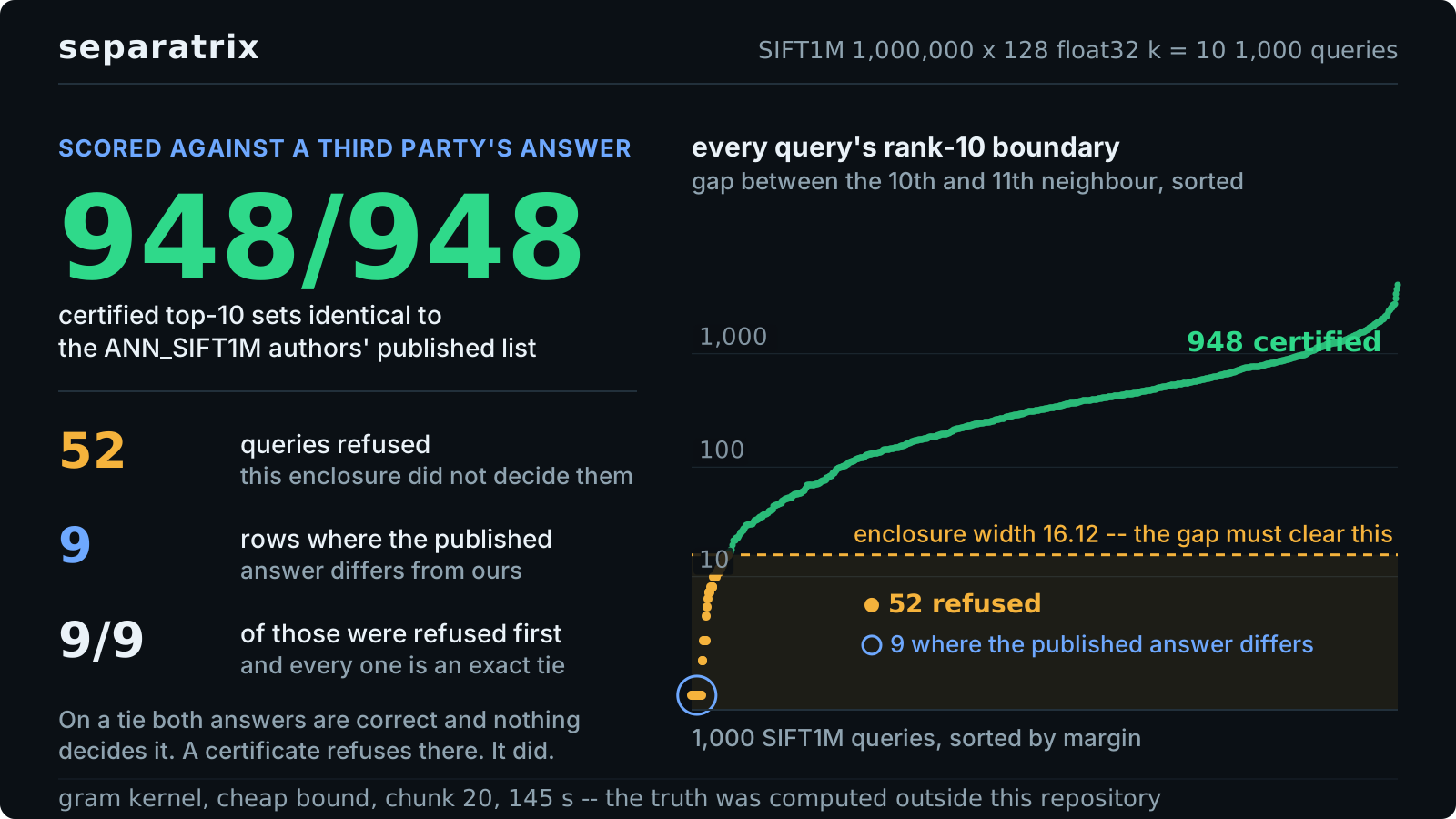
1,000,000 × 128 INRIA SIFT descriptors, 1,000 queries, k = 10, chunk=100, 48.0 s.
The ANN_SIFT1M release ships the authors' own exact top-100 list, so this
is the one table here whose answer key was not computed by this code.
| what | measurement |
|---|---|
| refused | 52 of 1,000 (5.2%) |
| CERTIFIED sets agreeing with the published top-10 | 948 of 948 |
| rows where the published answer differs | 9 — rows 93, 170, 460, 574, 614, 731, 760, 930, 934 |
| how many of those 9 had been refused first | 9 of 9 |
| how many of those 9 exact integer arithmetic calls a tie | 9 of 9 |
| float32 Gram scores differing from exact int64 | 0 of 20,000,000 |
| float16 on the same bytes | REFUSED (RANGE_UNSAFE), before any score is read |
948 of 948 is clean because this corpus is arithmetically easy, and that is measurable
rather than lucky. SIFT descriptors are integers 0..255; every Gram intermediate stays
below 2^24, which float32 carries exactly, so the float32 score is the exact integer
distance — 0 of 20,000,000 scores differ from int64 over the same bytes. The flip count
here is therefore 0 by arithmetic, every non-tie refusal is pessimism exactly, and the
pessimism is visible as a number: the median frontier has gap 7.0 against an enclosure
width of 16.12, with a true error of 0. What this table can test is whether the
certificate ever contradicts a third party. It never did, and the 9 rows where the third
party differs were refused before they were found.
→ §10
.venv/Scripts/python bench.py --sift --out .donotcommit/sift.json # 516 MB, once
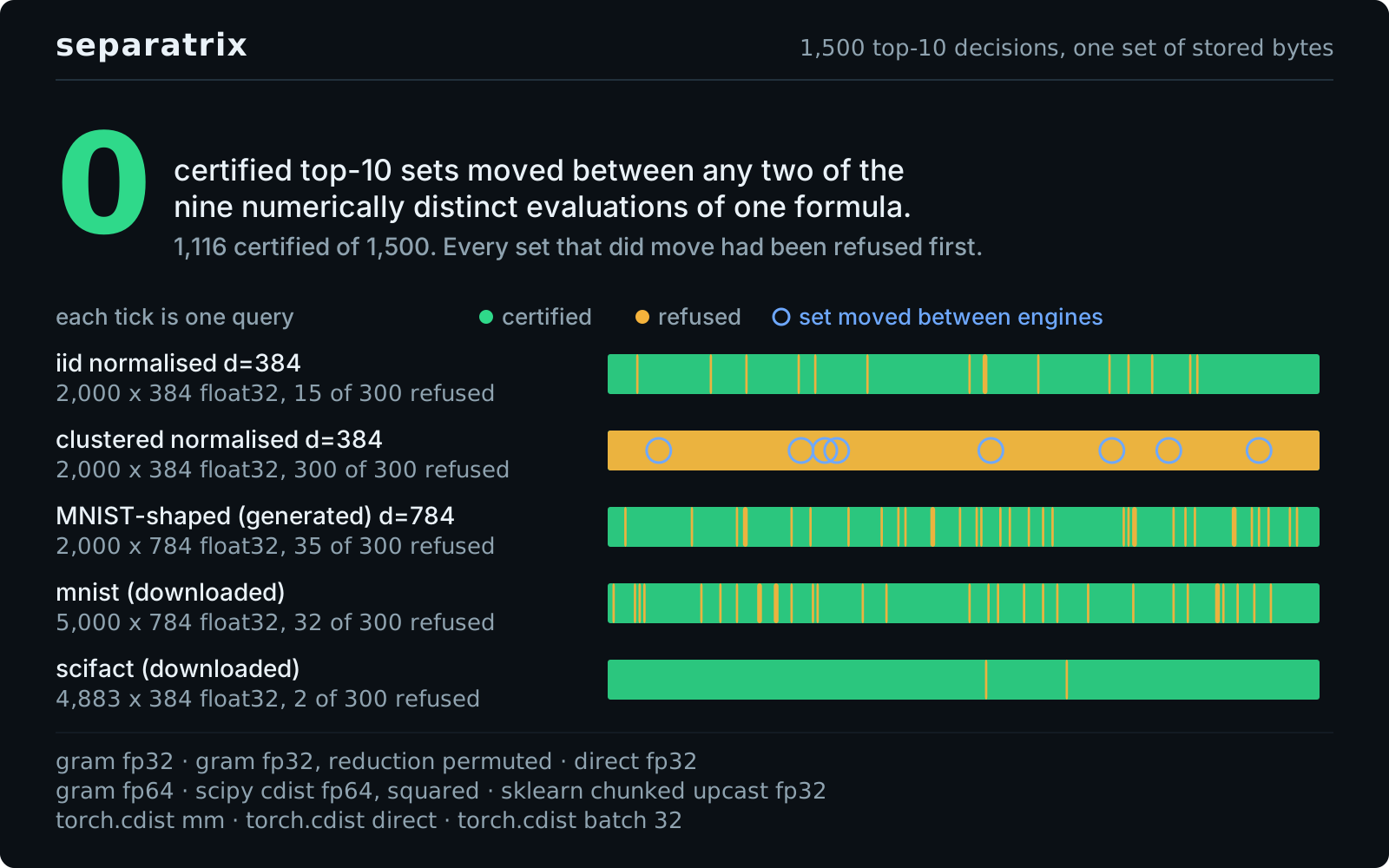
Same stored bytes, nine numerically distinct engines: numpy Gram fp32, the same with the
reduction permuted, numpy direct, numpy fp64, scipy.cdist,
sklearn.euclidean_distances, torch.cdist on both compute modes, and torch.cdist at
batch 32.
| corpus | shape | refused | moved, CERTIFIED | moved, REFUSED first |
|---|---|---|---|---|
| iid normalised d=384 (generated) | 2000×384 f32 | 15/300 | 0 | 0 |
| clustered normalised d=384 (generated) | 2000×384 f32 | 300/300 | 0 | 8 |
| MNIST-shaped d=784 (generated) | 2000×784 f32 | 35/300 | 0 | 0 |
| MNIST (downloaded, 5k rows) | 5000×784 f32 | 32/300 | 0 | 0 |
| BEIR SciFact + all-MiniLM-L6-v2 (downloaded, 4.9k rows) | 4883×384 f32 | 2/300 | 0 | 0 |
Four of five corpora returned 0 in the last column. Those four are arms where this package had nothing to say, and they are printed at the same size as the one that did. Only the clustered arm is evidence the corpus was not too easy. Three of these five are generated and two are downloads of a few thousand rows; the nine-engine comparison is not run at a million rows — nine evaluations of a 1,000 × 1,000,000 score array is 72 GB — so the real-data table above carries one external answer instead of nine internal ones. → §2
| corpus | gram refused | direct refused | median gram width | median direct width |
|---|---|---|---|---|
| iid normalised d=384 (generated) | 15/300 | 8/300 | 1.841e-04 | 9.180e-05 |
| clustered normalised d=384 (generated) | 300/300 | 2/300 | 1.841e-04 | 9.167e-05 |
| MNIST-shaped d=784 (generated) | 35/300 | 11/300 | 1.414e+03 | 5.191e+02 |
| MNIST (downloaded) | 32/300 | 4/300 | 3.580e+03 | 6.290e+02 |
| SciFact (downloaded) | 2/300 | 1/300 | 1.841e-04 | 8.085e-05 |
298 of the 300 refusals on the clustered index are attributable to the kernel alone.
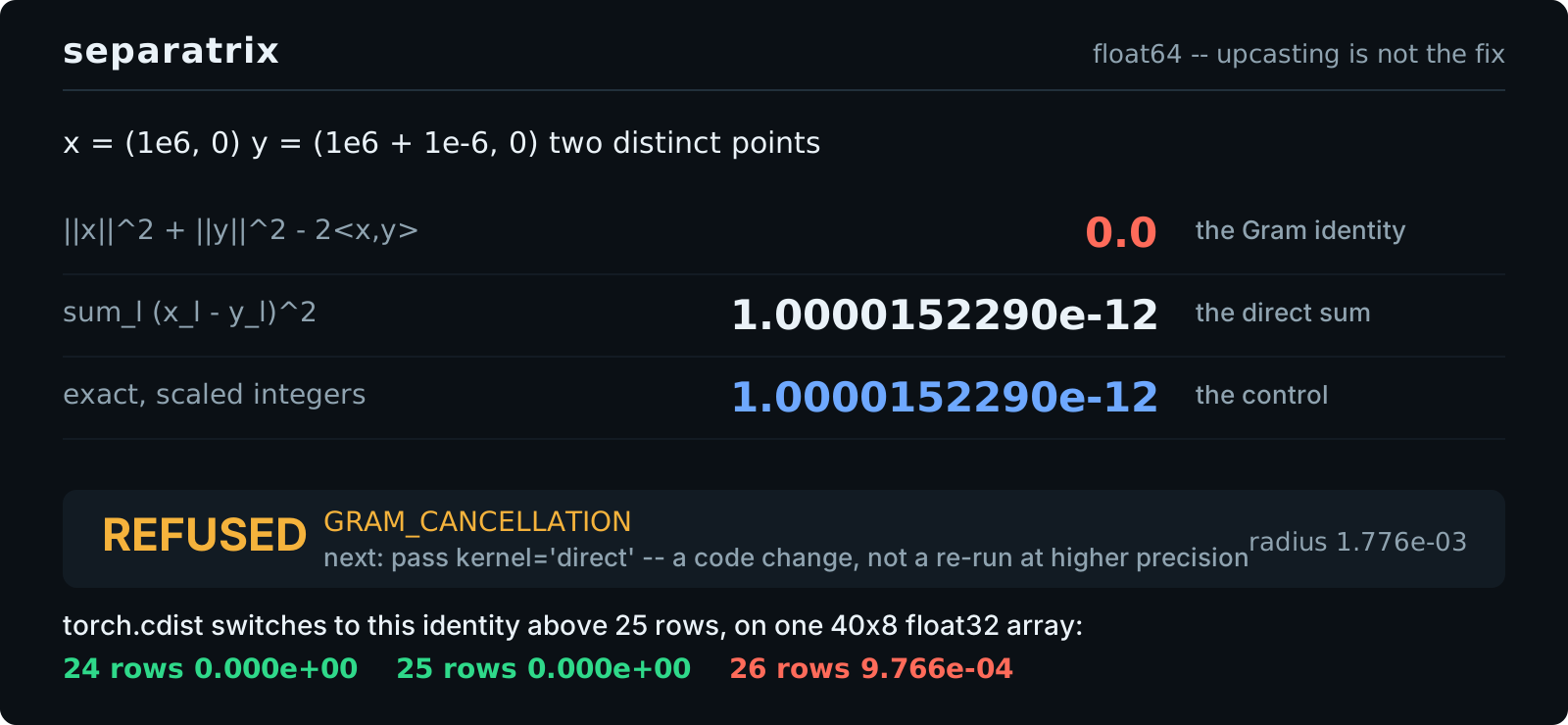
torch.cdist switches to the cancellation-prone Gram identity above 25 rows because it is
faster: below the switch the two compute modes are bit-identical, above it, on the same
stored bytes, they are not — 0.000e+00 at 24 and 25 rows, 9.766e-04 at 26, measured on
the installed torch 2.14.0+cpu rather than quoted from docs.
→ §5
| seconds | vs float64 gram | vs float32 gram | |
|---|---|---|---|
| float32 gram + argpartition — the status quo | 0.0229 | 0.73× | 1.00× |
| float64 gram + argpartition — the honest control | 0.0314 | 1.00× | 1.37× |
| scipy.cdist float64 + argpartition | 0.5357 | 17.1× | 23.4× |
| separatrix rung 1, per-row radii | 0.0529 | 1.68× | 2.31× |
| separatrix rung 2, per-pair radii | 0.0730 | 2.33× | 3.18× |
| the float32-vs-float64 diff — the competing practice | 0.0498 | 1.59× | 2.17× |
Parity with the diff it replaces (1.06×), and roughly 1.7× the float64 control. Neither is a selling point, and both are stated at their real size. Spread over six runs of the same file on the same corpus: rung 1 at 0.0517–0.0555 s, 1.59×–1.89× the control and 0.96×–1.12× the diff. Two earlier builds quoted 0.0505 s and 0.0650 s for this row; neither absolute reading reproduces and both are struck. The seconds move between builds and the ratios do not, so the ratios are the measurement and the seconds are the draw. → §6
| what | measurement |
|---|---|
| CERTIFIED verdicts the exact lattice contradicts | 0 |
| enclosure escapes on the adversarial corpus | 0 of 656 pairs — 82 per configuration, 8 configurations, 10 corpora |
| escalation contradicting a certificate | 0 over all 384 refused rows, 5,827 exact dot products |
| CERTIFIED on the recorded float16 range case | 0 |
One CERTIFIED decision that exact arithmetic contradicts withdraws the package. → §1
python -m venv .venv
.venv/Scripts/pip install -e .            # numpy and scipy are the only hard deps
.venv/Scripts/python -m pytest tests/ -q  # 212 passed; 1 skips without the cache
.venv/Scripts/python bench.py --out results.json
.venv/Scripts/python make_assets.py --measure   # every picture here, offline
.venv/Scripts/python bench.py --sift      # the real-data table, 516 MB once
bench.py --no-download skips the two corpora that need a network and runs the rest.
torch, scikit-learn, datasets and sentence-transformers are optional, imported
lazily, and named in bench.py's own output when absent rather than skipped silently. Every
module owns a runnable self-check: python -m separatrix.enclose.
Nothing in the certified layer is new, and saying so first is what makes the rest believable. Three of these beat this design on their own axis.
| work | what they had first, or do better | what separatrix adds |
|---|---|---|
CGAL Filtered_predicate / Interval_nt (manual) |
This exact rule, shipping since ~2001: interval enclosure, disjoint-from-zero certifies the sign, overlap escalates to exact | a different adversary — a rank-k set boundary in 384 dimensions in Python, where the escalation target is a set rather than a sign |
| Melquiond & Pion, static filter certification (RAIRO Theor. Inform. Appl. 2007) | the same class of a-priori bound, formally machine-checked where these are only tested against an integer oracle | nothing on rigour. This is a gap, stated as one |
Ogita–Rump–Oishi Dot2 (SIAM J. Sci. Comput. 2005) |
an a-posteriori bound at u where this is a-priori at (d+1)u. Benchmarked here: it certifies 64 of 64 boundaries this package refuses |
throughput only — Dot2 is elementwise and forfeits the gemm, at 61× to 99× the cost over six runs. If you can afford roughly 100×, use Dot2 |
| Higham, ASNA 2nd ed. ch. 3 | the bound itself, one page, Theorem 3.1 and (3.1) | the plumbing to a top-k set and a typed refusal |
| scikit-learn #9354 / PR 13554 | fixed euclidean_distances fp32 instability by chunked upcasting, on by default since it landed |
the diagnosis this is the mitigation for. It also shrinks the addressable population to torch.cdist above 25 rows, hand-rolled Gram code, and low-precision indexes |
| CADNA / Discrete Stochastic Arithmetic (site) | unstable branching as a first-class counter — the same output shape, and older | a proof over a box instead of a 95% confidence estimate from three random-rounding runs, and a pip channel |
python-flint (Arb), mpmath.iv |
both pip-installable, both rigorous, both doing enclose-or-escalate today | it rides the gemm. Arb is scalar; this needs no arithmetic beyond the one BLAS call the scores already cost |
torch.use_deterministic_algorithms, CUBLAS_WORKSPACE_CONFIG, ReproBLAS |
same-machine run-to-run reproducibility, in-tree, free | they make two runs agree on a value that was never determined. This reports whether the answer was ever in doubt |
torch.cdist(compute_mode="donot_use_mm_for_euclid_dist") |
one keyword, already installed, and it removes the cancellation class rather than diagnosing it | knowing which of your decisions needed it |
"The mechanism is unknown to the Python ecosystem" is not a sustainable claim and is not made anywhere in this repository.
The origin of the observation is the author's own, from an earlier clustering pipeline:
torch.cdist switching to the Gram identity above 25 rows, where it flipped single-linkage
merge order on clustered low-precision keys, and where points at offset 1e6 with 1e-6
separation cancelled to exactly 0.0 so a persistence routine reported two distinct points
as one. That last case is the picture above, and it is the only part of that story with a
number in
RESULTS.md.
Found by running the modules against each other, and by handing the loader the kind of file a stranger would. None of it was found by reading the code.
- A negative radius certified everything. Precondition P3 admits
n·u == 1/2, whereγ_nis exactly 1.0 and rounds outward to1.0000000000000002. The Gram form multiplies by γ and stays sound; the direct kernel's relative form divides by1 − γand produced a radius of −9.224903e+14, which inverts every interval so max-in falls below min-out and the rule certifies every row. NowBOUND_VACUOUS, pinned by two tests assertingR ≥ 0andlo ≤ hiover every kernel × bound × adversarial case. → §1.1 - A 64-frontier cap made refused rows read as certified. With 69 refused rows out of 200, the 5 past the cap were invisible to any consumer reconstructing the refused set from
v.frontiers, and two evaluations then "disagreed on 5 CERTIFIED rows". Measured: 5 apparent disagreements before, 0 after. AVerdictnow caps nothing; the CLI caps what it prints. 0.14× the cost of the fp64 reference. The design's headline. It does not reproduce, and neither does its revision to0.91×. Withdrawn. The honest words are parity with the diff and ~1.7× the float64 control. → §6summation="pairwise"as a certificate. Deleted. OpenBLAS accumulates with ~8 unrolled accumulators, giving reduction depth ≈d/8 + 3≈ 101 at d=784 against the pairwise model's2·log₂(784)+2 = 21.2— 4.8× too shallow, by counting, before any measurement.- The pre-registered prediction of
flipped = 0on every corpus did not hold — and it failed in the direction that helps least. The clustered arm flips 5 of 300, and the plain float32-vs-float64 diff finds the same 5. So that arm is not one where separatrix saw what the practice missed; it is one where both saw the same thing and only one needed a second run. → §3 - The pessimism gate fired on the synthetic generator and the design's number was wrong in both directions. The design predicted 107/300 on a clustered normalised d=384 index and generalised to real embeddings. Measured: 300/300 on the synthetic clustered generator, 2/300 on real BEIR SciFact. The synthetic generator is far more adversarial than a real index, and no number from it may be quoted as a statement about one. → §4
- A four-line tuned margin beats this on coverage.
gap > eps·|score|certifies 295 of 300 on the clustered arm where separatrix certifies 0. What it does not have is anyepsbelow1e-3that avoids issuing certificates a witness contradicts — and theepsthat does costs 122 of 300 certificates on the iid arm and 108 on MNIST-shaped. The differentiator is no tuning, and a proof, which is smaller than the pitch. → §7.2 - Three things broke on the first million-row corpus, none of them soundness. Frontiers all reported row 0 after
--escalate, so two refused rows read as one.chunk=was accepted, validated, and then ignored — 1,000 queries × 1M rows is 8.00 GB of scores in one allocation on a machine with 2.9 GB free. And the float64 norm pass copied the whole corpus, 1.02 GB. Peak working set after the three fixes: 2,565 MB. → §10.1 - Five ways a stranger's file crashed the loader, all with a bare traceback instead of a verdict: a zero-byte
.npy, a non-zip.npz, an npz whose member fails its CRC check, a mangled header falling through into Python's tokenizer, and anexact_latticesearch that hung indefinitely on a large delta rather than refusing. All five now return typed errors; the hang refuses in 0.01–0.03 s. The suite is 212 tests, covering every one of the eight refusal reasons through the public API.
Collected once, here.
- It certifies the rounding of one named formula on the bytes it was handed, and nothing else. A 384-dim embedding out of a float16 forward pass carries ~1e-3 relative error, three to four orders above the float32 rounding certified.
CERTIFIEDmeans rounding did not choose this ranking — never that the ranking is right. - Not a detection. The float32-vs-float64 diff was right on 1,495 of 1,500 rankings measured here. The status quo is mostly fine; this returns a proof instead of an empty diff, at the same cost.
- Not faster than what it replaces. 1.68× the float64 control, 1.06× the diff, on the printed draw. There is no speed story.
- Pessimistic where it matters most. 379 of 384 refusals here were pessimism, not damage. The exact lattice puts the pessimism factor at ≤256×, and that is an upper bound on the gap rather than a measurement of it. → §7.5
- The refusal actions that work offline do not ship at the 26% refusal rate measured here — 384 of 1,500 rows. The action that works in production is free and needs no library: retrieve
k+5and let the reranker absorb the boundary. ordered=Truecompares k boundaries instead of one and refuses correspondingly more often. Its column is never merged with the set column.- The rung-1 memory collapse costs refusals where norms vary: 35 against 26 on MNIST-shaped, 32 against 15 on real MNIST. It costs 0 at d=384 with unit norms. → §7.3
- One corpus carries the real-data-at-scale evidence, and it is an easy one for the arithmetic. SIFT1M's integer components make its float32 scores exact, so its flip count is 0 by arithmetic and it can never produce evidence that rounding chose a ranking.
flipped > 0stays a property of the generated clustered corpus; the nine-engine agreement table, the tuned-margin baseline, the Dot2 arm, the shuffled-enclosure control and the cost table are all generated-corpus only. → §10.7 - Never claimed anywhere in this repository: any GPU number (no CUDA path is designed); any claim about an approximate index (IVF/PQ/HNSW search error is ~1e-2 relative, four orders above the float32 enclosure width, so certifying it would certify the wrong quantity while printing CERTIFIED —
faissis not a dependency, not a loader and not a refusal code); accumulator width (P5 is not testable by either probe tried and travels on every verdict as a declared assumption); a machine-checked bound; and a probability of any kind — Higham & Mary'ssqrt(n)·uwould cut the width ~19× at d=384 and is cited and refused for exactly that reason. → §8 - Measured on CPython 3.11.9 only, on one machine. Two of the five small corpora need a network, and every row drawn from them is labelled
(downloaded): the three generated corpora reproduce offline and carry 550 of the 1,116 certified sets, so a reader without a network can check that much and no more.
- Make the pessimism the product. The tight rung and per-pair radii already exist; the missing piece is an escalation that runs only on the frontier and turns a refusal into a decision at a bounded cost, so the 379 pessimistic refusals become 379 answers.
- Dot2 as an opt-in rung. It wins on coverage by a mile and loses on throughput by 61×–99×. That is a knob, not a verdict, and it should be exposed as one.
- A machine-checked radius. Melquiond and Pion did this for the static filters. The
gamma/etaderivation is one page and is the part of this repository whose bugs are unsound rather than merely wrong. - A benchmark row for the argmin and threshold surfaces. Both ship —
certified_argminiscertified_topk(k=1, largest=False)andcertified_thresholdreturns a trit array whose0is undetermined — and neither has a refusal count on any corpus above, so neither is quoted on this page. - A GPU path — currently a host copy before the enclosure, which is why there is no GPU number anywhere on this page.
MIT · python ≥ 3.10 · RESULTS.md · Invented by Teerth Sharma · teerths57@gmail.com · github.com/teerthsharma/separatrix
floating-point · rounding-error · interval-arithmetic · certificate · abstention · determinism · top-k · nearest-neighbors · numerical-reproducibility