Settings Reference
Editorialist's settings are organized into three tabs: Core, Contributors, and Configuration. The Core tab doubles as the plugin's dashboard — most of it is live status, not knobs.
Core · Editorial review — the dashboard for the active book's revision state.
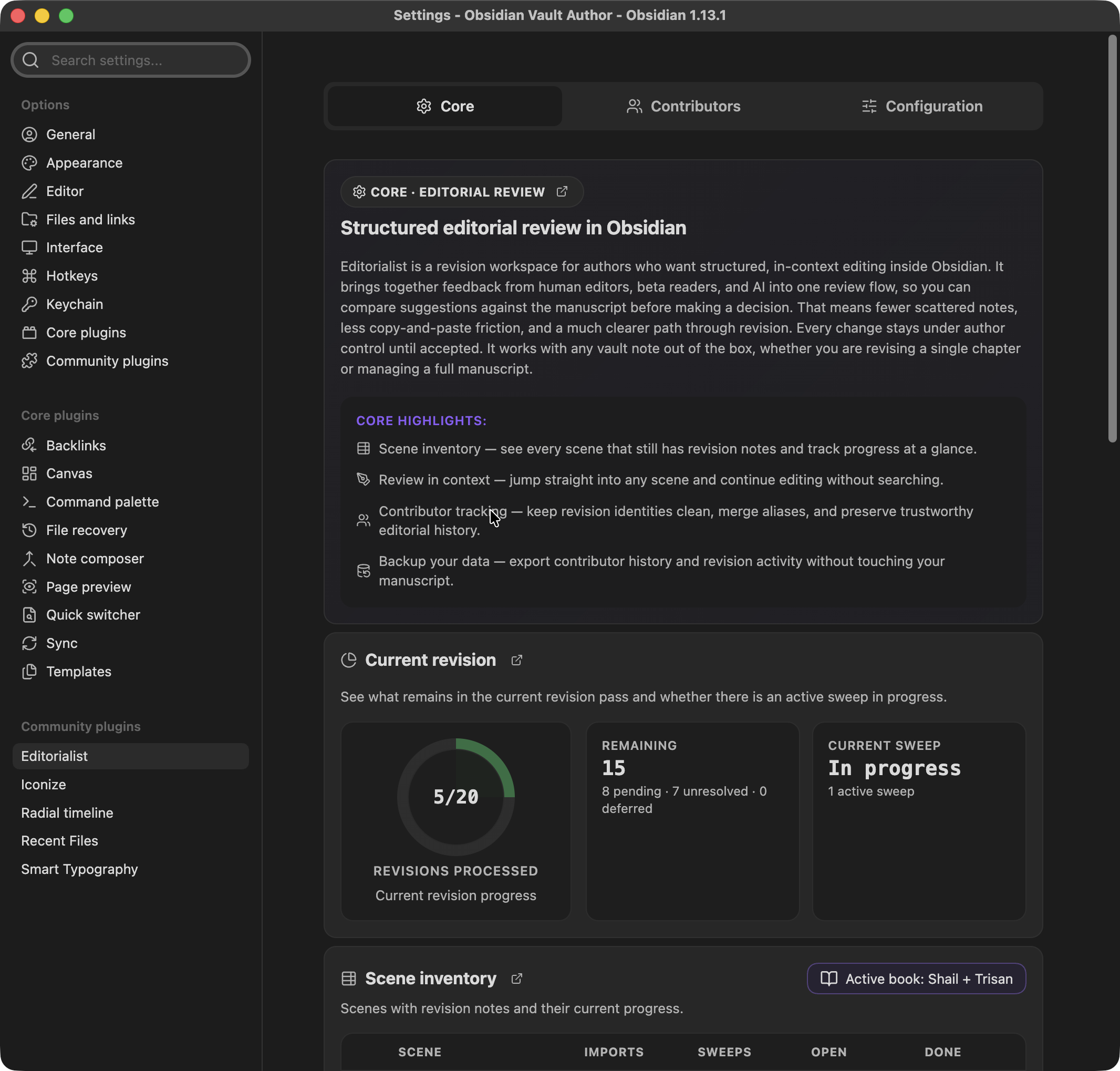
If the Radial Timeline plugin is not installed, a card explains what it adds and links to install it. With it installed, Editorialist scopes everything below to the active book.
A pie chart of the current revision's completion, with metrics: tracked scenes, and remaining / accepted / rejected / rewritten counts.
A table of every tracked scene in the active book:
| Column | Meaning |
|---|---|
| Completion | Per-scene polish state, from Editorialist:revision / Editorialist:revision_updated frontmatter |
| Scene | Scene name; with Radial Timeline installed, Status glyphs (Todo / Working / Complete) and Stage glyphs (Zero / Author / House / Press) render from shared frontmatter |
| Imports | Review batches imported into the scene |
| Sweeps | Completed guided review sweeps |
| Open / Done | Suggestion counts |
Scenes with pending edits show a badge. An active-book filter button narrows the table.
Summary of the free-form revision notes collected from scene frontmatter: scene count, item count, human notes, and inquiry count — with a Start review button that launches the pending-edits flow (disabled when there's nothing to review).
Lifetime totals: suggestions processed, accepted / rejected / rewritten, completed sweeps.
Shows which tracking mode is active and why:
| Mode | When |
|---|---|
| Radial Timeline based | RT installed and an active book is set — scenes tracked by RT's stable scene IDs |
| Using stable note IDs | RT absent; Editorialist injects and tracks its own stable note IDs |
| Path-based tracking fallback | Neither available — scenes tracked by file path (fragile across renames) |
The Inject stable note IDs action upgrades a vault from path-based tracking. Tracked and missing counts are shown alongside.
Bulk operations. All of them require confirmation before touching anything:
- Clean all notes/scenes — remove review blocks from notes.
- Clean completed notes/scenes — remove only fully-resolved review blocks.
- Reset one batch — pick a batch from a list and remove its history.
- Reset all history — clear all revision history.
Author, version, and links to GitHub, releases, issues, and docs.
Contributors · Directory — every reviewer who has ever contributed a batch, human or AI.
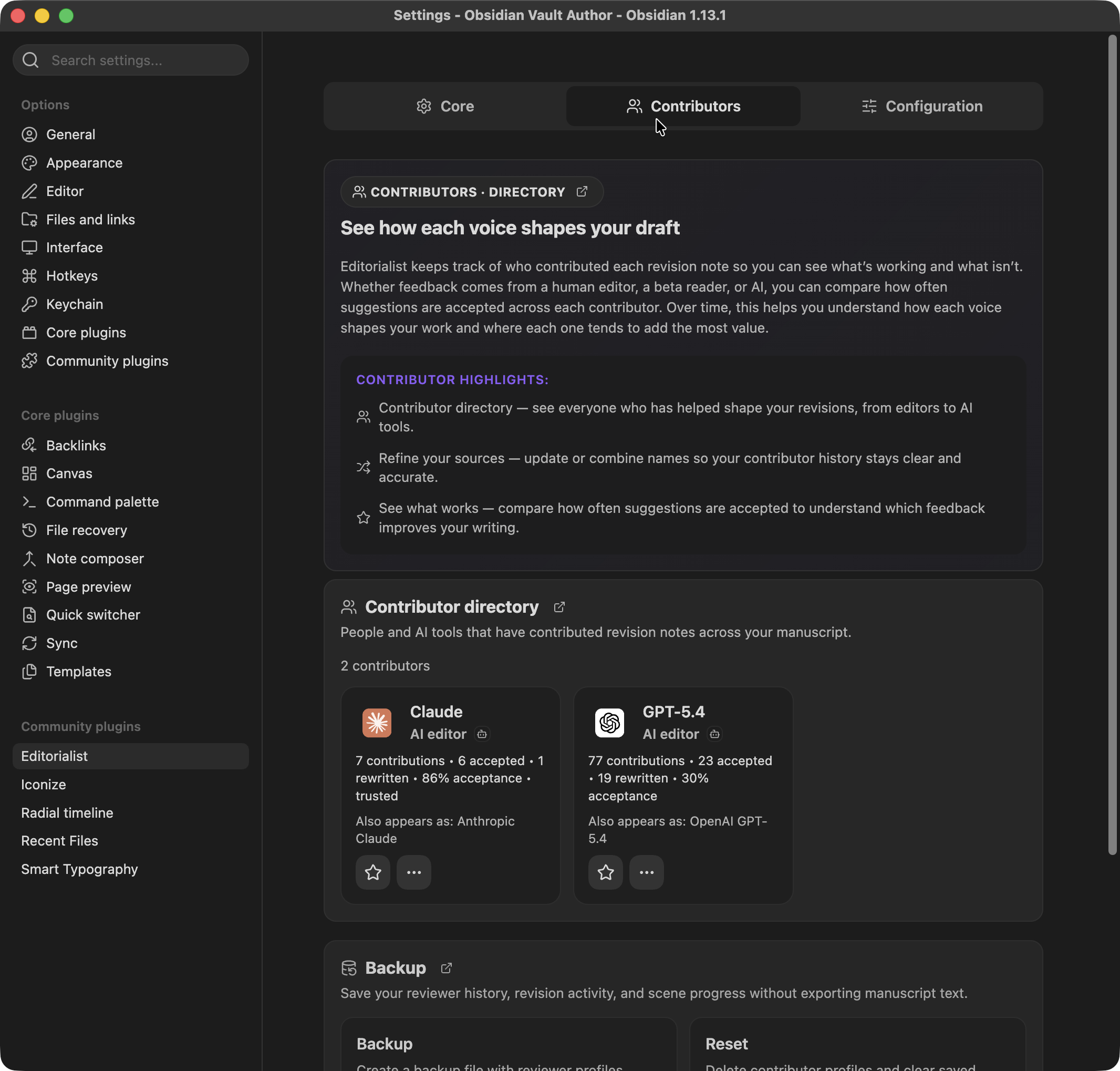
A card grid, one per contributor:
-
Identity — display name, avatar (or AI provider brand icon, derived from the
Provider:/Model:batch metadata), role icon, and strength icons. - Stats — total suggestions, accepted, rewritten, and acceptance percentage.
- Trusted badge — earned at ≥5 suggestions with ≥80% acceptance.
- Aliases — alternate names that have been merged into this contributor.
- Star — mark a contributor to enable the starred-only filter in the Review Panel.
-
Manage (…) — opens contributor actions:
- Edit identity — display name, role (e.g. human-editor, beta-reader, ai-editor), and strengths (dialogue, structure, prose-level, continuity, pacing, fact-check, sensory-detail).
- Merge / reassign — move all suggestions from one contributor to another (existing or newly created). Use this when the same person shows up under two names.
- Export backup — writes a JSON file containing reviewer profiles, aliases, starred status, and revision history. Metadata only — never manuscript text.
- Delete all contributors — clears the directory and stats. Accept/reject decisions already recorded in your notes are preserved.
Configuration · Cut archive — where cut text gets preserved.
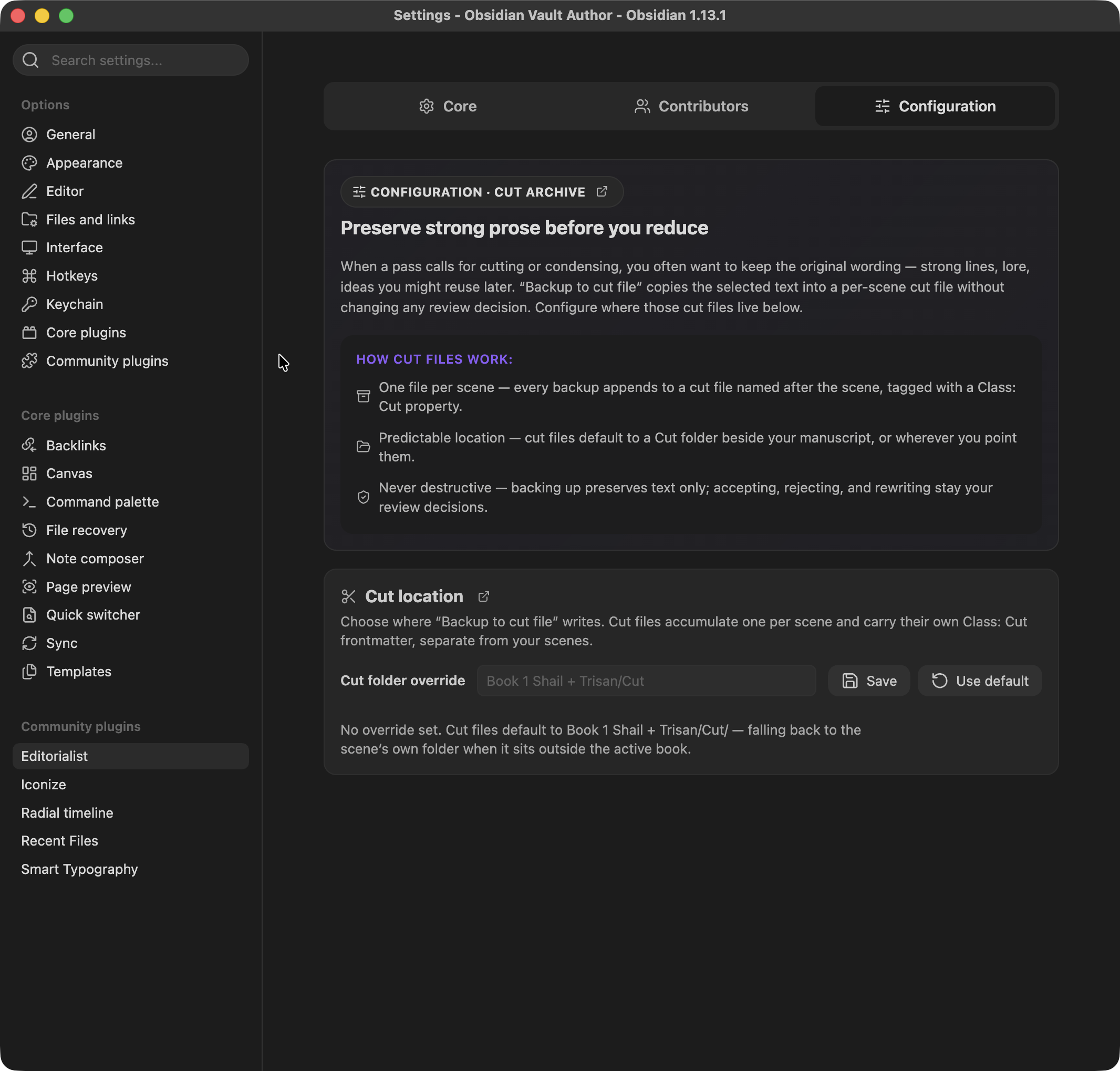
When you accept a Cut suggestion (or use Backup to cut file from the suggestion toolbar), the removed text is archived to a per-scene cut file — one cut file per scene, named after the scene and tagged with its own Class: Cut frontmatter, with hidden metadata per entry: the operation, the contributor, the reason, and a timestamp. Cut files never touch review status or acceptance decisions — they are a safety net, not part of the workflow state.
-
Cut folder override — a path field. Leave empty to use the default:
<book-source-folder>/Cutwhen a book context exists, otherwise<scene-folder>/Cut. - Save / Use default buttons apply or clear the override.
- Editorialist is local-only — everything runs inside your vault.
- Your notes change when you import a batch, apply a suggestion, clean review blocks, or run a maintenance action — and bulk maintenance asks for confirmation first.
- Backup export contains contributor and revision metadata; your manuscript text stays in your vault.