Repository navigation
Reference Data Display
Status: External Health Connect design reference. This is background material, not OpenVitals implementation policy.
To assure users that their data is being read correctly, clearly show how your
app obtains data, which comes from the
packageName property of the DataOrigin class.
There are two ways to achieve this:
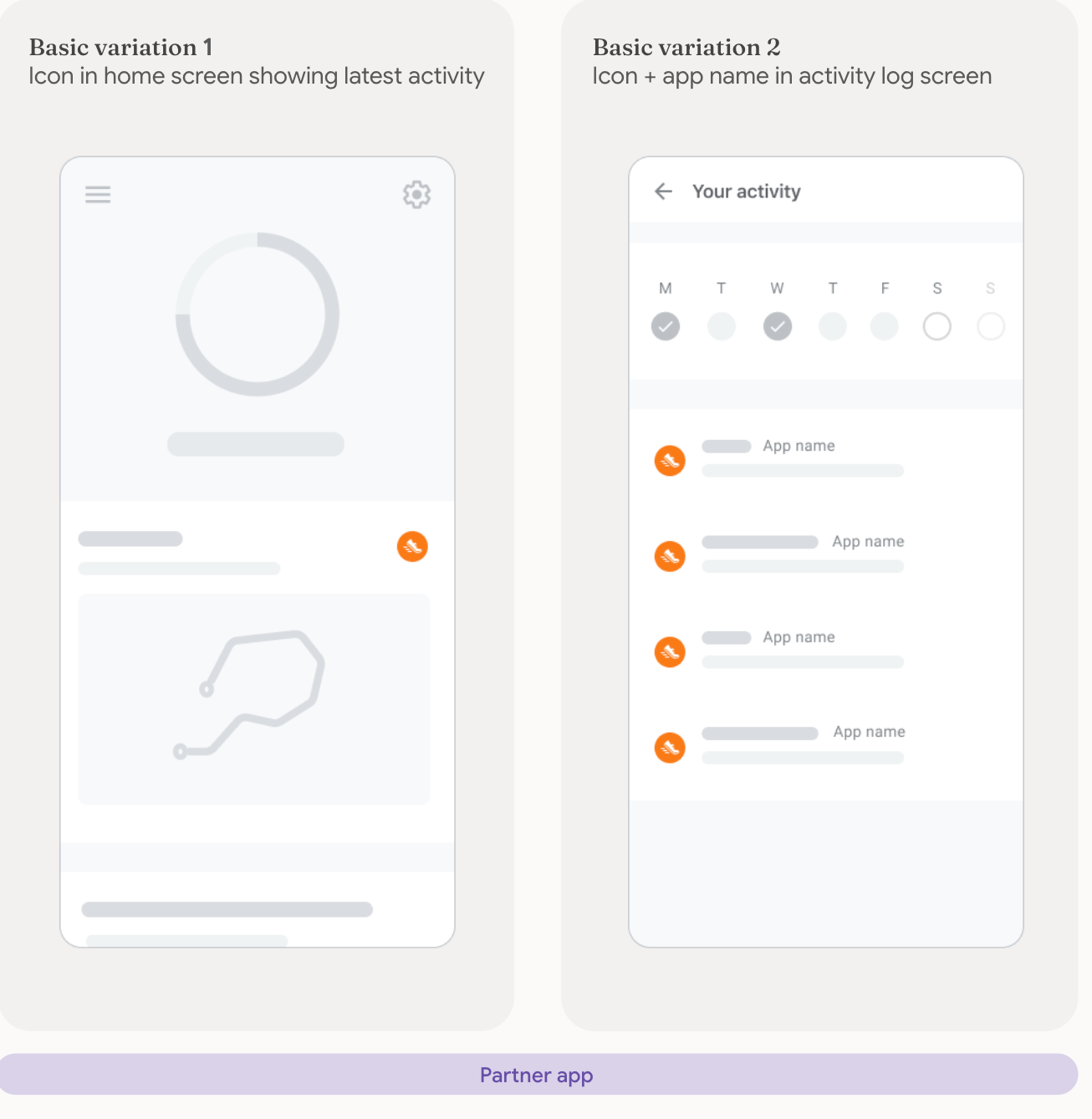
At a minimum, your user interface (UI) should display the app source icon and name (or only the app name if the icon can't be shown). Basic attribution is suitable for the following screens: Home, Activity log, and Activity details.
To support proper attribution, your application can display the name and icon of the application that originally recorded the data. This improves user trust and provides clarity about where health information originated.
You don't need to request any sensitive permission, such as
QUERY_ALL_PACKAGES, in order to retrieve this information. The following
example demonstrates how to retrieve the app label and icon for a given package
from the PackageManager:
fun getAppLabelAndIcon(context: Context, packageName: String): Pair<CharSequence?, Drawable?>{
return try {
val pm = context.packageManager
val appInfo = pm.getApplicationInfo(packageName, 0)
val label = pm.getApplicationLabel(appInfo)
val icon = pm.getApplicationIcon(appInfo)
label to icon
} catch (e: PackageManager.NameNotFoundException){
null to null
}
}
This utility helps verify proper attribution by displaying both the app name
and icon alongside the data.
See the implementation in the HealthConnectManager.kt sample.
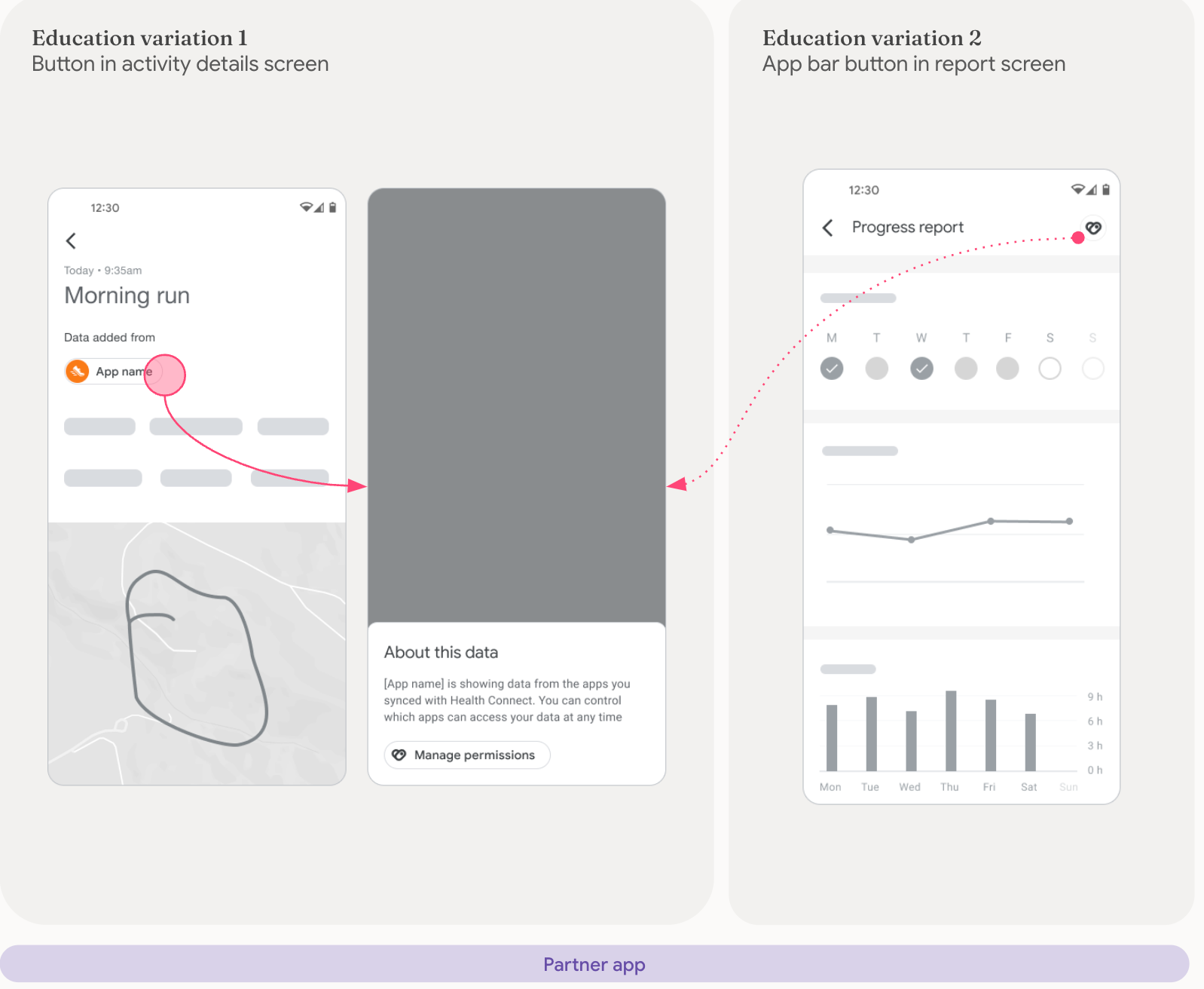
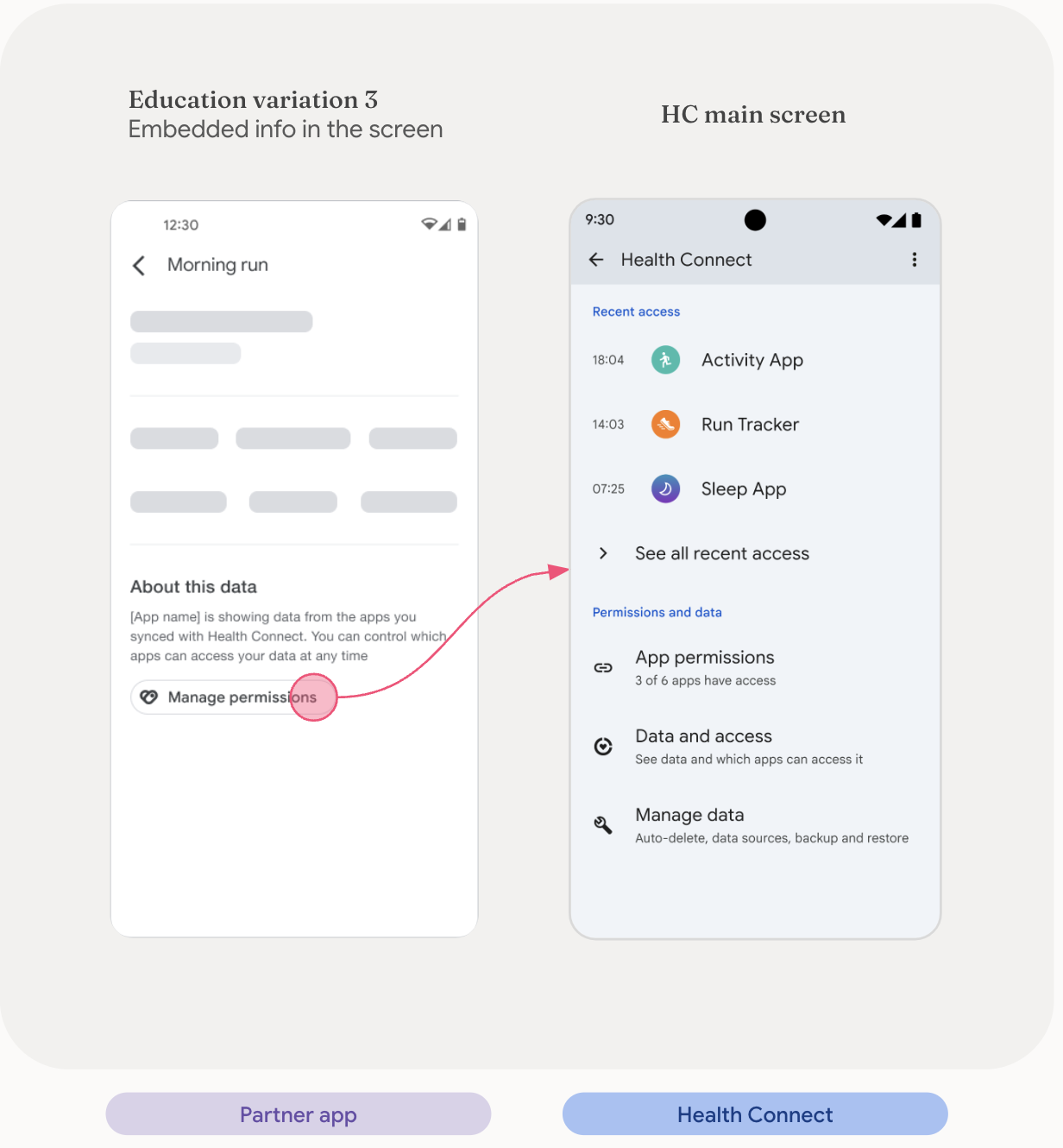
Your app should help users obtain information about where data
originates from, with a direct link to the "App permissions" screen in
Health Connect. This type of attribution is suitable for the following screens:
Activity details, Reports and insights.

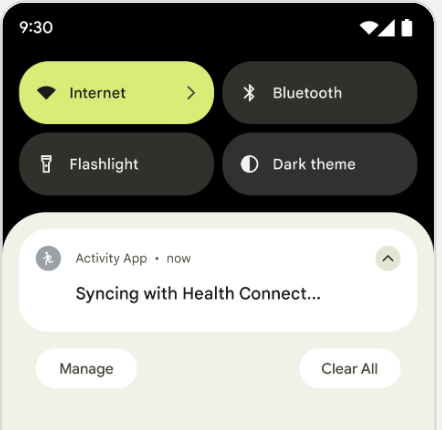
If there's enough latency when syncing your app with Health Connect, show this
notification in your app during sync. This informs the user that the process may
take a while to finish. If you use notifications for syncing, they should be set
to a low priority by default.
Generated from docs/reference/design/data-display.md. Edit it there; changes made here are overwritten.
This wiki mirrors the Markdown in Hale-MTU/OpenVitals on every push to main.
Features
- Features
- Achievements
- Activity And Training Plans
- Activity Metrics
- Apple Health Import
- Beverage Logging And Caffeine
- Bluetooth LE Sensors
- Body Energy
- Body Metrics
- CoMaps Navigation Context
- CSV Import
- Cycle Tracking
- Daily Readiness
- Elevation Correction
- Feature Map
- FIT Files Import
- Food Logging
- GPX/KML/KMZ/TCX Route Import
- Health Connect Metrics Dashboard
- Health Report Export
- Heart And Vitals
- Heart Rate Recovery
- Home Screen Widgets
- Hydration
- Manual Entry Of Metrics
- Medical Records
- Metric Detail Customization
- Mindfulness
- Non Health Connect Metrics Dashboard
- Nutrition
- Offline Maps Support
- Onboarding And Permissions
- Preloaded Beverage Nutrition Reference
- Privacy, Support, And Diagnostics
- Recording Of Activity
- Reminders
- Settings And Preferences
- Sleep Score And Recovery
- Sleep Tracking
- Statistics
- Sync With Another Phone
How-to
App
- App Guide
- FAQ
- Getting Started
- Health Connect
- Install
- Local And Connected Editions
- Permissions
- Privacy
- Screenshots
- Support
Reference
- Design Reference
- Reference
- Design Guidelines for Offline & Sync
- OpenVitals UI Notes
- Reference: Data Capture
- Reference: Data Display
- Reference: Health Connect Matchmaking
- Reference: Health Connect Onboarding
- Reference: Health Connect Permissions
- Reference: Health Connect UX
- Reference: Promoting Health Connect
Engineering
- Code Analysis
- Engineering
- Flutter ↔ Kotlin test-parity matrix
- apple-health-import
- Architecture
- body-cycle-recovery
- Design system conformance
- Development
- Feature Playbook
- Flutter -> Kotlin test parity: domain/data/core/contract/state/navigation/di/bootstrap/l10n/widget_test
- Flutter → Kotlin test-parity matrix: features section
- Flutter → Kotlin test-parity matrix: ui / goldens / integration / fixtures
- Flutter-to-Kotlin test-parity matrix — dashboard + devicesync
- manual-entry
- Translations
Proposals
- Proposals
- Activity Start Flow Analysis
- Activity Start Flow Simplification Proposals
- Caffeine Detail And Future Sleep Insights
- Cycle Tracking: Design and Status
- Medical Records Through Health Connect
- Medical Records: What Is Left
Releases
- OpenVitals 2.16.0
- OpenVitals 2.15.2
- OpenVitals 2.15.1
- OpenVitals 2.15.0
- OpenVitals 2.14.5
- OpenVitals 2.14.4
- OpenVitals 2.14.3
- OpenVitals 2.14.2
- OpenVitals 2.14.1
- OpenVitals 2.14.0
- OpenVitals 2.13.0
- OpenVitals 2.12.0
- OpenVitals 2.11.2
- OpenVitals 2.11.1
- OpenVitals 2.11.0
- OpenVitals 2.10.1
- OpenVitals 2.10.0
- OpenVitals 2.9.1
- OpenVitals 2.9.0
- OpenVitals 2.8.0
- OpenVitals 2.7.3
- OpenVitals 2.7.2
- OpenVitals 2.7.1
- OpenVitals 2.7.0
- OpenVitals 2.6.6
- OpenVitals 2.6.5
- OpenVitals 2.6.4
- OpenVitals 2.6.3
- OpenVitals 2.6.2
- OpenVitals 2.6.1
- OpenVitals 2.6.0
- OpenVitals 2.5.0
- OpenVitals 2.4.1
- OpenVitals 2.4.0
- OpenVitals 2.3.2
- OpenVitals 2.3.1
- OpenVitals 2.3.0
- OpenVitals 2.2.8
- OpenVitals 2.2.7
- OpenVitals 2.2.6
- OpenVitals 2.2.5
- OpenVitals 2.2.4
- OpenVitals 2.2.3
- OpenVitals 2.2.2
- OpenVitals 2.2.1
- OpenVitals 2.2.0
- OpenVitals 2.1.0
- OpenVitals 2.0.4
- OpenVitals 2.0.3
- OpenVitals 2.0.2
- OpenVitals 2.0.1
- OpenVitals 1.9.0
- OpenVitals 1.8.0
- OpenVitals 1.7.7
- OpenVitals 1.7.6
- OpenVitals 1.7.5
- OpenVitals 1.7.4
- OpenVitals 1.7.3
- OpenVitals 1.7.2
- OpenVitals 1.7.1
- OpenVitals 1.7.0
- OpenVitals 1.6.3
- OpenVitals 1.6.2
- OpenVitals 1.6.1
- OpenVitals 1.6.0
- OpenVitals 1.5.1
- OpenVitals 1.5.0
Project