Home
Allure Framework is a flexible, lightweight multi-language framework for writing self-documented tests. It provides modular architecture and neat web reports with the ability to store attachments, such as screenshots, logs and so on.
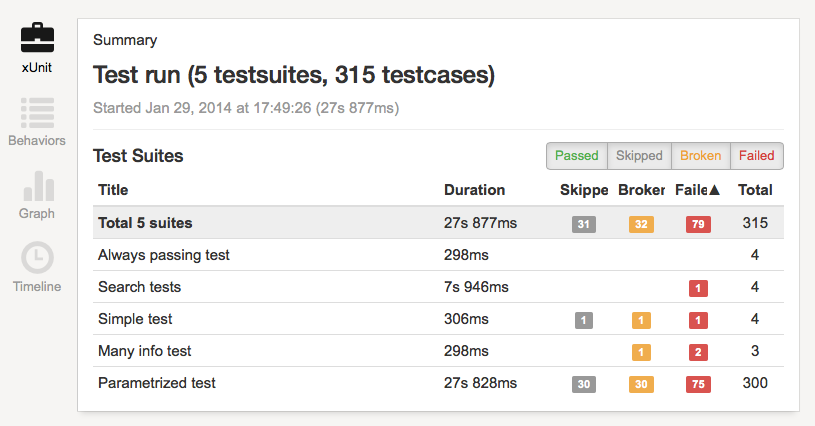
- An example report
- Overview with Screenshots
- FAQ and Troubleshooting
- Glossary
- Latest StackOverflow Questions
- Upgrading to 1.4
Allure follows the two-steps model:
- gathering information about tests
- generating report.
During this step all information about running tests is saved to XML files with predifined format. To do this we provide so-called adapters - small libraries which are attached to particular test frameworks and know how to extract test information to XML. Please select one of supported test frameworks for more information:
Having XML files created by adapter you can easily generate Allure report with one of the following tools:
- Use Allure Command Line Tool to generate report by running a console command
- Use Allure Jenkins Plugin to generate report as Jenkins job artifact
- Use Allure Teamcity Plugin to generate report as Teamcity job artifact
- Use Allure Maven Plugin to generate report during Maven build
This section tells about advanced Allure features. For example you can group your tests by stories or features, attach files, distribute assertions over a set of custom steps and so on. All these features are supported by Java test frameworks so we provide only Java examples. Please refer to particular adapter guide for more details on how it works with the test framework of your choice.