Repository navigation
Home
English · Italiano · Deutsch · Nederlands · Français · Español · Português · Português (Brasil) · Dansk · Norsk · Svenska · Íslenska · Eesti · Lietuvių · Latviešu · Polski · Čeština · Magyar · Română · Ελληνικά · Русский · Українська · Türkçe · Afrikaans · العربية · עברית · اردو · हिन्दी · বাংলা · ไทย · Bahasa Indonesia · Tagalog · 日本語 · 한국어 · 中文 · 中文 (繁體)
by Costantino Cerrotta IC8TEM
YA-MS is a free program for radio amateurs who work meteor scatter (MS) on 50, 70, 144, 222 and 432 MHz. For the real path between your locator and the DX station's, it computes hour by hour how much each active meteor shower helps the path (its efficiency), which side of the path the reflections come from (Hot A / Hot B), where to point the antenna, and an experimental forecast of the reflections per hour derived from a live meteor radar (Collm, Germany). It runs on Windows, Linux, Raspberry Pi and macOS (.NET 8 + Avalonia), in 36 interface languages.
The main source is the article by C. Cerrotta IC8TEM and G. Sartori IV3GTH, "METEOR-SCATTER. Ovvero come collegare l'Europa in VHF tutto l'anno senza tante pretese" (version 7). Every formula and data item in the program cites its source; see Sources.
 Sky dome |
 Efficiency calculation |
 GRAVES radar |
- Operators who want to know when a meteor-scatter path is open and where to point, beyond the generic "the shower peaks tonight".
- Stations working long paths on 144 and 432 MHz, where the radiant position decides whether a shower is useful or useless.
- Anyone who wants to check the numbers: the calculation manual and the in-program explanation give every step with its origin: a published source, a check made on the program, or a choice of the program.
Since version 1.6 the main tabs have sub-tabs (a lighter row under the main one). At start-up a 5-second splash screen shows the Perseids over ESO's VLT (photo ESO/S. Guisard, CC BY 4.0).
| Tab | Sub-tab | What it shows |
|---|---|---|
| Live and real-time data | Live traffic | Azimuthal map of all collected MS traffic, with a cloud of the most probable trails for each contact, band colours, blinking when a correspondent answers you |
| Radar flux | Hourly meteor counts and trail heights read from the Collm SKiYMET radar, Sodankylä image, estimate at your band | |
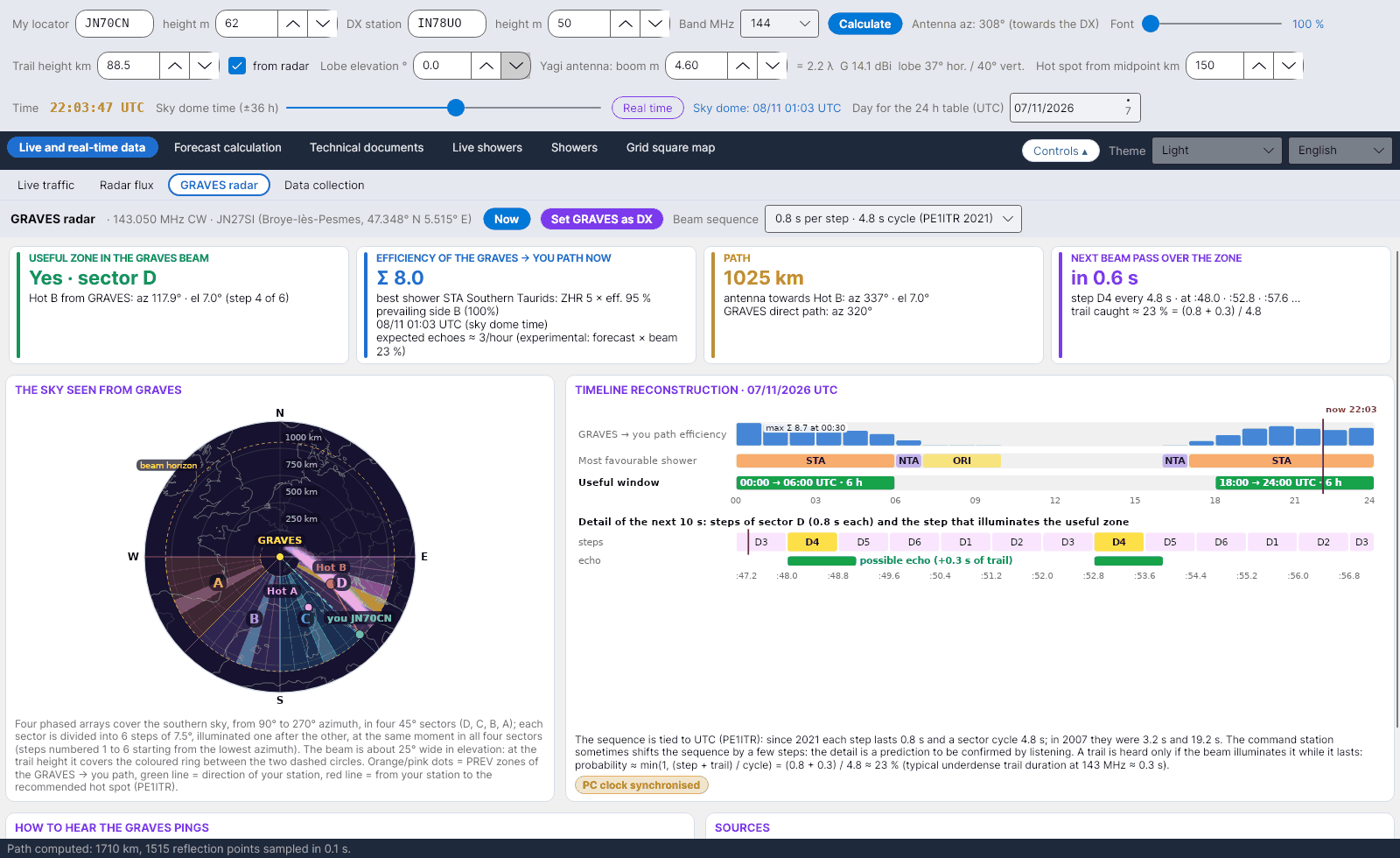
| GRAVES radar | The GRAVES → you forward-scatter path: useful zone in the beam, sector and step, next beam pass, how to listen | |
| Data collection | Three telnet cluster streams (DX cluster, RBN, DM4X/PSKReporter) and the MS spot filter | |
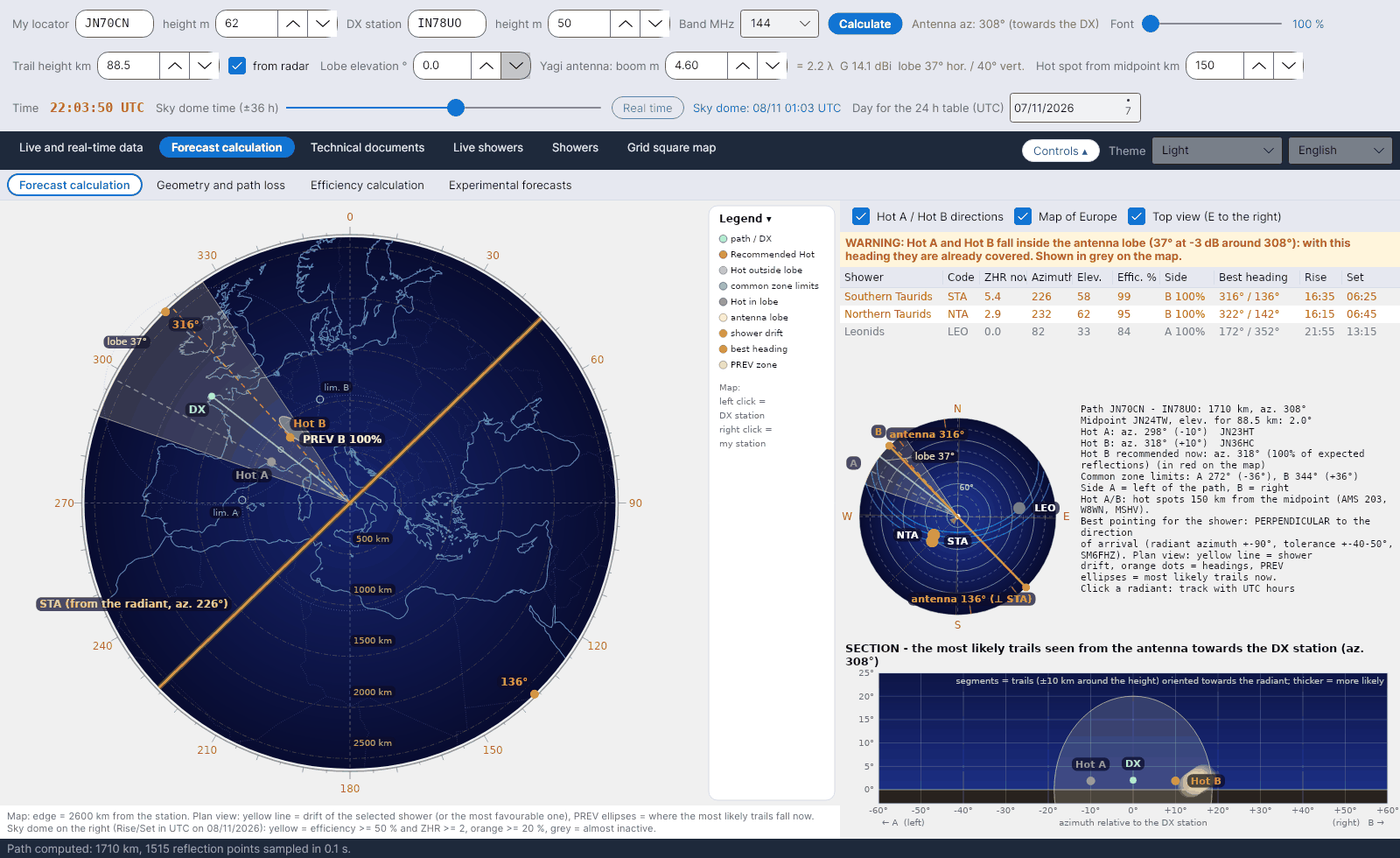
| Forecast calculation | Forecast calculation | Plan map of the path with Hot A / Hot B, antenna lobe, PREV zones and shower drift; shower list; small sky dome with radiants and the right antenna directions; section seen from the antenna |
| Geometry and path loss | Distance, midpoint, elevation, Hot A / Hot B, common zone limits, path loss 28–432 MHz, link budget, antenna | |
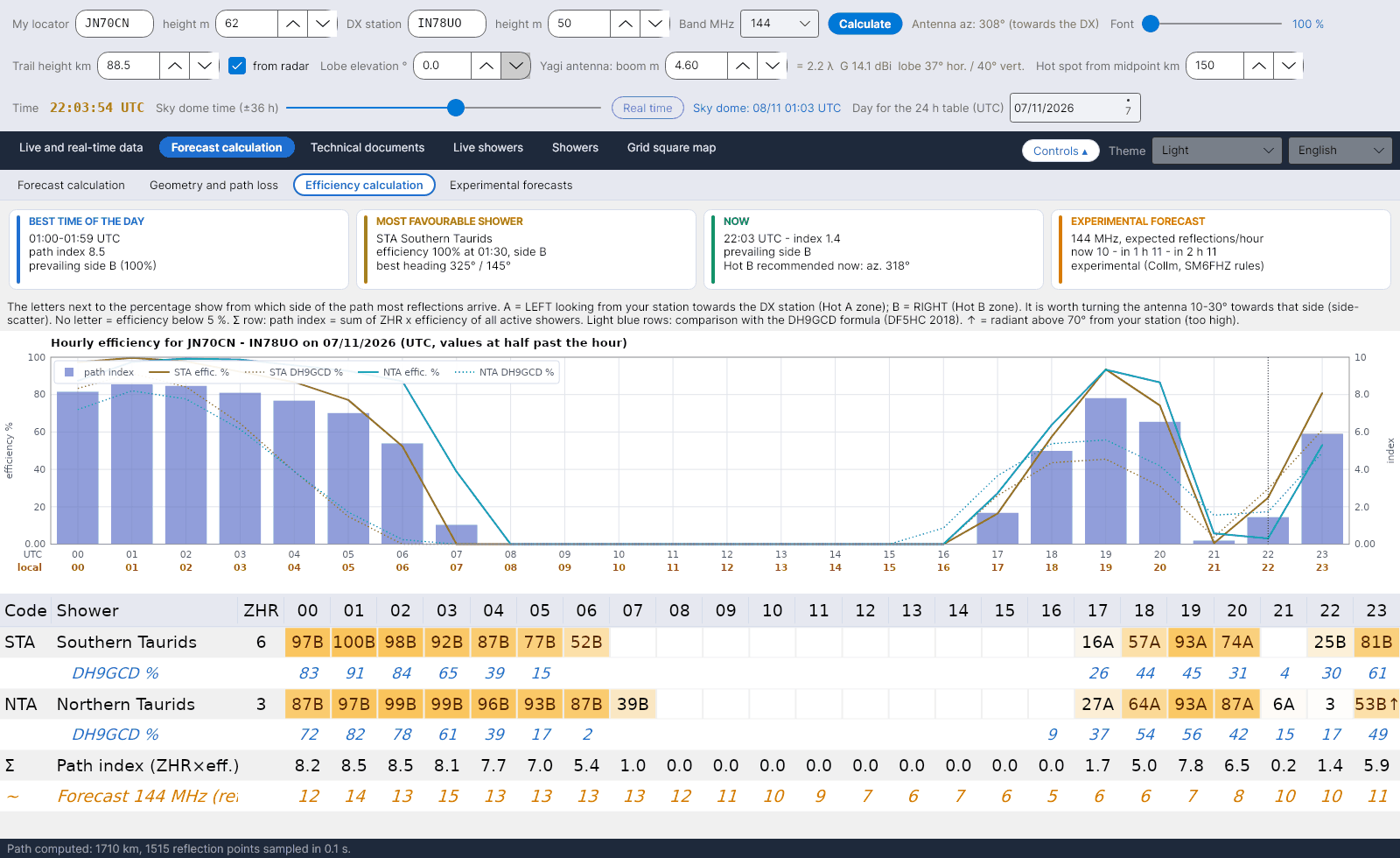
| Efficiency calculation | Glance cards, hourly efficiency of each shower with side A/B, path index, DH9GCD comparison, chart | |
| Experimental forecasts | Collm flux scaled to 144 MHz (or any frequency) with λ^k and station factor K, 24-hour forecast, RMOB comparison | |
| Live showers | – | Measured ZHR of the Global Meteor Network and CMOR radiant maps |
| Showers | – | IMO catalogue with the next peak (IMO date and time or calculated) |
| Grid square map | – | Worked and confirmed Maidenhead squares from an ADIF file, one tab per band |
| Technical documents | Sources | All sources; the main one is the Cerrotta–Sartori article |
| Map of European radars | Where Collm, Sodankylä, GRAVES and CMOR are relative to your station | |
| Explanation of the efficiency calculation | Step-by-step document on how the efficiency is computed, exportable to Word |
Above the tabs there are three rows of controls (your locator, DX station, band, antenna, trail height, time); see Getting started. The Controls button folds them away, and the language and colour scheme are chosen at the top right; see Settings and data folder.
- Real path, not fixed directions: the efficiency is computed for the great-circle path between the two locators (older programs used four fixed directions).
- Specular reflection model (McKinley) on points of the E layer every 15 km, with the trail height read live from the Collm radar.
- Hot A / Hot B 150 km either side of the midpoint (adjustable 30–400 km), the recommended one in red, the ones already inside your antenna lobe in grey.
- Live radar: Collm checked every 5 minutes, only changed sources downloaded again; offline the program keeps working with the last saved data.
- Experimental forecast at 50/144/432 MHz with the λ³ rule of SM6FHZ, comparable with RMOB observers.
- Everything in one
datafolder next to the program: no AppData, no system folders.
The efficiency is an experimental model (specular reflection + underdense trails). Compare it with MCG_MS, MS-Soft and your own experience on the air.
- Installation
- Getting started
- Troubleshooting and FAQ if something does not work.
Downloads: Releases on GitHub.