Repository navigation
Showers
English · Italiano · Deutsch · Nederlands · Français · Español · Português · Português (Brasil) · Dansk · Norsk · Svenska · Íslenska · Eesti · Lietuvių · Latviešu · Polski · Čeština · Magyar · Română · Ελληνικά · Русский · Українська · Türkçe · Afrikaans · العربية · עברית · اردو · हिन्दी · বাংলা · ไทย · Bahasa Indonesia · Tagalog · 日本語 · 한국어 · 中文 · 中文 (繁體)
Tab: Showers.
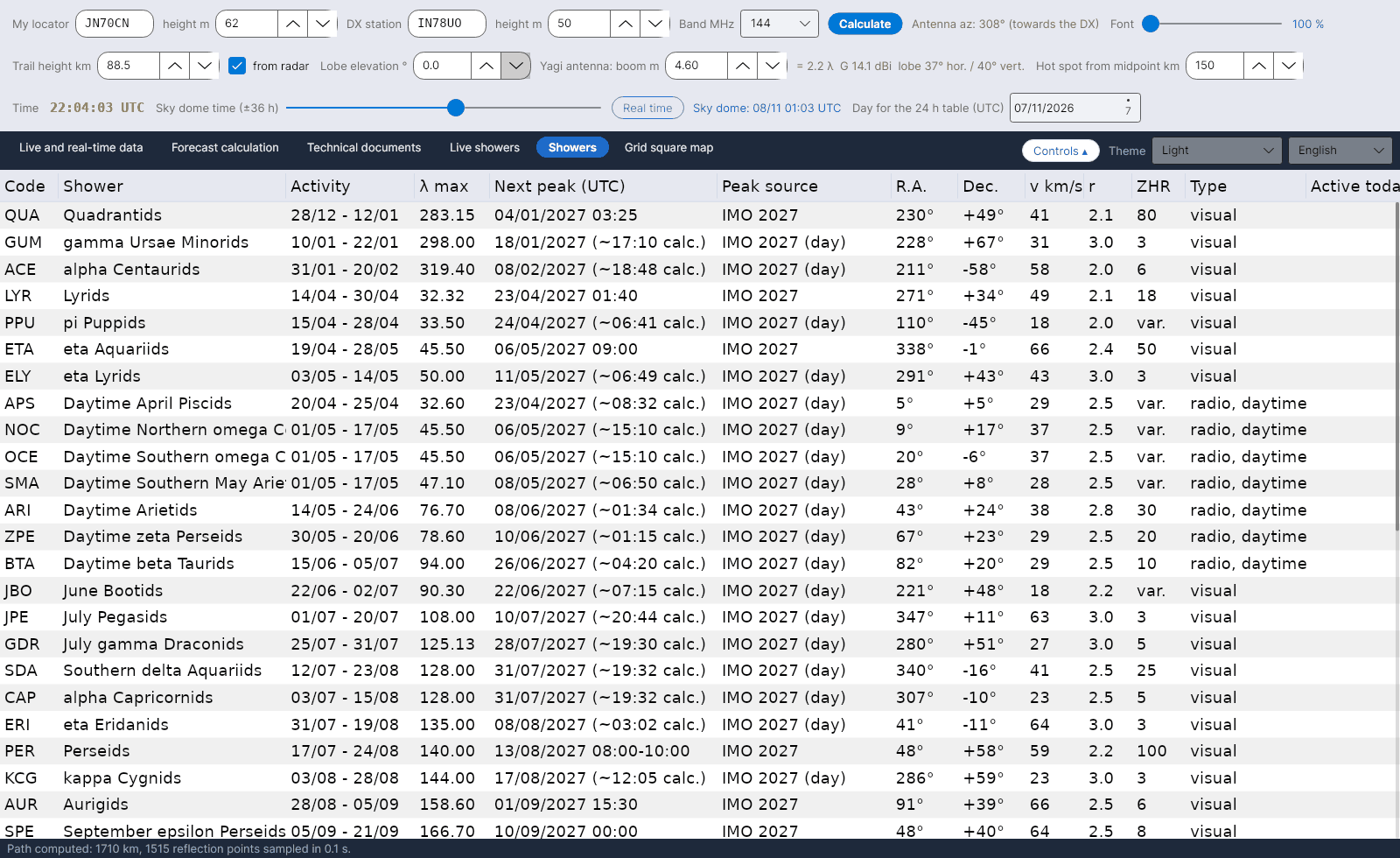
The shower catalogue used by all calculations: 45 showers from the IMO Meteor Shower Calendar 2026 and 2027 (tables 5 and 7) plus the Antihelion Source (table 6), each with its next peak.
| Column | Meaning |
|---|---|
| Code | IMO code (QUA, PER, GEM, …) |
| Shower | Name |
| Activity | Activity period (day/month – day/month) |
| λ max | Solar longitude of the peak (J2000), from IMO |
| Next peak (UTC) | Date and time of the next peak (see below) |
| Peak source | IMO 2026 / IMO 2027 = date and time published by the IMO; IMO 2026 (day) = the IMO gives only the day, the time shown is calculated (~hh:mm calc.); calculated from λ = no IMO value for that year |
| R.A., Dec. | Radiant at the peak (moving for the Antihelion Source) |
| v km/s, r | Geocentric speed and population index |
| ZHR | Peak ZHR (var. = variable) |
| Type | visual or radio, daytime |
The showers active today (UTC) are highlighted with a yellow veil and bold text.
The program always shows the next peak. When the IMO has published that year's calendar it uses the IMO date and time from data/massimi_imo.csv (2026 and 2027 are included); otherwise it computes the instant at which the Sun reaches the solar longitude of the peak (Meeus, Astronomical Algorithms, ch. 25, solved with Newton's method).
Check: the calculation agrees with the IMO 2026 and 2027 calendars within a few minutes where the IMO gives the time (e.g. Quadrantids 3/1/2026 21:13 against 21:00; Geminids 14/12/2027 19:51 against 20:00). Exceptions: Daytime kappa Leonids 2026 one day later (26/9 instead of 25/9) and the time of the eta Aquariids 2027 (15:10 against 09:00 IMO) – in these cases the IMO value is used.
Adding a year: when the IMO publishes a new calendar, add its rows to data/massimi_imo.csv (year;code;MM-DD;hh:mm, time empty if the IMO gives only the day). Until then the peak is calculated.
The catalogue includes the minor showers of the IMO list – for example the October Camelopardalids (OCT, ZHR 5, active 5–6 October), the Andromedids, the gamma Ursae Minorids – and the daytime radio showers of April–October (Daytime April Piscids, Daytime Arietids, Daytime zeta Perseids, Daytime beta Taurids, Daytime kappa Leonids, Daytime Sextantids, …). Even with small ZHRs they contribute to the path index and to the recommended Hot. For the daytime radio showers the IMO gives no ZHR: where none is given the program uses a working value of 5.
ZHR_max, α0, δ0 and λ_max from the IMO calendar; the slopes B (different before and after the peak) and the daily drifts dα/dλ, dδ/dλ are working values written in data/sciami.csv (the IMO drift table has not been entered yet). Manual eq. 9 and 13. The Antihelion Source position is interpolated linearly between the dates of IMO table 6 (data/ant_radiante.csv; active 10 December – 20 September, ZHR about 4).
data/sciami.csv is a plain text file (separator ;) that you can edit: code, name, start and end (MM-DD), λ max, R.A., Dec., drifts, v, r, ZHR, B before/after, type (V visual, R daytime radio). If a line is wrong the program shows a message at start-up and ignores it.
Sources: International Meteor Organization – Meteor Shower Calendar 2026 and 2027, www.imo.net (tables 5, 6 and 7); Rossano IZ5TEK (scattertek).