Repository navigation
Experimental Forecasts
English · Italiano · Deutsch · Nederlands · Français · Español · Português · Português (Brasil) · Dansk · Norsk · Svenska · Íslenska · Eesti · Lietuvių · Latviešu · Polski · Čeština · Magyar · Română · Ελληνικά · Русский · Українська · Türkçe · Afrikaans · العربية · עברית · اردو · हिन्दी · বাংলা · ไทย · Bahasa Indonesia · Tagalog · 日本語 · 한국어 · 中文 · 中文 (繁體)
Tab: Forecast calculation › Experimental forecasts.
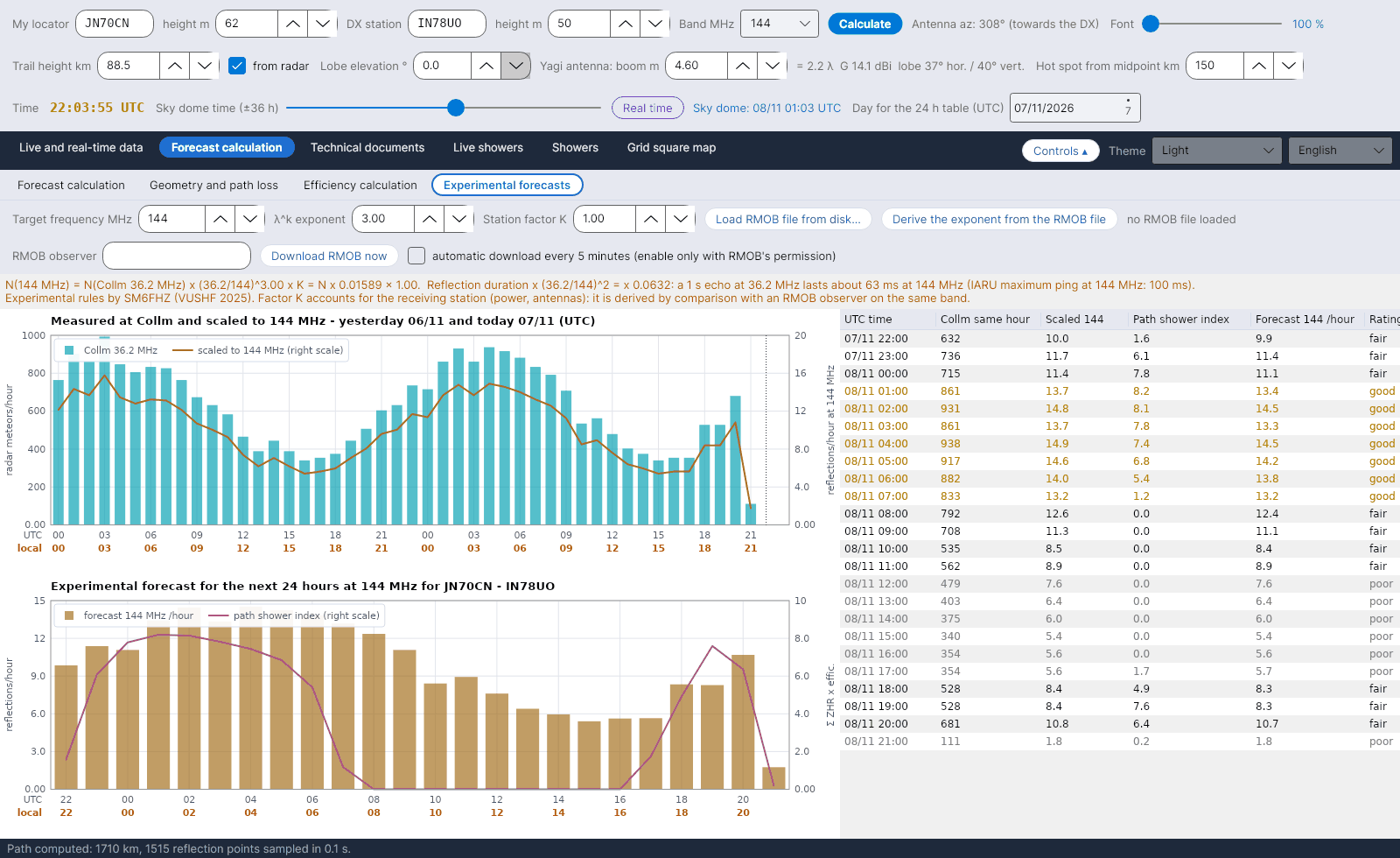
This tab turns the meteor counts of the Collm radar (36.2 MHz) into an estimate of the reflections per hour on an amateur band (144 MHz by default, any frequency from 28 to 1300 MHz), forecasts the next 24 hours for your path and lets you compare the estimate with an RMOB observer – for example one listening to GRAVES on 143.050 MHz.
Everything here is experimental: the frequency rule is an empirical rule, and the station factor depends on your station. Use the numbers to compare hours and days, and check them on the air.
| Control | Default | What it does |
|---|---|---|
| Target frequency MHz | 144 | Frequency of the forecast (28–1300 MHz) |
| λ^k exponent | 3 | Exponent k of the frequency rule (SM6FHZ: 3) |
| Station factor K | 1 | Accounts for the receiving station (power, antennas); derived by comparison with an RMOB observer on the same band |
| Load RMOB file from disk... | Reads a monthly RMOB text file (see below) | |
| Derive the exponent from the RMOB file | Fits k from the common hours of Collm and RMOB | |
| RMOB observer | empty | Observer name as it appears in the file name (e.g. NAME_112026rmob.TXT → NAME) |
| Download RMOB now | Downloads the current month's file of that observer once | |
| automatic download every 5 minutes (enable only with RMOB's permission) | off | See RMOB and automatic programs |
The orange line under the controls shows the rule with the current numbers, e.g. N(144 MHz) = N(Collm 36.2 MHz) x (36.2/144)^3.00 x K = N x 0.01589 x 1.00, the duration scaling and the IARU maximum ping at that frequency.
Source: SM6FHZ, "432 MHz Meteorscatter, Challenges and Techniques", 45th Nordic VUSHF, May 2025 – number and intensity of reflections scale with λ³, duration with λ² (432 MHz is 14–15 dB below 144 MHz and lasts 1/9). Check: in McKinley's equation λ³ is the power of a single underdense trail, not the number of trails; for mass index 2 the number of trails above a fixed threshold scales about as λ^1.5 (IZ5TEK; OH5IY). The program keeps k = 3, SM6FHZ's experimental rule, and says so; the right k for your station comes from the RMOB comparison. In forward scatter the duration also grows with sec²φ (McKinley; OH5IY): Collm measures in backscatter (φ = 0), so the forecast multiplies by sec²φ at the path midpoint (×4 at 60°, ×8.5 at 70°, ×33 at 80°). With k = 3, 1000 meteors/hour at Collm become about 16 reflections/hour at 144 MHz; RMOB observers of GRAVES on 143.050 MHz usually count 20 to 140 echoes/hour (RMOB bulletin, June 2018): the order of magnitude is compatible, and the difference is the station factor K. (Manual eq. 44–45.)
Persistence: the scaled value of the same hour of the day before (or two days before if missing), corrected by the change of the path shower index I (Σ ZHR × efficiency, see Efficiency calculation). The constant 10 represents the sporadic background and limits the correction when the index is small. Choice of the program (manual eq. 47).
| Panel | Content |
|---|---|
| Measured at Collm and scaled to f MHz – yesterday and today (UTC) | Collm radar meteors/hour; scaled values (orange, right scale); the RMOB counts if loaded (green, right scale) |
| Experimental forecast for the next 24 hours at f MHz for … | Forecast reflections/hour (bars) and the path shower index (right scale) |
| Table | UTC time · Collm same hour · Scaled · Path shower index · Forecast /hour · Rating |
Rating: good when the forecast is at least 1.3 × the 24-hour mean, fair from 0.8 ×, poor below. The same forecast appears in the EXPERIMENTAL FORECAST card and in the orange row of the Efficiency calculation, and it is the base of the expected echoes in the GRAVES radar tab.
RMOB (Radio Meteor Observatories On Line, Pierre Terrier) collects the hourly meteor counts of radio observers; many in Italy listen to GRAVES on 143.050 MHz (Venice Planetarium, Faenza, Rovereto and others).
Reading RMOB files. Two text formats are accepted:
| Format | Look | Notes |
|---|---|---|
| Monthly file (Colorgramme / Spectrum Lab) | one row per day, `day | n |
| Bulletin table | header ` UT | 1 2 3 …, rows 0h |
Month and year come from the file name (…_MMYYYYrmob…) or from the header; otherwise the current month is used (and the program says so).
Fitting the exponent. With K = 1, from the median of the RMOB/Collm ratios over the common hours (at least 3):
Choice of the program (manual eq. 46). The dialog shows the common hours, the median ratio and k; Yes applies k (and sets K = 1), No keeps k = 3 – then adjust K by hand to the value suggested in the same dialog.
RMOB asks automatic programs not to fetch its files. For this reason the automatic download is off at the start and should be enabled only after asking RMOB for permission. Without it you can always use Load RMOB file from disk... or press Download RMOB now when you need it.
The download address is a template in config.ini (key rmob_url, default https://rmob.org/index.php/livedata/live_datas/{NOME}_{MMAAAA}rmob.TXT, where {NOME} is the observer and {MMAAAA} month and year); downloaded files are kept in data/radar/.
Source of counts: Collm (radar 36,2 MHz) by default. If your station is within 3500 km of Japan, the "Japan live" entries also appear (beacons JA2SDA at Toyokawa and JE3AKE at Otsu, 53 MHz), with the automatic HROFFT counts published by Ogaki every 10 minutes; the choice is saved.
Japan: monthly HRO counts (IPRMO)...: opens the window with the hourly hand counts of the Japanese observers from the RMOJ monthly files. Choose the month and the observer; Update from IPRMO downloads the new months. The first chart is the monthly mean per UTC hour translated to your frequency, the second the daily totals.
The automatic HROFFT count gives 30 to 130 echoes every 10 minutes, much more than the hand counts of the RMOJ files, because it also counts weak echoes and interference: it is a relative value, to be calibrated with the monthly files of the same beacon. The 3500 km limit reserves the source for East Asian stations, which see the same radiants at the same hours; for Europe Collm remains.
→ IPRMO RMOJ · HRO Ogaki