Repository navigation
Efficiency Explanation
English · Italiano · Deutsch · Nederlands · Français · Español · Português · Português (Brasil) · Dansk · Norsk · Svenska · Íslenska · Eesti · Lietuvių · Latviešu · Polski · Čeština · Magyar · Română · Ελληνικά · Русский · Українська · Türkçe · Afrikaans · العربية · עברית · اردو · हिन्दी · বাংলা · ไทย · Bahasa Indonesia · Tagalog · 日本語 · 한국어 · 中文 · 中文 (繁體)
Tab: Technical documents › Explanation of the efficiency calculation.
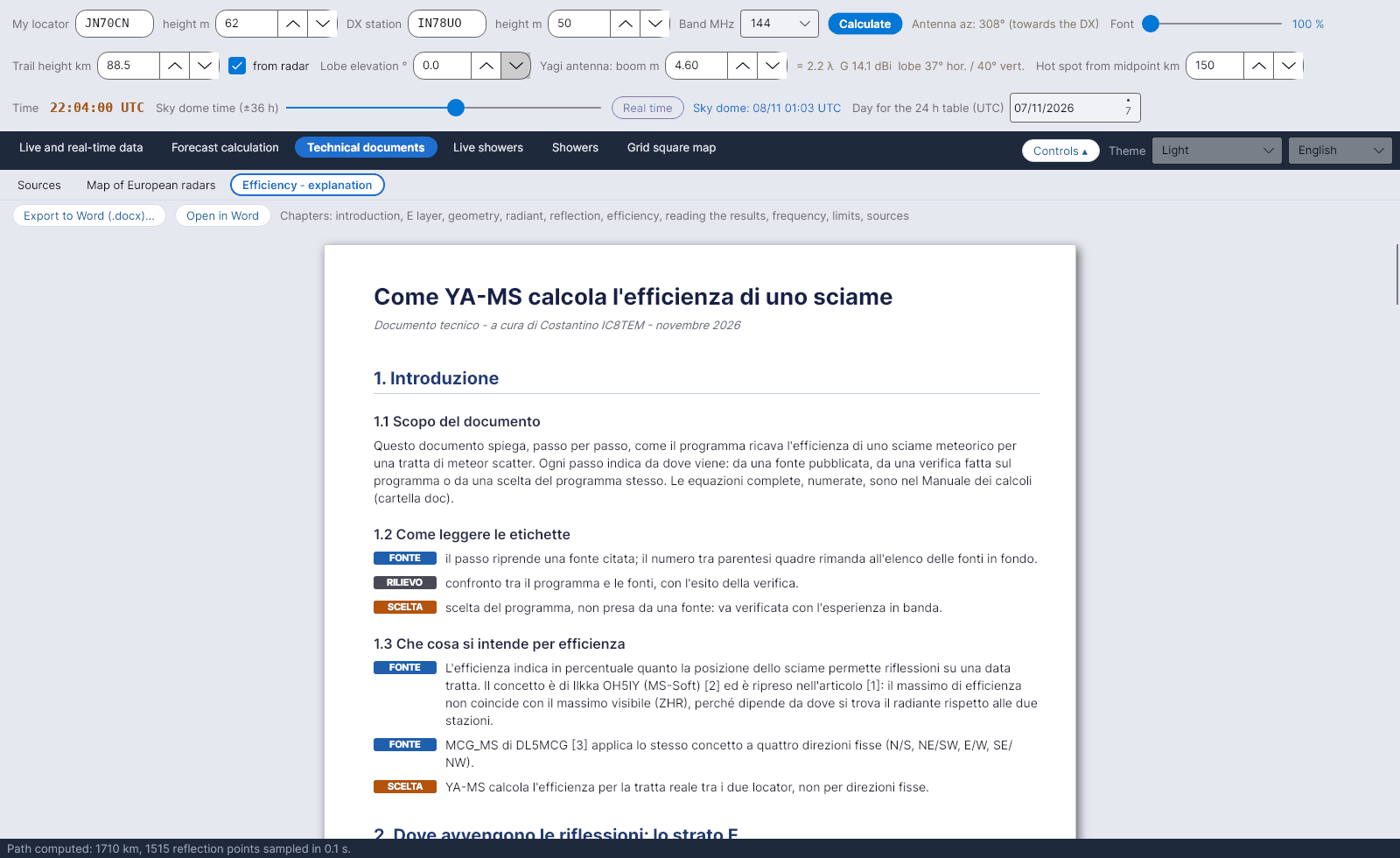
A technical document, "Come YA-MS calcola l'efficienza di uno sciame" (How YA-MS computes the efficiency of a shower), shown inside the program as a light page. It explains step by step how the efficiency is obtained, and says for each step where it comes from. The program shows it in the interface language (all 36 languages), as does the calculation manual; this wiki also gives its content in Efficiency calculation and Geometry and path loss.
Every step carries a coloured label:
| Label | Colour | Meaning |
|---|---|---|
| FONTE (source) | blue | the step takes up a cited source; the number in brackets refers to the list at the end |
| RILIEVO (check) | green | comparison between the program and the sources, with the result |
| SCELTA (choice) | orange | a choice of the program, not taken from a source: to be checked with experience on the air |
| Chapter | Content |
|---|---|
| 1. Introduction | Purpose, labels, what efficiency means (OH5IY, MCG_MS; YA-MS uses the real path) |
| 2. Where reflections happen: the E layer | Trails at 80–120 km; trail height = mode of the Collm histogram (check: 89.5 km on 5/11/2026) |
| 3. Path geometry | Earth and midpoint; antenna elevation (article formula); common zone and its limits; Hot A / Hot B; antenna lobe (VE7BQH, DL6WU, Kraus, W4RNL) |
| 4. The shower radiant | Radiant position (IMO 2026/2027), peak date (IMO or solar longitude), activity profile |
| 5. Reflection condition | Specular reflection (McKinley), Gaussian tolerance 0.05 rad, best heading (SM6FHZ), DH9GCD formula |
| 6. From one point to the efficiency | Reflection points every 15 km, weight of each point, percentage; comparison with QTFGUI (DJ5HG) |
| 7. Reading the results | Side A / B, path index, radiant colours, PREV zones, section seen from the antenna |
| 8. Working frequency and path loss | λ³ / λ² rules, from radar to amateur band, path loss references |
| 9. Known limits | Underdense trails only, isotropic antennas (in azimuth; vertical pattern optional), working values |
| 10. Sources | 17 numbered sources |
| Button | What it does |
|---|---|
| Export to Word (.docx)... | Saves a copy of data/efficienza_spiegazione.docx where you choose (suggested name YA-MS - calcolo dell'efficienza.docx) |
| Open in Word | Opens the same .docx with the default program for Word documents (Word, LibreOffice, …) |
| File | Content |
|---|---|
data/efficienza_spiegazione.txt |
The text shown in the tab, one block per line (TITLE, SUB, H1, H2, P, `TAG |
data/efficienza_spiegazione.docx |
The Word version |
data/spiegazione/efficienza_spiegazione_<code>.txt / .docx
|
The same document in the other 35 languages (e.g. _en, _de, _pt-br) |
doc/YA-MS_manuale_calcoli.docx |
The calculation manual (Italian): all equations (Word equation editor), numbered, with their sources |
doc/manuali/YA-MS_manuale_calcoli_<code>.docx |
The calculation manual in the other 35 languages |
The two documents are regenerated from the source with tools/build_spiegazione.py data [code] and node tools/build_manuale.js <file.docx> [code]; the translations are in tools/traduzioni_doc/ (tools/build_documenti.sh rebuilds all languages).