Repository navigation
Sources
English · Italiano · Deutsch · Nederlands · Français · Español · Português · Português (Brasil) · Dansk · Norsk · Svenska · Íslenska · Eesti · Lietuvių · Latviešu · Polski · Čeština · Magyar · Română · Ελληνικά · Русский · Українська · Türkçe · Afrikaans · العربية · עברית · اردو · हिन्दी · বাংলা · Bahasa Indonesia · Tagalog · ไทย · 日本語 · 한국어 · 中文 · 中文 (繁體)
Tab: Technical documents › Sources.
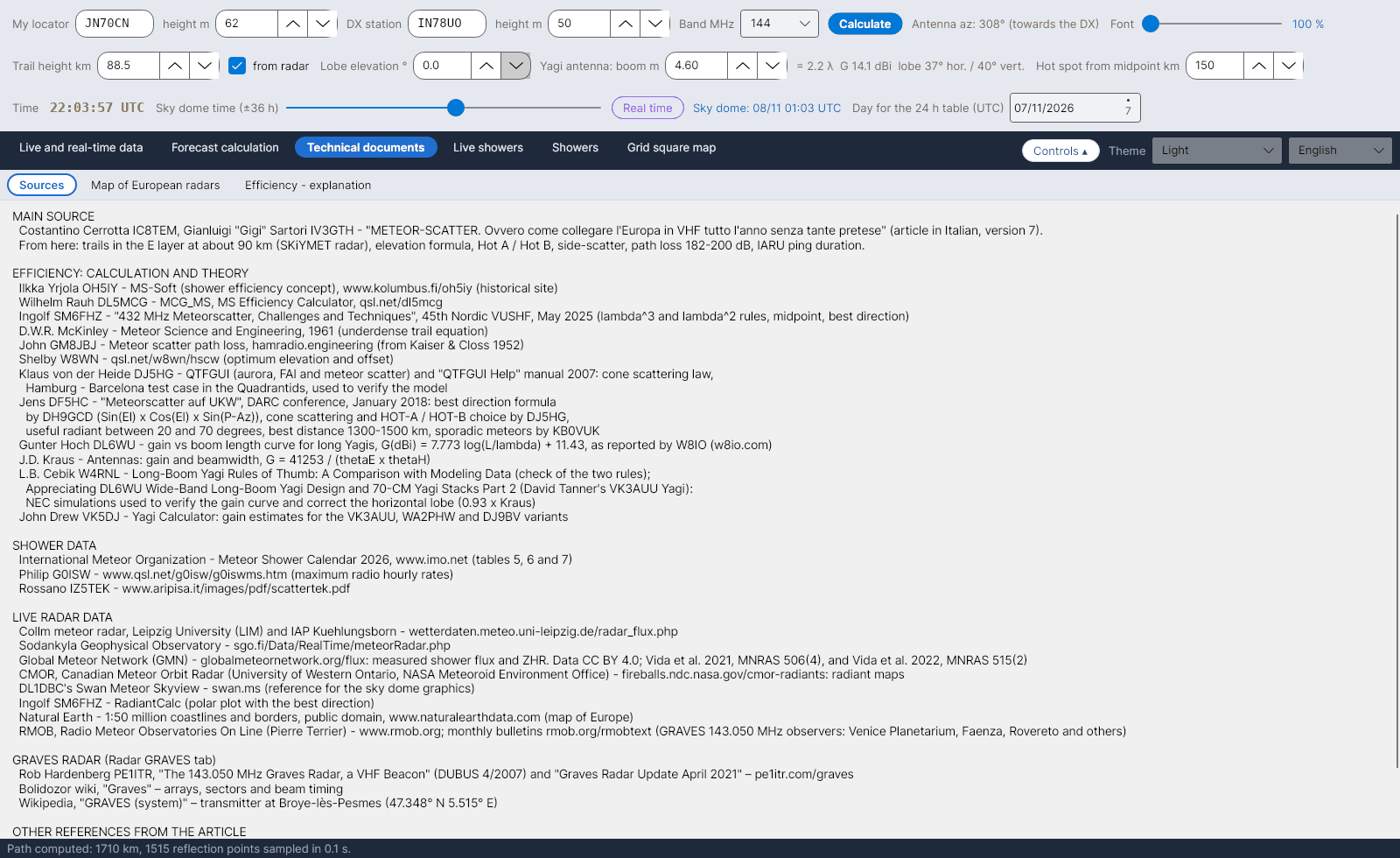
The Sources tab lists every work YA-MS is built on, grouped as below (the text is selectable, so you can copy the references). The same sources, numbered, close the calculation manual (doc/YA-MS_manuale_calcoli.docx) and the Efficiency - explanation document.
| Source | Used for |
|---|---|
| Costantino Cerrotta IC8TEM, Gianluigi "Gigi" Sartori IV3GTH – "METEOR-SCATTER. Ovvero come collegare l'Europa in VHF tutto l'anno senza tante pretese" (article in Italian, version 7) | Trails in the E layer at about 90 km (SKiYMET radar), Earth radius 6372.7955 km, elevation formula, Hot A / Hot B, side-scatter 10–30°, path loss 182–200 dB, minimum signal −130 dBm, IARU ping durations, sporadic peak at 06 UTC |
| Source | Used for |
|---|---|
| Ilkka Yrjölä OH5IY – MS-Soft, www.kolumbus.fi/oh5iy (historical site) | Concept of shower efficiency; 200 dB average path loss |
| Wilhelm Rauh DL5MCG – MCG_MS, MS Efficiency Calculator v1.61, qsl.net/dl5mcg | Efficiency on four fixed directions (comparison) |
| Ingolf SM6FHZ – "432 MHz Meteorscatter, Challenges and Techniques", 45th Nordic VUSHF, May 2025 | λ³ and λ² rules, midpoint, best direction (radiant az ±90°) |
| D.W.R. McKinley – Meteor Science and Engineering, McGraw-Hill, 1961 | Specular reflection, underdense trail equation |
| John GM8JBJ – Meteor scatter path loss, hamradio.engineering (from Kaiser & Closs 1952) | 182 dB minimum path loss |
| Shelby W8WN – qsl.net/w8wn/hscw (AMS Bulletin 203 offset table) | Optimum elevation and offset, hot spots 50–150 km |
| LZ2HV – MSHV | Hot A / Hot B (comparison; in the manual) |
| Klaus von der Heide DJ5HG – QTFGUI and the "QTFGUI Help" manual (2007) | Cone scattering law; Hamburg – Barcelona Quadrantids test case used to verify the model |
| Jens DF5HC – "Meteorscatter auf UKW", DARC conference, January 2018 | Best-direction formula by DH9GCD; cone scattering and HOT-A / HOT-B choice by DJ5HG; useful radiant 20–70°; best distance 1300–1500 km; sporadic meteors by KB0VUK |
| Günter Hoch DL6WU – gain vs boom length of long Yagis, reported by W8IO (w8io.com) | G(dBi) = 7.773 log(L/λ) + 11.43 |
| J.D. Kraus – Antennas, McGraw-Hill | G = 41253 / (θE·θH) |
| L.B. Cebik W4RNL – Long-Boom Yagi Rules of Thumb: A Comparison with Modeling Data; Appreciating DL6WU Wide-Band Long-Boom Yagi Design; 70-CM Yagi Stacks Part 2 (VK3AUU Yagis by David Tanner) | NEC simulations used to verify the gain curve and correct the horizontal lobe (0.93 × Kraus) |
| John Drew VK5DJ – Yagi Calculator | Gain estimates for the VK3AUU, WA2PHW and DJ9BV variants |
| J. Meeus – Astronomical Algorithms, 2nd ed., Willmann-Bell, 1998 | Julian day, sidereal time, solar longitude, azimuth/elevation (in the manual) |
| Source | Used for |
|---|---|
| International Meteor Organization – Meteor Shower Calendar 2026 (and 2027), www.imo.net, tables 5, 6 and 7 | Radiants, λ max, v, r, ZHR, Antihelion Source, peak dates and times |
| Philip G0ISW – www.qsl.net/g0isw/g0iswms.htm | Maximum radio hourly rates |
| Rossano IZ5TEK – www.aripisa.it/images/pdf/scattertek.pdf | Shower data |
| Source | Used for |
|---|---|
| Collm meteor radar, Leipzig University (LIM) and IAP Kühlungsborn – wetterdaten.meteo.uni-leipzig.de/radar_flux.php | Hourly meteor flux and trail heights (Radar flux) |
| Sodankylä Geophysical Observatory – sgo.fi/Data/RealTime/meteorRadar.php | Meteor count image |
| DL1DBC – Swan Meteor Skyview, swan.ms | Reference for the sky dome graphics |
| SM6FHZ – RadiantCalc | Polar plot with the best direction |
| Natural Earth – 1:50 million coastlines and borders, public domain, www.naturalearthdata.com | Map of Europe |
| RMOB, Radio Meteor Observatories On Line (Pierre Terrier) – www.rmob.org; monthly bulletins rmob.org/rmobtext | GRAVES 143.050 MHz observers (Venice Planetarium, Faenza, Rovereto and others) for comparison |
| Source | Used for |
|---|---|
| Rob Hardenberg PE1ITR – "The 143.050 MHz Graves Radar, a VHF Beacon" (DUBUS 4/2007) and "Graves Radar Update April 2021" – pe1itr.com/graves | Sectors, steps, 0.8 s / 3.2 s step timing |
| Bolidozor wiki, "Graves" | Arrays, sectors and beam timing |
| Wikipedia, "GRAVES (system)" | Transmitter at Broye-lès-Pesmes (47.348° N 5.515° E) |
See GRAVES radar.
G3WZT, DH8BQA, geekshed.co.uk, WSJT-X manual, WB2FKO (pings), IU6GIR (143.050 MHz activity), IARU Region 1 VHF Handbook.
data/regole_sperimentali.csv lists the constants and rules used by the program, each with its source (typical trail height, height range, Earth radius, λ³ / λ² rules, IARU ping durations, path losses, minimum signal, indicative EIRP, sporadic peak, useful distances at 432 MHz, best direction, maximum useful radiant elevation at 432 MHz, side-scatter).
Radar data belong to their institutions. Permission must be asked before fetching them automatically in a distributed program.