Tools and Prompts
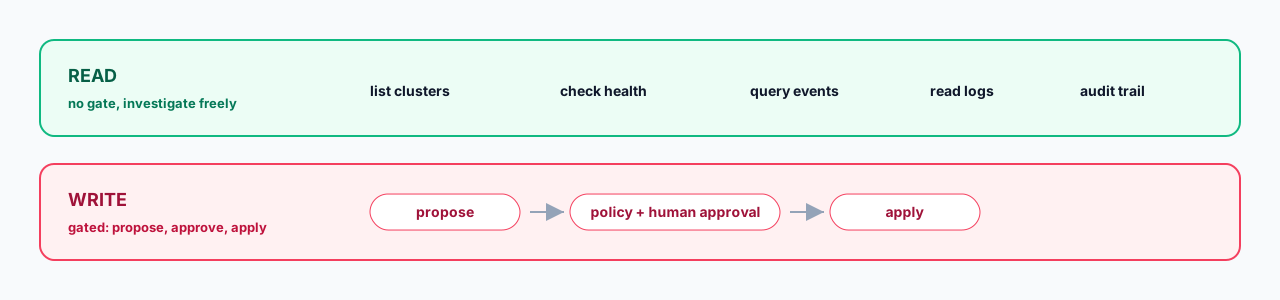
33 tools across ten toolsets, plus ten prompts. Almost all of it is read: the whole Open Cluster Management API is safe to inspect. Only two toolsets can change anything, and only through the propose -> approve -> apply gate.
Every hub-level tool works for any managed spoke - a standalone OpenShift cluster, a
HyperShift hosted cluster, or a cloud cluster - because on the hub they are all
ManagedClusters. Run ocm-mcp doctor to call every read tool against your hub and
print a PASS / EMPTY / SKIP / FAIL table before wiring up an agent.
| Toolset | What it covers | Tools | Writes |
|---|---|---|---|
| inventory | ManagedClusters, ClusterSets, set bindings, ClusterClaims, ManagedClusterInfo | 6 | - |
| observability | cluster health, events, pod logs | 3 | - |
| placement | Placements, PlacementDecisions, AddOnPlacementScores | 3 | - |
| work | ManifestWork status feedback + the gated deploy flow | 6 | gated |
| addons | ClusterManagementAddOns, fleet + per-cluster add-on health | 3 | - |
| registration | pending join CSRs + gated cluster lifecycle actions | 3 | gated |
| policy | governance compliance + violations rollup (if installed) | 2 | - |
| hosted-control-planes | HyperShift HostedClusters and NodePools (when the hub hosts them) | 3 | - |
| resources | generic get/list over an allow-list of OCM API types | 2 | - |
| audit | pending proposals, this server's own audit trail | 2 | - |
-
read - safe, non-mutating, no gate. Annotated
readOnlyHint. - propose - stores a pending change; mutates nothing on any cluster. Runs static guardrails and a hub dry-run first.
-
apply - delivers an already-approved change. Needs a human-minted HMAC token
bound to the exact content. Annotated
destructiveHint.
OCM_MCP_READ_ONLY=1 makes every propose and apply tool refuse - a strictly-inspection
deployment, backstopping the token gate.
-
inventory:
list_clusters,get_cluster,list_cluster_sets,list_cluster_set_bindings,list_cluster_claims,get_cluster_info(OpenShift version, nodes, console URL - from the hub, no spoke access needed). -
observability:
get_cluster_health,query_events,get_pod_logs. -
placement:
list_placements,get_placement_decision,list_addon_placement_scores. -
work:
list_manifestworks,get_manifestwork(per-resource status feedback, the "why not Applied"),list_manifestworkreplicasets. -
addons:
list_cluster_management_addons,get_addon_health,list_addons_for_cluster. -
registration:
list_pending_csrs. -
policy:
list_policies,list_policy_violations(reports clearly if the add-on is not installed). -
hosted-control-planes:
list_hosted_clusters,get_hosted_cluster,list_node_pools(HostedCluster objects live on the hosting cluster; if HCPs are hosted elsewhere the tools say so and the ManagedCluster view still covers them). -
resources:
list_resources,get_resource. -
audit:
list_pending_proposals,get_audit_trail.
The work toolset proposes a workload change:
-
propose_manifestwork(cluster, name, summary, manifests_json)-> validate + store. -
apply_manifestwork(proposal_id, approval_token)-> create the ManifestWork. -
rollback_manifestwork(proposal_id, approval_token)-> delete it (fresh token).
The registration toolset proposes an OCM lifecycle action:
-
propose_cluster_action(cluster, action, summary, params_json)-> validate + store. -
apply_cluster_action(proposal_id, approval_token)-> apply it.
action is one of:
-
cordon- add aNoSelecttaint so Placements stop scheduling to the cluster. -
uncordon- remove that taint. -
set_label- set or remove a label (params_json:{"key": "...", "value": "..."}; empty value removes it). -
accept- sethubAcceptsClient=trueand approve the cluster's pending join CSRs (the double opt-in that finishes onboarding). -
enable_addon- create aManagedClusterAddOnin the cluster namespace (params_json:{"addon": "...", "install_namespace": "..."}). -
disable_addon- delete aManagedClusterAddOn(params_json:{"addon": "..."}).
list_resources and get_resource read any Open Cluster Management type through one
interface - but only types on a fixed allow-list. This is deliberately an allow-list,
not a deny-list: Secret, ConfigMap, and every core kind are absent, so the
dangerous read cannot be named. The safety guarantee does not depend on an operator
remembering to block anything.
managedclusters              managedclustersets           managedclustersetbindings
placements                   placementdecisions           addonplacementscores
manifestworks                manifestworkreplicasets       clustermanagementaddons
managedclusteraddons         addondeploymentconfigs        addontemplates
clustermanagers              klusterlets                   policies
policysets                   placementbindings
MCP prompts are reusable templates a client offers as a starting point. Each drives the agent through the safe workflow with the real tool names.
| Prompt | Arguments | What it drives |
|---|---|---|
diagnose_fleet |
- | sweep every cluster and add-on, summarize what is unhealthy and why. Reads only. |
remediate_with_approval |
symptom |
investigate, propose the smallest safe fix, wait for the human token, apply, verify, report. |
incident_postmortem |
- | write the post-incident report strictly from get_audit_trail. |
why_not_scheduled |
cluster, placement, namespace
|
explain a Placement decision from the live objects. |
onboard_cluster |
cluster |
accept a pending cluster safely through the approval gate. |
addon_troubleshoot |
addon |
diagnose a degraded add-on across the fleet. |
hosted_cluster_health |
cluster |
assess a HyperShift hosted control plane and its node pools. |
policy_compliance_report |
- | summarize governance compliance and prioritize what to fix. |
capacity_report |
- | find clusters with headroom and clusters under pressure. |
rollout_status |
name, namespace
|
track a ManifestWorkReplicaSet rollout across selected clusters. |
The full argument-by-argument reference lives in docs/tools.md.
Next: Guardrails Deep Dive.