Repository navigation
Repository Growth
Prerequisites: Project status, which counts the same issues and pull requests this page charts by week.
Unfamiliar word or acronym? The Glossary defines it.
Generated at: 2026-10-23T00:14:32Z (UTC), from ChiefGyk3D/Clouds-Against-Humanity, which was created on 2026-10-10 (day 0 on the chart). The numbers come from GitHub and drift: this is a snapshot, not a live counter.
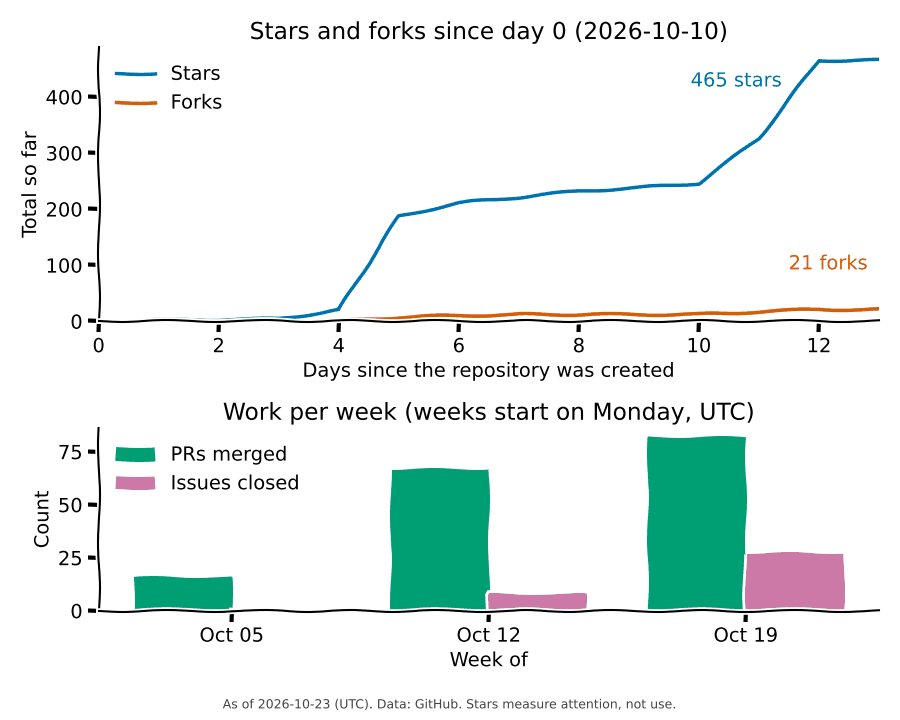
As of 2026-10-23, 13 days after the repository was created: 465 stars, 21 forks, 165 pull requests merged and 35 issues closed.
- Stars measure attention, not use. A star is a click. It says someone saw the project and liked the idea, not that they ran it, finished a lesson or would recommend it. Forks are a little closer to use, and still a weak signal.
- Early numbers are noisy. A repository that is a few days or weeks old can jump on one share or one post and then flatten. One chart of a short history proves very little; read the shape over months.
- The numbers come from GitHub and drift. Accounts get deleted and spam stars get removed, so a count can fall. Times are in UTC, and a week runs Monday to Sunday.
- Throughput is not quality. Pull requests merged and issues closed show how much moved, not how good it is.
- Only counts per day are stored. The snapshot has no user names, no addresses and no tokens, and CI checks that.
This table is the text version of the picture, one row per week (UTC, Monday to Sunday). The last two columns are running totals at the end of that week.
| Week of | New stars | New forks | PRs merged | Issues closed | Stars so far | Forks so far |
|---|---|---|---|---|---|---|
| 2026-10-05 | 2 | 0 | 16 | 0 | 2 | 0 |
| 2026-10-12 | 230 | 12 | 67 | 8 | 232 | 12 |
| 2026-10-19 (partial) | 233 | 9 | 82 | 27 | 465 | 21 |
Totals: 465 stars, 21 forks, 165 merged pull requests, 35 closed issues.
Run these from a login that can read the repository. They show the same data without the script:
gh api repos/ChiefGyk3D/Clouds-Against-Humanity --jq .created_at
gh api repos/ChiefGyk3D/Clouds-Against-Humanity/forks --paginate --jq '.[].created_at'
gh pr list --repo ChiefGyk3D/Clouds-Against-Humanity --state merged --limit 5000 --json mergedAt
gh issue list --repo ChiefGyk3D/Clouds-Against-Humanity --state closed --limit 5000 --json closedAt
# stars: a GraphQL query for stargazers(first: 100, orderBy: {field: STARRED_AT, direction: ASC}) { edges { starredAt } }, paged
python3 -I scripts/gen_repo_metrics.py --refresh   # does all of the above, draws the chart and rewrites this page
python3 -I scripts/gen_repo_metrics.py --check     # offline: the same check CI runs
Drawing needs matplotlib, which the repository does not depend on: use the system package (python3-matplotlib on Debian-based systems), or make a private virtual environment with python3 -m pip install matplotlib and run the script with that interpreter. The check needs only Python.
The same script works for any repository you can read: pass --repo owner/name with its own --snapshot, --out and --page paths (or --no-page). Run python3 -I scripts/gen_repo_metrics.py --help for the list.
Next: Project status, which says what the work is doing right now.