Repository navigation
Current Visual Guide
The current visual library has a complete Synergy Map companion, plus the portable template's four system maps, seven detailed agent guides, and one combined atlas. Each of those twelve topics has one canonical SVG in the template. Their generated art is illustrative; exact paths, commands and boundaries are selectable vector text with an adjacent full text companion. The SVG canvas is 7680 × 4320; embedded generated art has its own smaller native resolution.
These images explain the selected beta source. They do not start agents, authenticate providers, grant access, or prove deployment. Use the versioned CLI manual before running commands.

Read the map guide · Download the interactive ZIP · Full 7680 × 4320 PNG · Editable SVG · Connection reading guide · Media edition 1.0 · Checksums

The 49-block / 120-connection / 92-icon map joins inputs, selected scope and canonical records, Agent 0, seven specialist/worker lanes, tools and processing, evidence/review, accepted output, and continuity. Lower catalogs show all ten AUTOBOT functions, twenty security domains, provider support levels and direct I/O. The HTML viewer's complete reference includes 400 Agent1 questions, 100 Agent Z questions, twenty provider/navigation targets, and the stock Access/Agenda catalogs.
Use the detail at full size: download/extract the ZIP and open
SYSTEMX-Synergy-Map.html locally to search, pan, zoom, select a block's inputs and
outputs, or follow one of three worked routes. GitHub downloads HTML release
assets rather than hosting the viewer as an application. The standalone SVG keeps
selectable text and embedded fonts; the PNG is rendered natively at 7680 × 4320.
Getting Started Easy Mode supplies a short first-use path.
This separate media edition documents 1.11.0-beta.4 at reviewed source
3db12866e552a3cdc190d0a23c8f89a87ba3d3b9. Arrow styles distinguish local data,
generated views, references, selected external actions, review and rework.
External provider, permission, deployment and security claims still need their own
evidence. The canonical twelve template graphics retain their beta.3 provenance.
Watch the 10:55 beta.4 product film ·
Chapter and scene guide ·
Descriptive transcript · English captions.
The film combines an eight-second Blender opening, full-screen original maps,
focused current diagrams, large isolated local CLI captures, and animated
task/review paths. Software remains v1.11.0-beta.4 and white-paper edition 2.2;
the twelve canonical illustrations keep their beta.3 provenance.
Open the full 7680 × 4320 PNG · Editable SVG · Reading-order text · Media edition 2.0 · Checksums


This original native vector/text process map is the film's separate media companion. The expanded Synergy Map above supplies the newer dense all-in-one overview and interactive connection tracing. The film map keeps its original bytes and publication identity. It uses the original four maps' white/blue engineering layout and role colors to connect the human work loop to exact files, the seven roles, governance, host execution, owner review, and evidence return. Its text companion includes all twenty standard Access Matrix actor rows and ten unset Agenda entries. It adds no permission grant or installed worker and does not replace the twelve canonical template SVGs below. Use its full-size regions and text companion for dense reference labels; the film moves from overview to detail.
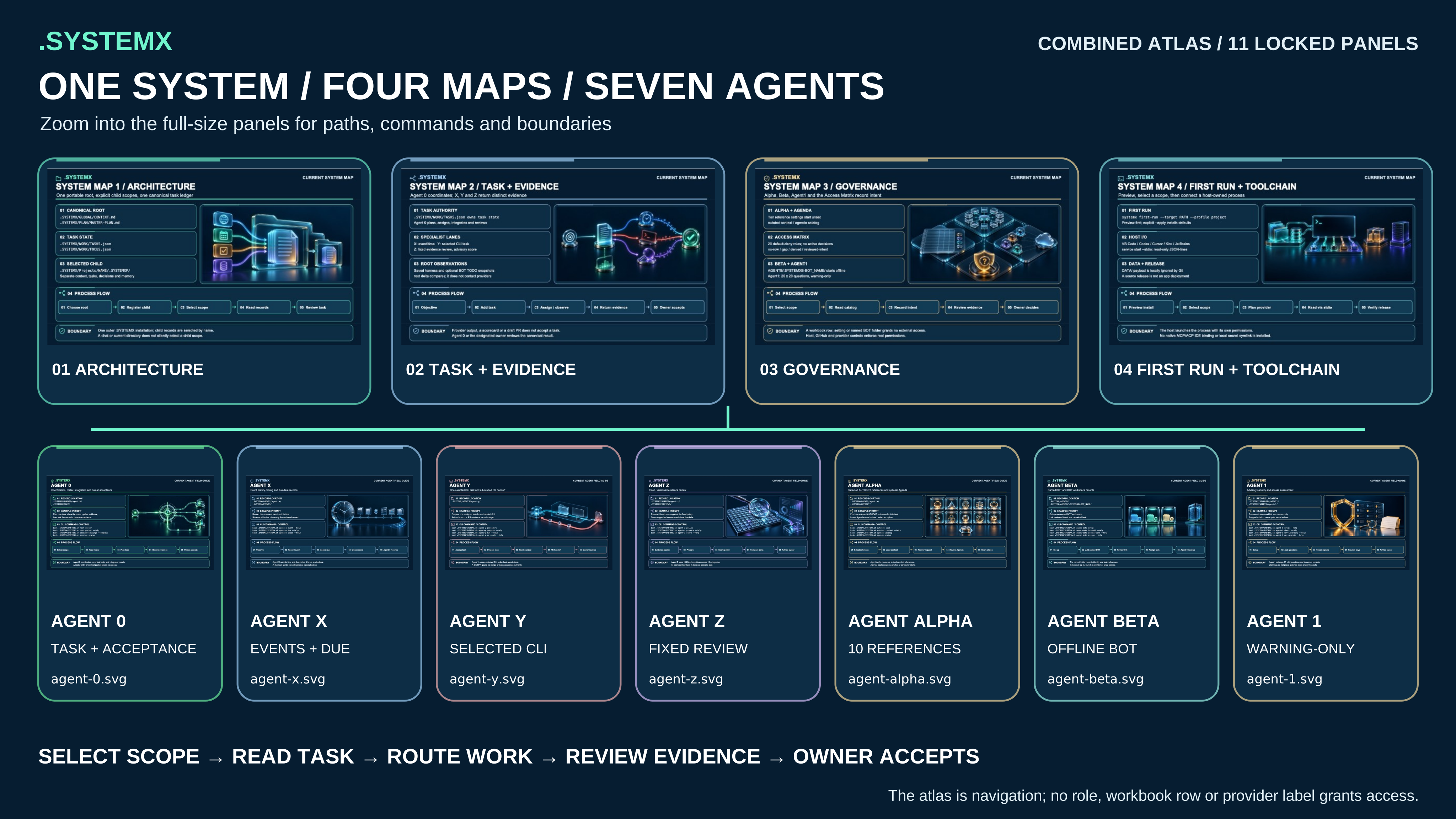
Open the full-size atlas · Read its complete description. The atlas connects scope, task authority, governance, and the host toolchain. Open the separate maps and agent sheets below for their full-size paths, commands, and process flows.
The separate 8K PNG export pack contains twelve 7680 × 4320 exports, a source-bound manifest, checksums, and the text guide. Its embedded generated illustrations originated at 1672 × 941 pixels; the larger export keeps vector labels sharp without adding native illustration detail. The pack is a release download, outside the portable source.
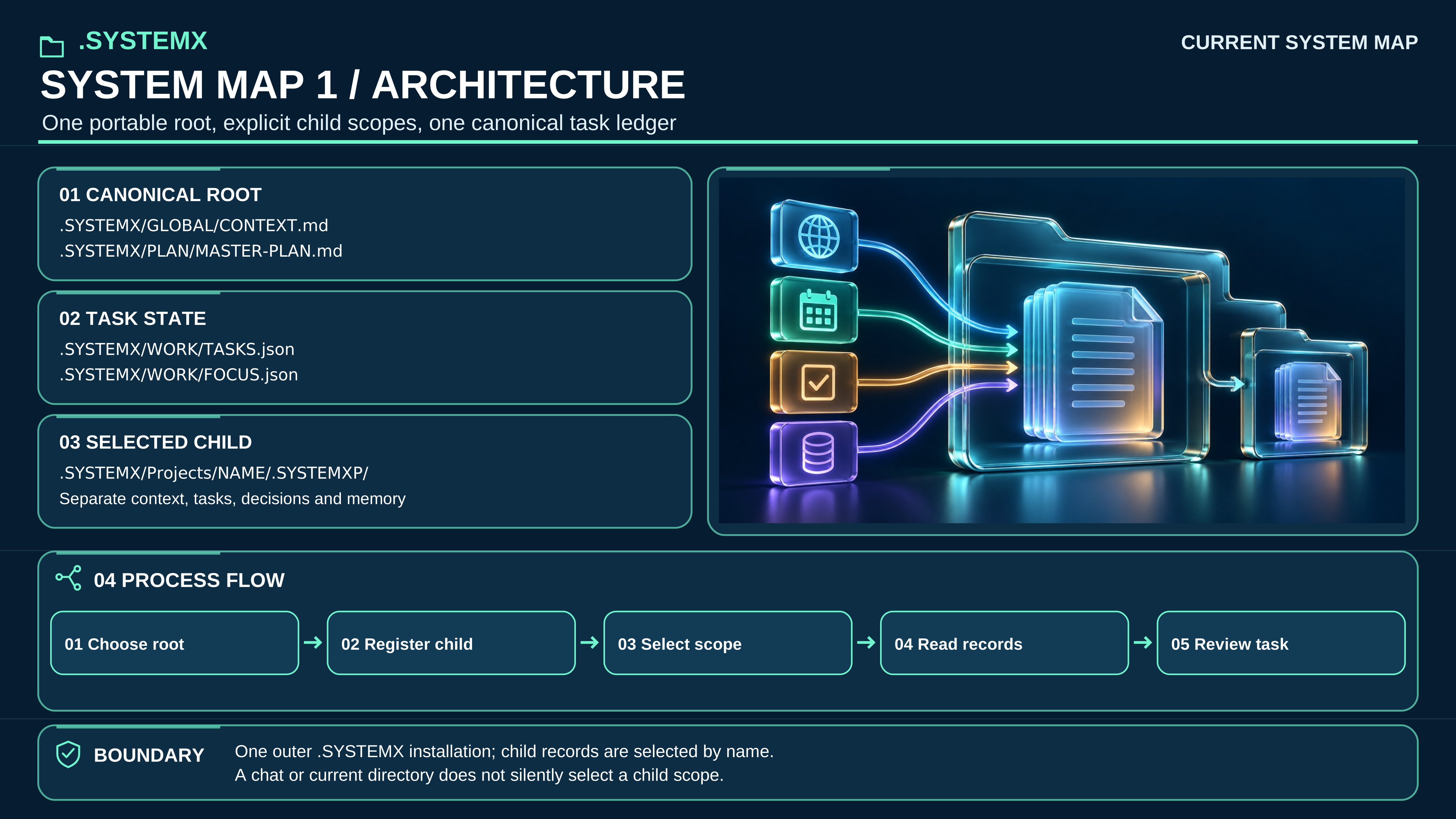
Open full-size SVG · Read full text
Text equivalent: Select the intended root or registered child before reading or writing. GLOBAL/CONTEXT.md and PLAN/MASTER-PLAN.md provide purpose and outcomes; WORK/TASKS.json is the sole task-status ledger. WORK/FOCUS.json selects the next useful step. A child has independent records and does not create a second outer installation.
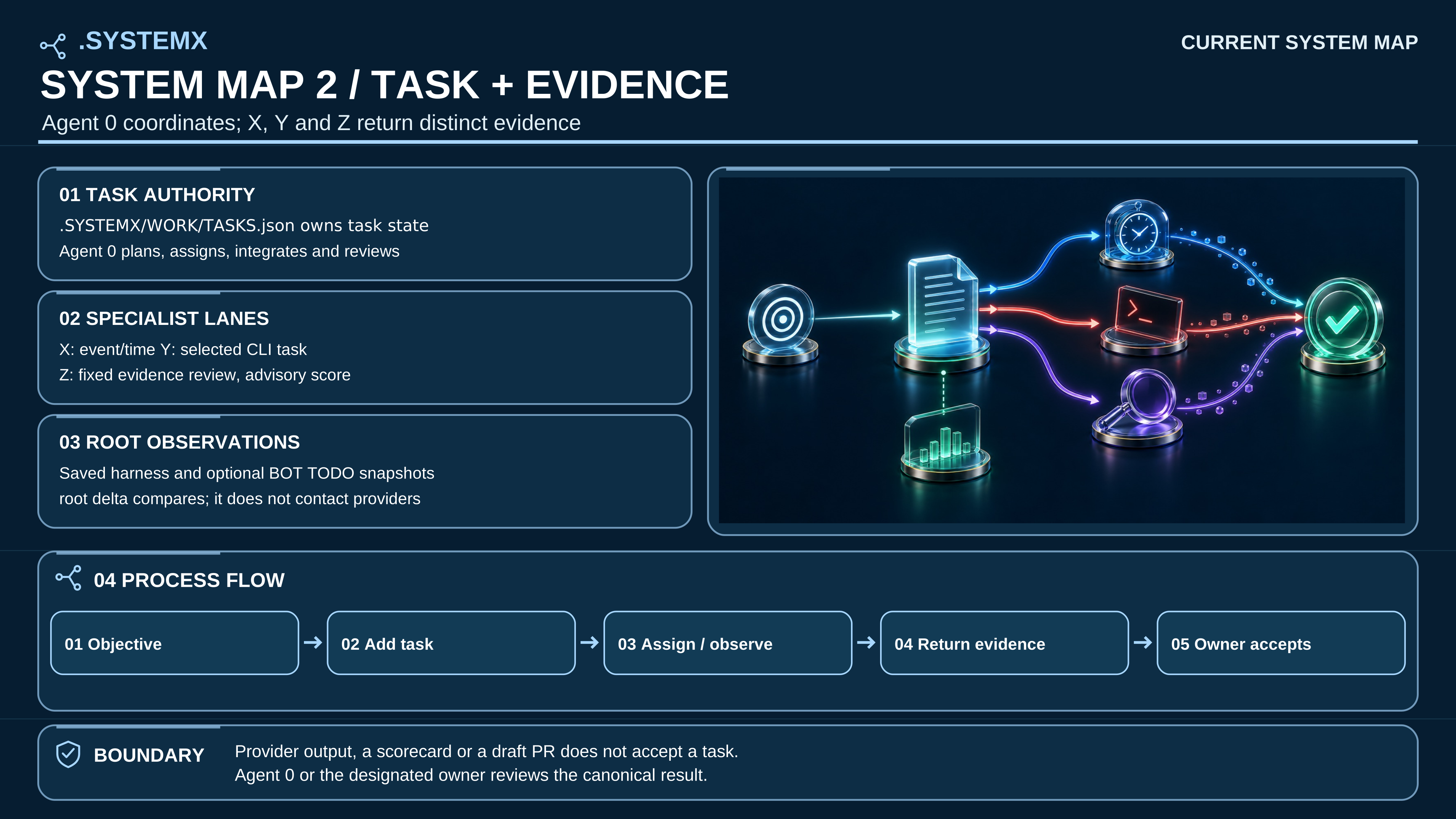
Open full-size SVG · Read full text
Text equivalent: An authorized objective becomes a scoped task in WORK/TASKS.json. Agent X records events and due items; Agent Y may run one selected installed CLI; Agent Z reviews fixed questions. ROOT compares retained harness and optional bot observations without contacting them. Agent 0 integrates evidence, and the designated owner accepts or saves the remaining work.
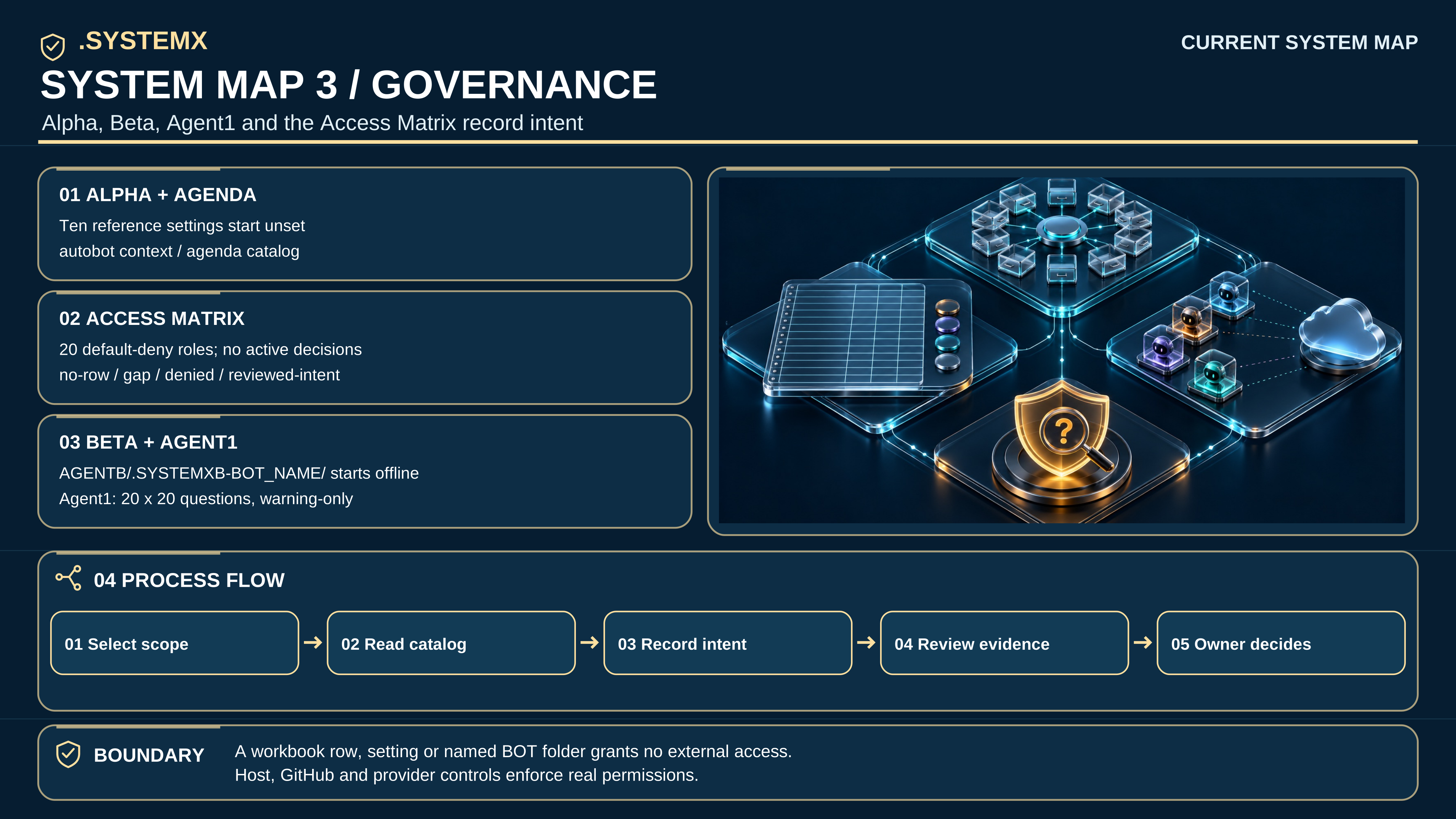
Open full-size SVG · Read full text
Text equivalent: Agent Alpha selects from up to ten reference functions. Agenda ships ten setting definitions, all unset; project options are empty. The Access Matrix ships 20 default-deny role rows and four decision-rule states, with no active decisions. Agent Beta records named folders under AGENTB/.SYSTEMXB-BOT_NAME/; Agent1 supports 20 × 20 security questions and ten event buckets. None of these records grants external access or launches a bot.
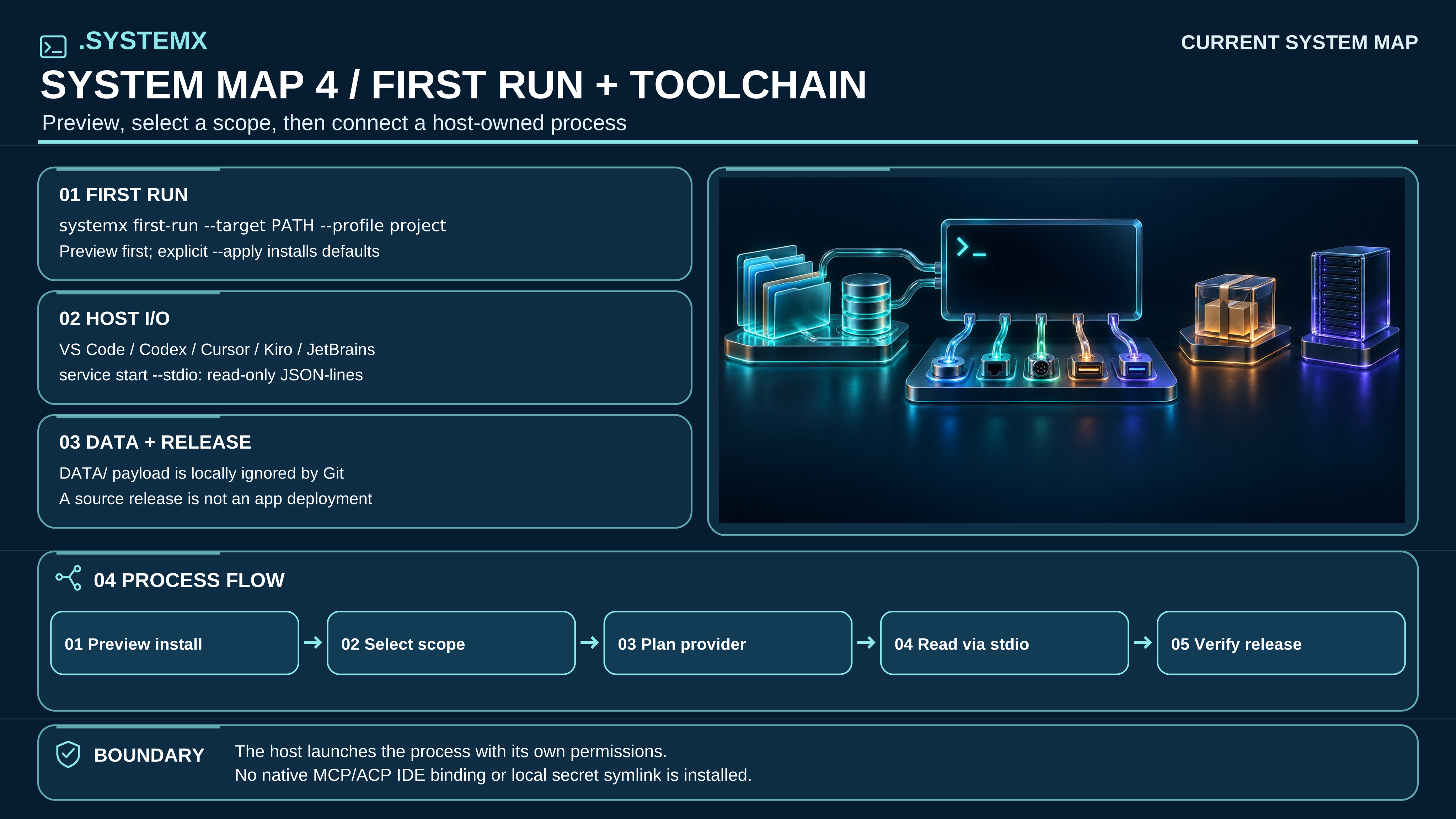
Open full-size SVG · Read full text
Text equivalent: Preview systemx first-run --target PATH --profile project before apply. Select a root or registered child and inspect onboard status and onboard plan. VS Code, Codex, Cursor, Kiro and JetBrains may invoke the reviewed CLI or a host-owned read-only JSON-lines session; this template installs no native MCP or ACP binding. DATA payloads stay local and ignored by Git by default. A version tag or package is not a deployment receipt.
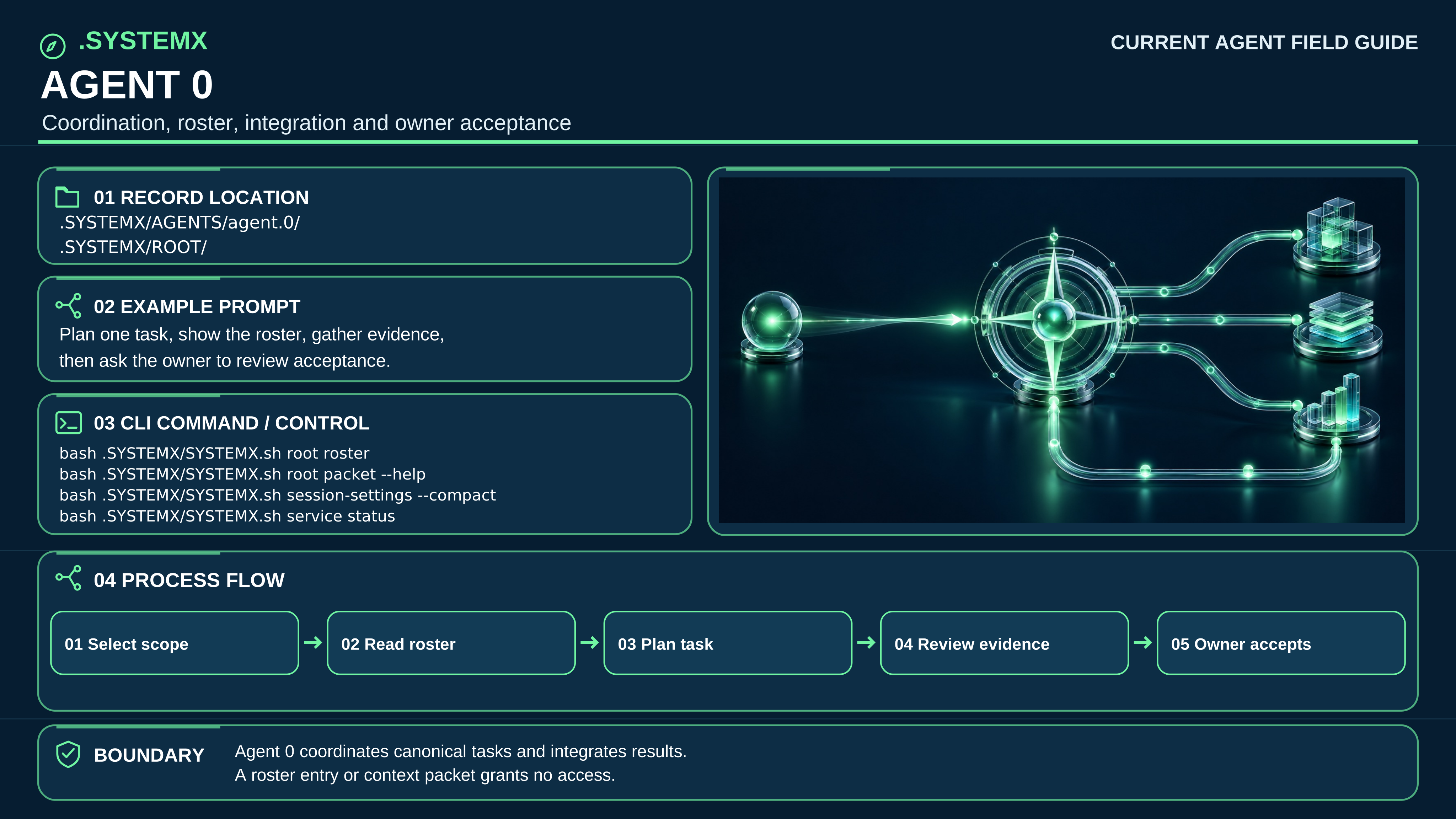
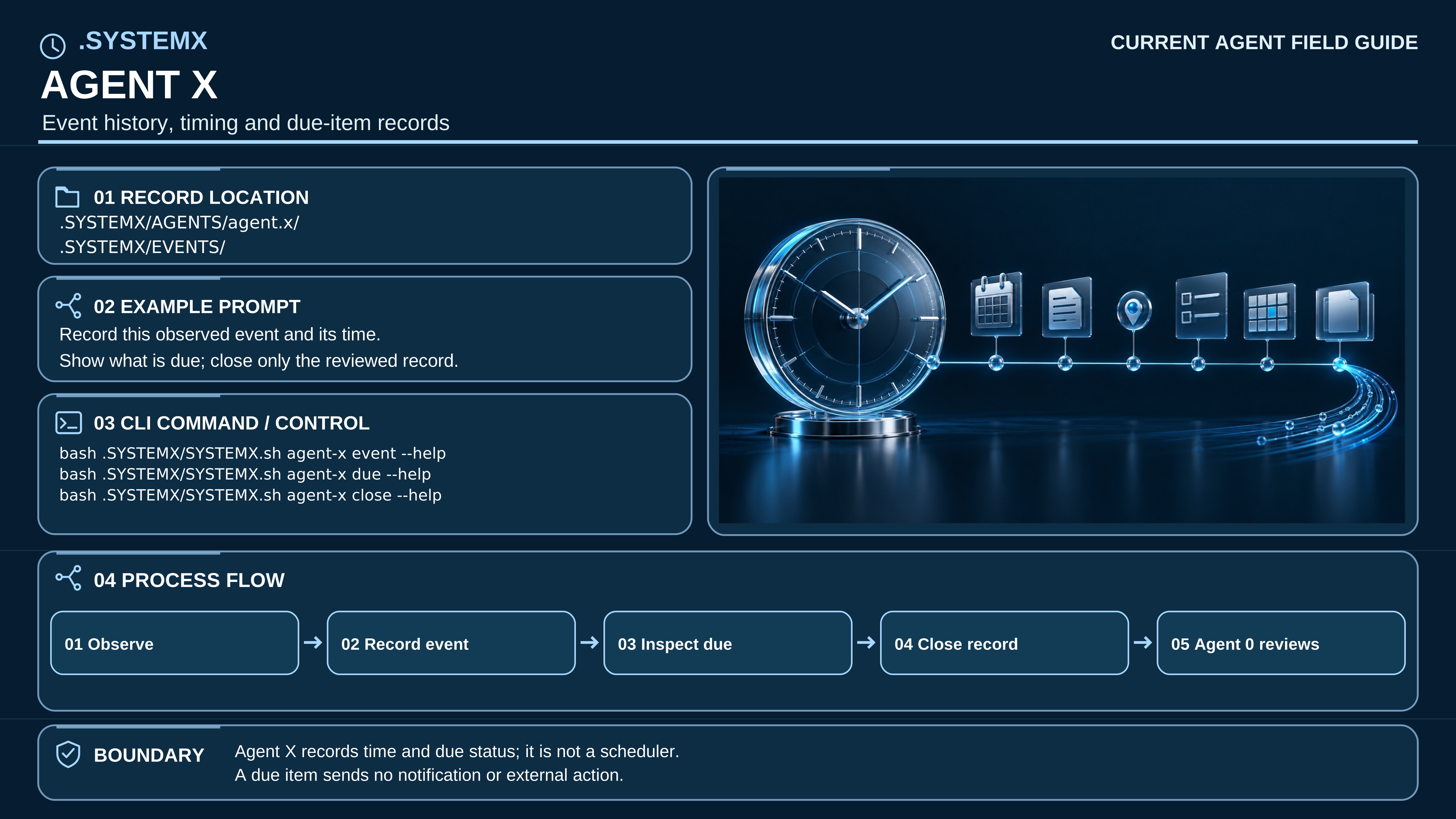
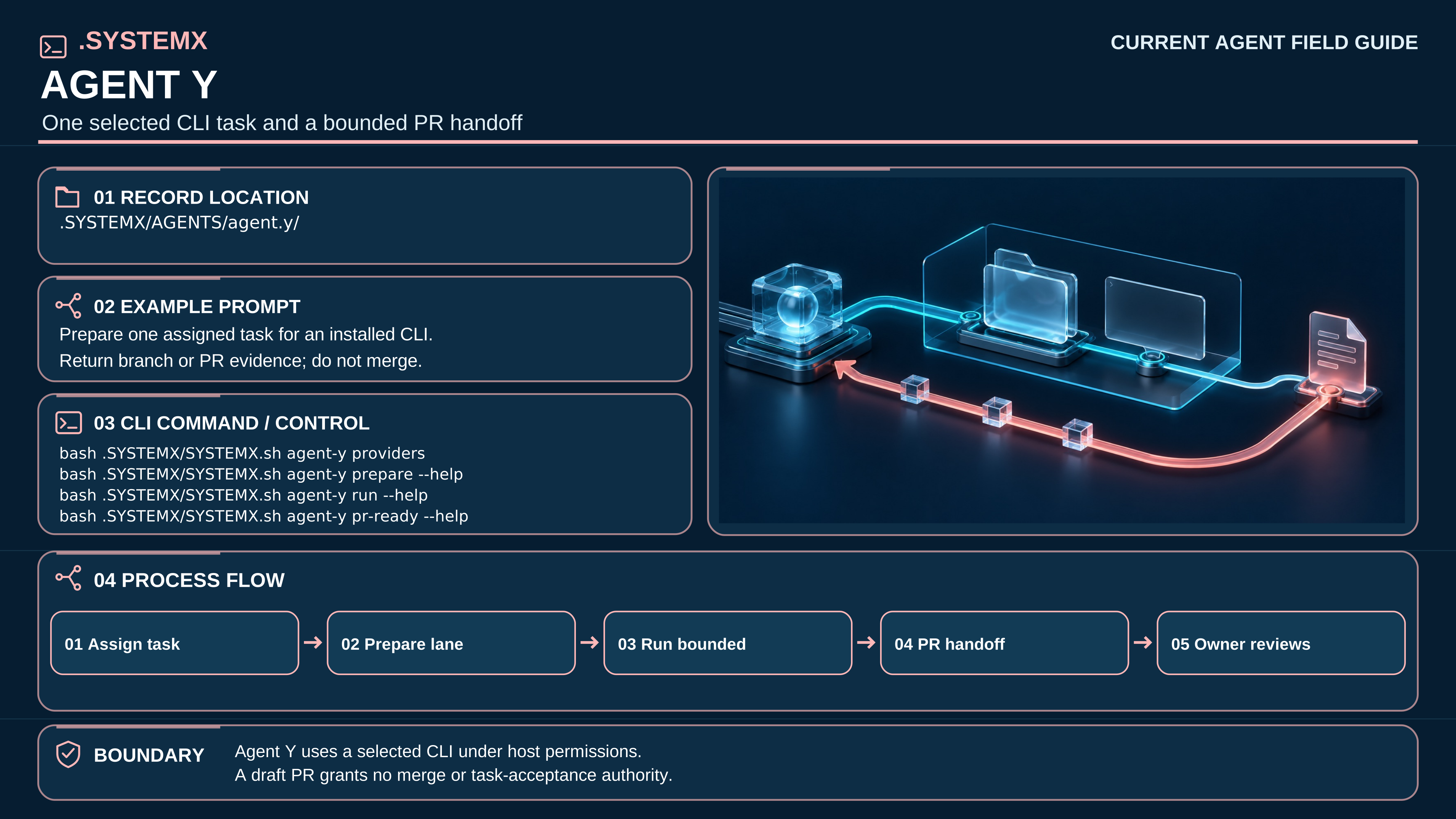
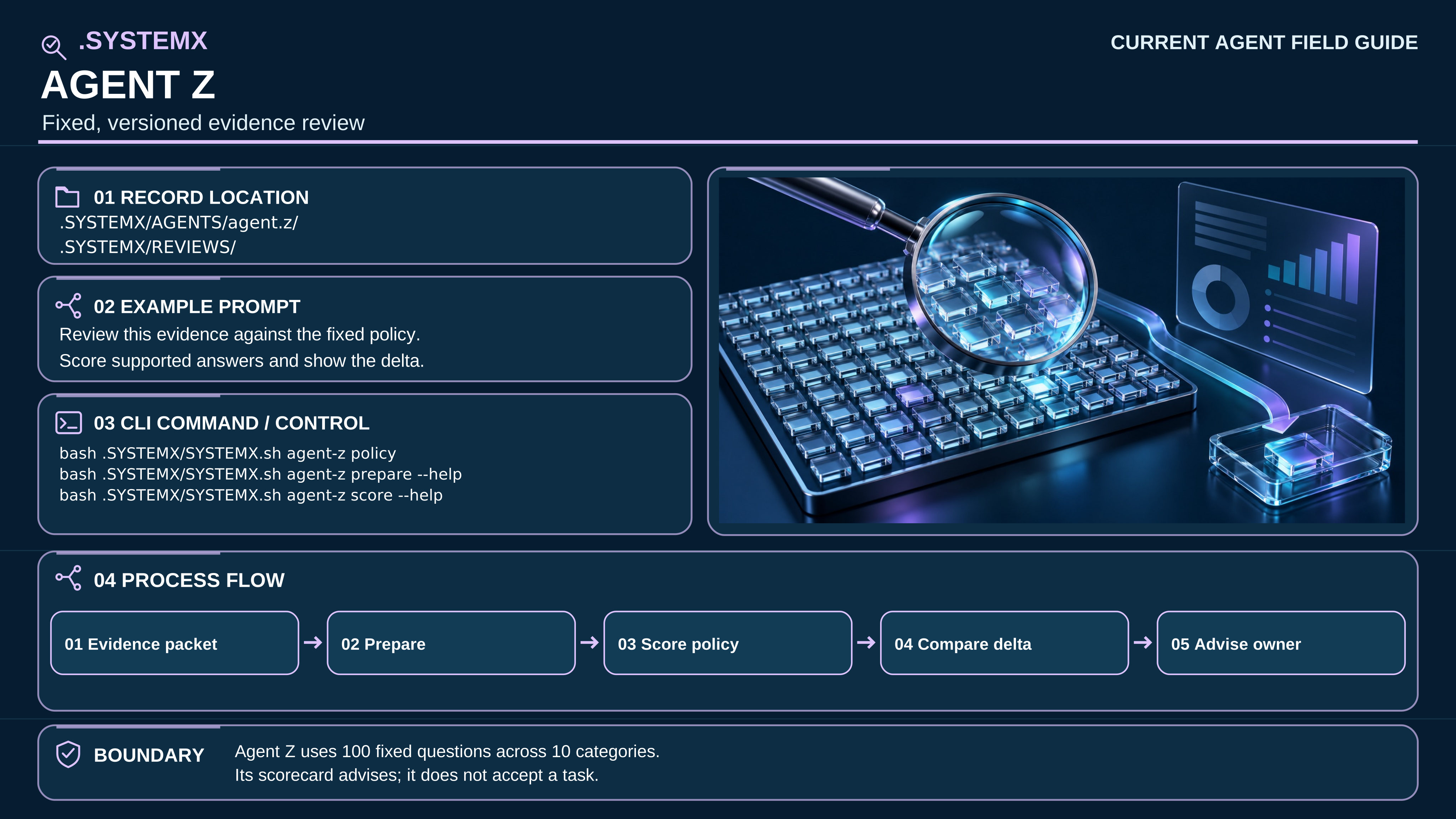
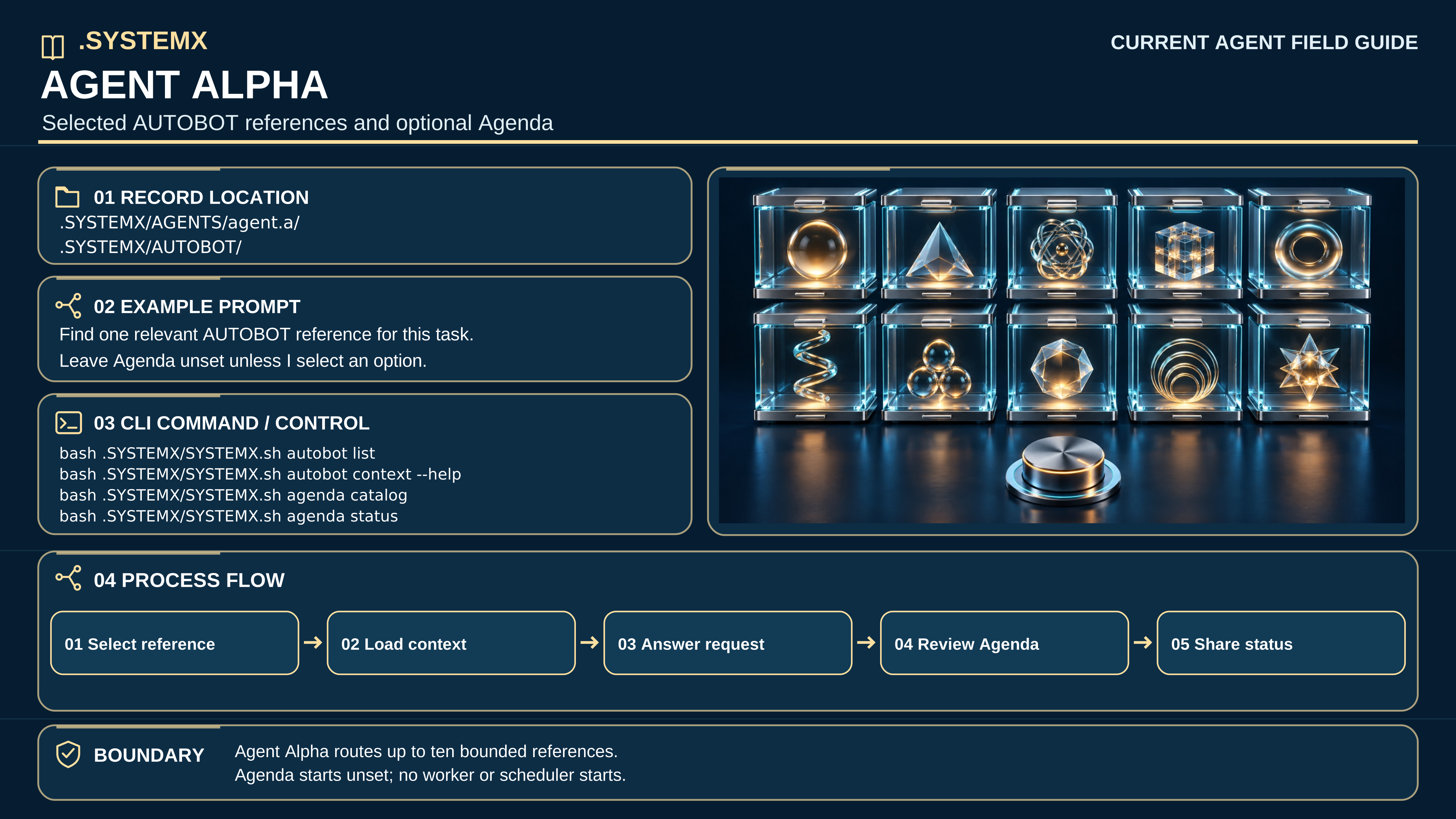
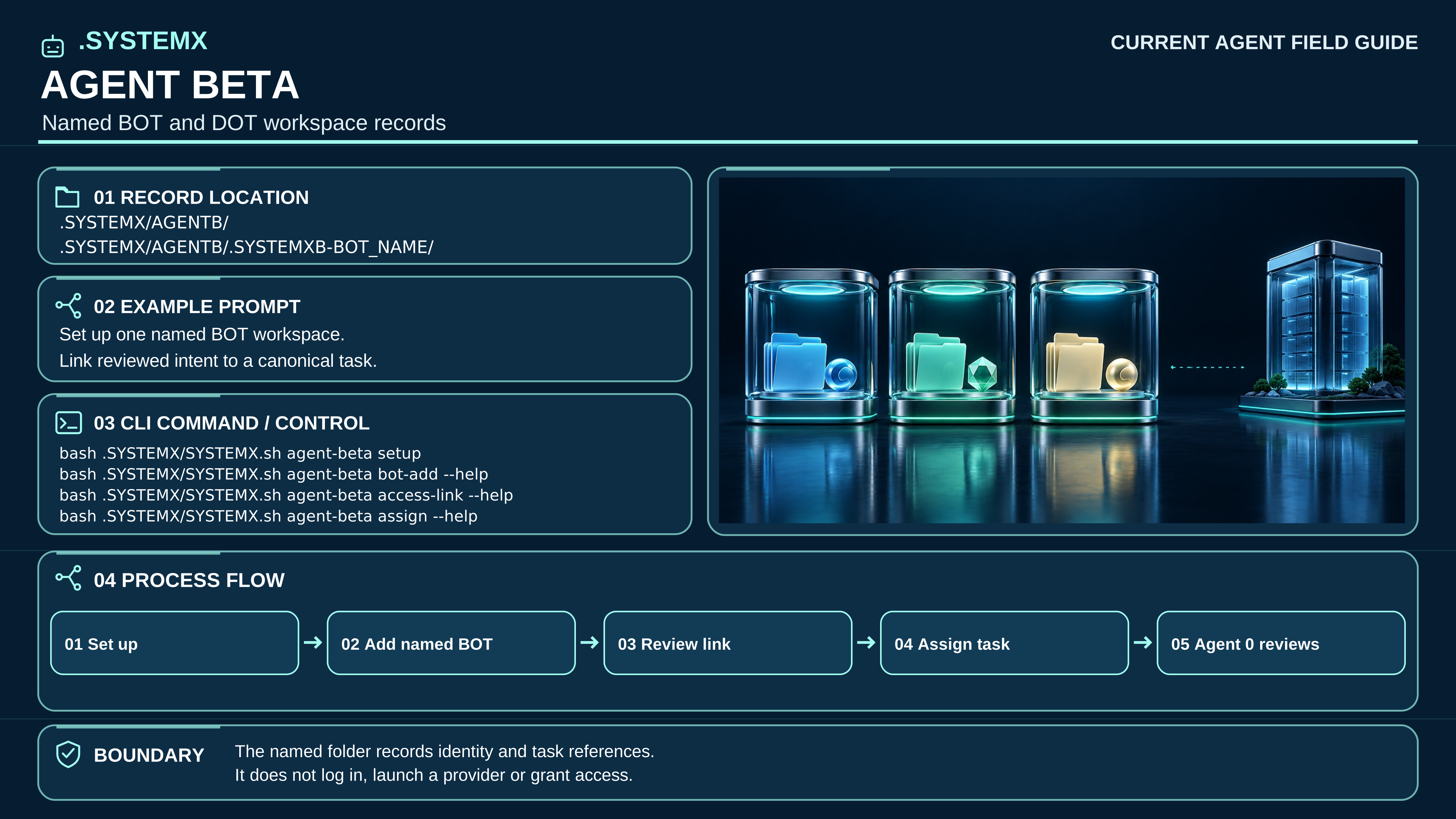
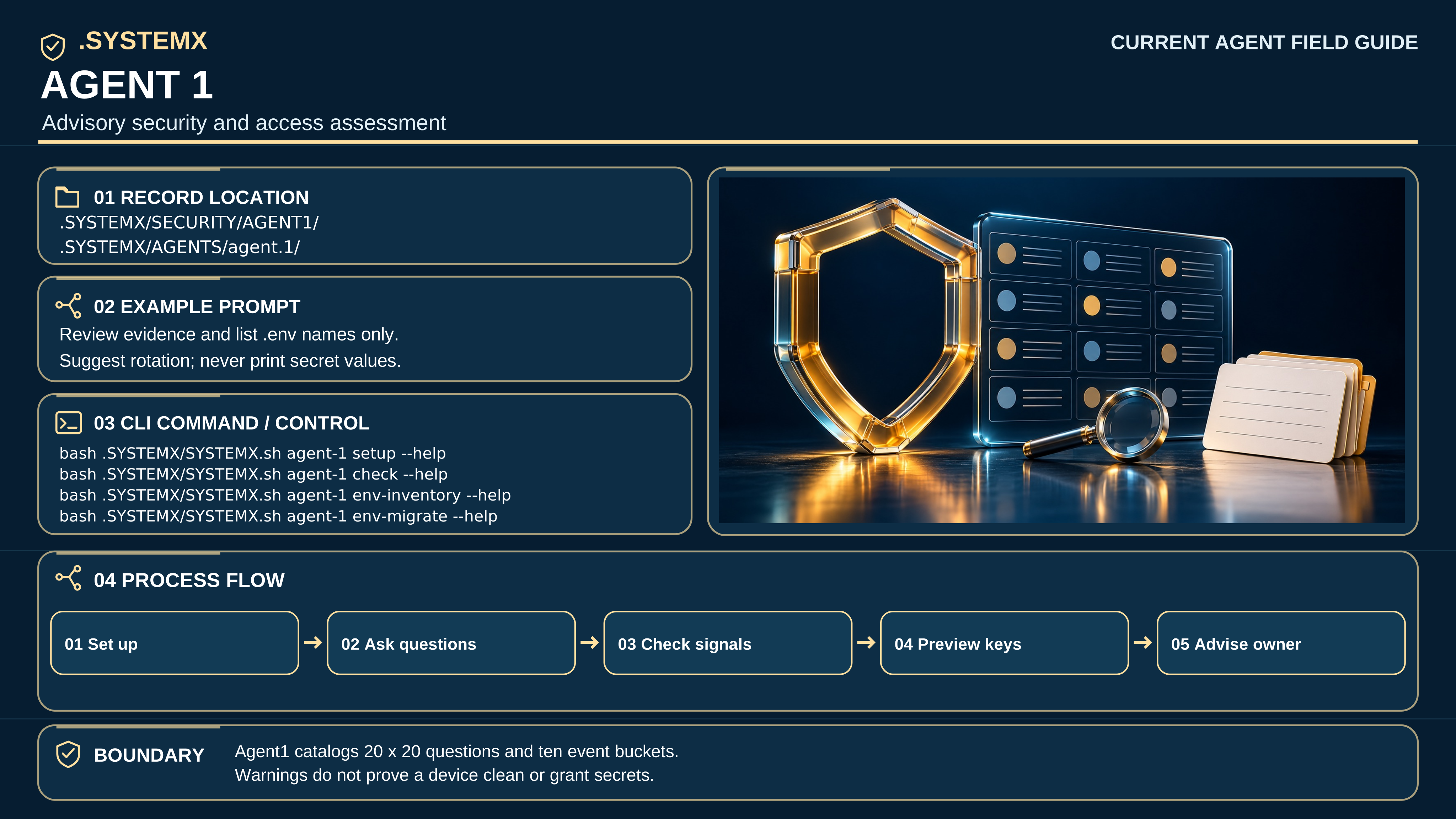
Each role guide shows its record location, an example prompt, a CLI help route, a five-step flow, and an authority boundary. The detailed field-guide text spells these out; the compact table below is navigation.
| Role | Current SVG | Boundary |
|---|---|---|
| Agent 0 | Open guide | Coordinates canonical tasks, roster, evidence and owner acceptance; its records do not grant host permissions. |
| Agent X | Open guide | Records event history, occurrence times and due items; it does not run a scheduler. |
| Agent Y | Open guide | Carries one selected task through an installed CLI and optional draft PR; it does not merge or accept a task. |
| Agent Z | Open guide | Applies its fixed 100-question advisory review; a scorecard is evidence, not acceptance. |
| Agent Alpha | Open guide | Selects up to ten AUTOBOT references; Agenda starts unset and does not start workers. |
| Agent Beta | Open guide | Records named offline BOT/DOT workspaces; a folder does not authenticate a provider. |
| Agent1 | Open guide | Supports warning-only security and access review; no check certifies a device clean. |
The earlier four-part alpha.3 posters and beta.1 graphic set remain in immutable release history. They are not embedded as current graphics. The edition 2.2 white paper examines beta.4; these illustrations retain their beta.3 art provenance.