Repository navigation
Role Solution Architect
You are on the hook for what exactly is being built, and under whose authority. P1 is yours: it ends when the spec, the bar per slice and the guardrails are signed, and the crossing into P2 is the one hand-off nothing downstream survives without.
Looking for what to do on Monday? That is the journey — eight steps in order, each with its artefact, a template and prompts, and interactive on the site.
This page is the standing definition of the job: what you own, what you may settle alone, what crosses your desk, how the role fails, and how anyone can tell from outside whether it is being done.
| You have always done this | What a model in the middle adds |
|---|---|
| Discovery, the credited requirements email, consolidated FRs | Three of the requirements now describe a model's behaviour |
| Constraints by type, NFRs as scenarios, utility trees, ratification | Autonomy level and cost per case join the NFR list. A compliance constraint becomes a cap inside a tool |
| ADRs at the trade-off points, the trade-off matrix, ATAM | ADRs move from whether to how: one per agent, behaviours never knobs, cost per case as a column |
| Vendor evaluation on weighted criteria | The same matrix, with portability and the door weighted higher, because frameworks change under the design |
| High-level design: components, integration, data | Topology, the authority budget with its gate map, checker placement |
| Run-time architecture: capacity, cost, observability | A model gateway, caching with its break-even, routing with a breaker, a trace that marks cache hits |
| Architecture review and sign-off | The review walks four artefacts: the map, the spec, the ADRs, the authority budget |
| You own | The constraint register · the ratified NFR sheet · the exact / best-guess / consequential map · the agent-fit and process-depth decision · the ADRs at the sensitivity points · the authority budget · the gate map · the layered context spec · the caching and routing design |
| You shape | The bar, which is the product manager's · the golden set, which is QA's · the bolt cut, which is engineering's · the alarm set, which is the platform's. You are consulted on all four and you settle none of them |
| You must not touch | The autonomy level · the verdict on a slice · the decision to merge past a red check · what the sponsor is shown |
Your authority is in the artefacts, not in a signature. That is deliberate: a design that needs you in the room to be followed is a design that has not been written down.
| Step | The decision | Why it cannot be delegated | Where it lands |
|---|---|---|---|
| Elicit | The read-back itself | The mechanism is a person hearing their own words said back with their name on them. A summary nobody heard read aloud is not a read-back | Credited requirements email |
| Constrain | Whether a constraint is real | The only way to learn that a $400 threshold is a policy your compliance team owns, rather than a number somebody once typed, is to ask a person | Constraint register |
| Map | What counts as money | Whether a fee waiver, a goodwill credit or a seat upgrade is a consequential action is a judgement about your business | Exact / best-guess / consequential map |
| Shape | The escalation condition | It depends on your context sizes, your latency budget and the shape of your traffic — none of which a model can read from the outside | Agent-fit and process-depth decision |
| Decide | Which decisions earn a record | That judgement is what keeps the folder readable, and a readable folder is the only kind anyone opens | The ADR set |
| Bound | Whether a wrong action can be undone, and how fast | A fact about your ledger, your regulator and your operations | Authority budget · gate map |
| Detail | Where the checkers go | Each one costs a call. Putting them everywhere is the same error as putting them nowhere, made more expensively | Layered context spec · checker plan |
| Evolve | The missing-control finding | Naming the control that would have made an incident impossible is the one judgement a postmortem exists to produce | Missing-control postmortem |
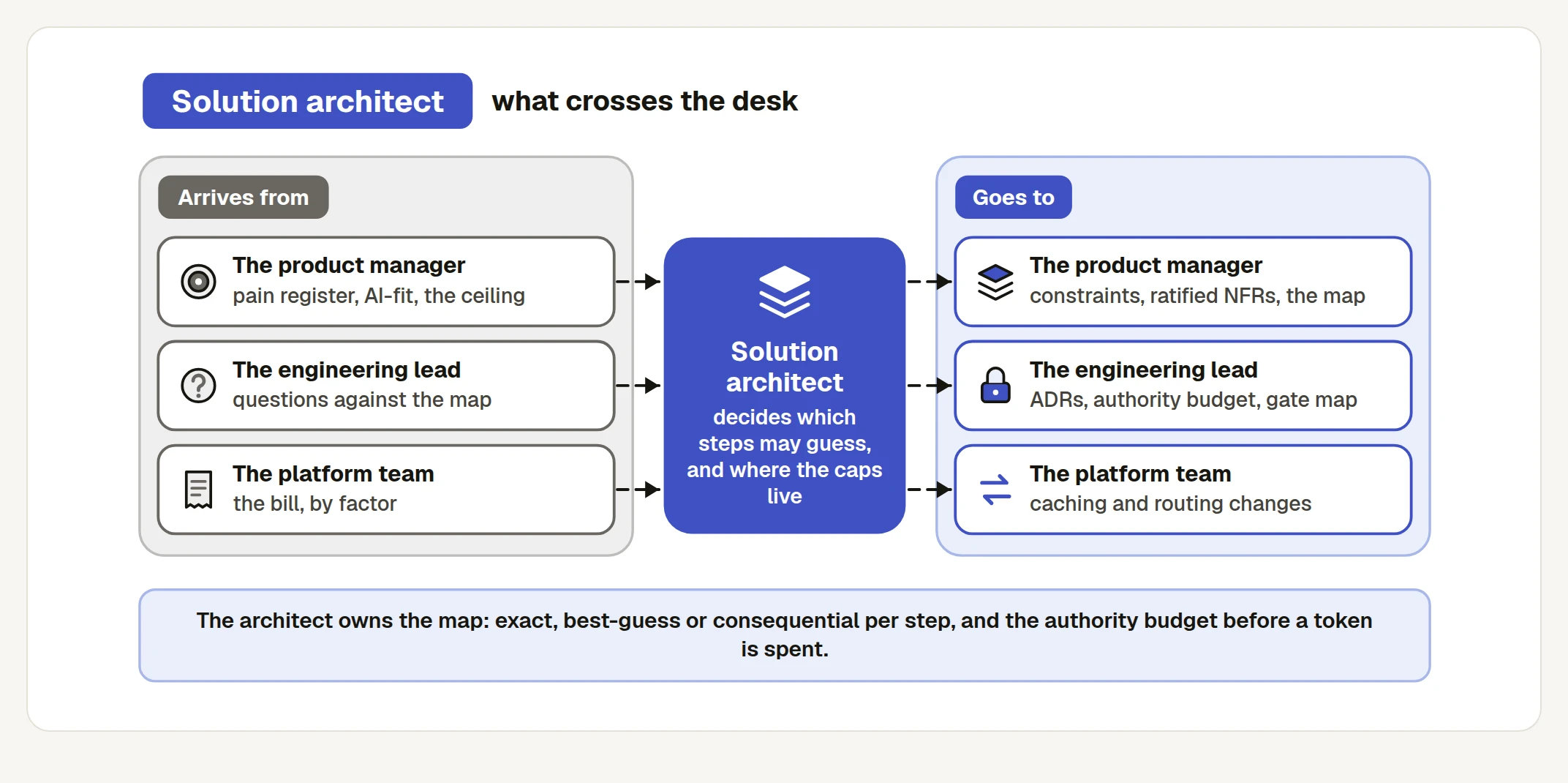
| Phase | You receive | You hand over | To |
|---|---|---|---|
| P0 · Frame | Pain register · AI-fit record · the autonomy ceiling | Constraint register · candidate NFR scenarios | Product manager |
| P1 · Design & Spec | The eight-field spec, in draft | Ratified NFRs · the map · the ADRs · the authority budget · the gate map | Engineering lead · QA lead |
| P2 · Build & Prove | Questions against the map | Answers, and nothing else | Engineering lead |
| P3 · Run & Learn | The bill by factor · the incident timeline | Caching and routing changes · the missing-control finding | Product manager · Sponsor |
P2 is the row people get wrong. Decisions made in P1 are read in P2, not re-opened. If a decision genuinely has to change, that is a new ADR with a date on it, not a conversation — otherwise the map stops describing the system and nobody notices for a month.
| Gate | Yours? | What you bring to it |
|---|---|---|
| Intent | Product manager's | The constraint register, so the verdict is made against real limits |
| Plan | Shared with the product manager | The authority budget and the gate map |
| Behaviour | QA's | — |
| Release | Product manager's | Confirmation the rollback path is the one the design assumed |
| Expansion | QA's | — |
You hold no gate alone, and that is the design. An architect whose authority comes from a signature is an architect who is consulted late; an architect whose authority comes from the artefacts is one whose decisions survive them being on holiday.
The ADR folder nobody opens. Every decision recorded, which is the same as none of them recorded, because nobody can find the three that mattered. The tell: more than about a dozen ADRs for one feature, or an ADR whose title is a noun rather than a choice.
The map that stopped describing the system. Steps re-tagged in code and never in the map. The tell: ask an engineer to point at the consequential steps, then compare with the map. Any difference at all means the map is now documentation rather than a control.
Token budget before authority budget. The cap gets set to whatever was affordable, and the question of what the agent may do becomes a consequence of what it could afford. The tell: the authority budget's dates are later than the token estimate's.
Checkers everywhere. A checker after every step, which doubles the bill and still misses the one that mattered, because attention went to coverage rather than to consequence. The tell: the checker count equals the step count.
Consulted, not accountable. The design is advice, so it is followed when convenient. The tell: a decision was changed in P2 without an ADR, and you found out afterwards.
Not by diagrams produced. Three things, all observable by someone else:
| What it means | |
|---|---|
| Decisions that held | ADRs from P1 still describing the system at P3, without a silent amendment |
| The bill's shape | The four factors — context, tier, cache, attempts — each traceable to a design choice somebody made on purpose |
| Incidents that produced a control | A postmortem you were in that named a control, and the control exists |
The fourth thing, which is harder to count and matters most: whether the team can answer "why is it built this way?" when you are not there.
- Ask what the $400 is. Every organisation has one — a threshold everyone repeats and nobody can source. Find out whether it is policy, contract or folklore. The answer reshapes more NFRs than any workshop will.
- Tag one live feature's steps exact, best-guess or consequential. Then ask an engineer to do the same from memory and compare. The gap is your starting position.
- Write the authority budget for one feature before looking at any token estimate. Two lists: allowed alone, needs a person.
- Count the ADRs for the most recent feature. If there are none, ask where the trade-offs went. If there are thirty, ask which three someone would actually read.
- Find the escalation condition in whatever is running. If there isn't one, that is the finding: a system with no escalation condition has one autonomy level, which is its highest.
- Read one postmortem and check whether it names a control or a string. If a string, it will happen again with different wording.
- Take the PM's sort and add the proof column. That is the whole exact / best-guess map, and it takes twenty minutes for one feature.
- Write the escalation condition for your topology. Collapse anything multi-agent that cannot name its limit.
- Move every cap from prompt text into a tool signature.
- Compute the chain accuracy for your feature. Multiply, do not average.
- Write the ADR for the last decision you made in a meeting and nobody wrote down. Then add the ADR folder to the agent's context pack.
Exercise 1. Your feature has six chained best-guess steps, each measured at 92%. What is the end-to-end success rate, and what are your two options?
Answer
0.92⁶ = 0.606. Right about three times in five.
Option one: shorten the chain. Two of the six are usually merges of exact work that crept into a prompt, or steps that can be done by one call instead of two. Removing two steps takes you to 0.92⁴ = 0.72.
Option two: checkers after the steps that are costly and easy to miss. A checker does not make a step more accurate; it catches the misses so they become re-drafts instead of passenger-visible errors. Cap re-draft rounds at two, then escalate.
Do both, in that order. And note what does not help: raising the model tier on all six. That is the expensive answer to a structural problem.
Exercise 2. A team lead wants to feed the entire fifteen-year-old reservation codebase to the agent so it can "understand and update" it. What do you say, and what do you do instead?
Answer
Say no, for two reasons: the whole codebase makes answers worse, not better, and a big-bang migration has no safe rollback.
Instead: score each module on risk, documentation, coupling, reversibility and how much it teaches. Migrate low-risk, well-documented, loosely-coupled pieces first; payments last. Wrap each piece behind a clean interface, route a slice, grow the new, retire the old — the Strangler Fig pattern (Fowler, 2004).
Where the docs are missing, extract the business rules into a rule sheet — condition, action, source line, confidence — and have a person check everything below 0.9 confidence. The agent then reads a few hundred tokens of rules that carry the intent the code buries, instead of four thousand lines that do not.
Exercise 3. Finance says caching is on, but the bill has not moved. Where do you look first?
Answer
At the order of the prompt, before anything else. The cache matches an exact prefix in the order tools → system → messages, up to the block marked for caching. If the passenger's request is placed first "for emphasis", the prefix changes on every call and the cache never hits.
Then three more, in order: is anything volatile inside the cached block (a timestamp, a request id)? Is the team switching models mid-task, which discards the cache? And is the prefix reused at all — below two uses caching costs money, since a write is 1.25× input for a five-minute cache against a read at 0.1×.
Next: Role: Engineering lead · How to Design an Agent on Paper · How to Hold the Security Boundary · Decision Trees
| You want | Go to |
|---|---|
| The day-to-day walk, with templates and prompts | Journey · Solution Architect |
| Designing the agent on paper first | How to Design an Agent on Paper |
| Running the NFR workshop | How to Run an NFR Workshop |
| Build, buy or borrow | How to Choose Build, Buy or Borrow |
| Where a boundary is actually enforced | How to Hold the Security Boundary |
| Chained probability and every other formula | Formulas and Calculators |
| Practising the judgement calls | Exercises · Scenario Library |
Next: Journey · Solution Architect · Role: Engineering Lead · Role: Product Manager