Repository navigation
The Agentic PDLC
Four phases and eight loops. Every other page on this wiki hangs from them, and they are the structure SkyWays, the agentic manual walks through with one airline, one feature and ninety days.
The one-sentence version. Frame what is worth doing, specify it so a machine can build it, build and prove it in slices, then run it and let what you learn become the next frame.
| Phase | The question it answers | Who is accountable | It ends when | |
|---|---|---|---|---|
| P0 | Frame | Is this worth doing, is it AI at all, and how much may the machine do? | Product manager | The pain is a measurement and the AI-fit verdict is recorded |
| P1 | Design & Spec | What exactly is being built, and under whose authority? | Solution architect | The spec, the bar and the guardrails are signed |
| P2 | Build & Prove | Does it meet the bar, slice by slice? | Engineering lead | The golden set clears the bar and a shadow run agrees |
| P3 | Run & Learn | Is it still doing what we launched, and what did it cost? | Sponsor | Two numbers are reported and the next P0 brief exists |
P0 and P1 are cheap to get wrong on paper and expensive to get wrong in production. That asymmetry is the whole argument for the phases.
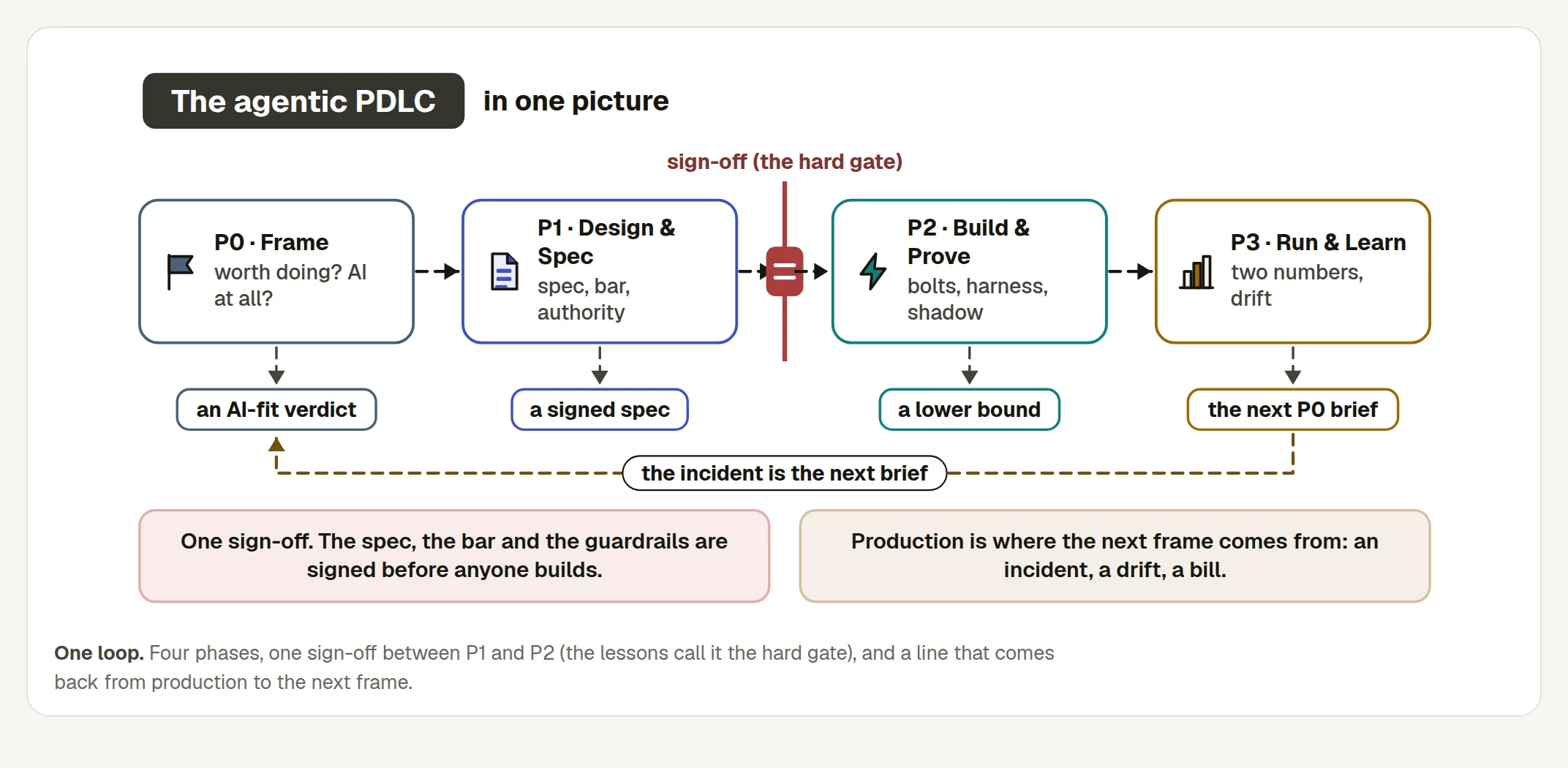
▸ Open the live, interactive version
The same picture, drawn out with what each phase leaves behind: the agentic PDLC.
The dotted line is the point. P3 is not the end of a line, it is the input to the next P0.
Nobody announces that they are skipping P0. What happens is that all four phases run at once and the team calls it speed: a spike starts on Monday, the spec is written around the spike on Thursday, and the first genuine decision about what the machine may do is taken by whoever wires the tool. The phases are then reconstructed backwards from the code, which is why the artefacts read like descriptions rather than instructions. SkyWays settled the $400 refund cap on day six, in P0, and nobody noticed it had never left the document until day 82, when $2,000 went out that was not owed.
The second failure is subtler and more common: a phase is declared finished on a date rather than on an end condition. "P1 closes Friday" is a calendar entry. "P1 closes when the bar per slice is signed" is a phase. The first always closes; the second sometimes tells you something you did not want to hear, which is the only reason to have it.
| Phase | The sign it genuinely closed | The sign it was faked |
|---|---|---|
| P0 | The pain is one line with a count, a cost and a link to the evidence a sceptic can open | The pain is a sentence from the request email, reworded |
| P0 | The AI-fit verdict names what was rejected and why | The verdict is "yes, agentic" with no alternative considered |
| P1 | Someone who was not in the room built the first bolt without asking a question | Every engineer asks the same three questions in week one |
| P1 | Each acceptance bar has a derivation, not a round number | Every bar is 80% |
| P2 | A slice below its bar blocks the merge, and somebody has watched it do so | The harness exists and has never gone red |
| P2 | The shadow run disagreed with the desk somewhere, and that was written down | The shadow run agreed everywhere, and nobody found that odd |
| P3 | Both numbers reached the sponsor on one line | The saving reached the sponsor; the spend reached finance |
| P3 | A brief for the next P0 exists with a named owner | The retro produced actions, none of which is a brief |
The phases are per change, not per programme. A one-line fix to a refund cap runs all four in an afternoon: it is still framed, still specified, still proven, still watched. What varies is the depth, and that is decided in How the named methods sit on the spine.
Template · Phase-exit checklist
# Phase exit · <P0|P1|P2|P3> · <feature>
Accountable: <name, role>   Date proposed: <date>   Decision: <exit | stay open | exit with debt>

## The end condition for this phase, written before we started
<the one sentence from the phase table — copied, not paraphrased>

## Is it met?
| Evidence | Where it lives | Current? | Read by |
|----------|----------------|----------|---------|
| <pain register / spec / bar sheet / golden score / two-number report> | <link> | <yes/no, last touched <date>> | <name> |
| | | | |

## What the next phase cannot start without
| Artefact | Owner | State | If missing, what the next phase does instead |
|----------|-------|-------|----------------------------------------------|
| <artefact> | <name> | <done / draft / absent> | <the workaround, and what it will cost> |

## Exit with debt — only if this table is filled in
| What we are crossing without | Why now and not later | Owner | Date it is repaid | What breaks if it is not |
|------------------------------|------------------------|-------|-------------------|--------------------------|
| <artefact> | <reason> | <name> | <date> | <consequence, concretely> |

## Questions the next phase's owner asked in the handover meeting
<every one. Each is a field the phase did not finish.>

## Signed
<name, role> — <date>. Next phase owner: <name>, who has read the above.
Prompt · Which phase is this actually in
You are auditing where a piece of work genuinely sits in a four-phase lifecycle.

The phases and their END CONDITIONS:
P0 Frame — ends when the pain is a measurement and the AI-fit verdict is recorded.
P1 Design & Spec — ends when the spec, the acceptance bar per slice and the guardrails are signed.
P2 Build & Prove — ends when the golden set clears the bar and a shadow run agrees.
P3 Run & Learn — ends when two numbers are reported and the next P0 brief exists.

Below is what I can actually show you about the work.

Produce:
1. | Phase | End condition | Met / partly / not met | The single artefact that decides it |
2. The EARLIEST phase whose end condition is not met. That is the phase the work is in,
   regardless of what the board says.
3. Everything that has been built ahead of that phase, and what it is therefore built on.
4. The cheapest thing to do next to close the earliest open phase.

RULES:
- Judge only on artefacts I have shown you. A meeting is not an artefact.
- "We discussed it" is not met. "It is in the prompt" is not signed.
- Do not be encouraging. Do not suggest a process improvement. Answer the question.
- If two phases are open, say so plainly and name the earlier one.

WHAT EXISTS:
<paste: links, contents, or an honest list of what is written down>
A phase does not end on a date. It ends when it has handed over what the next phase cannot start without. Four hand-offs, four minimum sets.
| Hand-off | What must cross | Gate |
|---|---|---|
| P0 → P1 | Pain register, functional requirements, constraints by type, ratified NFRs | soft |
| P1 → P2 | The eight-field spec, the acceptance bar per slice, the authority budget and gate map | hard |
| P2 → P3 | Golden set at bar with its lower bound, the shadow-run comparison | soft |
| P3 → P0 | Two-number report, drift readout, the incident turned into a brief | soft |
Only one of the four is a hard gate (the sign-off before anything is built). Everything downstream is built and measured against the spec, the bar and the guardrails, so those three are settled before P2 opens. The full list lives on The Evidence Pack.
A hand-off degrades into a meeting. The receiving phase's owner sits through forty minutes of context, says yes, and then spends the next fortnight asking the questions the meeting did not answer — each one a field the previous phase left open, each one now answered by whoever is nearest rather than by whoever is accountable. The artefacts exist in some form, but they are scattered across a wiki, a Slack thread and somebody's laptop, so nobody can say what actually crossed.
The tell is easy to spot and nobody looks for it: count the questions the receiving owner asks in the first week. Zero means the pack was complete. Fifteen means the hand-off was a conversation, and the answers to those fifteen are now in fifteen places.
| Sign | Why it matters |
|---|---|
| The hand-off has a record, not minutes | A record names artefacts and states; minutes name opinions |
| Every artefact on it has one accountable name | Two names is nobody |
| The receiving owner has read it before the meeting, and the meeting is short | A hand-off meeting that runs long is a hand-off that was not ready |
| Anything crossing incomplete is on a debt line with a date | Undeclared debt is discovered in P2, at the worst price |
| Questions asked in week one are logged back onto the record | It is the only honest measure of hand-off quality you will get |
Template · Hand-off record
# Hand-off · <P0→P1 | P1→P2 | P2→P3 | P3→P0> · <feature>
Date: <date>   Gate: <soft | HARD>
Handing over: <name, role>   Receiving: <name, role>   Both present: <yes/no>

## The minimum set for this hand-off
| # | Artefact | Owner | State | Link | Version / date | Receiver has read it |
|---|----------|-------|-------|------|----------------|----------------------|
| 1 | <artefact> | <name> | complete / partial / absent | <link> | <v2, 12 Mar> | yes / no |
| 2 | | | | | | |

## Crossing incomplete — the debt
| Artefact | What is missing | Why we are crossing anyway | Owner | Due | What is blocked until then |
|----------|-----------------|-----------------------------|-------|-----|----------------------------|
| <artefact> | <the specific gap> | <reason> | <name> | <date> | <the bolt / the slice / the gate> |

## Numbers that cross with it
| Number | Value | Where it came from | Who owns it downstream |
|--------|-------|--------------------|------------------------|
| <cases per day> | <240> | <Q2 ticket export> | <name> |
| <refund cap> | <$400> | <constraint register, day 6, regulatory> | <name> |

## Decisions the receiving phase may NOT re-open
<list them, with the record each was taken in. Everything not listed here is open.>

## Questions asked in week one — filled in AFTER the hand-off
| # | Question | Asked by | Which artefact should have answered it |
|---|----------|----------|----------------------------------------|
| 1 | | | |

## Accepted
<receiving owner's name> — <date>. Accepted with <n> debt lines above.Three artefacts make this the only gate that halts: the eight-field spec, the acceptance bar per slice and the authority budget with its gate map. They are hard for one reason each.
| Artefact | Why nothing downstream survives without it | What P2 does if it is absent |
|---|---|---|
| The spec | It is what the coding agent reads. A machine cannot ask what you meant | The agent invents an interpretation, consistently, and it is plausible |
| The bar per slice | "It works" is no longer a yes or a no, so somebody has to say what share is enough | The team ships at whatever number they got, and calls it the bar |
| The authority budget | It is the list of what the machine may do, with caps typed into signatures | The tool signature accepts any amount, and the cap lives in the prompt |
SkyWays crossed this gate with all three written and the third only partly implemented. The cap was in the autonomy record from day 12 and repeated clearly in the system prompt. It was not in the refund tool's signature. On day 82 the agent issued $2,000 within its permissions and outside its policy. The hand-off record would have caught it with one column: implemented, or written down?
Cross it on credit if you must — some programmes genuinely cannot wait — but write the waiver, because an undeclared crossing is indistinguishable from a completed one six weeks later.
Template · Hard-gate waiver · P1 → P2
# Hard-gate waiver · P1 → P2 · <feature>
This document exists because the hard gate was crossed without its full set.
Raised by: <name>   Approved by: <sponsor name>   Date: <date>   Expires: <date>

## What is missing
| Artefact | Missing entirely, or written but not enforced? | Where the real control currently lives |
|----------|-----------------------------------------------|-----------------------------------------|
| <authority budget> | written, NOT enforced | <the system prompt — which is not a control> |

## Why we are crossing now
<the business reason, in two sentences, with the date it is tied to>

## The blast radius while the waiver stands
| Action the agent can take | Band | Cap enforced in code? | Approver enforced? | Worst single outcome |
|---------------------------|------|-----------------------|--------------------|----------------------|
| <refund> | R4 | no | no | <an unowed payment of unbounded size> |
| <rebook> | R4 | yes | yes | <a wrong itinerary, recoverable> |

## What we are doing instead, until it is closed
| Compensating control | Who operates it | How often | Is it enforced or is it a habit? |
|----------------------|-----------------|-----------|----------------------------------|
| <daily manual review of all refunds> | <name> | daily | habit |

## Closure
| The artefact, completed | Owner | Due | Evidence it is enforced, not written |
|-------------------------|-------|-----|--------------------------------------|
| <typed cap on the tool signature + test> | <name> | <date> | <the failing test, linked> |

## Review
This waiver is read aloud at the <weekly> delivery meeting until it is closed.
If it passes its expiry date, the feature returns to <the lower autonomy level>.

Signed: <sponsor>, <date>.
Prompt · Audit a hand-off against its minimum set
You are checking whether a phase hand-off is complete. Be strict and unhelpful about gaps.

The minimum set for <P0→P1 | P1→P2 | P2→P3 | P3→P0> is:
<paste the rows from The Evidence Pack for this hand-off>

Below is what the team says it has.

Produce:
1. | Artefact | Claimed state | Evidence I can actually see | Verdict: COMPLETE / PARTIAL / ABSENT / WRITTEN-BUT-NOT-ENFORCED |
2. A separate list: every artefact that is WRITTEN-BUT-NOT-ENFORCED. For each, name the place
   the control currently lives (a prompt, a document, a convention) and the place it must live
   (a tool signature, a policy, a required check).
3. The three gaps that would cost the most if this hand-off is the HARD one, ranked by the
   worst single outcome, not by effort.
4. For each of those three: the smallest artefact that closes it, and who owns it.

RULES:
- A control described in a prompt is NOT enforced. Say so every time, without softening it.
- Do not accept "we agreed that" as evidence. Ask which document.
- Do not propose a process. Propose artefacts.
- If you cannot tell from what I gave you, write CANNOT TELL and the one question that settles it.

WHAT THE TEAM HAS:
<paste>
The other three hand-offs have a receiving owner sitting in a meeting. This one does not, because P0 for the next thing has not started, so there is nobody on the far side. That is why it is the hand-off most often missing entirely: the two-number report goes to the steering committee, the drift chart goes on a wall, the postmortem produces actions, and none of the three becomes a brief.
A postmortem that does not produce a brief has not finished. SkyWays' day 82 incident produced a typed cap, a confirmation token, refunds dropped one autonomy level and six new golden cases — and that list is the next P0 brief, once somebody writes it as one.
Prompt · Turn a P3 readout into the next P0 brief
Below are the P3 outputs for <feature>: the two-number report, the drift readout, and the
postmortem or bill root-cause note.

Write the P0 brief for the next cycle. A P0 brief has exactly four parts:
- THE PAIN: who holds it, how often, what it costs today, and the evidence.
- THE AI-FIT QUESTION: is there judgement, is there volume, is it recoverable?
- THE VALUE LINE: the saving, minus run cost and review load.
- THE AUTONOMY QUESTION: which action, which door, one-way or two-way.

RULES:
- Every number must come from the material below. If a number is not there, write
  "UNKNOWN — <who can produce it> by <when>" instead of estimating. Never estimate.
- A missing enforced control from a postmortem is a PAIN, not an action item. Write it as one:
  who is exposed, how often the path is open, what one instance costs.
- Do not carry over the previous cycle's framing. If the evidence says the problem moved,
  say the problem moved.
- End with: the ONE thing that, if it came back badly, would mean not doing this at all.

P3 MATERIAL:
<paste>
Phases are a line. Loops are what make the line a ring: each one opens in one phase and closes in a later one, and some close back into an earlier one.
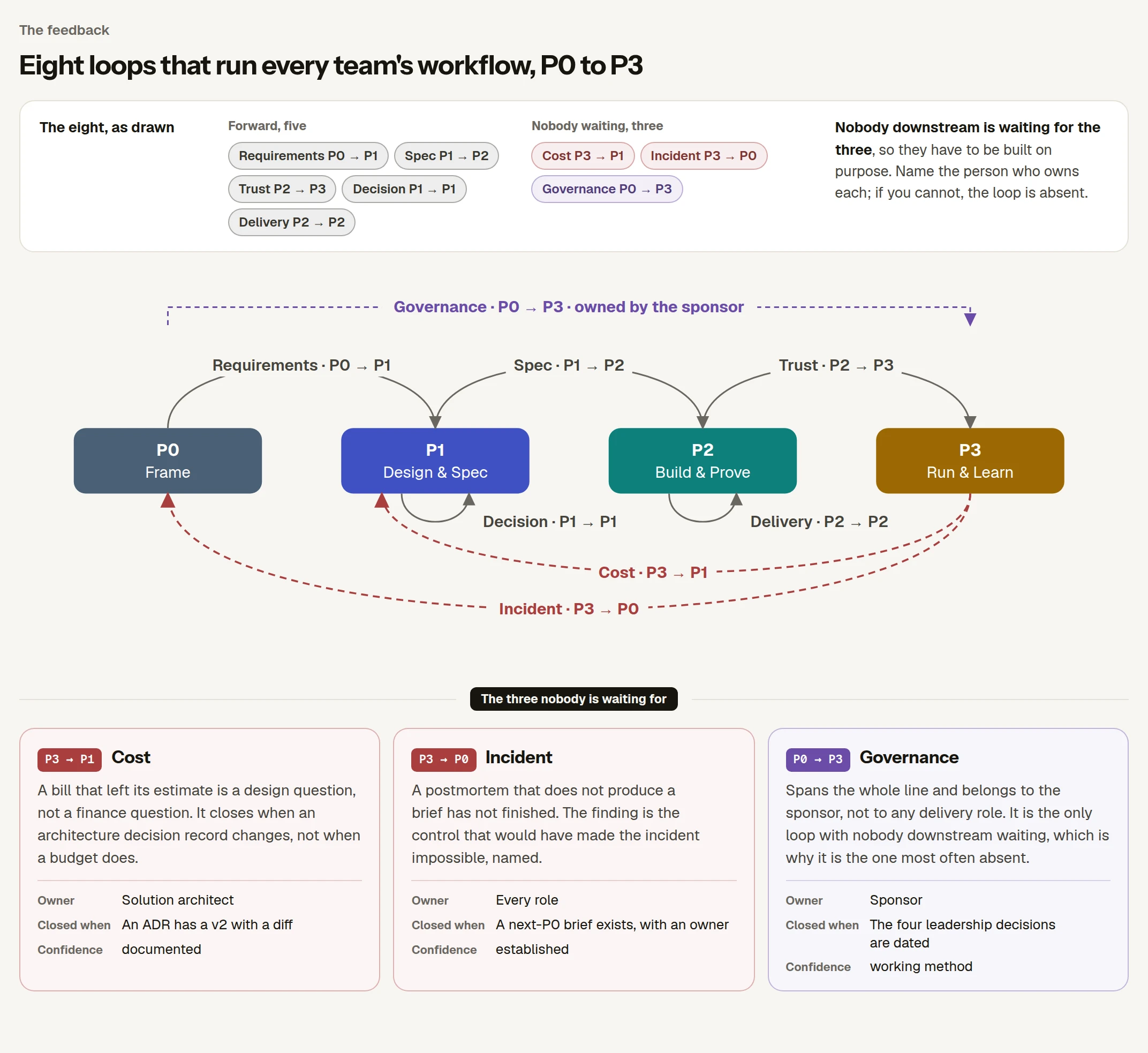
▸ Open the live, interactive version
The same eight on one line, with the two backwards ones drawn beneath it: eight loops make the line a ring.
Three of them have nobody waiting at the far end, and those are the ones teams forget to build. Two run backwards and one spans the whole line:
- Cost closes from P3 back into P1. A bill that left its estimate is a design question, not a finance question.
- Incident closes from P3 back into P0. A postmortem that does not produce a brief has not finished.
- Governance spans P0 to P3 and belongs to the sponsor, not to any delivery role.
Each loop, with its owner, its artefacts and where the idea comes from, is on The Eight Loops.
The five forward loops close on their own, because somebody downstream is waiting and will chase. The other three (two run backwards, and governance spans the whole line) have nobody waiting, so they close only if a named person makes them close. What happens instead is that the cost loop becomes a finance escalation — a spend review, a budget increase, a conversation about tooling — and never reaches the design that caused it. SkyWays' day 75 bill was 4.4 times its estimate with traffic flat, which is a behaviour change, which is a design change. Handled as a budget question it recurs next quarter with a different multiple.
| Loop | Closed looks like | Open looks like |
|---|---|---|
| Cost | A bill anomaly produced an amended decision record and a routing change | A bill anomaly produced an approved budget increase |
| Incident | A postmortem produced a brief with a pain, a cost and an owner | A postmortem produced a list of actions in a ticket tracker |
| Governance | One person reports two numbers on one line, every cycle, unprompted | Numbers are produced when the steering committee asks |
A practical test: for each of the three loops nobody waits for, name the person. Not the team, the person. If you cannot, the loop is absent, and absent is the honest word — not "informal".
The machine took the drafting. It did not take the judgement — it concentrated it. Every step in this manual names a tool, a use, a caution, and exactly one thing that is never delegated. Read the third column of each table first: forty steps across five roles produce forty of those lines, and they have a shape. Every one is a fact about your business, your regulator or your ledger that no amount of context makes knowable from outside.
Drawn as four lanes, phase by phase: where the model helps, and where it must not.
| The model drafts | You check | Never delegated |
|---|---|---|
| Distinct pains from six transcripts, deduplicated | Every line still carries the name of who said it | Which pain is worth solving |
| Counts from a ticket export, with the script it ran | The script counted the right date column | Whether a wrong action can be undone |
| Cost-per-case arithmetic, assumptions in named cells | A sceptic can move one cell and watch the answer move | The autonomy level itself |
The autonomy level is the decision money and regulators hang off. Merged-without-attribution is how a stakeholder later says they were never heard, which is why the check on the first row is the name and not the wording.
| The model drafts | You check | Never delegated |
|---|---|---|
| The constraint register, sorted by type | The register separates real constraints from habits | The read-back, to the person who said it |
| A first pass at the agent map, every step tagged | A $400 threshold is policy, not folklore | What counts as money |
| The eight-field spec from the brief and the notes | Each bar was derived from two money figures, not chosen | The bar and the autonomy fields |
The only way to learn that a threshold is a policy your compliance team owns, rather than a number somebody once typed, is to ask a person. Whether a fee waiver, a goodwill credit or a seat upgrade counts as a consequential action is the same kind of question.
| The model drafts | You check | Never delegated |
|---|---|---|
| The deterministic floor from the exact-code inventory | The boundary line says what the system must refuse | The never-touch list |
| Checker implementations and a first judge rubric | The judge agrees with human labels on a fresh sample | The expected outcome on every golden case |
| Golden-set candidates pulled from real traffic | The harness runs in cost order and blocks the merge | The verdict: proven, failed or unproven |
The expected-outcome field is the judgement the entire golden set rests on, and it is the one thing a model cannot supply without making the set circular. Proven, failed and unproven are three different sentences with three different consequences.
| The model drafts | You check | Never delegated |
|---|---|---|
| The trace schema and a starting alarm set | The factors multiply back to the bill you were sent | What is masked and what is kept |
| The bill decomposed into its four factors | The blast radius of each new permission is named | Declaring the incident over |
| A draft of the two-number report | Drift is measured against the launch set, not last week | What the sponsor sees |
What is masked is a legal and contractual question about your own data. Declaring an incident over means somebody with accountability has looked at the state of the world — what was written, what was sent, what cannot be unwound — and said so with their name on it.
For any step in this manual, ask what a model would have to know about your organisation to make the call, and whether that knowledge exists anywhere it could read. If the answer is no, the step is in the third column, and the honest move is to write the line down rather than discover it in a postmortem.
Most of this is the discipline you already have. The honest list of what actually changes:
| Unchanged | Changed by putting a model in the middle |
|---|---|
| Discovery, stakeholder interviews, the pain behind the ask | The pain must be a measurement, because the machine downstream cannot ask what you meant |
| Prioritisation and the business case | Value is counted net of tokens, the judge and the review load |
| A PRD with problem, users, scope, metrics | Eight fields a coding agent reads, acceptance in EARS, a bar per slice |
| Sprints, milestones, dependencies | Bolts: one risk each, the walking skeleton first, the shadow run as the milestone |
| Unit, integration and end-to-end tests | Exact work tested exactly, best-guess work measured as a share, a harness that gates the merge |
| Code review | Depth set by the risk of the change, never by the size of the diff |
| Threat modelling | One genuinely new threat: every text the agent reads is a possible instruction |
| Postmortems | The question is which enforced control was missing, never who was careless |
The role pages carry this split in full: Product manager · Solution architect · Engineering lead · QA lead · Sponsor.
The same split, told as a working week rather than as a role, is in the five journeys: Journey: Product manager · Journey: Solution architect · Journey: Engineering lead · Journey: QA lead · Journey: DevOps.
Two opposite mistakes, and a team usually makes one of them consistently. The first is treating the whole column on the right as new, which produces a parallel process: an AI working group, an AI review board, an AI intake form, and a delivery team that now has two lifecycles and uses whichever is less trouble. The second is treating none of it as new, which produces a PRD handed to a coding agent that builds something plausible and wrong, and a test suite that asserts equality on an output that is right 80% of the time.
The expensive one is the second, because it is invisible until the shadow run. The suite is green, the demo works, and nobody has agreed what share of cases being right is enough — so the first person to ask is a passenger.
| Sign | What it tells you |
|---|---|
| The team's existing ceremonies are unchanged in name and cadence | Nobody is running a second lifecycle |
| The PRD template gained fields; it was not replaced | The change landed in the artefact, not in a new process |
| Somebody can point at a test that measures a share rather than asserting equality | The exact/best-guess split has actually been made |
| A pull request was reviewed deeply because of what it touches, not how big it is | Review by risk band is real, not aspirational |
| The phrase "the model decided" appears nowhere in a postmortem | The missing-control question has replaced the blame question |
Template · The practice delta
# Practice delta · <team> · <date>
What we already do, what changes, and what we are NOT adding. One page, reviewed each quarter.

## Unchanged — we keep these exactly as they are
| Our existing practice | Where it lives | Why it survives a model in the middle |
|-----------------------|----------------|----------------------------------------|
| <sprint planning, Tue 10:00> | <board> | <cadence is unaffected; only the unit of work changes> |

## Changed — same ceremony, different content
| Practice | What we did before | What it produces now | Who changed it | Since |
|----------|--------------------|-----------------------|----------------|-------|
| <definition of done> | <"tests pass"> | <"tests pass AND the slice is at or above its bar, lower bound"> | <QA lead> | <date> |
| <code review> | <every PR, one approver> | <depth by risk band from a path rule; R4 needs a named approver> | <eng lead> | <date> |

## Added — genuinely new artefacts, with an owner each
| Artefact | Owner | Replaces nothing / replaces <x> | First one due |
|----------|-------|----------------------------------|---------------|
| <acceptance bar sheet> | <PM> | replaces nothing | <date> |
| <authority budget> | <architect> | replaces nothing | <date> |

## NOT adding — and why, so it is not re-proposed each quarter
| Proposed | Why not, for us, now |
|----------|----------------------|
| <a separate AI review board> | <it creates a second lifecycle; the five gates already have owners> |

## The one thing we are worst at
<name it. It is usually the bar per slice or the authority budget.>
Owner: <name> Due: <date>Four methods get mentioned in every agentic conversation. They are not competitors; they occupy different parts of the same lifecycle.
| Method | What it is | Where it sits | When to use it |
|---|---|---|---|
| SDD — spec-driven development | The spec, not the code, is what you maintain | P1 and P2, lightly in P0 and P3 | Always. It is the backbone |
| BMAD, the Breakthrough Method of Agile AI-Driven Development | Skills in your coding tool: five named agents, one Build loop, and documents (a brief, a PRD, a spine, a spec, stories) added around it as the work grows | P0 to P2 | Complex, multi-team, audited work. Its project path is six documents before any code; its own docs send a small change straight to Build |
| AI-DLC — AI-Driven Development Life Cycle (AWS) | Run only the stages a given change actually needs | A principle across all four phases | When the depth of a change is unknown up front |
| AIDD — AI-driven development | The day-to-day craft: context files, story files, editor agents, review by risk | P2 mostly | Every day, by everyone who writes code |
The decision that matters is not which method. It is how deep to go on this change, and that is a judgement the architect makes per change. See Solution architect, step 3.
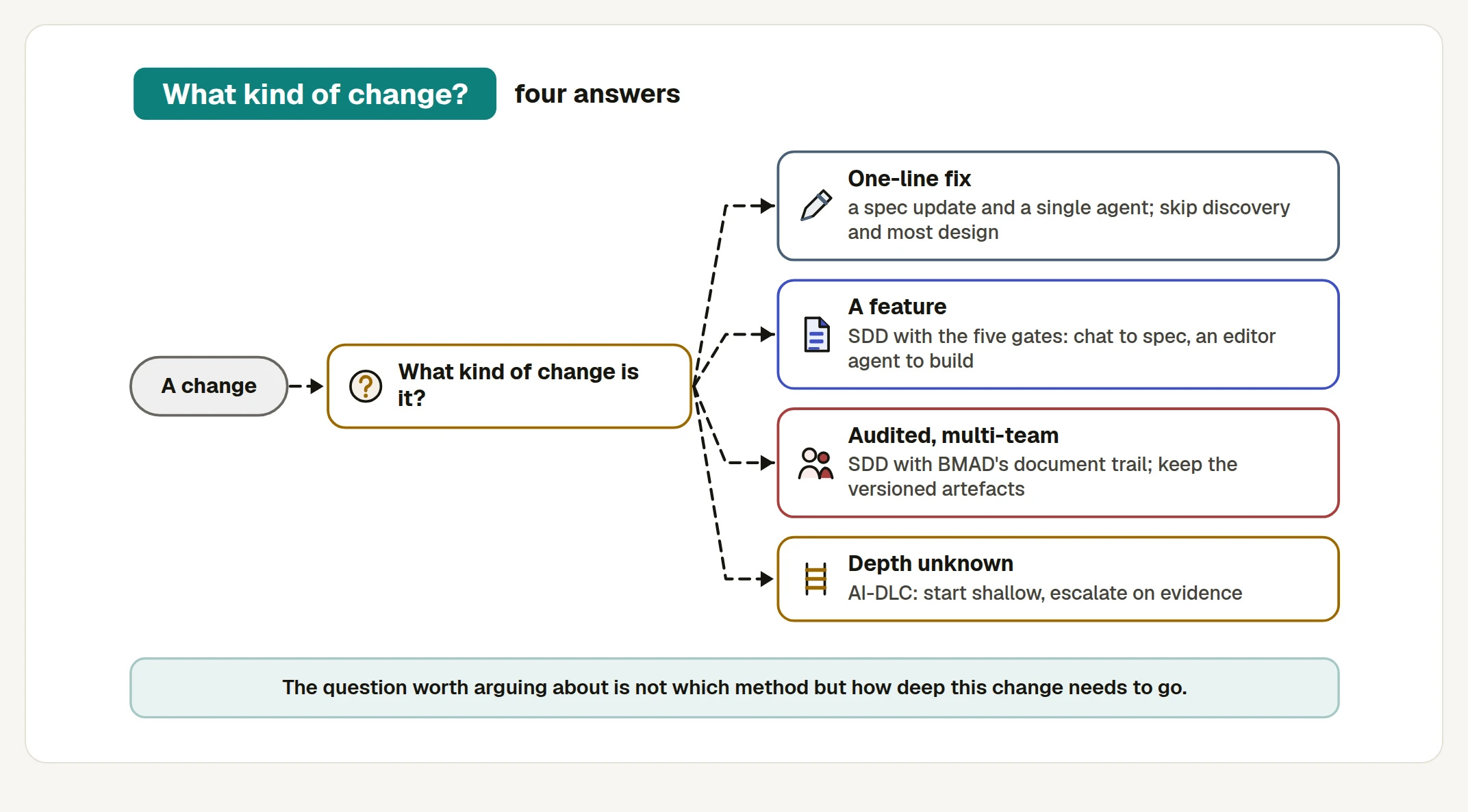
A team adopts one method as an identity. "We are a BMAD shop" means the document trail runs on a typo fix, six artefacts are generated for a one-line change, and within a month the team is quietly skipping the whole thing on everything — including the audited, multi-team work the trail was built for. The opposite failure is the same mistake upside down: "we just use the editor agent", applied to a refund cap, which is R4 work being done with R1 ceremony.
Depth is a property of the change, not of the team. A one-line change to a refund cap is tiny and deep. A 900-line refactor of a read-only report is large and shallow. Anything that sizes ceremony to diff will get both of those backwards.
| Sign | Why it matters |
|---|---|
| Two changes in the same sprint ran at different depths, on purpose | Depth is being decided, not defaulted |
| The depth decision is written down in one place, in under ten lines | A depth decision that takes an hour is its own overhead |
| SDD is on every change, however shallow | The spec is the only artefact that survives the code |
| A change escalated mid-flight, and that was normal rather than a failure | AI-DLC's actual content: evidence raises depth |
| Nobody has said the words "our methodology" this quarter | Methods are tools here, not an identity |
Template · Method-depth decision
# Depth decision · <change name> · <date>
Decided by: <architect name>. Ten lines or fewer. If it takes longer, the change needs splitting.

## The change, in one sentence
<what is being changed, and what it touches>

## The four questions
| Question | Answer | Consequence |
|----------|--------|-------------|
| Highest risk band any tool or path it touches? | <R1–R5> | <R4+ means a named approver and deep review, whatever the size> |
| Reversible cheaply once live? | <yes/no> | <no means the plan gate is hard for this change> |
| More than one team's artefacts change? | <yes/no> | <yes pulls in BMAD's document trail and versioned hand-offs> |
| Is an auditor or a regulator a reader of the result? | <yes/no> | <yes means the trail is kept, not just the outcome> |

## Depth chosen
<Shallow: spec + single agent | Standard: SDD + five gates | Deep: SDD + document trail + kept artefacts>

## What we are deliberately NOT doing at this depth
| Skipped | Why it is safe to skip here |
|---------|------------------------------|
| <shadow run> | <read-only path, no action taken, rollback is a flag> |

## Escalation trigger — the evidence that raises the depth mid-flight
| If this happens | Depth becomes | Who decides |
|-----------------|---------------|-------------|
| <the change turns out to touch a gated write> | Deep | <architect> |
| <the golden set moves more than <n> points on an untouched slice> | Standard | <QA lead> |

## SDD applies regardless
Spec updated: <yes — link>. A change with no spec change is a change nobody can review.
Prompt · Recommend the depth for this change
You are helping decide how much process a single change deserves. You are NOT deciding whether
to do it.

Depths available:
- SHALLOW: spec update + one editor agent, cheap tier, review at the end.
- STANDARD: spec-driven, the five gates, chat model for the spec and editor agent for the build.
- DEEP: spec-driven plus a versioned document trail, artefacts kept for audit, named approver.

Below is the change.

Produce:
1. The highest risk band the change touches (R1 reversible draft ... R5 irreversible or
   safety-critical), and WHICH tool or path puts it there.
2. Answers to: reversible cheaply once live? more than one team's artefacts? an auditor reads
   the result?
3. A recommended depth, in one word, with a one-sentence reason.
4. The two ceremonies you would skip at that depth, and the specific reason each is safe to skip.
5. One escalation trigger: the concrete evidence that should raise the depth mid-flight.

RULES:
- Never use the size of the diff as a reason. A one-line change to a money cap is the deepest
  work there is; a large refactor of a read-only report is not.
- If the change touches money, identity or policy, the answer is at least STANDARD and you must
  say why explicitly.
- Recommend SDD on every depth, including SHALLOW. Do not offer "no spec" as an option.
- Keep the whole answer under 200 words.

THE CHANGE:
<paste: what it touches, which tools, which paths, who reads the result>
| Tool | Use it for |
|---|---|
| Chat LLM | The phase-placement audit. Paste what exists, ask which end condition is unmet first. It is good at being literal about evidence, which is exactly the discipline that slips |
| Chat LLM | Drafting the hand-off record from the artefacts you already have, then listing what is on neither the record nor the disk |
| Claude Code | Checking the claim behind the hard gate: grep the tool signatures for the cap, the policy for the approver, and the CI config for the required check. A control it cannot find in code is not enforced |
| Chat LLM, adversarially | "Read this waiver as the sponsor who will be asked about it after an incident. What does it not say?" Cheap, and it finds the missing blast-radius row |
| Do not delegate | Declaring a phase closed. The model can tell you the end condition is unmet; only a named person can decide to cross anyway, and that decision is the job |
Take one feature your team is working on right now.
- Write which phase it is genuinely in. Not which sprint, which phase.
- Write the hand-off it most recently crossed, and name the artefacts that actually crossed with it.
- If the P1 → P2 hand-off happened without a signed spec, a bar per slice and an authority budget, you crossed the one hard gate on credit. Write down what you owe.
- For each of the three artefacts, add one column: enforced, or written down? A cap in a prompt goes in the second column.
- Name the person — not the team — who closes the cost loop and the incident loop. If you cannot name them, write absent rather than informal.
What most teams find
The spec exists in some form. The bar per slice and the authority budget usually do not, which is why the two most common production surprises are "it is right about 80% of the time and nobody agreed that was enough" and "nobody decided what it was allowed to do". Both are P1 artefacts missing from a P2 build.
The fourth question is the one that changes the conversation. Most teams can produce all three artefacts and then discover, in the second column, that one of them describes a control nobody implemented. That is not a documentation gap; it is the day 82 incident with the date not yet filled in.
Try it · the harder version, for a team that passed the first
Run the phase-exit checklist backwards on something already in production.
- Take a feature you shipped three months ago and write its P1 exit as if you were signing it today.
- For each artefact, find the current version. Not the version that crossed — the current one.
- Count how many have been changed since launch without the spec being changed with them.
The count is your drift between what the system does and what the pack says it does. Anything above zero means the pack has become a historical document, and its next reader — an auditor, a new engineer, or you in six months — will be misled by it rather than helped.
Stage-gate systems come from Cooper (1990); the phase names here are the manual's own. The eight-loop ring, the hard and soft split, and the minimum artefact set are working methods — constructions of this manual, offered as defaults to tune, not as standards. Full lineage on Sources and Confidence.
Next: The Eight Loops · Gates and Governance · The Evidence Pack · Glossary · Journey: Product manager · Journey: Solution architect