Repository navigation
Study Plans
The repo's learning paths are organised by role. These are organised by calendar — the same material, arranged around a life that already has a job in it.
Pick the one whose time budget you can actually defend to yourself.
Four questions, six plans. The first question is the one people skip, and it is the one that changes the answer most: a plan for a team is not a faster plan for one person, it is a different plan.
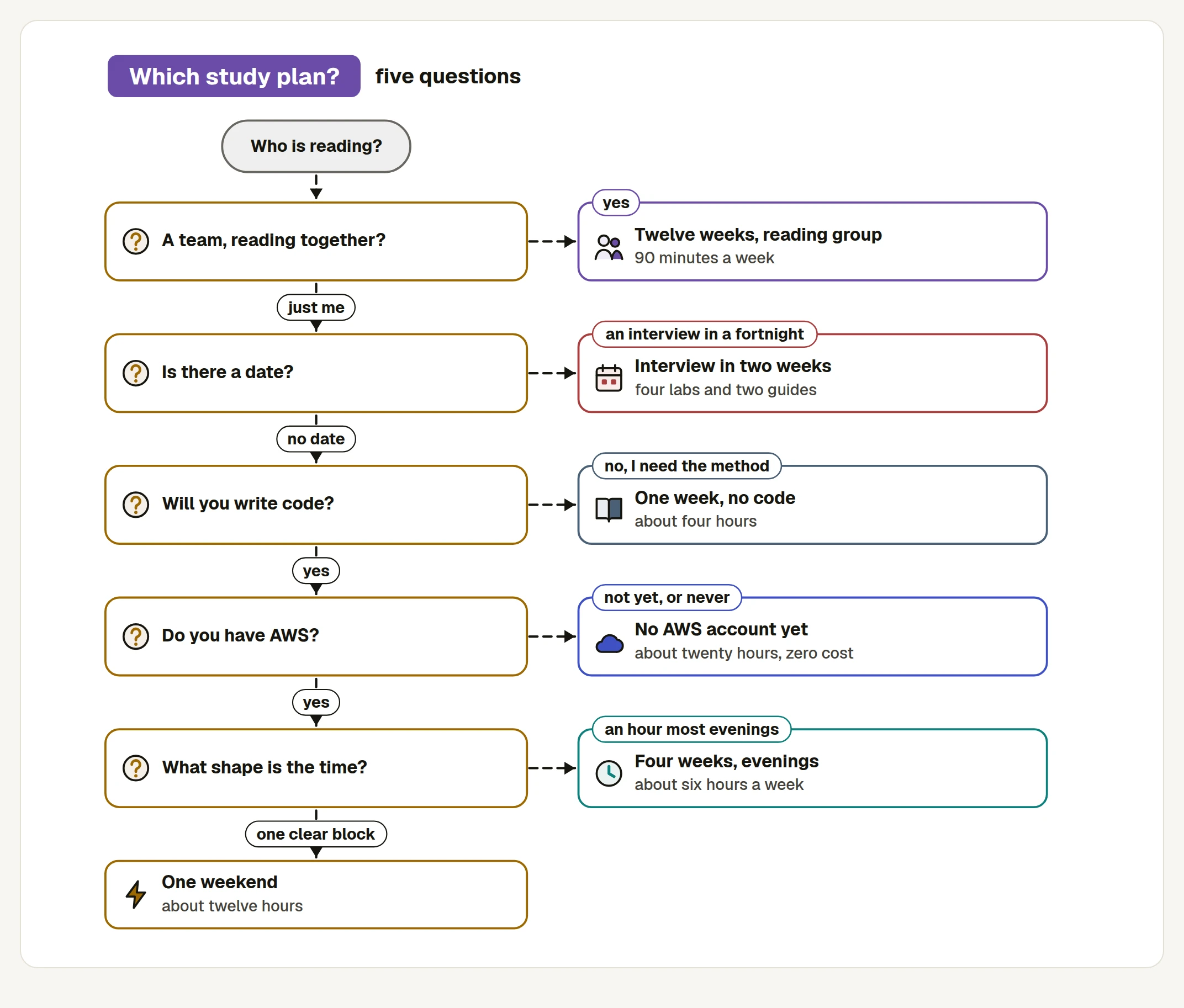
Every plan ends in something you made, not something you read. That is the only property they share, and it is the one to keep if you invent your own.
One queue sits in front of four of them. Bedrock model access is granted per model and per region, on request, and approval is not instant. Start the account on night one of whichever plan you pick, even where the plan does not touch AWS until week two.
For a product manager, architect, delivery lead or sponsor who needs the method before the machinery. No AWS account, no Python.
| Day | ~45 min | Ends with |
|---|---|---|
| 1 | The Agentic PDLC and The Eight Loops | The eight loops marked closed, open or absent for your own programme |
| 2 | Your role page: PM · Architect · Engineering · QA · Sponsor | Your Monday list, five items |
| 3 | Gates & Governance and The Evidence Pack | The table for the P1 → P2 hard gate (the sign-off before anything is built), filled in honestly for one feature |
| 4 | Formulas & Calculators, then Sets A and B of Exercises | An acceptance bar you derived rather than guessed |
| 5 | Two scenarios from outside your industry, plus Anti-Patterns | Three anti-patterns you recognise, each with an owner |
| Any | One simulation in the workbench, from the live manual | A decision you got wrong once, cheaply |
This is the plan to run before a programme starts, and the one to hand a sponsor who asks what they should read.
For a working engineer with an hour most evenings.
| Week | Evenings | Do | Ends with |
|---|---|---|---|
| 1 | Mon–Thu | AWS setup (night 1, then wait for access) · Module 00 · PDL-01 lab | A classified use case of your own |
| 2 | Mon–Thu | Module 02 — onboarding notebook, Converse masterclass, exercises 1–2 | A working tool-use round trip |
| 3 | Mon–Thu | AGL-01 → AGL-02 → AGL-03 · then Module 05 | The loop, by hand, and then in Strands |
| 4 | Mon–Thu | Module 06 · TOOL-03 lab · your own agent | An agent in your domain |
Start setup on night one even though you will not use it until week two. Model access approval is the only part with a queue.
The Weekend Sprint, hour by hour. Do AWS setup the week before — a weekend spent waiting on model access is a wasted weekend.
| Sat AM | Sat PM | Sun AM | Sun PM | |
|---|---|---|---|---|
| 3 h each | Model answering: onboarding notebook, Converse masterclass | Tool use: refund agent, exercise 3 | The loop by hand, then Strands | Your own domain; capstone if energy remains |
For a team. One session a week, pre-work before, discussion during.
| Wk | Pre-work | Discuss |
|---|---|---|
| 1 | Module 00 | Bring one candidate use case each. Classify them together |
| 2 | Autonomy Ladder, Scope Fence | Which rung does ours need? What would we cut? |
| 3 | Module 02 | Everyone runs the Converse notebook beforehand |
| 4 | Token Tax Ledger | Cost our use case. Argue about the assumptions |
| 5 | Module 05 + AGL labs | Everyone writes the loop by hand. No exceptions |
| 6 | Module 06 | Design our tool catalogue together |
| 7 | Module 07 + Handoff Multiplier | Pick a topology and compute its H× |
| 8 | Module 10 core labs | Where would our corpus break retrieval? |
| 9 | Grounding Triangle | Read five of our own cited answers. Do the passages support them? |
| 10 | Module 13 | Draft our golden set. Include cases we fail |
| 11 | Module 11 | Who owns the corpus? Who is on call? |
| 12 | Scorecard | Score our system. Two people score independently and compare |
The week-12 disagreement is the point. Where two scorers differ is your actual agenda.
Everything here runs offline. Genuinely useful while access is pending — or if you never enable it.
| Module 00 · Module 01 · Module 15 | ~13 h |
| All 10 L.A.B. labs — every one is offline and stdlib-only | ~5 h |
rag_by_hand.py · quality_gate.py
|
~2 h |
| The whole field guide | as long as you like |
Ruthless. These four labs plus two guides answer more interview questions than the rest combined.
| Days | Do |
|---|---|
| 1–3 | AGL-01, AGL-02, AGL-03 — be able to write the loop from memory |
| 4–5 |
EVAL-03 — and read quality_gate.py
|
| 6–8 | Your role's interview guide — prepare the three stories it asks for |
| 9–11 | Autonomy Ladder, Evidence Ladder, Failure Signature Catalog |
| 12–14 | Build one small agent end to end. Measure its cost per resolved task. Bring the number |
The four questions to be able to answer cold: what does it do when it does not know · how do you know it works, and on what evidence rung · what did you decide not to build · what did you get wrong and what changed.
Nobody finishes a plan exactly. The value is having a next action rather than a 16-module directory.
Share yours. If you invented a schedule that worked around your constraints, add it — this page is editable by anyone. Real plans from real people beat designed ones.