Repository navigation
Definitions and Code Shape
Find code by what it is rather than what it says: where a name is defined, what kind of definition it is, where it is used, and code that has a given shape however it is laid out. These search current files only.
| Short | Takes | Searches | Example |
|---|---|---|---|
sym: |
Part of a definition's name, or a /regex/; returns definitions only |
Current files only | symbol:RetryPolicy |
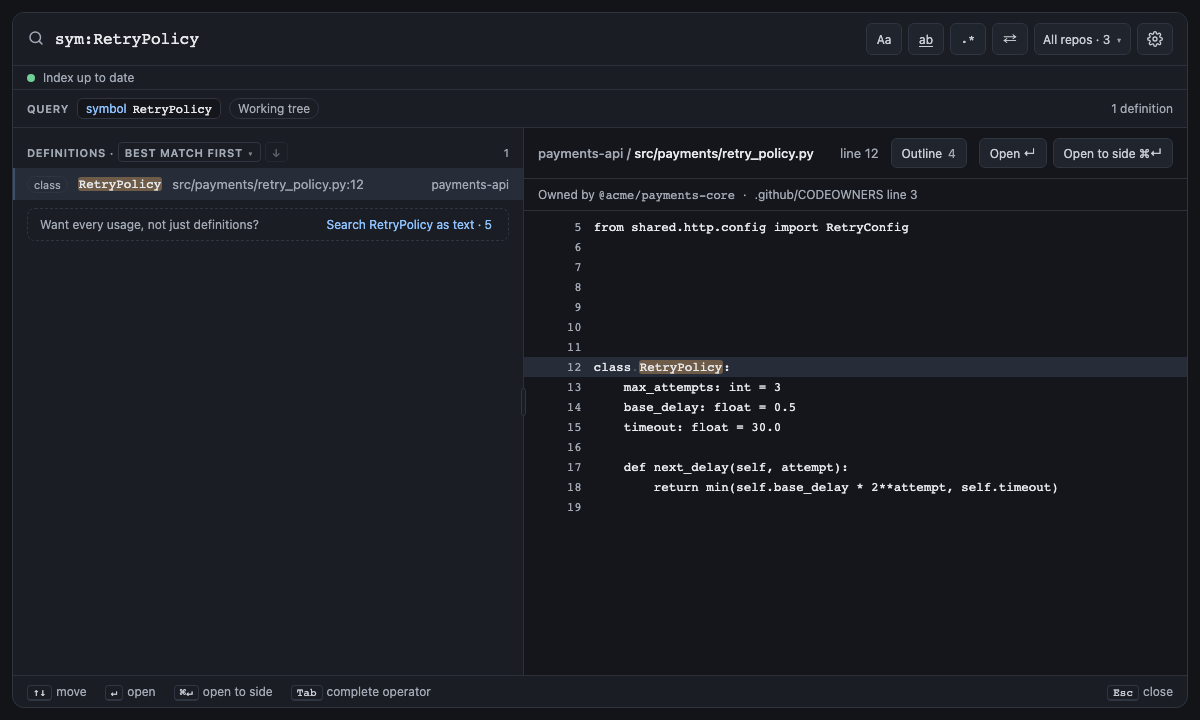
symbol: returns definitions only: the function, method, class, interface or type whose name contains the value.
With no match, the panel offers to search the name as text. Spelunk: Find Definitions, on the editor's right-click menu, searches
the name at the cursor exactly, as sym:/^RetryPolicy$/ (see
Searching from your code).
Screen 9: sym: definitions · Screen id symbol-definitions · milestone M4

The built panel
| Short | Takes | Searches | Example |
|---|---|---|---|
| none |
function, method, class, interface, type or other; returns definitions of that kind only |
Current files only | kind:class symbol:Retry |
symbol: finds where things are defined; kind: keeps one kind of definition. The kinds are what Spelunk's
per-language rules tell apart: function (top-level functions, and functions assigned to a name), method (functions
inside a class, struct or interface), class (classes, and structs, enums and objects in languages that call them
classes), interface (interfaces, traits and protocols), type (type aliases, and structs, enums and unions in Go,
Rust and C) and other (Ruby modules). kind: returns definitions on its own too, so kind:class file:models/ lists
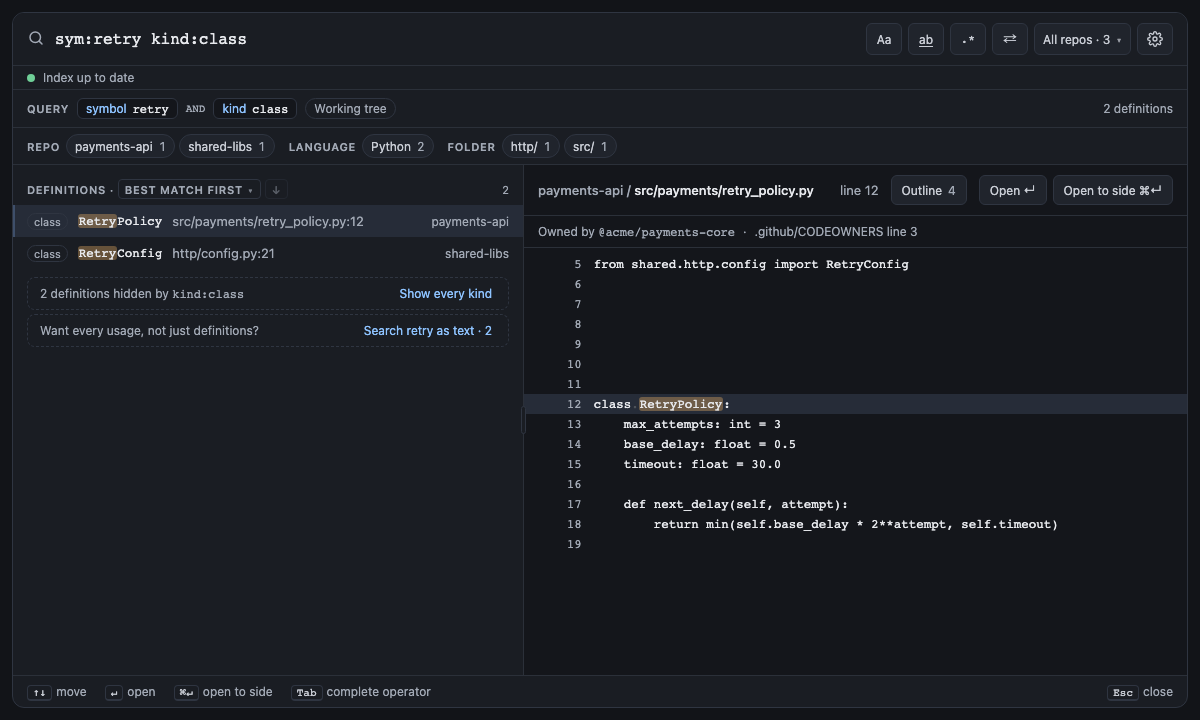
the classes under models/, and -kind:method leaves methods out. When kind: hides definitions the panel says how
many, with Show every kind.
A word or regex next to kind: or symbol: matches the definition's name, as symbol: does: kind:function parse
returns the functions whose names contain parse, such as parseLine, and kind:function -test leaves out the ones
named for tests.
ref:, content:, struct: and a regex across lines next to kind: or symbol: match inside the definitions it
keeps, from a definition's first line to its last. kind:function ref:RetryPolicy lists each line that uses
RetryPolicy inside a function, and each result ends in the function it is in (in function build_client); a
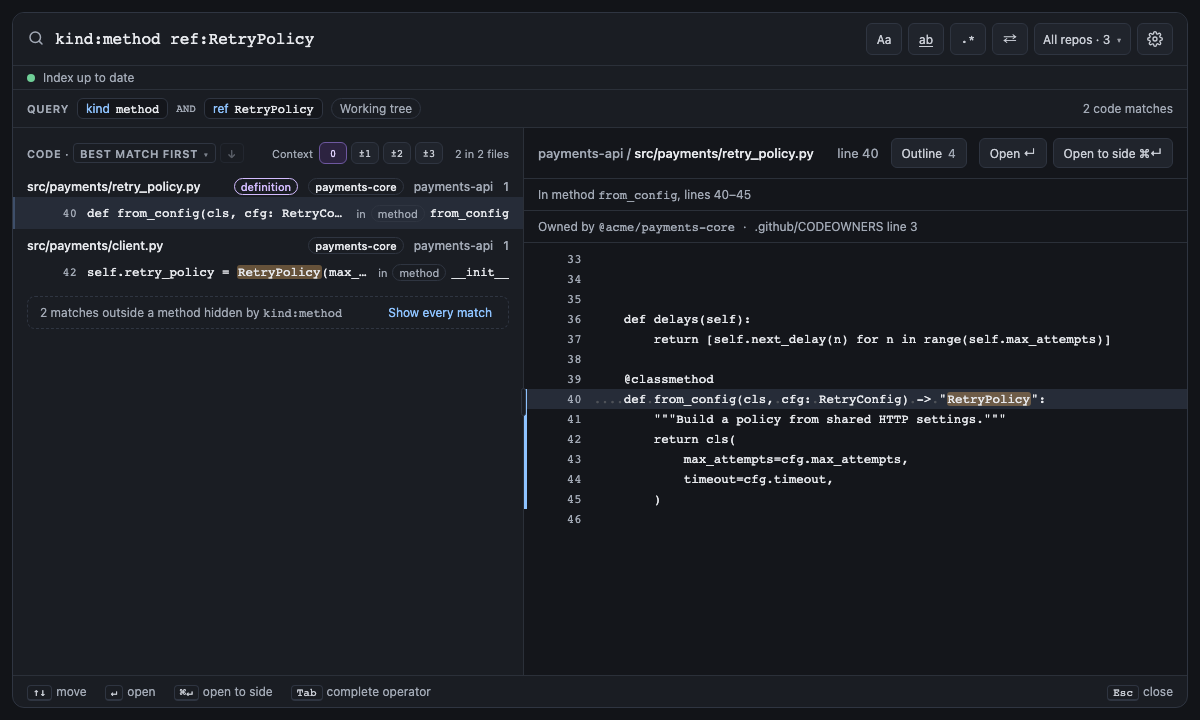
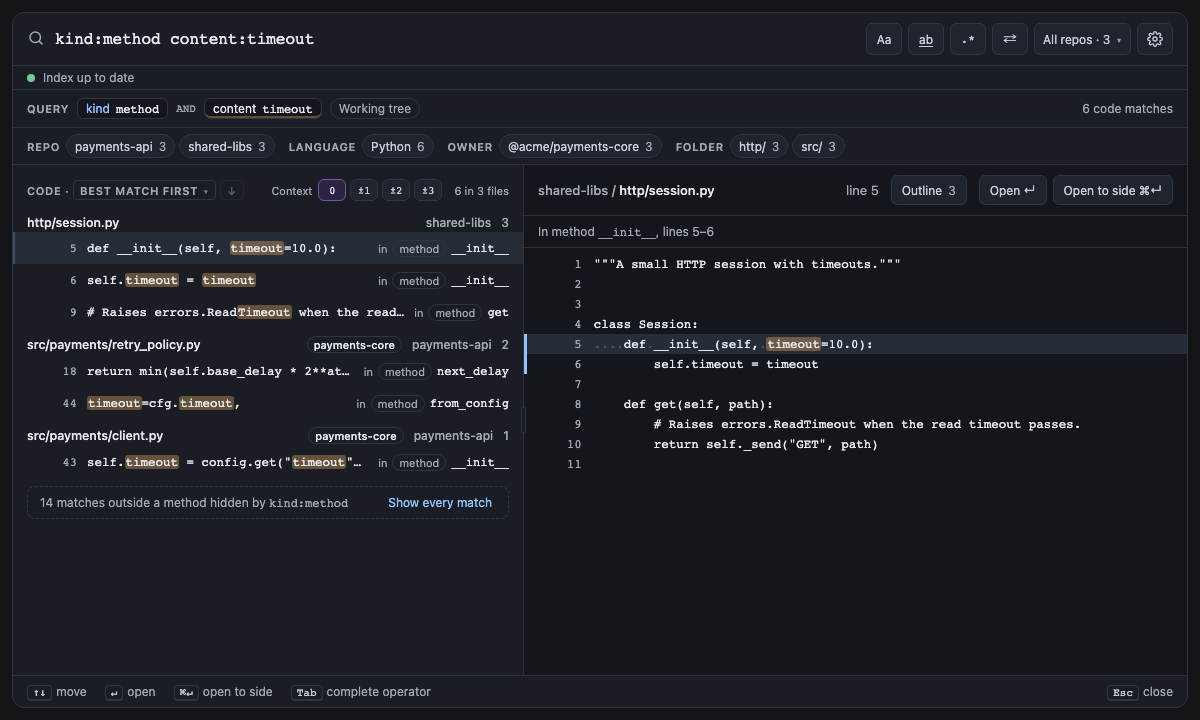
use inside a method of a class names the method, the innermost definition the query keeps. kind:method content:timeout lists the lines inside methods that mention timeout, and kind:function parse ref:RetryPolicy the
uses inside functions named for parsing. Left out, they leave out definitions: kind:function -ref:RetryPolicy lists
the functions that never use it.
A definition ends at the last line indented under it, or at the } or end that lines up with it, as Python's
indentation and the usual brace styles both show. Selecting a result marks those lines in the preview, which says
In method from_config, lines 40–45 under its title. The uses outside every definition the query keeps, such as an
import, are counted in a note: "2 matches outside a method hidden by kind:method", with Show every match, which
removes kind:.
Screen 45: Uses inside definitions · Screen id uses-in-definitions · milestone 2.1
kind:method ref:RetryPolicy lists the two uses of RetryPolicy inside methods, from_config and __init__, each
row naming its method, and the note counts the two outside one: the import and a test's module-level line. The
preview marks from_config's lines. kind:method content:timeout does the same for any text.

The built panel
| Short | Takes | Searches | Example |
|---|---|---|---|
| none | A name, or a "quoted name"; returns the lines that use it as a whole word, without the lines that define it |
Current files only | ref:RetryPolicy |
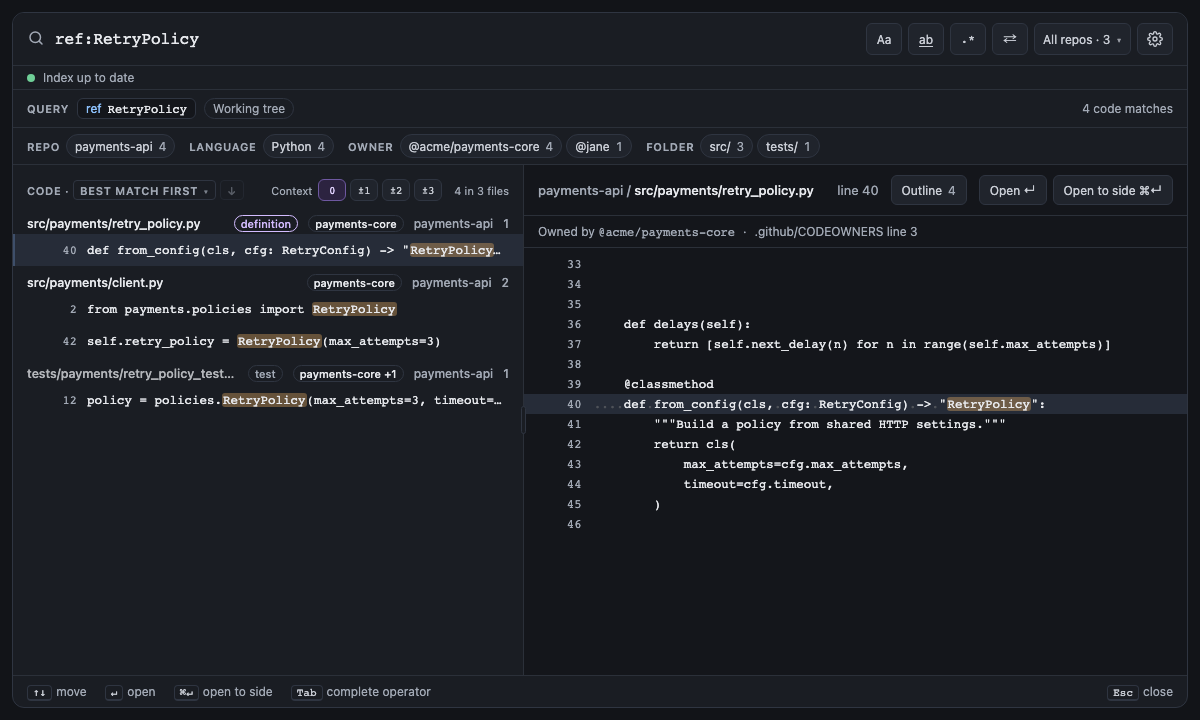
ref:RetryPolicy finds the lines that use a name: it matches RetryPolicy as a whole word, whatever word: says,
and leaves out the lines that define it, so class RetryPolicy: is not a result but RetryPolicy(max_attempts=3) is.
It matches by name, not by meaning, unlike VS Code's Find All References: a different RetryPolicy in another repo
counts too, and so does the name in a comment or a string. Spelunk: Find Uses, on the editor's right-click menu, searches ref: for
the name at the cursor.
Screen 35: kind: keeps one kind of definition; ref: finds a name's uses · Screen id symbol-kinds · milestone 1.1
sym:retry kind:class keeps the classes whose names contain retry, RetryPolicy and RetryConfig, and a note
counts the definitions of other kinds it hid (the retry functions), with Show every kind, which removes
kind:class. ref:RetryPolicy finds the lines that use RetryPolicy as a whole word: the import, the calls and the
return annotation, but not class RetryPolicy:, which defines it, nor RetryPolicyError or retry_policy.

The built panel
| Short | Takes | Searches | Example |
|---|---|---|---|
| none | A "quoted template": code with :[holes], matched by its shape in file text (see Code by its shape) |
Current files only | struct:"backoff(:[call], tries=:[n])" |
struct: takes a template: code with holes. struct:"backoff(:[call], tries=:[n])" finds every call of backoff
whose last argument is tries=, however it is laid out, so a call over three lines is found as well as one on a single
line. The template and each file are read as tokens by the file's language: words, punctuation, brackets and whole
strings.
- A hole,
:[name], takes any code whose brackets pair up, so:[call]takeslambda: send(event.url, event.body)whole, brackets and commas and all. It takes as little as it can: inf(:[a], :[b]),:[a]ends at the first comma outside brackets. It may take nothing, sof(:[args])findsf(). - Inside the template's brackets a hole may run over lines; outside them it stays on the line where it starts, so
return :[x];can't take the rest of a file without semicolons. - Spaces and line breaks don't matter, except between two words:
foo(a,b)findsfoo( a ,\n b ), andreturn xdoesn't findreturnx. Punctuation written together stays together:a == :[b];doesn't finda = = 1;. - Code in comments and strings never matches, by each language's rules (Python's
#and triple quotes, Go's raw strings, Rust's lifetimes, SQL's--, and so on); a hole may take a string or a comment whole. A file in no known language reads"…"as a string and has no comments. - A name used twice must take the same code, spaces aside:
if :[x] == :[x] {finds a value compared with itself.:[_]takes anything and is never compared. - A template's brackets needn't pair up (
if err != nil {is a template), but it must start and end with code, and two holes need code between them, or the query says what's wrong. A hole takes as little as it can, so one at the end would always take nothing: enda == :[b]with what comes afterb, as ina == :[b];.
Each match is one result on the line it starts, showing every line it spans like a regex across
lines: the template's code is marked in the term's color and each hole's code in its own
paler, underlined color, and a chip under the result says what each hole took (:[call] lambda: send(event.url, event.body)), its spaces squeezed and cut after 80 characters. Matches don't overlap, and a call inside another's hole
is part of it. case: applies to the template's words and strings; word:yes changes nothing, since words already
match whole. It never matches file names, works in current files only, and Replace can't change it.
Screen 40: struct: finds code by its shape: a template's holes take any code, over lines · Screen id structural-search · milestone 1.2
struct:"backoff(:[call], tries=:[n])" finds the three calls of backoff in http/webhooks.py: one over three
lines, one over two and one on a single line. In 1.1 the nearest search was /backoff\(.*tries=/, which found only
the one-line call, and the comment and the string that look like one (below). Now each match is one result showing
every line it spans: backoff(, the ,, tries= and ) are marked in the term's color, what :[call] took in blue
and what :[n] took in green, each underlined, and a chip under the result lists what each hole took. The comment on
line 6 and the string on line 18 aren't code, so they don't match. The preview's header says lines 7–9 and marks
the same, and opening the result selects the whole call.

In 1.1: a regex finds the one-line call, the comment and the string

The built panel
![Built panel for structural-search: struct:"backoff(:[call], tries=:[n])"](https://raw.githubusercontent.com/cruisinme30/spelunk/main/docs/dev/proof/structural-search.png)
Next: Commits and time: search Git history, and the code as it was.