Eggholder
Description [view source]
The Eggholder function is a challenging optimization problem with a complex landscape, making it a popular benchmark for testing optimization algorithms. It is defined mathematically as:
Here is a link to an interactive Desmos version: https://www.desmos.com/3d/zkjsc9pdn7
Eggholder().visualize()
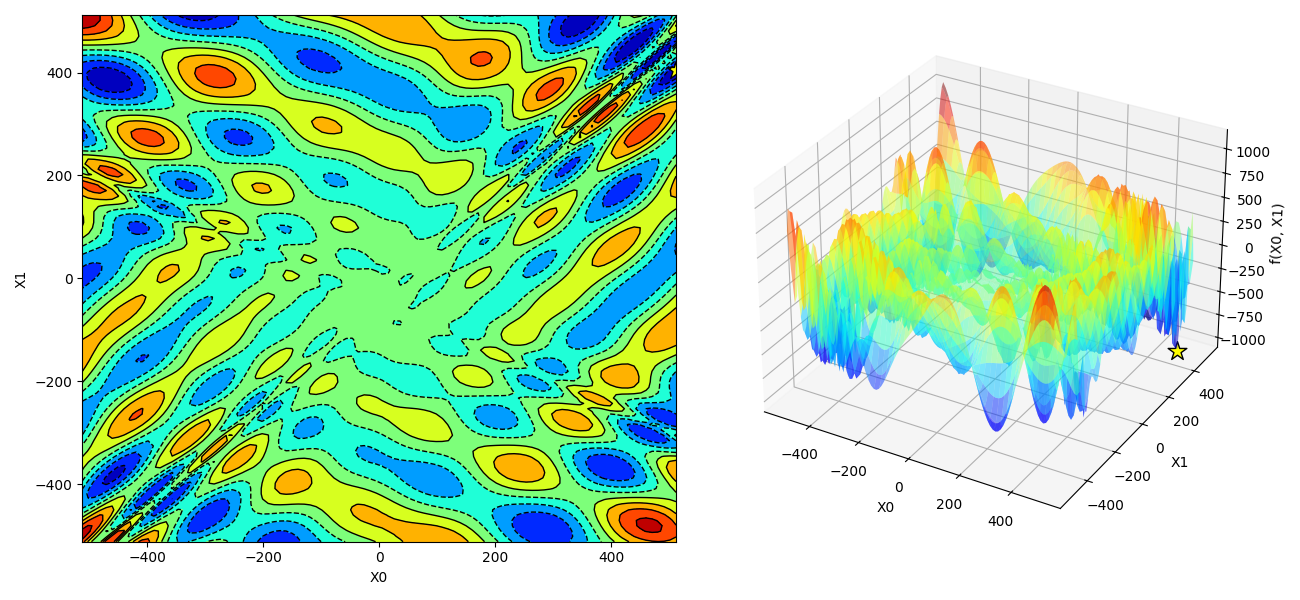
- Multimodality: The function has many local minima, making it difficult for optimization algorithms to find the global minimum.
-
Global minimum: The global minimum is
$f(x^*=<512, 404.2319>) = -959.6407$ . -
Search space: Typically, the function is evaluated over the bounded region
$[-512, 512]$ for both$x$ and$y$ .
The Eggholder function is useful for evaluating the performance of optimization algorithms, especially in terms of their ability to navigate complex landscapes with numerous local minima. Its highly intricate surface structure makes it an excellent test case for algorithms designed to explore and exploit challenging search spaces. Success on the Eggholder function indicates robustness and effectiveness in handling a variety of real-world optimization problems.
The exact origin of the Eggholder function is not well documented in the literature. The oldest reference we could find is the following :
Zelinka, I. (2004). SOMA — Self-Organizing Migrating Algorithm. In: New Optimization Techniques in Engineering. Studies in Fuzziness and Soft Computing, vol 141. Springer, Berlin, Heidelberg. https://doi.org/10.1007/978-3-540-39930-8_7
Note that the previous article is not a primary source and that the author cites a website that is no longer working as the source.