Holder Table
Description [view source]
The Holder Table function is a commonly used benchmark for testing optimization algorithms due to its highly rugged landscape with multiple local minima. It is defined mathematically as:
Here is a link to an interactive Desmos version: https://www.desmos.com/3d/cz4xzyjq6h
HolderTable().visualize()
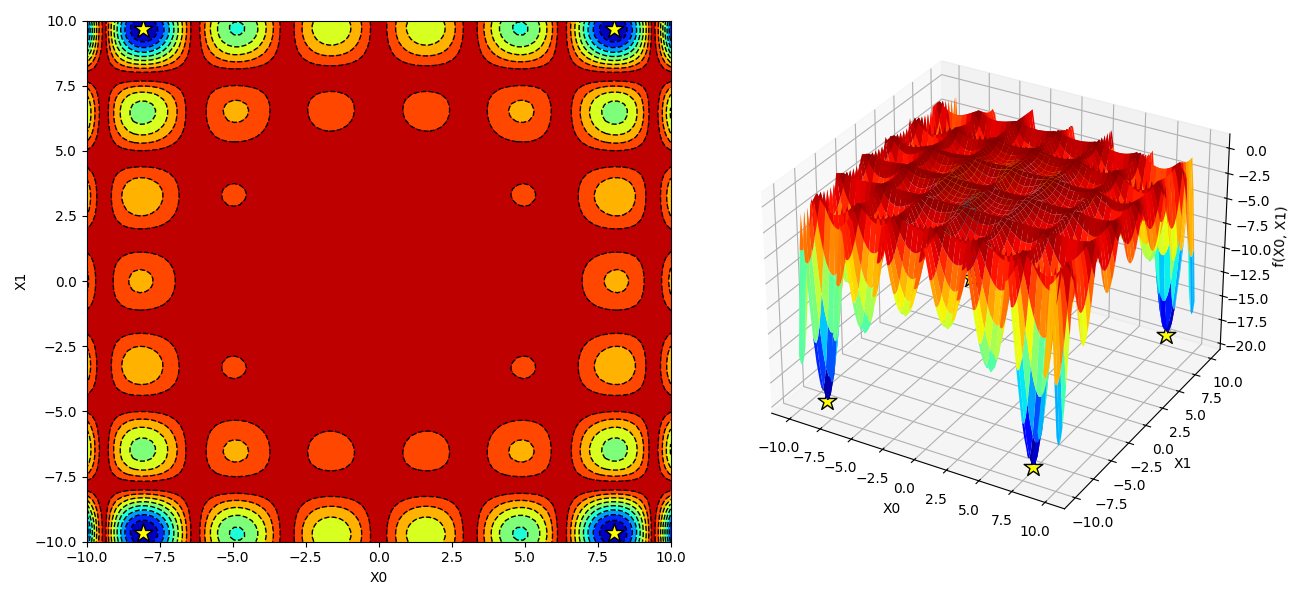
- Multimodality: The function’s landscape includes steep ridges and deep valleys, providing a significant challenge for optimization techniques.
-
Global minimum: Due to the symmetry of the function and the default search space, there are four global minimums located at
$(8.05502, 9.66459)$ ,$(-8.05502, 9.66459)$ ,$(8.05502, -9.66459)$ and$(-8.05502, -9.66459)$ where the function evaluates to$f(x^*)=-19.2085$ . -
Search space: The function is typically evaluated over the domain
$-10 \leq x_i \leq 10$ .
The steep ridges and deep valleys of the function's surface make it a challenging problem for both gradient-based and heuristic optimization methods. Success in optimizing the Holder Table function indicates robustness and efficiency in handling complex, multimodal optimization problems.
The Holder Table test function was introduced in the following article :
Mishra, S. K. (2006). Some new test functions for global optimization and performance of repulsive particle swarm method. Available at SSRN 926132.
It can be found here : https://papers.ssrn.com/sol3/papers.cfm?abstract_id=926132