Six Hump Camel Back
Description [view source]
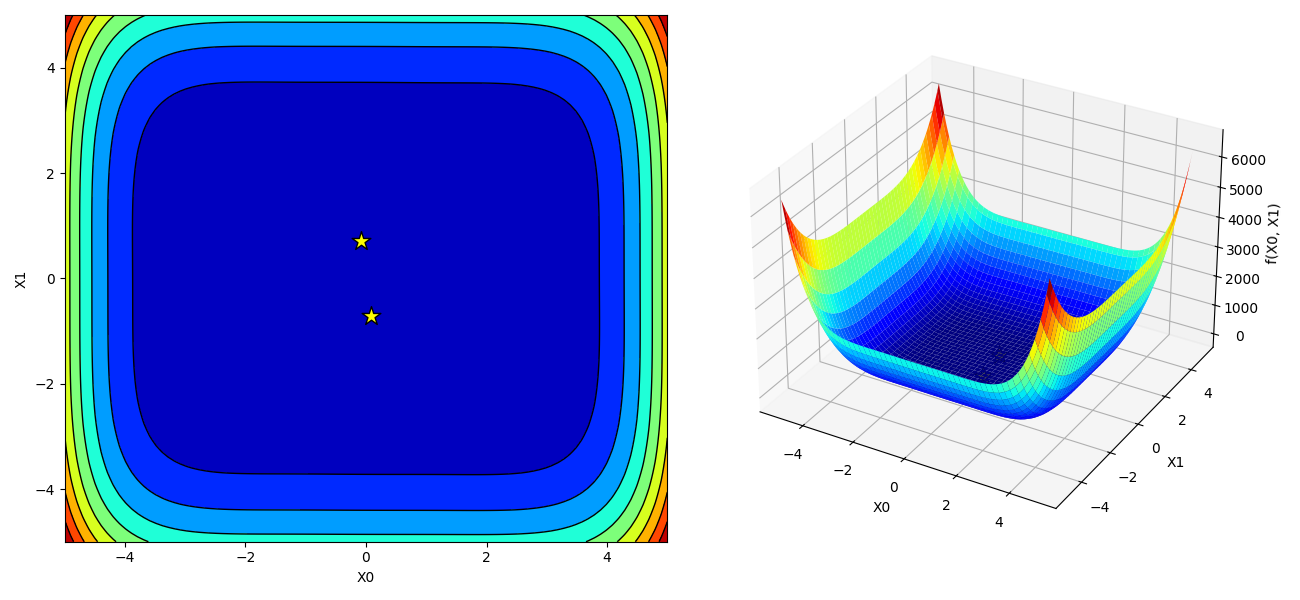
The Six Hump Camel Back function is a well-known benchmark for testing optimization algorithms due to its complex landscape with multiple local minima and two global minima. It is defined mathematically as:
Here is a link to an interactive Desmos version: https://www.desmos.com/3d/bx4eexcurg
SixHumpCamelBack().visualize()
SixHumpCamelBack().visualize(plot_bounds=[(-1, 1), (-1, 1)])
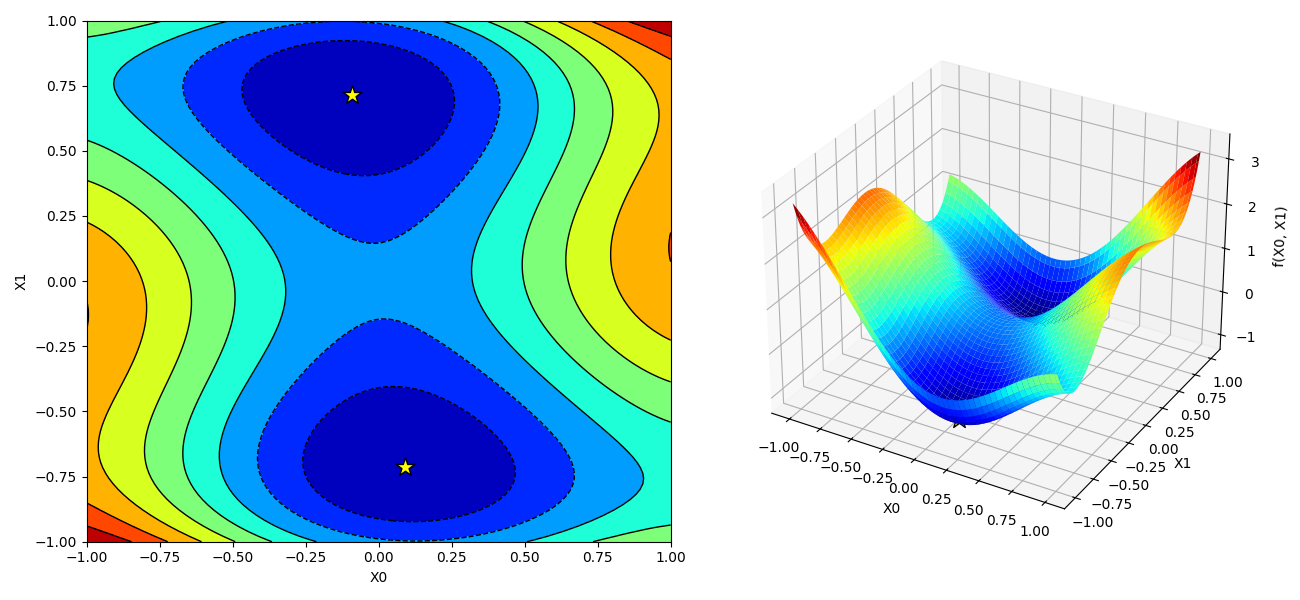
- Multimodality: The function has six local minima, which makes it challenging for optimization algorithms to find the global minima.
-
Global minima: There are two global minima located at
$f(x^*=<0.0898, 0.7126>)\approx-1.0316$ . -
Search space: Typically, the function is evaluated over the bounded region
$x$ $\epsilon$ $[-3, 3]$ ,$y$ $\epsilon$ $[-2, 2]$ .
The Six Hump Camel Back function is useful for evaluating the performance of optimization algorithms in terms of their ability to handle complex, multimodal landscapes. Its multiple local minima and two global minima provide a rigorous test for optimization techniques, particularly those that rely on local search heuristics. Algorithms that can effectively navigate the Six Hump Camel Back function's terrain are likely to perform well on a variety of real-world optimization problems.
The oldest reference we could find is (Molda & Smutnicki, 2005), but older ones may exist since the former is a review.