Griewank
Description [view source]
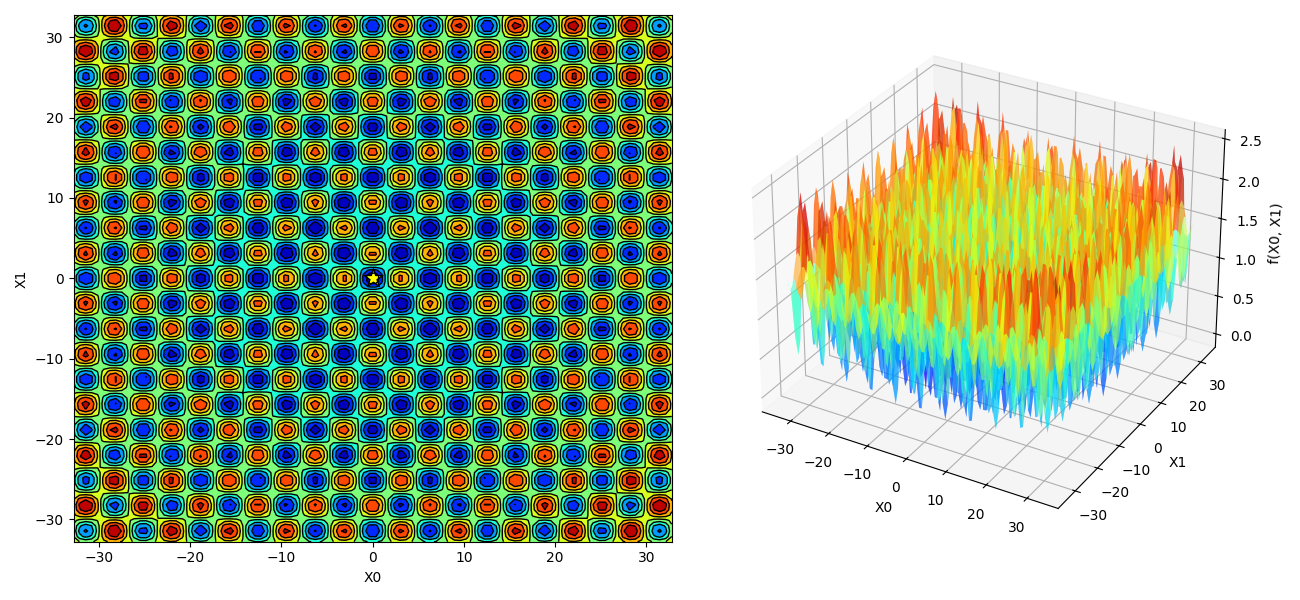
The Griewank function is commonly used to test optimization algorithms. It has many regularly distributed local minima and is defined mathematically as:
where Griewank.ndim) of the input vector
Here is a link to an interactive Desmos version: https://www.desmos.com/3d/nkaboyl8cv
Griewank().visualize()
Griewank().visualize(plot_bounds=[(-5, 5), (-5, 5)])
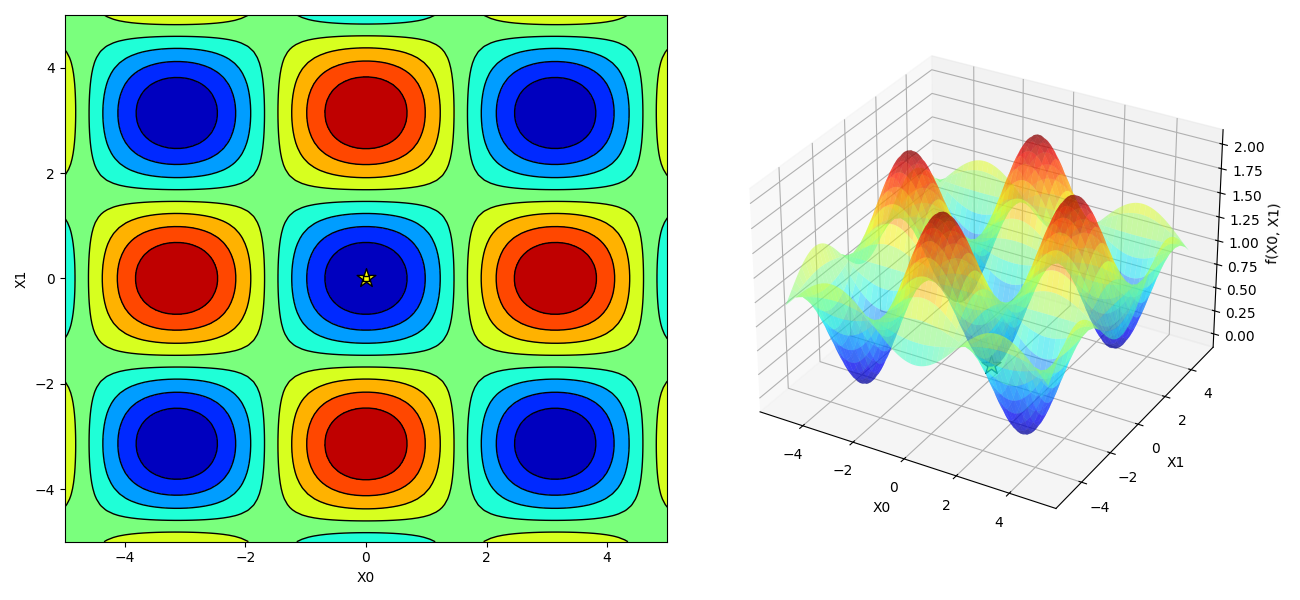
- Multimodality: The function has many local minima, making it difficult for optimization algorithms to find the global minimum.
-
Global minimum: The global minimum is
$f(\vec{x} = <0,\cdots,0>) = 0$ . -
Search space: The function is typically evaluated on the domain
$-32.768 \leq x_i \leq 32.768$ .
The Griewank function is particularly useful for evaluating the exploration and exploitation properties of optimization algorithms due to its ruggedness. It has regularly spaced local minima that provide a consistent challenge, yet does exhibit learnable patterns.
The Griewank function was introduced by Andreas Griewank in his 1981 paper titled Generalized Descent for Global Optimization. The article is available here : https://link.springer.com/article/10.1007/BF00933356.