Gramacy and Lee
Description [view source]
The Gramacy and Lee function is a benchmark problem for testing optimization algorithms, particularly those used for surrogate modeling and Bayesian optimization. It is defined mathematically as:
Here is a link to an interactive Desmos version: https://www.desmos.com/calculator/nkhgpxg2az
GramacyLee().visualize()
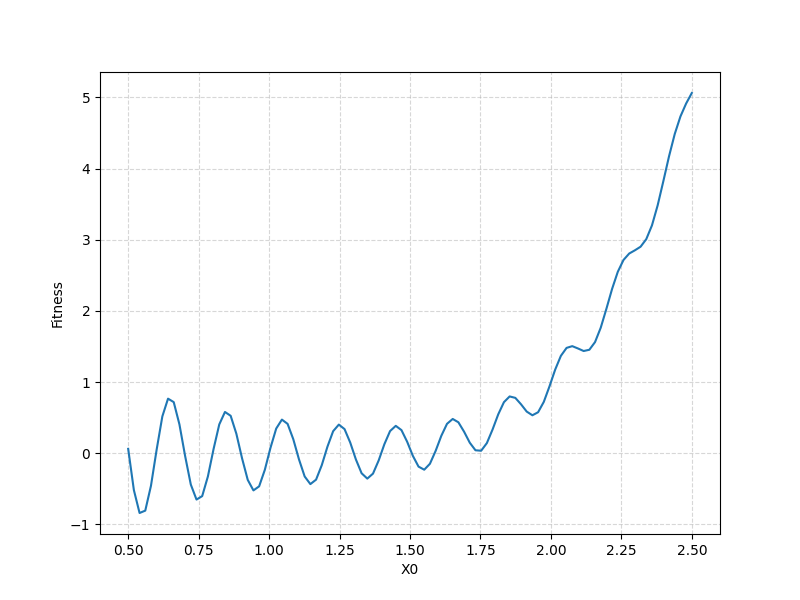
- Multimodality: The function has multiple local minima, making it useful for testing optimization algorithms' ability to avoid local traps and find the global minimum.
-
Global minimum: The global minimum occurs at
$x^* \approx 0.548563444$ , where$f(x^*) \approx -0.8690111349895003$ . -
Search space: The function is typically evaluated over the interval
$0.5 \leq x \leq 2.5$ , which is the default value. - Smoothness: The function is smooth and differentiable, making it suitable for gradient-based optimization methods.
The Gramacy and Lee function was introduced in (Gramacy & Lee, 2012) in the context of surrogate modeling (click here). Its multimodal landscape makes it an interesting optimization problem, which is why it is included here.
This function was introduced by Gramacy and Lee in their article titled Cases for the nugget in modeling computer experiments, published in 2012. The article is available at: https://doi.org/10.1007/s11222-010-9224-x.