Langermann
The Langermann function is a multimodal test function used for benchmarking optimization algorithms. It is particularly known for its complex landscape, which features multiple local minima and a global minimum that is difficult to locate. The Langermann function is defined mathematically as:
where
Here is a link to an interactive Desmos version: https://www.desmos.com/3d/ba2hgstckz
# Instantiate objective function
foo = Langermann()

# Define a common colormap
plot_kwargs = {'cmap': 'hsv'}

# Visualize the objective function
foo.visualize(plot_2d_kwargs=plot_kwargs,
              `plot_3d_kwargs=plot_kwargs)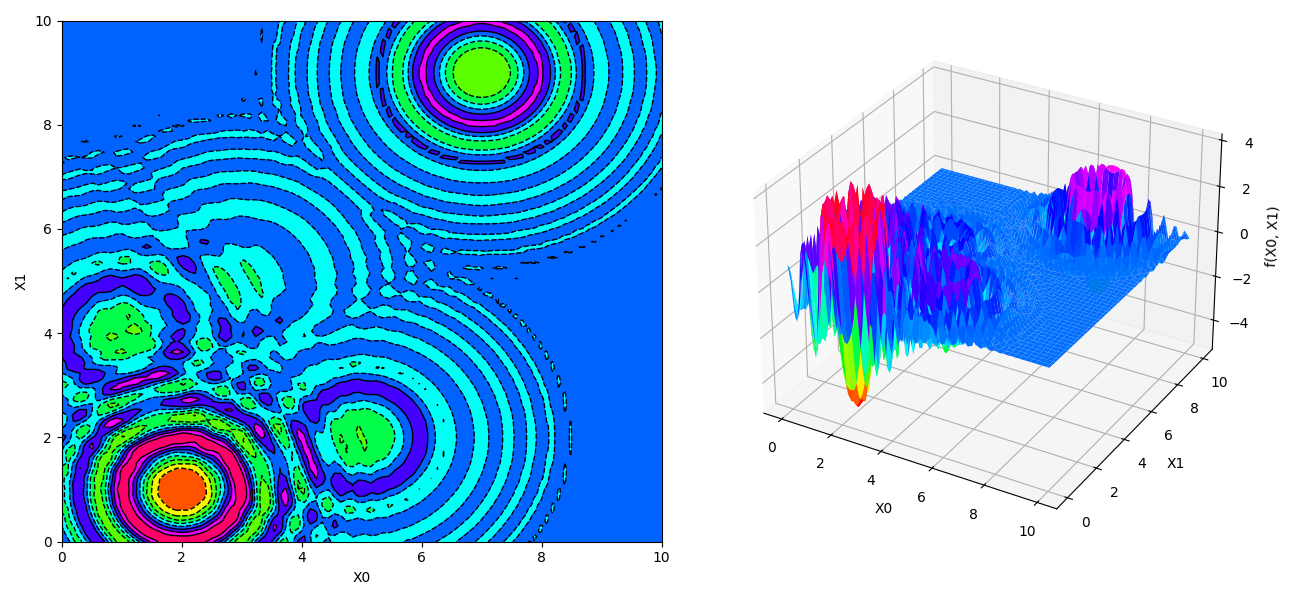
- Multimodality: The function has multiple local minima, making it challenging for optimization algorithms to locate the global minimum.
- Global minimum: The global minimum is difficult to define exactly due to the nature of the parameters, but the function typically has a minimum value in the specified domain.
-
Search space: The function is generally evaluated within the bounded region
$0 \leq x_i \leq 10$ .
The Langermann function is particularly useful for evaluating the performance of optimization algorithms due to its complex and multimodal landscape. The presence of numerous local minima requires algorithms to effectively explore the search space to locate the global minimum. This makes the Langermann function a valuable test case for global optimization methods, particularly those that are designed to escape local optima and explore extensively.
The oscillatory nature of the function, with its exponential and cosine components, creates a challenging environment for both gradient-based and heuristic optimization methods. Success in optimizing the Langermann function indicates robustness and efficiency in handling complex, multimodal optimization problems. The function is often used in comparative studies to benchmark the performance of different optimization algorithms, providing insights into their strengths and weaknesses.
Adorio, E. P., & Diliman, U. (2005). Mvf-multivariate test functions library in c for unconstrained global optimization. Quezon City, Metro Manila, Philippines, 44.