Architecture
A component-level overview of OPNGMS for operators and contributors: the request path, the background worker, the optional log lake, the multi-tenant security model, and the technology stack — all grounded in the actual Compose files and backend/app/ code.
For deployment mechanics see Installation; for every environment variable see Configuration; for the security model in depth see Security.
OPNGMS is a single-origin SPA + API, a background worker, and the two datastores they share. The frontend nginx serves the React bundle and reverse-proxies /api to the API container, so the browser only ever talks to one origin. The worker is the only component that reaches out to managed OPNsense appliances; the API never calls a firewall directly on the request path. The log lake is an opt-in overlay where managed devices push syslog over mTLS, independent of the API-pull telemetry path.
                         ┌─────────────────────────────────────────────────────────┐
                         │                      Docker host                         │
   Browser (SPA)         │                                                          │
        │   HTTPS         │   ┌──────────┐  /api    ┌──────────┐                     │
        ▼ ───────────────┼──▶│ frontend │ ───────▶ │   api    │ ──┐ asyncpg         │
  TLS terminator         │   │ (nginx)  │  proxy   │ (uvicorn │   │  (opngms_app,    │
  (your proxy / built-in │   │ SPA +    │          │  FastAPI)│   │   RLS-enforced)  │
   nginx/Caddy/Traefik;  │   │ /api     │          └────┬─────┘   ▼                  │
   sets X-Forwarded-Proto)│  │ proxy)   │               │      ┌──────┐              │
        ▲ ───────────────┼──┘          │               │      │  db  │ TimescaleDB  │
        │   HTTP(S)       │             enqueue jobs ───┼────▶ │(PG16 │  + RLS       │
        │                 │                  ▼          │      │ +RLS)│              │
        │                 │            ┌──────────┐     │      └──────┘              │
        │                 │            │  redis   │ ◀───┘         ▲                  │
        │                 │            │  (arq    │               │ asyncpg (owner,  │
        │                 │            │  queue)  │               │  RLS-exempt)     │
        │                 │            └────┬─────┘               │                  │
        │                 │                 │ poll / apply / report                  │
        │                 │            ┌────▼─────┐ ──────────────┘                  │
        │                 │            │  worker  │                                  │
        │                 │            │  (arq)   │ ── HTTPS (API key/secret) ──┐    │
        │                 │            └──────────┘                             │    │
        │                 └──────────────────────────────────────────────────┼────┘
        │                                                                      ▼
        │                                                      ┌───────────────────────────┐
        │                                                      │  Managed OPNsense fleet   │
        │                                                      │  (per-tenant firewalls)   │
        │                                                      └─────────────┬─────────────┘
        │                                                                    │ syslog/RFC 5424
        │             ── optional log lake overlay ──                        │ over mTLS :6514
        │                                                                    ▼
        │                                              ┌──────────┐    ┌──────────────┐
        └───── Logs page query (api → OpenSearch) ────▶│OpenSearch│◀───│  syslog-ng   │
                                                       │ (index   │    │ (mTLS recv,  │
                                                       │ per day) │    │ tenant from  │
                                                       └──────────┘    │ cert O/CN)   │
                                                                       └──────────────┘
Note: The
apicontainer's port 8000 is not published to the host — only the Compose network (the trusted nginx) can reach it. Likewise OpenSearch (port 9200) is internal-only; the trust boundary for the log lake is the mTLS device →syslog-ng:6514hop.
The core stack is six services (docker-compose.prod.yml). The optional log lake adds three more (docker-compose.logs.yml, or bundled into docker-compose.full.yml). Every service also receives TZ for log timestamps (data is always stored in UTC).
| Service | Image / base | Responsibility | Key dependencies |
|---|---|---|---|
| db | timescale/timescaledb:2.17.2-pg16 |
Primary datastore: tenants, users, devices, metrics (Timescale hypertables), events, config snapshots/changes, reports, schedules. Enforces Row-Level Security. | — (has healthcheck pg_isready) |
| redis | redis:7 |
Job queue broker for arq — the worker's task queue and cron scheduler. | — (has healthcheck redis-cli ping) |
| migrate | ghcr.io/l0rdg3x/opngms-backend |
One-shot: runs alembic upgrade head as the DB owner, creating the schema, the opngms_app role, RLS policies, and grants. Exits 0 on success. |
db healthy |
| api | ghcr.io/l0rdg3x/opngms-backend |
uvicorn app.main:app — the FastAPI HTTP API. Connects as the non-superuser opngms_app role, so RLS is enforced on every query. Health at GET /healthz. |
db healthy, redis healthy, migrate completed |
| worker | ghcr.io/l0rdg3x/opngms-backend |
arq app.worker.WorkerSettings — background jobs and cron: device polling, event/config ingest, perimeter attacker rollup + retention purge, config apply, firmware actions, report generation/delivery, cert renewal, session reap, orphan sweeper, silent-tenant alerts. Connects as the owner (RLS-exempt) and scopes every query by explicit tenant_id. |
redis healthy, migrate completed |
| frontend | ghcr.io/l0rdg3x/opngms-frontend |
nginx serving the React SPA bundle and reverse-proxying /api to the api container (single origin). TLS terminated here (built-in overlays) or upstream (base model). |
api |
| opensearch (log lake) | opensearchproject/opensearch:2.17.1 |
Stores per-device, per-tenant device logs in daily indices (opngms-logs-*). Plain HTTP, security plugin disabled, internal-network only. |
— |
| syslog-bootstrap (log lake) | ghcr.io/l0rdg3x/opngms-backend |
One-shot: python -m app.cli syslog-bootstrap — generates the CA + receiver cert/key into the shared certs volume. |
opensearch started, migrate completed |
| syslog-ng (log lake) | balabit/syslog-ng:4.5.0 |
mTLS syslog receiver on port 6514 (RFC 5424). Verifies each device's client cert against the CA, derives tenant_id from the cert O= RDN and device_id from CN=, and ships parsed events to OpenSearch. |
syslog-bootstrap completed |
Implemented in app/api/auth.py and app/api/mfa.py (services app/services/auth.py, app/services/mfa.py).
-
Password step —
POST /api/loginauthenticates email + password (AuthService.authenticate). On success it rotates any incoming session token (anti-fixation) and decides the session kind based on the user's MFA enrolment and the tenant-wide MFA policy (off/all/privileged). - The server issues a session cookie + a CSRF cookie (both
Secure,SameSite=Lax; the session isHttpOnly). If MFA is enrolled the cookie is a short-livedmfa_pendingchallenge session and the response isstatus: "mfa_required"; if policy requires MFA but the user hasn't enrolled, it's amfa_setupsession; otherwise a full-TTL session. -
TOTP step —
POST /api/login/mfaverifies the 6-digit TOTP code (or a one-time recovery code) against the user's encrypted secret, with alast_used_stepreplay guard, and upgrades themfa_pendingsession to a full session. -
Enrolment —
POST /api/me/mfa/setupreturns a TOTP secret (stored encrypted withMASTER_KEY);POST /api/me/mfa/confirmverifies the first code and returns one-time recovery codes (hashed at rest). Every step is recorded byAuditService.
A host-level break-glass CLI (python -m app.cli mfa-reset) clears MFA for a locked-out superadmin. See Security for session TTLs and cookie hardening.
Driven by arq cron in app/worker.py; per-device work uses OpnsenseClient (app/connectors/opnsense/).
-
Metrics (every minute) —
enqueue_device_pollsfans out apoll_devicejob per device. Each job builds anOpnsenseClientfrom the device's decrypted API key/secret, callscollect_and_store(telemetry →metricshypertable + devicestatus), thenevaluate_alerts. -
Events (every N minutes) —
enqueue_event_ingests→ingest_device_eventspulls IDS (Suricata) alerts, DNS events, service / reliability events, and config-change audit events via the connector. A per-(device, source)cursor plus anON CONFLICT DO NOTHINGinsert deduplicates, so re-polling never double-counts (app/services/ingest.py). Theservicesource classifies the OPNsense system log into reliability events (reboots, service crashes/restarts, disk-FS warnings — a curated, fail-safe rule set; only recognized lines are stored, not the whole log); a new high-severity event raises a deduped alert at ingest. Theconfig_auditsource parses the OPNsense audit log (diagnostics/log/core/audit, searched server-side for thechanged configurationline family so it isn't buried underconfigd.pynoise) into config-change events, attributing each by channel from the request path and the actor IP —gui(a human in the WebGUI),system(console / script), and theapichannel split by OPNGMS's auto-learned management IP intoopngms(OPNGMS's own change, from the learned IP) vsapi_external(an API client from any other IP). OPNGMS learns the management IP by correlating the box'sapichanges with its own apply ledger (an applied change within a few minutes of the logged API change) and only when the correlated changes agree on a single, unambiguous IP; the learning is conservative and self-correcting (a clean OPNGMS apply re-learns the right IP) and a no-op until learned. Anything OPNGMS did not make —api_external,gui,system— is the drift signal: stored at higher severity and raising a deduped alert. (This is the box's config log, distinct from OPNGMS's own Security write-ledger.) This API-pull event path is independent of the syslog log lake. The same per-device cron also runs the Security / Perimeter attacker rollup (ingest_perimeter) inside aSAVEPOINT— see flow 6. -
Config backup (daily) —
enqueue_config_backups→backup_device_configstores an encrypted, gzip-compressed snapshot ofconfig.xml, deduplicated on a canonical hash so an unchanged config doesn't create a new snapshot. These snapshots are the staleness baseline and rollback points for the apply pipeline.
The version-aware editor and curated templates (Configuration-Editor, Configuration) all funnel into one typed, audited, per-device-serialized apply pipeline.
-
Propose — a change is created as a
config_changerow (create_changeinapp/services/config_push.py), capturing the current snapshot's canonical hash asbaseline_hash. It originates either from a direct editor edit (POST /api/.../config/changes) or from applying a template/catalog item (POST /api/templates/.../apply), or as an ordered profile of several member changes. -
Schedule — the change moves to
status="scheduled"and anapply_config_change(orapply_profile_changes) job is enqueued, optionally deferred to a futurescheduled_at. -
Apply — the worker takes a Postgres transaction-scoped advisory lock keyed on
device_id(per-device serialization), re-reads the liveconfig.xml, and re-computes its canonical hash. Staleness guard: if the live config drifted frombaseline_hash, the change is markedconflictand not applied — no clobber. -
Connector → OPNsense API — when
LIVE_PUSH_ENABLEDis set, it first persists a pre-apply snapshot (the rollback point), then dispatches bykind(apply_for_kind→apply_alias/apply_firewall_rule/apply_monit_test/ catalog setting/grid appliers), which calls the OPNsense REST API (addItem/setItem/apply/reconfigure). WithoutLIVE_PUSH_ENABLEDthe same path runs as a dry-run (no mutation). The row endsapplied,failed, orconflict, and the result is audited. -
Verify / refresh — after a successful apply the worker re-enqueues a
backup_device_configso the next change's baseline reflects reality. -
Revert — an operator can revert an
applied/failedchange whosekindhas a registered inverse builder (app/services/config_revert.py): it reconstructs the prior state from the pre-apply snapshot and pushes the inverse as a new change. -
Sweeper — a cron (
sweep_orphaned_actions) re-enqueues scheduled config/firmware actions that were dropped by a lock-miss; afterMAX_REENQUEUE_ATTEMPTSit marks the rowfailedand raises anaction_orphanedalert, so nothing is silently lost.
Per-tenant white-labelled PDF reports (app/services/reporting/, Reporting).
-
Schedule fires (hourly cron) —
enqueue_due_reportsfinds every enabledreport_schedulewhosenext_run_atis due (UTC) and enqueuesdeliver_scheduled_report. Send now enqueues the same job withmanual=True. -
Build —
ReportService.build_reportaggregates the tenant's metrics/events for the window, renders an HTML template (per-tenant title, logo, language, optional device scope), and converts it to PDF with WeasyPrint. The PDF is stored as agenerated_reportrow; a build failure still advances the schedule's cadence so it won't re-fire hourly. -
Deliver —
send_report_email_jobloads the tenant's SMTP settings (credentials decrypted fromMASTER_KEY), applies any per-tenant white-label From address, and emails the PDF, retrying up toMAX_SEND_ATTEMPTSwith backoff. Every outcome (delivered / no-recipients / failed) is audited.
The worker runs as the RLS-exempt owner, so each repository (GeneratedReportRepository, ReportSettingsRepository) is constructed with an explicit tenant_id that scopes every query.
The opt-in overlay (app/services/log_search.py, Log-Lake).
-
Ingest — a managed OPNsense device forwards syslog (RFC 5424) to
syslog-ng:6514over mTLS, presenting a per-device client cert signed by the CA.syslog-ngenforcespeer-verify(required-trusted), derivestenant_idfrom the certO=RDN anddevice_idfrom theCN, refuses any message it can't attribute to a tenant, and writes to a daily OpenSearch index (opngms-logs-YYYY.MM.DD). -
Investigate — the Logs page calls
POST /api/.../logs/search. The API (not the browser) is the only OpenSearch client: it opens a Point-In-Time, builds aboolquery whosetenant_idand time-range filters are always injected from the RBAC-verified path, and pages withsearch_after. A user can never query another tenant's logs because the tenant filter is server-side and non-removable.
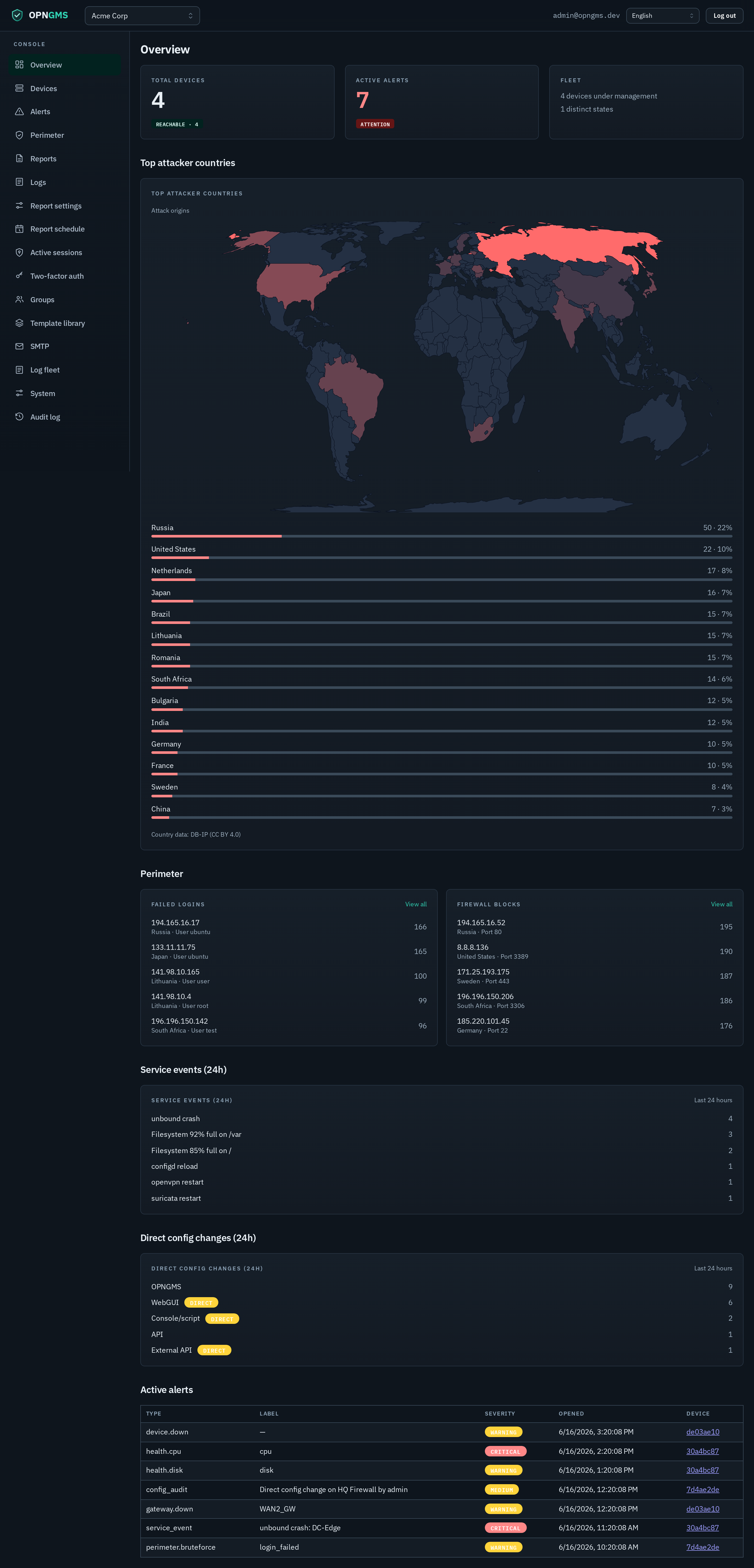
A per-tenant view of who is hammering the perimeter — failed admin logins and dropped firewall packets, grouped by attacker IP (app/services/perimeter.py). It rides the existing source-pluggable event ingest rather than introducing a new path, but deliberately stores a bounded rollup instead of per-packet rows.
-
Two new connector capabilities — the version-aware
OpnsenseClientgainsauth_failures(POST diagnostics/log/core/audit, paged like the IDS query) andfirewall_blocks(diagnostics/firewall/log), with parsers in the existing parsers module. Like every outbound call they go through the SSRF-guarded client; like every event source they advance a per-(device, source)IngestCursorwatermark, so re-polling never re-counts. -
Bounded rollup, not events — rather than appending per-packet rows to the
eventshypertable (which would grow without bound for a box under attack),ingest_perimetergroups the watermarked batch bysrc_ipand UPSERTs a dedicatedperimeter_attackertable keyed on(device_id, kind, src_ip)(kind ∈ {login_failed, firewall_block}). Each row carriescount,first_seen,last_seen, and adetailJSONB (top ports / attempted usernames). The table therefore stays bounded to the set of distinct attacker IPs, and is decoupled from both theeventstable and the existing IDS attacker-countries view. -
Failure-isolated cron —
ingest_perimeterruns inside the per-device events cron, wrapped in aSAVEPOINT, so a perimeter parse/UPSERT error rolls back only its own savepoint and can never roll back the IDS/DNS events ingest that shares the transaction. A separate dailypurge_perimetercron applies retention, keeping the rollup trimmed over time. -
Aggregation + API —
ReportAggregator.perimeter_topranks attacker IPs across the tenant's devices (SUM(count),MAX(last_seen), latestdetail) and resolves each IP's country via the GeoIP provider.GET /api/tenants/{tid}/perimeter/attackersserves both the Overview cards and the dedicated Perimeter page. In the PDF report the two perimeter sections are standard report sections —failed_loginsandfirewall_blockslive insections.py(SECTION_KEYS+BUILTIN_DEFAULTS, default on), andbuild_contextgates each one tenant-wide by its resolved section toggle (enabled["failed_logins"]/enabled["firewall_blocks"]), exactly likeattacker_countries. Toggle resolution follows the existingreport_settings.sections/report_schedule.sectionsprecedence.
Tenant isolation is enforced in the database with PostgreSQL Row-Level Security, not just in application code — a defence-in-depth design with two distinct database roles.
| Role | Used by | RLS | How tenant scope is applied |
|---|---|---|---|
opngms_app (non-superuser, NOBYPASSRLS) |
api (request path) |
Enforced | Every request sets app.current_tenant for the transaction (set_tenant_context); the RLS policy filters every tenant table |
DB owner (POSTGRES_USER) |
migrate, worker
|
Exempt (bypasses RLS) | Repositories are constructed with an explicit tenant_id that scopes each query |
How it works (app/core/db.py, rls.py, db_roles.py, deps.py):
-
Migration
0003creates theopngms_approle asNOSUPERUSER NOBYPASSRLS. PostgreSQL superusers always bypass RLS even underFORCE, so the API must connect as this non-superuser role for RLS to bite. -
Every tenant-scoped table (
devices,metrics,alerts,events,perimeter_attacker,config_snapshots,config_changes,report_settings,generated_reports,firmware_actions,template_overrides,report_schedule,device_log_forwarding,revoked_syslog_certs) isENABLE+FORCE ROW LEVEL SECURITYwith a singletenant_isolationpolicy:tenant_id = NULLIF(current_setting('app.current_tenant', true), '')::uuid
-
The
NULLIFmakes the policy fail-closed: ifapp.current_tenantis unset or empty it resolves toNULL, which matches no rows. A request that never went through the tenant dependency sees nothing. -
On the request path, the
require_tenant/ membership dependency resolves the caller's membership + role (RBAC), then callsset_tenant_context(session, tenant_id)for that transaction only before any tenant query runs. -
The
workerandmigrateconnect as the owner (RLS-exempt) because cron jobs operate across all tenants; they compensate by passing an explicittenant_idinto every repository and audit record. -
The new
perimeter_attackertable joins this set under the same sharedtenant_isolationpolicy — no bespoke RLS. Whether the perimeter data reaches the PDF report is not an RLS concern but a plain, tenant-wide report-section toggle (failed_logins/firewall_blocks), resolved bybuild_contextvia the existingreport_settings.sections/report_schedule.sectionsprecedence — exactly like every other report section.
See Security for the full threat model, credential encryption (MASTER_KEY / Fernet), CSRF, and session handling.
OPNGMS manages each firewall through OPNsense's own API — it is a client of that API, not a replacement for it. Its reach is bounded accordingly:
-
Bounded by the OPNsense API. OPNGMS can only do what OPNsense exposes over its API. Anything the firewall offers no API for cannot be automated from here — for example there is no firmware rollback or full
config.xmlrestore API, so neither is offered, and legacy non-MVC settings the API can't write are surfaced read-only in the liveconfig.xmlmap. As OPNsense widens its API surface, OPNGMS can cover more, but it never reaches past the API. -
Built from public, open-source OPNsense. The version-aware catalog — and the plugin coverage built on it — is generated from the public
opnsense/coreandopnsense/pluginssource. Community (public) plugins are covered; proprietary / Business-only plugins that are not published on public GitHub are not in the generated catalog. A Business box is still managed for everything its API exposes, but those closed plugins have no generated configuration models. See Configuration-Editor → Coverage limits.
| Layer | Technology |
|---|---|
| Backend | Python 3.14, FastAPI (uvicorn ASGI), SQLAlchemy async + Alembic migrations, arq task queue/cron, WeasyPrint (PDF), httpx (OPNsense + OpenSearch clients), cryptography/Fernet (secrets at rest), pyotp (TOTP) |
| Frontend | React 19, Mantine v9, Vite, TypeScript — single-page app served by nginx |
| Datastores | TimescaleDB (PostgreSQL 16 + Row-Level Security) for relational + time-series data; Redis 7 as the arq broker; OpenSearch 2.17 for the optional log lake |
| Infra | Docker Compose; pre-built multi-arch images from GHCR (ghcr.io/l0rdg3x/opngms-{backend,frontend}, published only from semver release tags, pinned by OPNGMS_VERSION); TLS via your own proxy or a built-in nginx / Caddy / Traefik overlay; syslog-ng 4.5 as the mTLS log receiver |
For setting up a local dev environment (Python venv, uvicorn --reload, Vite dev server) see Development.