Repository navigation
Translating
Since 0.47.0 the web console, the statistics page and graphs1090's page speak more than English, and since
0.51.0 the Bluesky posts do too, in the language chosen for them (SOCIAL_LANG). This page is for
the people who read a language and want it right: every language has a review sheet, the English beside the
translation, with a column for your correction. No account, no tool to install, no code.
| Language | Flag or picture | Since | Review sheet |
|---|---|---|---|
| English | United Kingdom and United States, cut along the diagonal | the reference | — |
| Français | France | 0.47.0 | fr.csv |
| Deutsch | Germany | 0.48.0 | de.csv |
| Nederlands | Netherlands | 0.48.0 | nl.csv |
| Italiano | Italy | 0.48.0 | it.csv |
| Español | Spain | 0.48.0 | es.csv |
| Português (Brasil) | Brazil | 0.48.0 | pt-BR.csv |
| Polski | Poland | 0.48.0 | pl.csv |
| Suomi | Finland | 0.48.0 | fi.csv |
| Eesti | Estonia | 0.48.0 | et.csv |
| Latviešu | Latvia | 0.48.0 | lv.csv |
| Lietuvių | Lithuania | 0.48.0 | lt.csv |
| Bahasa Indonesia | Indonesia | 0.48.0 | id.csv |
| Kiswahili | the map of Africa (spoken in many countries) | 0.53.1, not yet reviewed by a native speaker | sw.csv |
| हिन्दी | India | 0.55.0, not yet reviewed by a native speaker | hi.csv |
| Русский | Russia | 0.48.0 | ru.csv |
| Українська | Ukraine | 0.48.0 | uk.csv |
| العربية | its letter ʿayn, ع (spoken in many countries); right to left | 0.48.0 | ar.csv |
| 日本語 | Japan | 0.48.0 | ja.csv |
| 한국어 | South Korea | 0.48.0 | ko.csv |
| 简体中文 | China | 0.48.0 | zh-Hans.csv |
| 繁體中文 | Taiwan | 0.48.0 | zh-Hant.csv |
Swahili was translated in 0.48.0 and held back: 90% (the owner's bar) could not be promised, its technical words
differing between Tanzania, Kenya and the software glossaries. The owner published it on 22 October 2026 (0.53.1)
without a native review. Its sheet, sw.csv, is the place for a Swahili speaker's corrections: they are checked
against the English and applied like any other language's (tools/i18n.py apply sw.csv --dry).
Hindi came in 0.55.0 at the owner's request (25 October 2026), for the web pages and the posts. Asked first whether 90% could be promised for Tamil, Hindi and Urdu, the answer was: not without a native review, Hindi the easiest to reach. The owner asked for Hindi; it is published, like Swahili, without that review. Its words follow Indian software's usage (आप, सेटिंग, पासवर्ड), the aviation words are the usual Hindi ones (विमान, उड़ान, ऊँचाई), and the commands, names and unit symbols stay as they are. Plurals: one for 0 and 1, other beyond (CLDR). Large numbers on the statistics page follow Indian grouping (35.8 क॰, crore). Its sheet, hi.csv, waits for a Hindi speaker's corrections. Tamil and Urdu are not in: a native reviewer first.
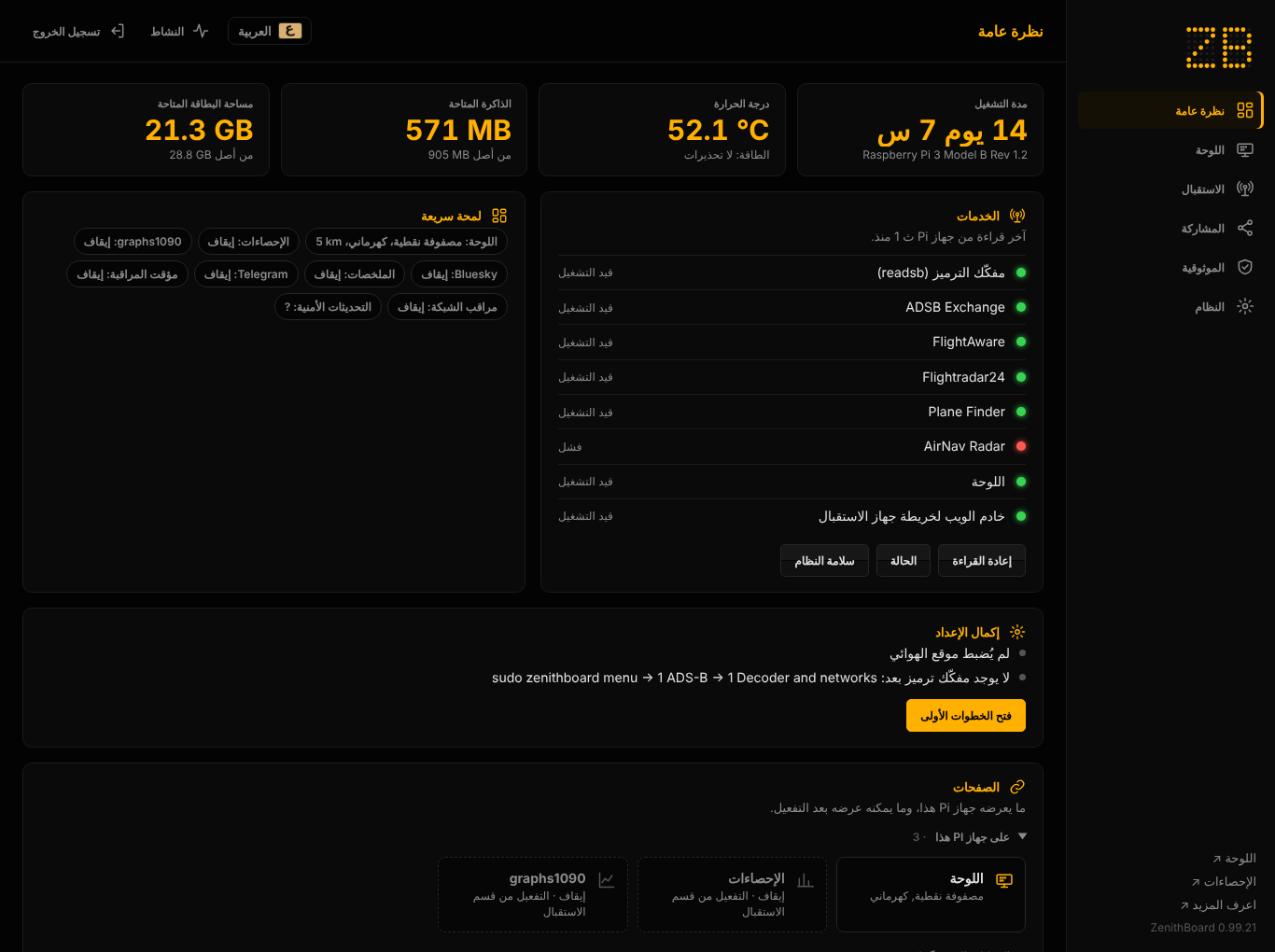
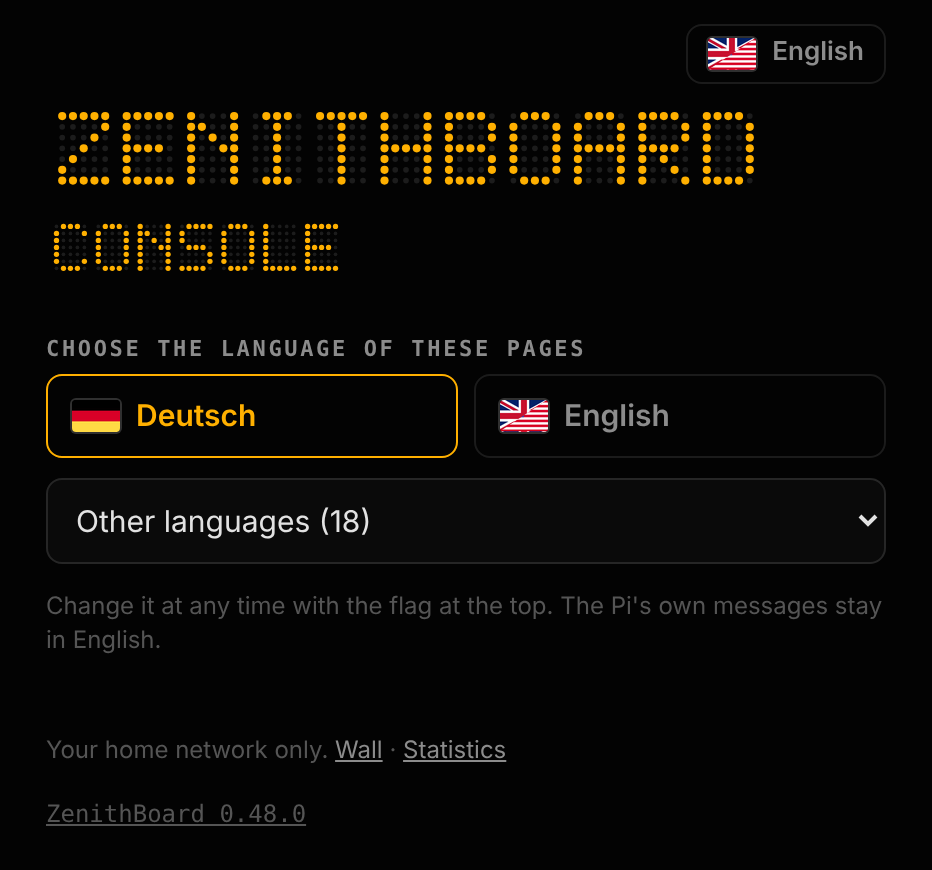
A language appears in the list at the top of the pages once it is translated; the first visit offers the browser's own language and English as two buttons, the others in one list. Hausa and Yoruba are not included (the owner asked for them unless their translation could not reach 90%): Yoruba's tone marks and the technical vocabulary of both are beyond what a machine translation gets right reliably. A native speaker who wants either can start a sheet: the owner opens an issue, and the language comes in once its sheet is filled.
The translations are first made by the session that builds each release, aviation words checked against each
language's own use; the review sheets are there so that someone who speaks it every day corrects them. Every
correction is checked against the English before it goes in (apply --dry, below); one that does not say what the
English says is not taken, and the reviewer is told why.
-
Open your language's sheet (the links above). On GitHub it shows as a table you can search; the Download raw file button gives the file.
-
Open it in LibreOffice Calc, Google Sheets or Excel (Excel: Data → From Text/CSV, file origin UTF-8, so the accents read right), and save it the same way: Excel's CSV UTF-8, LibreOffice's Unicode (UTF-8) character set. A plain CSV from Excel loses every letter outside the computer's own alphabet;
applyrefuses it and says so (0.54.12). The columns:Column What it is idThe row's number, to talk about it pageconsole,stats,graphsorposts(the Bluesky posts' words: a[part]is left out when a tag inside it is empty,{tag|cap}takes a capital letter);[plural: one]/[plural: other]/[plural: many]for the forms of a countwhereThe file it comes from englishThe reference translationWhat the page shows today correctionYours: write the right text here, leave it empty when the translation is fine commentWhy, if it helps (a usage, a nuance) -
Keep what is between braces exactly as it is —
{name},{n},{time}: the page puts a value there — and keep tags like<a>…</a>or<b>…</b>around the same words (they are the links and the bold). Move them in the sentence as your language needs. A correction that drops or renames one is refused, and said. -
Commands (
sudo zenithboard …), names (ZenithBoard, Bluesky, Tailscale, graphs1090) and menu entries of the terminal stay in English: the terminal and its menu are English. In Arabic, a menu path or a command left in English sits between two invisible marks, U+2066 and U+2069 (a left-to-right isolate), so that 7 Options → 4 Web console keeps its order inside the right-to-left sentence (0.99.21): keep them around it in a correction. The values the page puts in a sentence ({city},{dist},{n}) are isolated the same way by the page itself. The word in dots at the top of the statistics page and graphs1090's page (STATISTICS,GRAPHS) is written with its accents (ESTADÍSTICAS, GRÁFICOS): the dots, which have no accented letters, leave them out, and the page's name for screen readers keeps them. A language whose letters the dots do not have keeps the English word. -
Send the sheet back to the owner (an issue on GitHub with the file attached, or as you usually reach him). Saved as CSV, with commas or semicolons: both are read.
Editing it directly on GitHub (the pencil on the file) also works: it proposes the change for the owner to accept.
cp ~/Downloads/fr.csv /tmp/fr.csv                  # its name says the language: fr.csv, pt-BR.csv, zh-Hant.csv
python3 tools/i18n.py apply /tmp/fr.csv            # in a copy of the repository
python3 tools/i18n.py check fr                     # nothing missing, nothing broken
Before taking anything, python3 tools/i18n.py apply /tmp/fr.csv --dry lists each proposal beside the English and
today's translation: check each one says what the English says (a reviewer's local word for a term is welcome, a
changed meaning is not). Rows found inexact are left out with --skip ID,ID (their ids from the first column).
apply takes each row whose correction is filled in, applies it to the same English on the other pages too, keeps the old catalogue as .bak, refuses a correction that
loses a placeholder or a tag (and names the row), and writes the sheet again with the new translations. Then the usual
release: the change, its tests, a version, the PR. On the Pi: cd ~/ZenithBoard && sudo zenithboard update quick.
A plural row (posts [plural: one]) carries the whole entry in its translation column, {"one": …} with its quotes
doubled by the CSV. Since 0.53.4 apply reads those right. Before, the corrections of such rows came out ending in
""}, so a --dry that shows that is a reason to stop. A row whose correction is an instruction ("also fix the
sibling key…") is refused for its placeholders: it is done by hand, after reading it, or left out.
The first review, 23 October 2026 (0.53.4). Sheets for all 20 languages came back with 194 rows (153 with a correction):
-
149 corrections taken after
--dry. Most fix the case after a number (Polish, Ukrainian), the hour written the language's way (Japanese, Finnish, Indonesian), one term used everywhere ("callsign", "aircraft"), the menu's own names (Menü, menú, меню), and French's space that does not break before: ; ? !. -
Left out:
- Chinese (Simplified) fix-1, inexact: the look-up post already reads "正在 10.7公里 高空", and the proposal lost "at that height".
- Traditional Chinese fix-6, an instruction about spaces around
{what}: waiting for a decision.
-
Done by hand, from their notes:
- Russian: "за последнюю {n} минуту" in both track captions;
- Indonesian: "tanda panggil" for callsign everywhere;
- French: "24 dernières heures" in the three places that still said "dernières 24".
- 41 rows marked à trancher, one reviewer out of two, with no correction filled in, were not applied at first. The owner chose their first proposal the same morning; it went into 0.53.5 after the same placeholder check. Two are plural entries (Polish's distinct aircraft on the statistics page, Swahili's posted crossings).
- The English text is the key: in the pages' scripts every word shown goes through
t("…")(tn(n, "one", "other")for a count), and a static page's text is markeddata-t. A missing translation shows the English. - Catalogues:
flightinfo/static/i18n/<lang>/console.json,stats.json,graphs.json; the reading side isflightinfo/static/i18n.js. The posts (0.51.0):posts.json, read byflightinfo/post_lang.py. Its keys are found insocial.py,social_week.pyandsocial_card.py(L.t("…"),L.tn(n, "one", "other"),N_("…")). They are templates:{tags},{tag|cap}, and[parts]left out when a tag inside is empty, kept balanced bycheck. The sheets list them under the page posts. - What is not words comes from Unicode's CLDR through Node:
node tools/make_post_locale.jswritesflightinfo/data/post-locale.json. It holds the decimal and group signs, the day-and-month pattern, a span of days, the weekdays, the country names, the clock (0.52.1:{h}.{m}in Indonesian and Finnish) and the metric units ({n} км/ч; Arabic's metre by plural category).tests/fixtures/plurals.jsonholds the plural forms thatpost_lang.py's rules are held to. -
python3 tools/i18n.py keyslists every key;sync LANGadds the new ones and drops the old;checksays what is missing or broken;review LANGwrites the sheet. A change to an English string means its translations and its sheet in the same commit:tests/test_i18n.shfails otherwise. - A language whose folder holds
draft.txtis complete but not offered: the way to hold one back until it is reviewed. None is held back since 0.53.1 (Swahili was, from 0.48.0). - The language codes are listed in five places that the tests hold together:
lib/common.sh,console_actions.py,i18n.js,tools/i18n.py,post_lang.py.
More: Translation plan · Web console.