Repository navigation

Stride 4.4 is one of the largest updates the engine has received in years, with roughly 3200 commits since the previous version!
The main focus of this release was on modernization and reach, which includes much more stable Vulkan and Direct3D 12 backends, support for non-Windows platforms no longer being experimental and an overhaul of the shader compiler.
This update also includes many exciting new features, such as a CLI tool, ability to replace read-only assets and much more.
Highlights
Here are a few of the stand-out changes:
📱 Platform support
So far, Stride has mostly been a Windows-first engine. Other platforms were supported, but creating and running games on them would often lead to many problems. This update changes that.
All platforms have been brought back into shape and the test suite for them has been expanded to make sure they won't fall behind again. Additionally, with changes to the asset compiler, building projects on Linux and macOS now works the same as it does on Windows.
For Linux users: this release removed some legacy code which now makes it possible to use Game Studio on Linux via Proton/Wine. The experience isn't as solid as on the native Windows version, but it's still a big step forward for Linux development. If you'd like to try it out, we have created a guide that's available in the documentation.
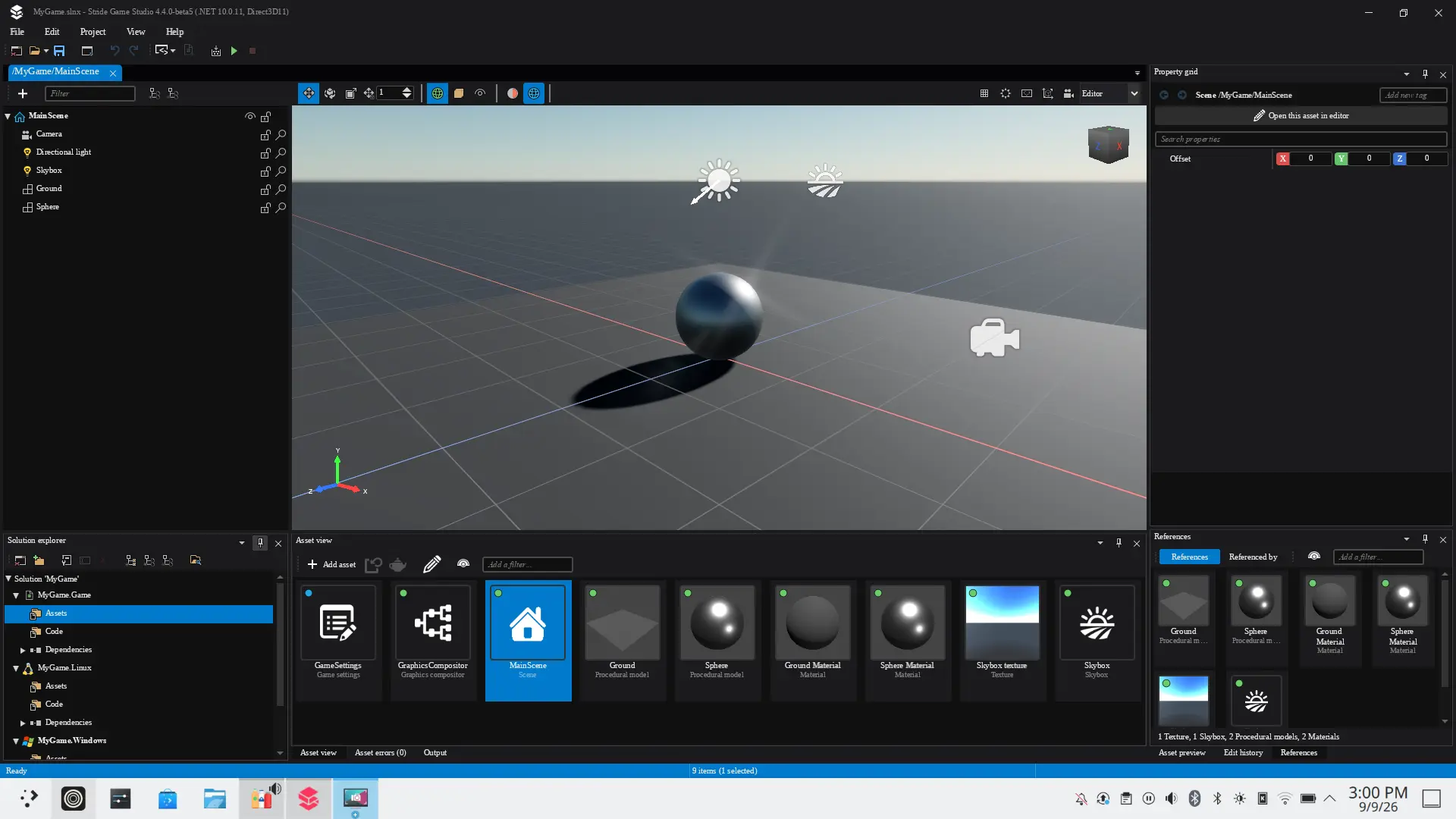
Note
Game Studio is being rewritten to be cross-platform.
Credits to Jklawreszuk for doing research and creating patches that enabled Proton support.
⌨️ New stride CLI tool
Some tasks that previously required the use of Game Studio or the launcher can now be done directly from the command-line! By using the CLI tool you can install and manage versions of Stride, create new projects and launch Game Studio with simple commands.
For more information, visit the Stride CLI page of our documentation.
dotnet tool install -g stride.cli      # Install Stride CLI
stride sdk install                     # Install the latest version of Stride
stride new topdownrpg && cd TopDownRPG # Create a project from a template
stride studio                          # Open it in Game Studio
dotnet new templates are also available if you'd rather use the standard .NET tooling directly:
dotnet new install Stride.Templates
dotnet new stride-game -n MyGame
🎮 Vulkan & Direct3D 12
Both APIs have received a large overhaul. They're now solid enough that we plan to make one of them the editor default and potentially remove Direct3D 11 in the next major release.
This overhaul also made it far easier to track down GPU crashes, as Stride can now pinpoint the exact rendering step that caused a device hang.
Note
If you write custom low-level rendering code, note that Direct3D 12 and Vulkan now use an explicit barrier/layout model. Direct3D 12 also requires Enhanced Barriers.
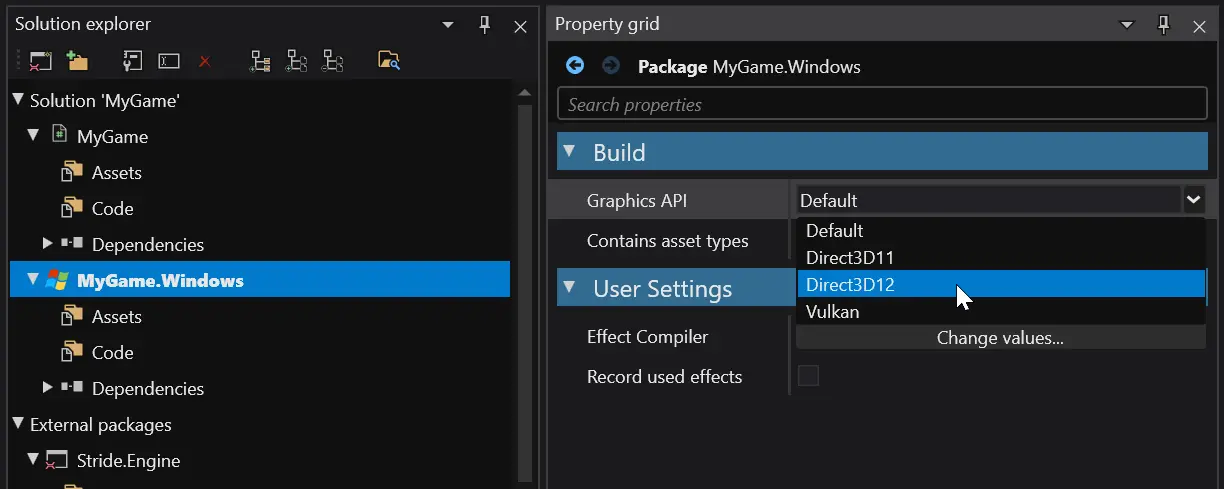
You can now pick the graphics API right from the UI for both your project and the editor. Game Studio can be configured in Settings > Environment > Graphics API (takes effect after a restart) and the game in the properties of the Windows package.
🎨 A brand-new SDSL shader compiler
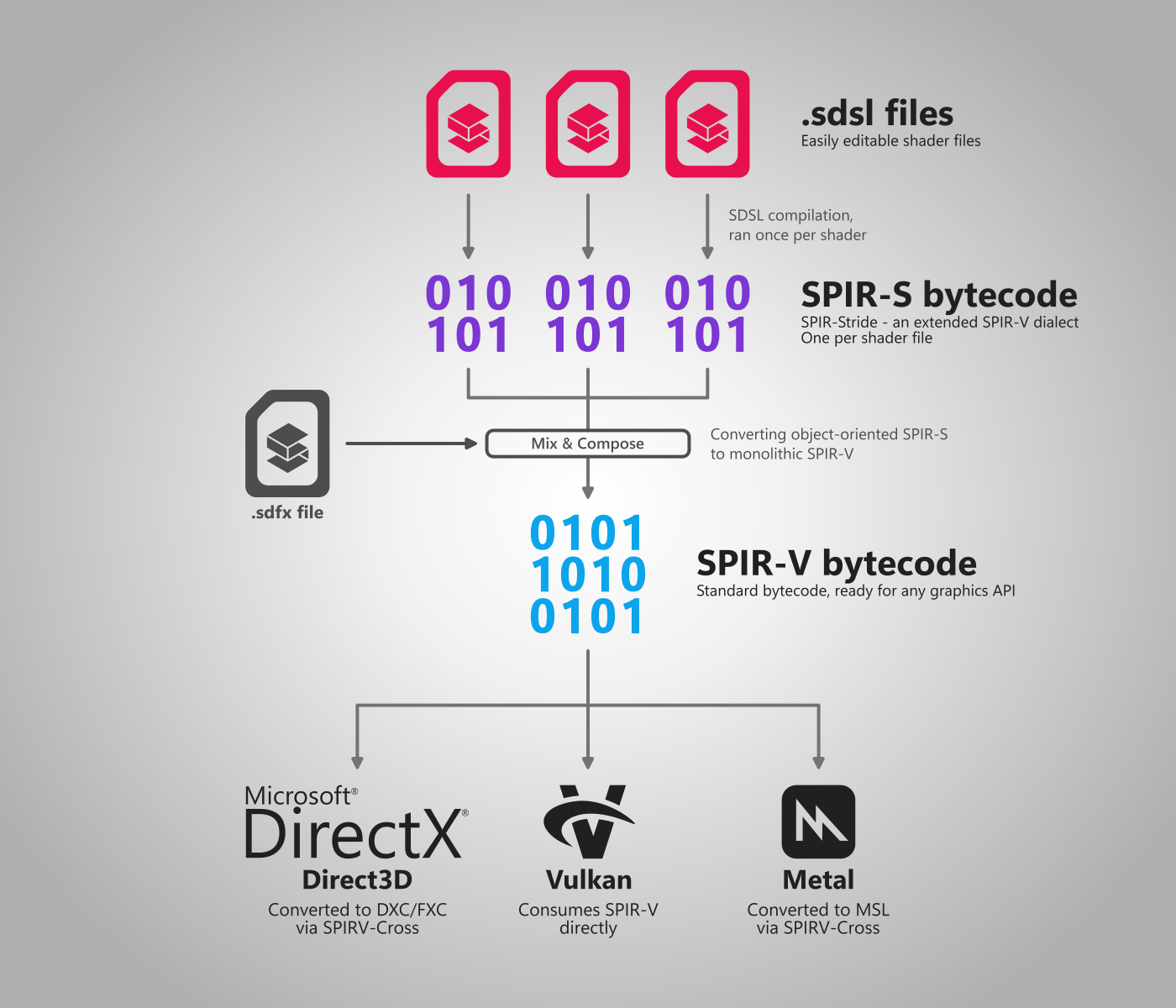
The biggest internal change in 4.4 is a complete rewrite of the SDSL shader compiler, now built around a modern SPIRV-centric pipeline.
Instead of parsing and stitching shaders together as text, Stride now works in SPIR-V bytecode end to end:
- Each
.sdslshader is parsed once and compiled into its own SPIR-S module (SPIR-Stride, Stride's extended SPIR-V dialect). - Effects (
.sdfx) then mix and compose those modules directly as bytecode, converting the result to standard SPIR-V for the GPU backend. - Crucially, text parsing happens only at that first step: recombining a new shader variation from already-compiled SPIR-S needs no re-parsing.
What this means for you:
- Much faster shader handling. Generating the many shader permutations a game needs now works directly with byte-code, without a need to re-parse any text.
- Improved stability. Stride now uses battle-tested tools in order to handle conversion between different Graphics APIs.
- Far better support for advanced features. Direct3D 12 and Vulkan now handle things like tessellation and compute shaders much more reliably.
- A future-proof foundation. With a real SPIR-V pipeline in place, adding modern GPU features such as ray tracing, mesh shaders/meshlets and wave intrinsics becomes much easier going forward.
Warning
Because the entire shader compiler was replaced, custom .sdsl shaders may need minor adjustments to compile cleanly. If you encounter any problems, please open an issue on GitHub so we can fix it.
Huge thanks to Youness Kafia, whose early prototyping and experimentation laid the foundation for the new SDSL pipeline.
⚡ NativeAOT & trimming support
The engine is now NativeAOT and trimming-friendly. This unlocks smaller, faster-starting, self-contained game builds. For more information on how to use this, visit the documentation.
📦 Improved assets and content workflow
Stride 4.4 makes it easier to work with assets through code thanks to the automatically generated Assets class, which provides strongly typed URL constants for all assets in your project. Now when you rename an asset, you will get build errors instead of a "content not found" message during runtime.
// Old approach
var playerModel = Content.Load<Model>("Models/Player");

// New approach
var playerModel = Content.Load(Assets.Models.Player);
Asset paths from external packages now begin with a namespace, to ensure there are no conflicts between different libraries. This won't break your existing projects, as the paths will be automatically changed in your code during the upgrade.
Adding assets to root now defaults to using the project package that an asset belongs to instead of the current one (like MyGame.Windows). This ensures that your assets work the same across different platforms. Game Studio also now tells you the name of the project package where the asset will be root and allows you to choose from alternatives.
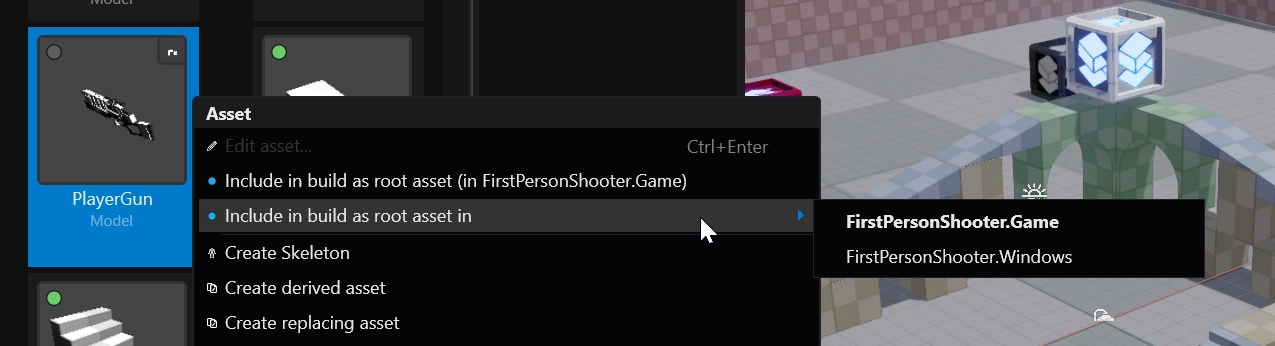
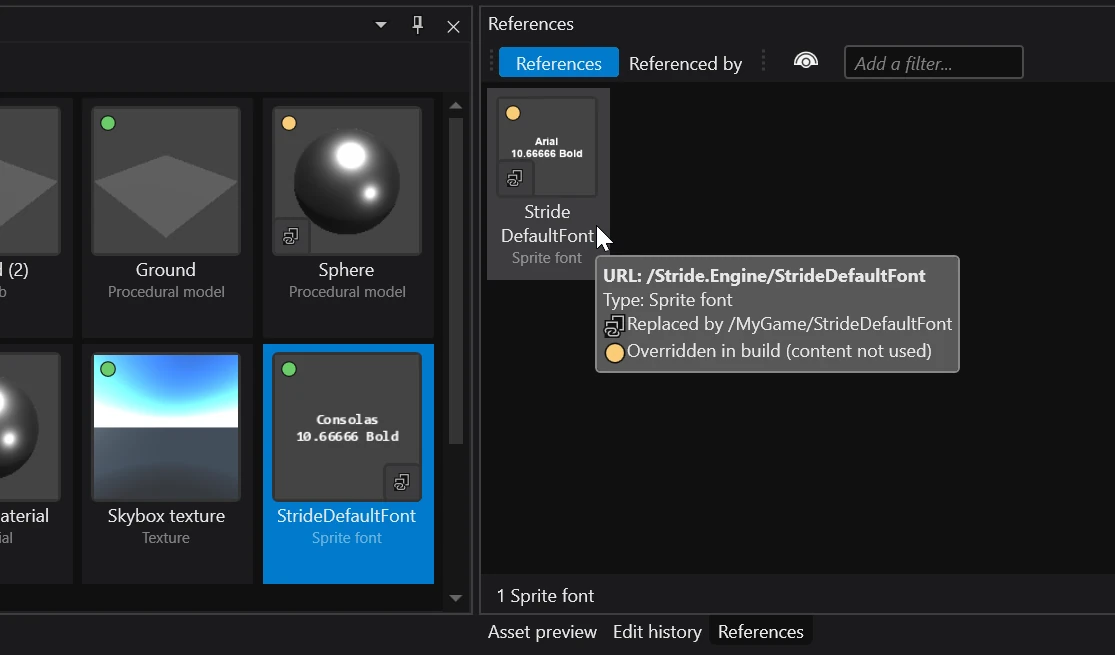
Finally, Stride now allows you to create replacement assets, which can be used to override assets from external packages or even the engine itself. For more information, visit their dedicated page in the documentation.
🚀 Launcher update
Along with 4.4, we also released an update to the launcher. On the surface, everything is mostly the same, aside from a minor face-lift. The real change comes under-the-hood with the launcher now using Avalonia as its UI framework, which will make it possible to target Linux and macOS in the future.
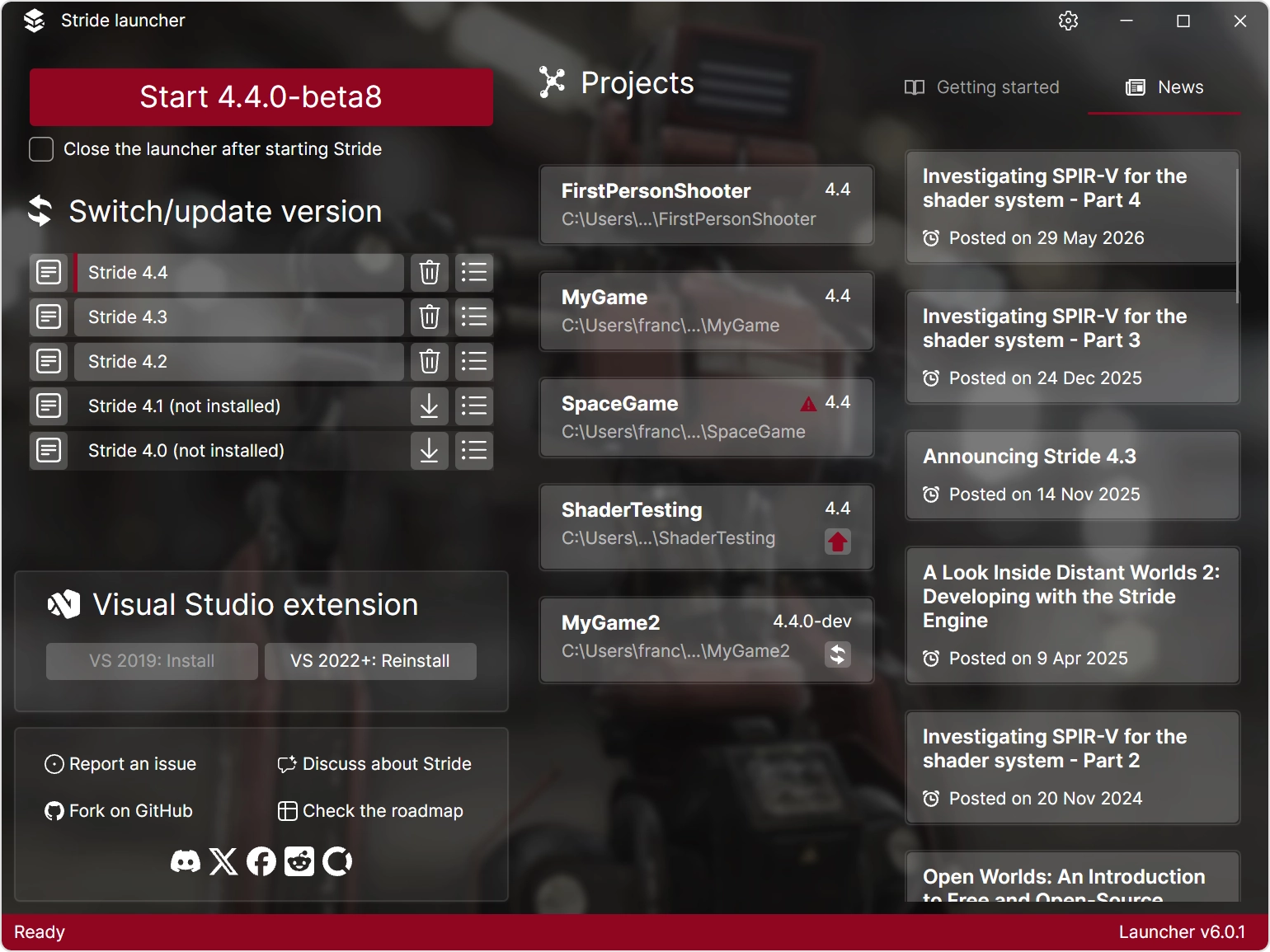
The new launcher is a part of the ongoing cross-platform editor rewrite. This is an enormous endeavour that will take a lot of time and effort, so if you are willing to help, check out the white paper and the Avalonia Editor Rewrite project on GitHub.
Credits to Kryptos for leading the avalonia rewrite and doing most of the work on the new launcher.
🧰 Building and engine architecture
- Much faster asset builds. Assets compile 2x faster for a typical game, and up to 10x faster for Stride's own tests, thanks to a new asset-build cache.
.slnxis the new default solution format. Existing.slnsolutions still open and save normally.- Game Studio can now open projects that use newer versions of .NET. You can use the newest C# features in your projects without having to update or fork the engine.
- Support for file-based apps. You can now create a Stride game using a single C# file. For more information, check out the community toolkit.
- Dropped support for 32-bit. The engine now only targets modern 64-bit systems.
⚙️ Changes to the physics CharacterComponent
While our integration of the Bepu physics engine is definitely mature enough by now, the CharacterComponent we introduced was not as well put together as it ought to have been.
- The gravity you may set would be mutated internally to prevent the body from sliding down slopes.
- Moving surfaces would not carry the character along with them.
- Moving past a slope would cause the character to fly off.
- Forces applied to bodies, and especially constraints, required unintuitive tweaks to work.
We looked at Bepu's own character example to solve these issues. Unfortunately, we could not avoid introducing a fair amount of breaking changes. Fortunately, we added a couple of sections in Characters to describe the new features and properties.
📖 Documentation
Since 4.3, our documentation has received a lot of changes. This is a part of an ongoing effort to bring the documentation up-to-date and restructure it to provide space for future content.
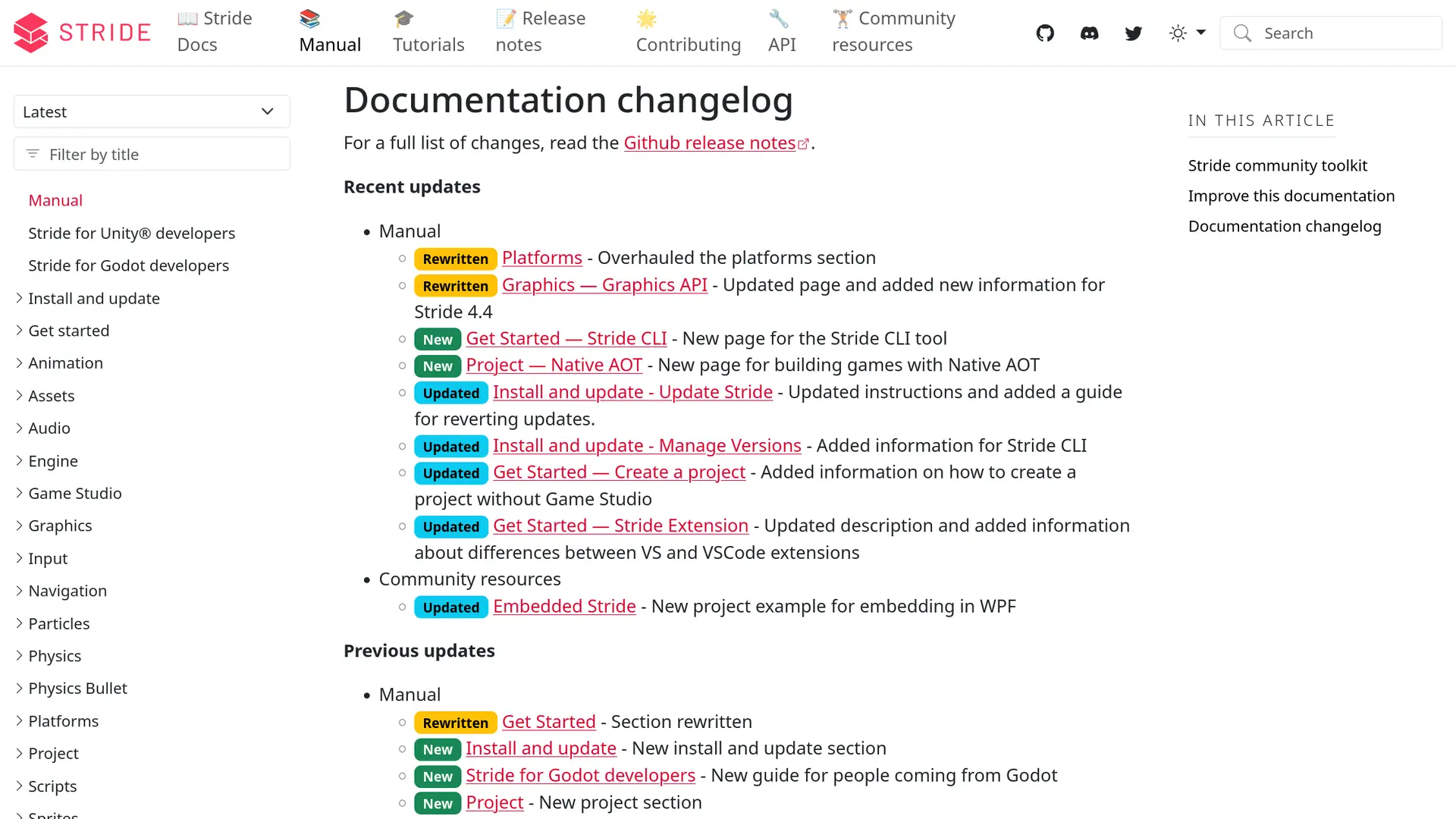
- Get started and Platforms have been rewritten from scratch.
- New sections: Assets, Install and update and Project.
- New pages for new features: NativeAOT, Replacement assets and Stride CLI.
- Brand new guide on how to build and publish games (link).
- Updated instructions on publishing custom external packages (link).
- Removed outdated sections and pages.
We have also started documenting parts of Stride's internal architecture in the main engine repository to help other contributors navigate this large codebase. A copy of these pages is available on the documentation website.
📈 Metrics and crash reports
Game Studio is now telemetry-free! We removed legacy metrics code, as it was mostly broken and the data collected with it didn't see much use. However, we are looking into reintroducing it in a future update as an opt-in system.
The crash reporter has been overhauled from the ground-up. It now runs independently from Game Studio and the launcher, which should make it much more stable compared to the old version.
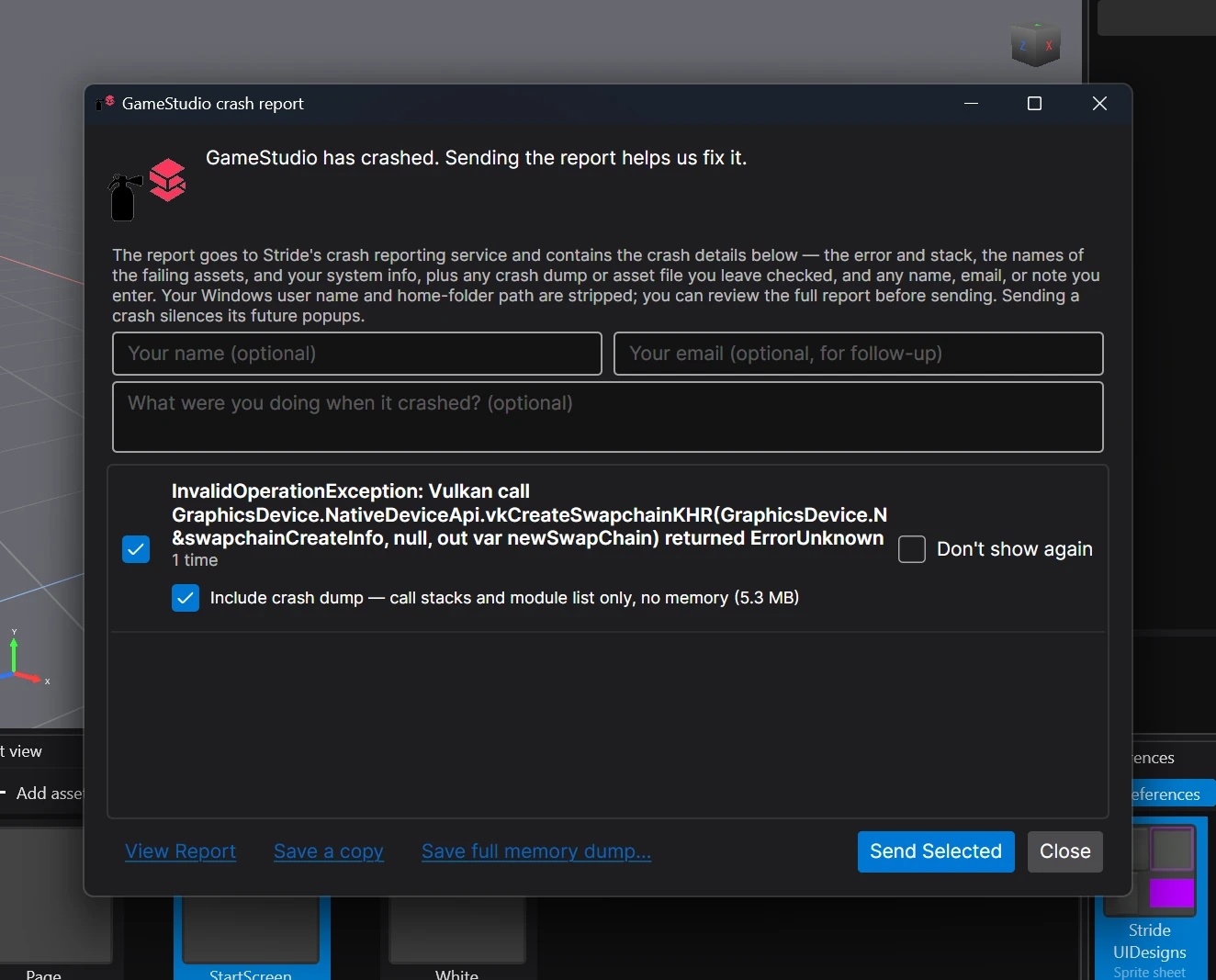
Crash reports can now be sent with a single button via Sentry. This should make it easier for us to fix common errors and improve engine stability. For full transparency, here are some notes about how crash data is collected and reported:
- You are in control. You can customize and view crash reports before they are sent.
- No automatic telemetry. Crash reports cannot be sent automatically without your consent. Note that failed uploads will be kept and sent later.
- All reports are private. Only certain core-contributors have access to the Sentry dashboard, which is the only place where crash reports can be viewed.
- Anonymity. The crash reporter masks user names, device timezone and other information that could be used to retrace your data back to you.
🧪 Quality & CI
These changes don't affect the engine directly, but they impact how confidently you can contribute back to its code.
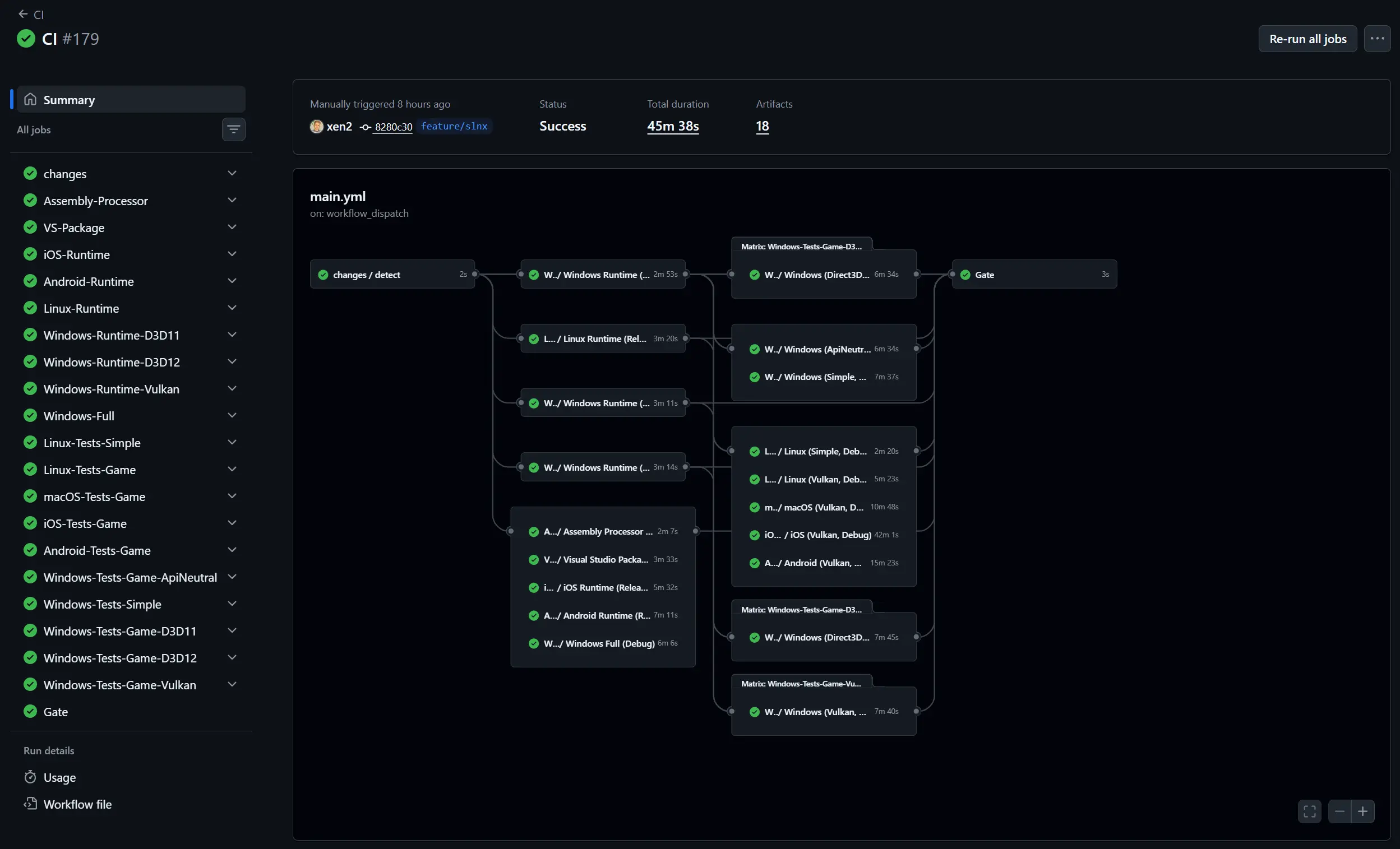
Stride 4.4's test suite has been greatly expanded. Instead of being occasionally invoked for a few specific configurations, the CI (Continuous Integration) now runs the entire test matrix across all platforms and graphics APIs.
Regressions on any platform or backend are now caught automatically before any change gets merged. This means that you can confidently open a pull request and trust the CI to prove it works everywhere.
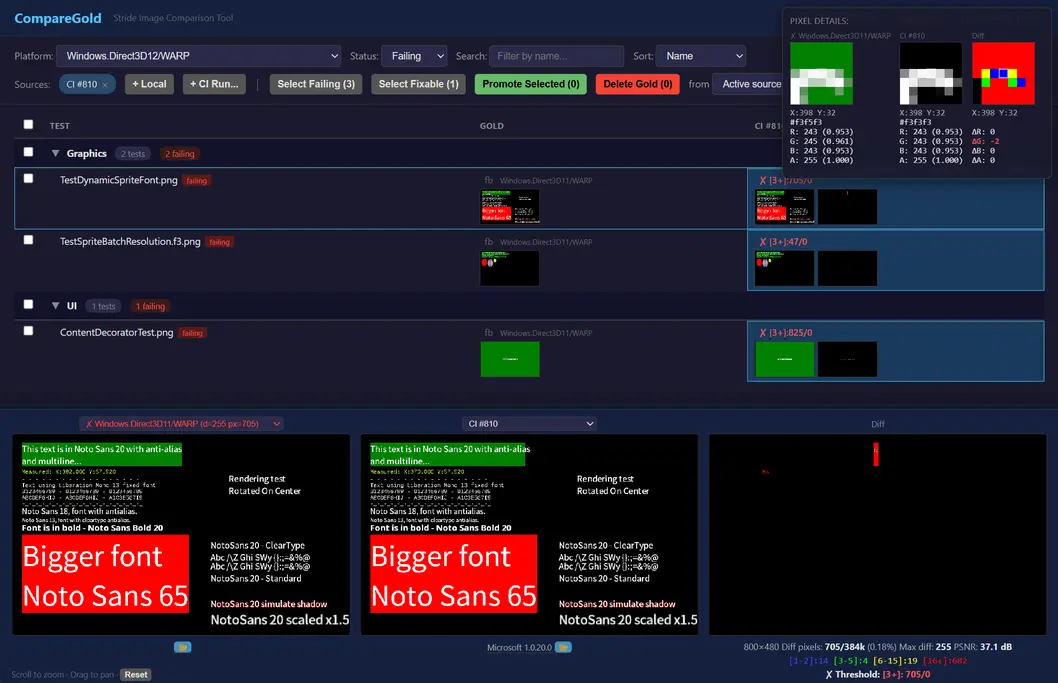
Our gold-image workflow has also received many improvements. For those unaware, Stride uses pre-taken screenshots (gold images) and compares them to new ones in order to test if its rendering capabilities work as intended. Of course, there are always small couple-pixel differences, even when comparing the same version, which is why it's important to have proper tooling.
The new CompareGold tool helps visualize differences between images and determine if something is wrong. It also makes it easier to promote images (replacing old gold images with new screenshots) and even pull results directly from any CI run or fork. For more information, check out GPU Regression Testing in the engine repository.
The CI can also now automatically generate gold images for every platform. This means that you no longer have to waste time retaking screenshots by hand, as the Test Gold Generation workflow will do it for you.
Breaking changes
- Custom shaders: the SDSL compiler was rewritten, so you might want to review how your custom shaders render. If you have a shader that no longer compiles or behaves differently, please open an issue on GitHub so we can fix it.
- Low-level graphics: Direct3D 12 now requires Enhanced Barriers. The legacy barrier path has been removed.
- Vulkan updated to 1.3: this might break support for older devices and users with outdated drivers.
- OpenGL has been removed: consider changing the graphics API of your project to Vulkan or Direct 3D.
- Convex hull changes: the library we use to generate convex hulls (V-HACD) was updated. This new version improves on speed and accuracy, but has a wildly different set of configurable parameters, so you may want to validate them for accuracy.
- Bepu
CharacterControllerwas reworked: existing character setups will behave differently and need adjustment. See ⚙️ Changes to the physicsCharacterComponent. - Removed the ability to override Game Settings: the feature was partially broken and not really that useful, which is why it was decided to remove it altogether. If you want to change settings depending on a user's platform/device, consider creating a custom Game class.
- Dropped support for 32-bit systems.
Changes to code API (should be automatically resolved during project upgrade):
GameSettings.Configuration.Get<T>is nowGameSettings.GetOrCreateConfiguration<T>Utilities.CopyWithAlignmentFallbackis nowMemoryUtilities.CopyWithAlignmentFallback.Utilities.Clearis nowMemoryUtilities.Clear.Utilities.AllocateMemoryis nowMemoryUtilities.Allocate.Utilities.AllocateClearedMemoryis nowMemoryUtilities.AllocateCleared.Utilities.FreeMemoryis nowMemoryUtilities.Free.Utilities.IsMemoryAlignedis nowMemoryUtilities.IsAligned.Utilities.Swap<T>is nowMemoryUtilities.Swap<T>.ScrollViewer.ScrollOfInternalis now private.
What's Changed
Auto-generated; a maintainer may hand-edit.
🎮 Graphics
- Vulkan and Direct3D 12 got a large overhaul and are much more stable. Both now use explicit resource barriers, Direct3D 12 requires Enhanced Barriers, and Vulkan moves to version 1.3 with dynamic rendering (@xen2, #3122, #3337, #3338, #3466, d3ac111; @sasvdw, #3324, #3311)
- Direct3D now runs on Silk.NET instead of SharpDX, and the graphics libraries were updated (@Ethereal77, #1715; @VaclavElias, #3294; @w0wca7a, 8ef20fd; @Feralnex, #2991)
- Removed the OpenGL and OpenGL ES graphics APIs. Use Vulkan or Direct3D instead (@xen2, #3069)
- Choose the graphics API from the UI: for Game Studio in Settings, and for your game in the Windows package properties. Game Studio offers a fallback when the saved API isn't available (@xen2, 53e49d4, f07623b, faf2304)
- A lost graphics device (driver crash, GPU removed) now stops the game cleanly with a clear exception. Before, it could crash, freeze or be ignored (@xen2, #3476)
- Fixed Vulkan crashes and glitches: when resizing the window, when closing the scene editor, with Local Reflections, with thumbnails, with the profiler overlay, on Linux windows and on Android after suspend, resume or screen rotation (@xen2, 5bd99d5, 366665c, #3400, #3465, 640b3c5, 4695607, 628a59b, 746720e; @sasvdw, #3287, e5f61cd)
- Vulkan textures now report the depth-stencil format the device actually uses (@xen2, #3427)
- Fixed Direct3D issues: Direct3D 12 reported more MSAA samples than supported, Direct3D 11 GPU timing queries read results too early, and the timestamp frequency had a different type on Direct3D 11 (@xen2, 8c82860, 0d07705, 130d14a)
- Fixed games that sometimes hung on exit while waiting for the GPU (@xen2, #3217, 4ce8295, 6cfd56b)
- Fixed a zero-sized window or crash after minimizing and restoring, and the window position is now only restored when leaving fullscreen (@xen2, #3300, 79ce727)
- Fixed voxel global illumination (@Nicogo1705, #3382, #3449)
- Fixed lighting and post-effect bugs: bloom no longer breaks on infinite or NaN values, environment light prefiltering is more accurate, the -Z face shows correctly in the cubemap cross view, alpha-tested shadow casters shade correctly, and the shadow map shader overrides were restored (@Nicogo1705, #3429; @sasvdw, #3341, #3330; @xen2, 6f1e300, 26db1ae, a12f7ea; @Eideren, #3038)
- Restored the blend settings of thin glass and SpriteStudio, and fixed saving blend state descriptions (@VaclavElias, #3501; @xen2, 9e873cc)
- Fixed a texture streaming crash with textures whose size isn't a power of two (@xen2, d1ff2c8)
- Fixed wrong normals on scaled procedural models, and a crash when comparing index buffer bindings (@Basewq, #3308; @johang88, #3078)
- One render stage can now render to several output formats (@xen2, 373dacd)
- The editor's fallback effects now draw tessellated meshes without tessellation, and each resource group keeps its own constant buffer (@xen2, #3475, #3479)
- The Null graphics backend compiles again (@sasvdw, #3371)
🔤 Fonts & images
- Load fonts at runtime (@VaclavElias, #2981)
- Fixed text rendering: glyph edges no longer bleed, the EditText caret and selection line up, kerning is correct, dynamic glyphs no longer show up blank or late, and FreeType was updated (@xen2, #3131, 4f53ce8, b1a5609, c5f6c51, 526128e, 7128ee1, #3129; @Eideren, #3058)
- System fonts are replaced with matching equivalents on Linux and macOS (@xen2, b8b16f6, 5e3819e)
- Fixed a crash in the debug text renderer, and the first debug text message is no longer skipped (@BenjaBobs, #3376, #3378)
- Loading and saving images from memory works on every platform, and
Image.Load/Texture.Loadhandle alpha the same way everywhere, with a newAlphaLoadModeoption (@Jklawreszuk, #2689, #3000; @xen2, #3190) - Fixed JPEG save quality, compiling very small textures, and resizing textures that aren't 8 bits per channel (@Ethereal77, #3034; @Basewq, #3125; @xen2, #3446)
🎨 Shaders
- Rewrote the SDSL shader compiler around a SPIR-V pipeline. Custom shaders may need small adjustments (@xen2, @ykafia, #3134)
- Fixed parser bugs: trailing-dot floats like
1., integer suffixes after0and on hex literals, binary expressions inside vector constructors, a dangling.or[, and numbers on non-English systems (@azeno, #3421, #3412; @Nicogo1705, #3467; @xen2, #3426; @sasvdw, #3325) - Fixed compiler crashes: a field named like a built-in method, calls to abstract methods, and geometry shaders reading input arrays directly (@azeno, #3391, #3413, #3422)
- Fixed wrong shader output: multidimensional arrays,
Buffer<T>element types, matrix truncating casts, eye data in multi-view, integer math in float expressions,SV_Coverage, entry point overrides, and code that HLSL conversion rejected (@sasvdw, #3293, #3431, #3304; @xen2, #3333, #3409, #3411, #3447, 37812f2, 3456cd1, b20f6ac; @Eideren, #3408; @Nicogo1705, #3468, #3450) - Constant expressions are now evaluated, so switch labels can be constants. A method that matches an inherited one without
overrideis now a compile error. Generic shaders and loop attributes are handled more reliably (@xen2, #3453, #3454; @VaclavElias, #3493; @Nicogo1705, #3389) - Shader classes keep their attributes, and the shader API gained
BinaryOperator.AddMathplus a small cleanup (@azeno, #3381; @Eideren, #3436, #3407) - Shader hot-reload works more than once, shaders no longer recompile endlessly, and you can opt out of loading shader source from its original location (@xen2, #3410, cc7ca73; @azeno, #3105)
- Clearer error when a stream is read before it's written. Fixed the precompiled shader batch file and a shader converter library conflict (@xen2, 33e1ed2, 653b8cb in #3069, 5ea321b, 18786dd)
📱 Platforms
- Linux and macOS builds now work like Windows, including building assets, with Vulkan on macOS through MoltenVK (@xen2, #3127, #3187, 9b176cb, dd7614a; @Jklawreszuk, #3152)
- iOS works again on devices and the simulator, with new video and audio backends on Apple platforms (@xen2, #3215)
- Android brought back into shape, including a fix for Android project builds failing (@xen2, #3194, 842ac4b; @Feralnex, #3070)
- The engine supports NativeAOT and trimming, for smaller, faster-starting builds (@xen2, #3204)
- Your game can use a newer .NET than Game Studio, which restarts itself on that version when needed. The engine is also ready for .NET 11 (@xen2, #3440; @Eideren, #3351)
- Dropped 32-bit (x86) support and old Windows 7/8 prerequisites (@xen2, #3181, 9bd76ff)
- Native libraries load more reliably and can be linked with LLVM's lld on Windows. Added Windows on Arm support for the shader converter (@Ethereal77, #3033; @xen2, 6c1259a, 6de4a65, #3434; @Kryptos-FR, #3045; @delustra, #3420)
- Windows video playback no longer depends on SharpDX (@azeno, #3032)
📦 Assets & content
- Asset paths now carry a package namespace so assets from different packages don't collide, with an automatically generated
Assetsclass of typed asset paths. Existing paths are updated during upgrade (@xen2, #3270, 0cb7693, 8f74993, 9eef715, 748e736, c818a30) - Replacement assets let you override assets from external packages or the engine itself (@xen2, #3295, 03edac1, 46c0de5)
- Faster asset builds: one build cache shared by the editor and every platform, cleaned up automatically, and the asset compiler reads a small build manifest instead of re-scanning your projects (@xen2, #3271, #3219, 442eca8)
- Adding an asset to root now uses the package the asset belongs to, and Game Studio lets you pick another one (@xen2, #3435)
- Project upgrades back up changed files first, ask once before writing, show progress, update your code automatically (for example renamed
Utilitiesmemory helpers andPixelFormatmembers), and work on projects without a solution. Very old pre-4.0 upgrade paths were removed (@xen2, #3244, 49607a7, 7571ad0, 0ac3fe9, e208935, ee76532, 4e340c2, f10df72, e8f751c) - Removed Game Settings overrides (@ferafiks, #3343)
ContentManager.Loadnow always throws with a clear message when an asset is missing.LoadAsync/ReloadAsyncbecame extension methods inStride.Engine(@xen2, #3327, #3169)- Fixed loading of the assets a runtime-created material references, and of serialized values whose type changed (@sasvdw, #3370; @xen2, #3305; @Eideren, b309fa0)
- Asset issues in logs now include the asset name, and the build stops early when an asset fails to compile (@Eideren, #3202; @xen2, b9a207d)
- Sprite sheets and their thumbnails recompile when the source image changes (@Acissathar, #3159)
- Model import can limit bone weights per vertex (@Nicogo1705, #3110)
- Asset types are removed correctly when a game assembly is unloaded (@ds5678, #3445)
⚙️ Physics
- Reworked the Bepu
CharacterComponentbased on Bepu's own character example. It handles slopes, moving platforms and forces properly, and accounts for collider mass. This is a breaking change (@Eideren, #3195, 975a586, 0533456) - Fixed transforms of bodies parented to other bodies, moving static colliders, and collisions with more complex meshes (@Eideren, #3013, 66a910b, #3036)
- Fixed crashes: adding the debug render component in the editor, overlap queries, convex hull generation, and invalid position or rotation values (@Nicogo1705, #3050; @Eideren, #3275, #3278, 5f01a46, #3306; @xen2, 137215c)
- Simulation callbacks keep the calling script's context, physics uses Stride's own job dispatcher, and statics skip inertia calculation (@Eideren, #3092, #3281; @Spajker7, 518e006)
- Updated BepuPhysics (@Nicogo1705, #3049, #3112)
TransformComponent.SetWorldnow applies rotation in the right order (@rafzi, #3087)
🧭 Navigation
- Navigation now runs on managed DotRecast instead of native code (@Jklawreszuk, #2987; @Doprez, #3025)
- Convex hull colliders such as stairs and ramps are walkable again (@xen2, e8524e4)
🖥️ UI
ImageElementcan rotate its image (@laske185, #3039)- UI input works across several render stages and render groups, and event routing is open for multi-user interfaces (@Eideren, #3176, #3057, #3056)
- Pointer events are no longer lost when the game updates several times per frame, and full-screen UI lays out and picks correctly at the adapted resolution (@xen2, 2ef8bf6; @delustra, #3439)
- Fixed slider snapping and keeping its value in range when the bounds change, and StackPanel spacing with collapsed children (@velumix, #3395, #3401; @phcodesage, #3399; @Acissathar, 35a94e1; @bai-chi-xing, #3298)
ScrollViewer.ScrollOfInternalis now private (@ds5678, #3361)
🔊 Audio, video & input
- Fixed crashes at shutdown when freeing sounds, and on macOS (@xen2, 13a902b, 09a51c8, 3e52f84)
- Fixed seeking and pausing in video playback, including on Android (@xen2, e1b2e30, 714cbe8, 15cafce, 70ea8f1)
- Fixed a reported crash in Windows input (@azeno, #3484)
🧠 Core
- Faster script system and fewer dictionary lookups (@Eideren, #2986; @Henr1k80, #3156)
PriorityQueueandPriorityNodeQueuekeep their order onRemove(@xen2, #3456)- Fixed late async task crashes and thread-safety issues in the update engine (@xen2, 844aaac, 66d49f9)
- The debug network listener only accepts connections from your own machine by default (@xen2, 24140ee)
- Logging lets you set levels per listener and per module, and no longer prints lines twice (@xen2, #3402)
- The profiler's result page no longer goes below 1 (@Nicogo1705, #3405)
- Removed all data collection (metrics) from the engine (@Jklawreszuk, #3279, #3342)
- The
Strideassembly was renamed toStride.Foundation(@xen2, #3234)
🛠️ Editor / Game Studio
- The entity tree shows where a dragged entity will land (@sasvdw, #3365)
- Recent projects menu with open and copy-path actions, and Game Studio can start a project from the command line (@xen2, #3490)
- Edit game build settings and
System.Guidproperties in the property grid. Asset types now work in array slots (@xen2, f07623b, 8c20d34; @Nicogo1705, #3280; @Eideren, #3212) - "Add Component" works with several entities selected, and batch import offers "Yes/No to all" (@luca-domenichini, #3089; @Acissathar, #3052)
- More reliable script editor: no more empty scripts, freezes on delete or hangs. It also has an updated code engine and themed menus (@xen2, faef609, 5c1e501, 616ad63, 4d356bb, f199015)
- Game code assemblies load and reload based on whether a project contains asset types (@xen2, c317357, a5ad794)
- Fixed editor crashes: creating prefabs from linked model nodes, assets with no display name, saving an upgraded session, duplicate setting names, and Update Platforms re-adding a platform (@w0wca7a, #3167; @Basewq, #3150; @xen2, 73329e3, cb1647c, d799ff1)
- Startup failures now show an error instead of hanging, and the main window no longer stays disabled after an upgrade (@xen2, d4cbd3f, 8c7ae0e, 2752f94)
- Fixed entity rotation in offset subscenes, swapped Front/Back gizmo labels, tooltip and gizmo hit areas, and duplicate thumbnail builds (@w0wca7a, #3173; @kjnorris1205, #3118; @Acissathar, #3059, #3107; @xen2, b51c850)
- Projects open faster, prefer
.sdpkgfiles, no longer fail on duplicate package references, and can have spaces in their name. Update Platforms no longer creates a stray package on older projects (@laske185, #2932; @Eideren, #3044; @Doprez, #2998; @xen2, #3406, 363228f) - Fixed iOS and Android workload detection on recent Visual Studio, removed WPF binding errors, and fixed a few small editor bugs (@JeroMiya, #3022; @xen2, #3485; @Eideren, #2886)
📚 Templates, samples & tools
- Create projects with
dotnet newtemplates, optional asset packs and the newstridecommand-line tool (@xen2, #3192, #3210, #3331, #3240; @thaildhe172591, #3385) - New projects and the engine use the
.slnxsolution format, and.slnstill works (@xen2, 11ecd98, f47b2f0, 386798c) - New 2D Platformer template (@D4rkDuck, #3042; @MsEpsilon, #3098)
- Templates and samples handle pausing better, and the content templates are released separately from the engine (@ds5678, #3355; @xen2, #3442)
- Sample fixes: camera controller setup, missing and twisted animations, the material demo background, a stray field in the collision demo, an updated target framework, refreshed assets, and unused files removed (@xen2, ab55182; @ds5678, #3463, #3459, #3415, #3373, #3360, #3443; @VaclavElias, #3358)
- The crash reporter was rebuilt to run on its own, with one-click reporting through Sentry and faster reports (@xen2, #3348, #3464; @Kryptos-FR, #3425; @johang88, #3029; @ds5678, #3462)
- Launcher update built on Avalonia, with shared package management and support for beta versions (@Kryptos-FR, #3276, #3372, #3354; @Jklawreszuk, #3383; @xen2, #3500, #3506, #3507, #3509, #3513, f3a4440)
🔧 Under the hood
- The build system was replaced with Stride MSBuild SDK packages, with parallel and incremental build fixes (@Kryptos-FR, #3085; @xen2, #3133, #3155, #3161, #3153, #3170, #3184, #3196, #3226, #3091; @Jklawreszuk, #2208)
- Build and release modernization:
dotnet buildreleases, simpler versioning, and a reworked asset compiler command line (@xen2, #3218, #3231, 0fe39a2, 243045b, c715498, 18b12af) - Build fixes for Visual Studio 2026, platform detection, NuGet conflicts, path handling, and many warnings (@Redwarx008, #3093; @ds5678, #3075, #3076, #3350; @VaclavElias, #3340, #3332, #3494)
- CI moved from TeamCity to GitHub Actions and now runs the full test matrix across platforms and graphics APIs, with validation layers and screenshot (gold image) testing (@xen2, #3115, #3158, #3160, #3162, #3164, #3224, #3346, #3345, #3417, #3418, #3473, #3198, #3189, #3216; @Kryptos-FR, #3448; @sasvdw, #3457; @Nicogo1705, #3470; @github-actions[bot], #3335)
- More unit tests for Core and the asset projects (@Kryptos-FR, #2967, #2996; @sasvdw, #3232; @Eideren, #3060)
- Code and dependency cleanup: unused tools and package references removed, vulnerable packages updated, Game Studio refactoring, faster code generation, animation helpers modernized (@Jklawreszuk, #2992, #2994, #2970; @Kryptos-FR, #3028; @VaclavElias, #3211, #3359, #3357; @ds5678, #3486, #3481; @Eideren, 9549217)
- Contributor documentation for the asset system, Quantum and the editor, plus README, license, XML doc and PR template updates (@Kryptos-FR, #3121, #3136, #3137; @VaclavElias, #2971, #3009, #3040, #3291, #3214; @Doprez, #3007; @Eideren, #3041; @Ethereal77, #3296; @ferafiks, #3282; @D4rkDuck, #3011)
- New contributors added to the README (@allcontributors[bot], #3139, #3140, #3141, #3142, #3143, #3144)
New Contributors
- @JeroMiya made their first contribution in #3022
- @D4rkDuck made their first contribution in #3011
- @ds5678 made their first contribution in #3075
- @rafzi made their first contribution in #3087
- @MsEpsilon made their first contribution in #3098
- @Redwarx008 made their first contribution in #3093
- @kjnorris1205 made their first contribution in #3118
- @luca-domenichini made their first contribution in #3089
- @steveberdy made their first contribution in #3079
- @Henr1k80 made their first contribution in #3156
- @bai-chi-xing made their first contribution in #3298
- @BenjaBobs made their first contribution in #3378
- @thaildhe172591 made their first contribution in #3385
- @velumix made their first contribution in #3395
- @phcodesage made their first contribution in #3399
- @delustra made their first contribution in #3420
Full Changelog: releases/4.3.0.2507...releases/4.4.0


