Repository navigation
HexIDs
The HexIDs are 64-bit unsigned integers used by a Hexmap to uniquely identify its Hexes. These numbers are constructed using the Hexes' location on the hex grid; allowing a discrete one-to-one and onto mapping between the HexIDs and positions on the hex grid!
HexIDs can be deconstructed to return a position on the hex grid. First, consider a hexagonal tiling of 2D space where the hexes are stacked vertically. This tiling is sub-divided into two grids as shown below: the primary grid (red) and the secondary grid (blue).
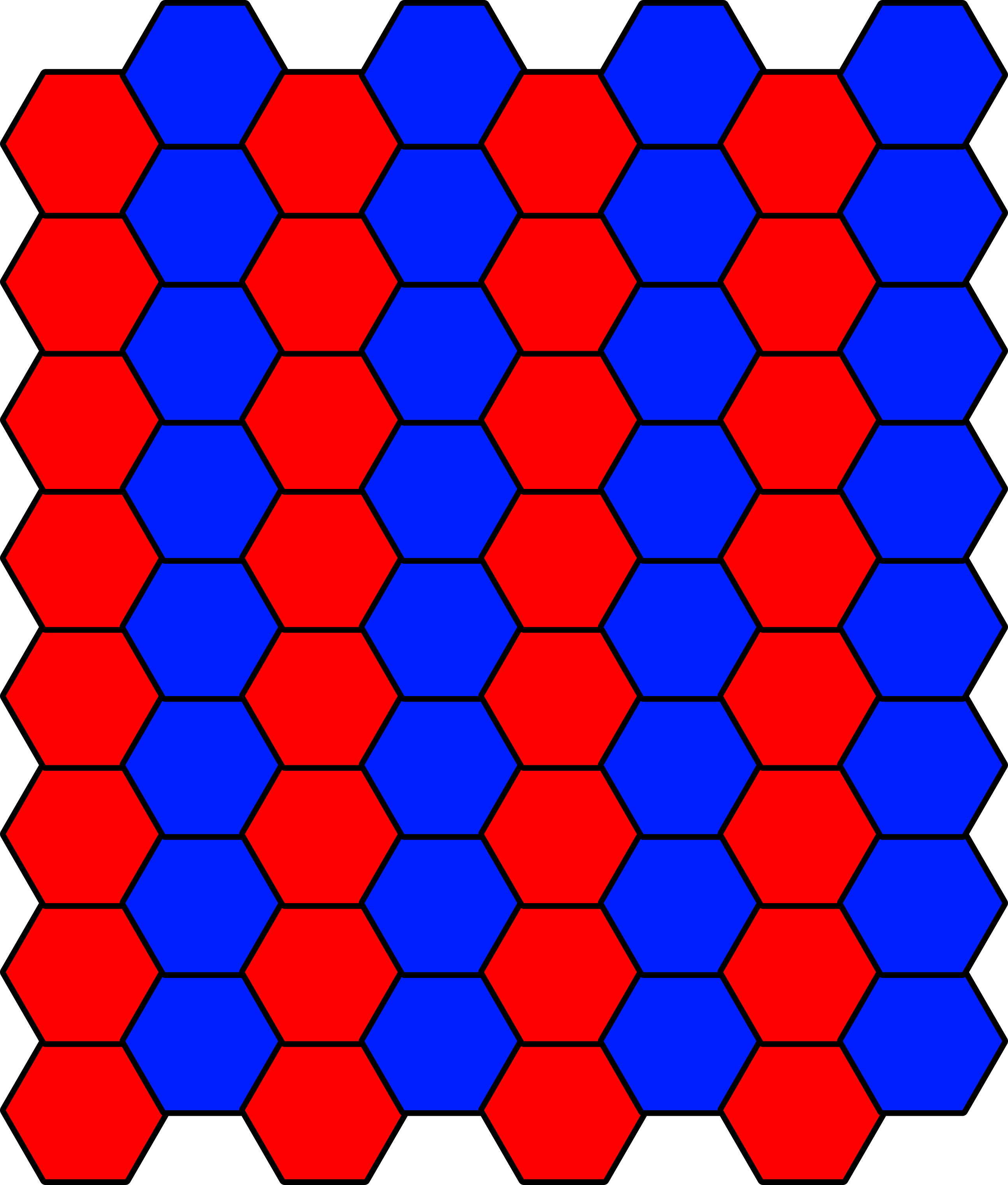 The sub-grids are essentially regular rectangular lattices; indexing them is extremely easy. We choose a Hex centered at coordinate (0,0). This hex has x and y indices of zero.
-
Bit 0: used to specify the primary or secondary grid.
-
Bit 1: unused
-
Bits 2-32: signed integer. Represents the x-index of the hex on the grid specified by bit 0.
-
Bits 33-63: signed integer. Represents the y-index of the hex on the grid specified by bit 0.