Repository navigation
Mathematical environments
## Continuous maps

> [!def] Continuity
> A map is continuous if the inverse image of every open set is open.

^def-continuity

> [!thm] Composition
> The composition of two continuous maps is continuous.

^thm-composition

Use [[#^def-continuity]] to prove [[#^thm-composition]].

> [!proof]
> Take inverse images successively.
By default, these display as Definition 1.1 · Continuity and Theorem 1.1 · Composition. References display def 1.1 and thm 1.1 and navigate to their targets. Each environment type has its own counter unless shared counters are enabled.
| Environment | Accepted callout types | Numbered |
|---|---|---|
| Definition |
def, definition
|
Yes |
| Theorem |
thm, theorem
|
Yes |
| Lemma |
lem, lemma
|
Yes |
| Proposition |
prop, proposition, prp
|
Yes |
| Corollary |
cor, corollary
|
Yes |
| Claim |
claim, clm
|
Yes |
| Example |
example, ex, exa, exm
|
Yes |
| Axiom |
axiom, axm
|
Yes |
| Assumption |
assumption, asm
|
Yes |
| Exercise |
exercise, exr
|
Yes |
| Conjecture |
conjecture, cnj
|
Yes |
| Hypothesis |
hypothesis, hyp
|
Yes |
| Proof |
proof, pf
|
No |
| Remark |
remark, rem, rmk
|
No |
| Solution |
solution, sol
|
No |
Use > [!thm]- Title for an initially collapsed callout, or > [!thm]+ Title for an expanded one. Add another > for each nesting level. Export expands collapsed content.
- Manual number:
> [!thm|A.1] Title. - No number:
> [!thm|*] Title.|-and empty metadata|also suppress numbering. - Automatic number: omit metadata or use
|auto. Automatic counters avoid manual numbers already used in the same scope.
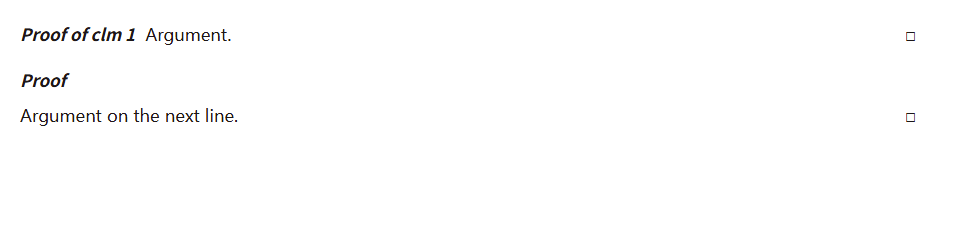
Use a proof callout for an unnumbered proof. If the opening line has no title, Proof occupies its own line and the argument starts below. A hollow square □ appears at the end automatically. A custom title or reference can sit beside the first paragraph; add an empty quoted line after the header to start the argument below it.
> [!proof]
> Let $U$ be open. Since $f$ and $g$ are continuous, both
> $f^{-1}(U)$ and $g^{-1}(f^{-1}(U))$ are open.
>
> Thus the composition $f \circ g$ is continuous.
To prove a previously stated theorem, lemma or claim, put its block reference directly after the marker:
> [!proof][[Chapter one#^claim-a]]
> Here is the argument.
This displays Proof of clm 1.1, with a clickable reference. > [!proof] [[#^thm-a]] works too. The reference follows numbering settings, aliases and book chapter renumbering. Use the block ID of the mathematical environment as the target.
A remark callout has an inline title in a brighter shade of the selected palette's main hue, with ordinary text underneath or beside it. It has no frame, shaded background, or QED square.
> [!remark]
> The argument only uses inverse images of open sets.
> It applies to arbitrary topological spaces.
Both environments use normal note text color for their content. pf is an alias for proof; rem and rmk are aliases for remark. Add a title such as > [!proof] Composition or use the usual +/- folding syntax. They support nested callouts and multi-paragraph content. If a proof starts with a list or display equation, its title occupies a separate line; if it ends with one, the square follows on its own final line. Long proofs can continue across PDF pages, with a single square at the end.
## An identity

$$
a^2+b^2=c^2
$$

^eq-example

See [[#^eq-example]].
By default, only display equations referenced in the indexed vault receive automatic numbers; unreferenced equations do not consume a number. You can number all display equations or disable automatic numbering. Inline math is not numbered.
Manual \tag{A} values are preserved. Without a manual tag, \notag or \nonumber suppresses automatic numbering. Each display-math block receives at most one automatic number; split it into separate blocks for separate references. Blocks containing multiple manual tags retain the original math without guessing a single reference number.