st cross
Runs the full research pipeline in one command: generates a report from every AI provider, then has every AI fact-check every report. The result is an N×N score matrix saved into the container.
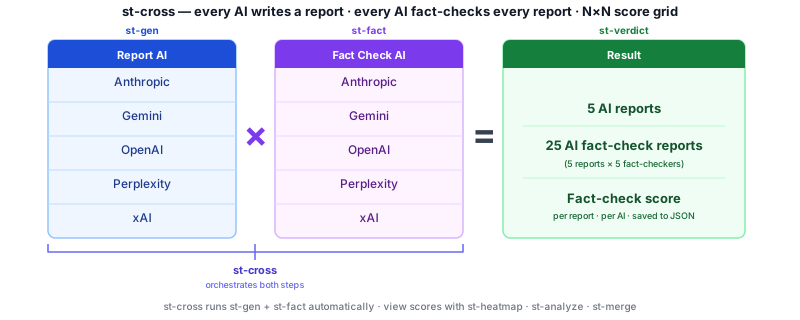
st-cross is the orchestrator: it calls st-gen to generate every report, then calls st-fact to run every fact-check. The scores land in the Result column, ready for st-verdict to summarise.
Run after: st-new Run before: st-merge st-heatmap st-verdict st-analyze
Related: st-bang st-fact st-heatmap st-verdict Multi-Model
Multi-model (0.9.0+):
--agentaccepts agents defined in~/.cross_ai_models.json— e.g.--agent anthropic-opusruns Opus alongside the bare--agent anthropicdefault. Same-make agents share one rate-limit semaphore. See Multi-Model.
st-cross subject.json                   # full N×N run: generate + fact-check all AIs
st-cross --no-cache subject.json        # bypass cache (no read, no write); does NOT force a re-run on a complete container
st-cross --force subject.json           # clear all existing fact[] entries and re-run every cell — use after a prompt change
st-cross --skip-gen subject.json        # skip generation — only run fact-checking
st-cross --timeout 3600 subject.json    # set a 60-minute per-cell timeout
st-cross --sequential subject.json      # run cells one at a time (debug / low-quota)
st-cross --max-concurrency 1 subject.json   # cap every provider to 1 in-flight cell
st-cross --dry-run subject.json         # preview the Step 2 matrix and exit
st-cross -q subject.json # minimal output (suppress live table)| Option | Description |
|---|---|
file.json |
Path to the JSON container |
--cache |
Enable API cache (default: enabled) |
--no-cache |
Disable API cache (no read, no write). Does not by itself force a re-fact-check on an already-complete container — see --force. |
--force |
Bypass resume detection AND clear all existing fact[] entries before launching, then re-run every cell. Implies --no-cache. Use after changing the fact-check prompt or when you want fresh verdicts. |
--skip-gen |
Skip Step 1 (story generation). Auto-detected if all stories already exist. |
--dry-run |
Preview the Step 2 matrix (pending vs complete cells) and exit without running anything. Implies --skip-gen. |
--timeout SECONDS |
Per-cell wall-clock timeout (default: 1800 = 30 min). 0 = no timeout. |
-p, --parallel
|
Run cells in parallel, gated by per-provider rate-limit semaphores (default). |
--sequential |
Run cells one at a time. Useful for debugging or very low-quota accounts. |
--max-concurrency N |
Override per-provider concurrency cap (default: per-make from cross_ai_core.get_rate_limit_concurrency() — xai=3, anthropic=2, openai=3, perplexity=2, gemini=5). |
--retry-budget SECONDS |
Per-segment retry budget passed to st-fact (default: 45). 0 = unlimited. |
-v, --verbose
|
Verbose output |
-q, --quiet
|
Suppress live table (minimal output) |
The two flags operate at different scopes and are independent — you almost always want both set.
-
--timeoutcaps the wall-clock time of one cell — the wholest-factsubprocess for a single (story × fact-checker) pair. If the cell takes longer than this,st-crosskills it and marks it failed. A cell typically makes ~50 API calls (one per segment), so the timeout must be large enough to cover all of them plus any retries that happen along the way. -
--retry-budgetcaps the time a single API call inside a cell spends retrying transient errors (rate limits, 503s). It is enforced insidecross-ai-core'sprocess_prompt()— when the budget is exhausted, the next segment proceeds without further retries. Setting it low (the default45= one ~15+30 s backoff cycle) prevents one rate-limited segment from eating the whole cell's wall-clock budget.
Rule of thumb: leave --timeout generous (the 30 min default is usually fine) and tune --retry-budget down rather than up. --retry-budget 0 (unlimited) is equivalent to pre-PAR-1 behaviour — a badly rate-limited cell can then spend its entire --timeout on one stuck segment. For low-quota accounts, prefer --sequential over raising --retry-budget.
Step 1 runs st-gen --bang per AI in parallel processes, each writing to its own _N.json file so there are no shared-file races. After all jobs finish, st-cross merges them into the main container and runs st-prep sequentially to build the story[] array. Step 2 launches one daemon thread per cell (N×N total), each calling st-fact as a subprocess for crash isolation. A per-provider threading.Semaphore (sized by cross_ai_core.get_rate_limit_concurrency()) gates how many cells for a given fact-checker AI can be in flight at once — this is what prevents parallel runs from tripping provider rate limits. --sequential collapses every provider onto a single Semaphore(1). The live ANSI display is updated every second; Ctrl+C cancels remaining cells while preserving the results collected so far.