st fact
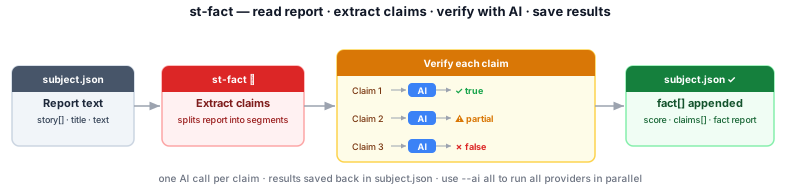
Sends a single story to an AI and asks it to fact-check every claim, scoring each one true, partially true, or false. Appends the result to the container.
Run after: st-prep Run before: st-verdict st-fix st-heatmap st-cross
st-fact subject.json                    # fact-check story 1 with default AI
st-fact -s 2 --agent gemini subject.json  # fact-check story 2 with Gemini
st-fact --no-cache subject.json        # bypass API cache
st-fact --all subject.json             # fact-check all stories in the container
st-fact --agent all subject.json          # run all AIs in parallel (one per story)
st-fact --timeout 30 subject.json      # 30-second per-paragraph timeout
st-fact --file subject.json            # also write results to a file
st-fact --paragraph subject.json # write paragraph segments to _paragraph_test_n.txt| Option | Description |
|---|---|
-s N, --story N
|
Fact-check a single story by number (default: 1) |
--all |
Fact-check every story in the container |
--agent AI |
AI provider to use, or all to run all providers in parallel (default: xai) |
--cache |
Enable the API response cache (default: enabled) |
--no-cache |
Bypass the API response cache |
--file |
Also write results to a .txt file alongside the container |
--paragraph |
Write paragraph segments to _paragraph_test_N.txt for debugging |
--display |
Write results to the display (default: on) |
--silent |
Suppress all output including progress bars; used internally by st-cross
|
-v, --verbose
|
Verbose output |
-q, --quiet
|
Minimal output |
--timeout N |
With --agent all: per-job limit in minutes (default: 20). Single-AI mode: per-paragraph limit in seconds (default: 0 = no limit) |
--retry-budget SECONDS |
Total retry budget in seconds passed through to process_prompt() (default: 0 = unlimited). Useful for parallel st-cross --parallel runs where a single 105-second tail would stall the matrix. Per-call (per segment), independent of --timeout (per subprocess). |
These interpretive flags moved to st-verdict in cross-st 0.7.0. st-fact is now a pure verifier: it produces fact-check data; st-verdict interprets it. This is the GATHER → VERIFY → INTERPRET architecture.
| Old (st-fact) | New (st-verdict) |
|---|---|
st-fact --ai-review subject.json |
st-verdict --what-is-false subject.json (or --what-is-true / --what-is-missing)
|
st-fact --ai-title subject.json |
st-verdict --ai-title subject.json |
st-fact --ai-short subject.json |
st-verdict --ai-short subject.json |
st-fact --ai-caption subject.json |
st-verdict --ai-caption subject.json |
st-fact --ai-summary subject.json |
st-verdict --ai-summary subject.json |
st-fact --ai-story subject.json |
st-verdict --ai-story subject.json |
If you call any of the removed flags, st-fact exits with a one-line error pointing at the right st-verdict invocation — no silent failure.
See also: Three Stages — the GATHER → VERIFY → INTERPRET architecture this migration is part of.
Splits the story into segments via mmd_util.build_segments(), sends them to the AI, and appends a fact[] entry to the container. The entry includes score, counts, summary, claims[] (per-segment verdicts), and timing{}.
The structured claims[] list is parsed from the AI's free-text reply via the shared cross_st/_report_signals.CLAIM_BLOCK_RE regex (also used by st-verdict and st-fix), so all three tools agree on what counts as a parseable claim. The pattern tolerates stray markdown markup (**, __) — anthropic in particular wraps every label in bold, which used to silently drop every anthropic claim from the structured list (counts and score were unaffected).