st verdict
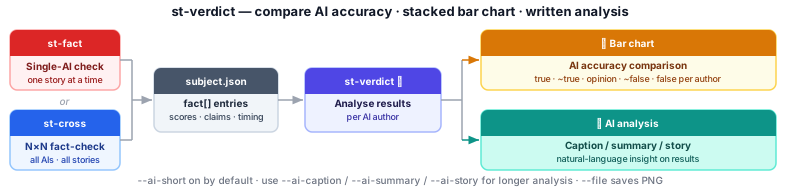
Reads fact-check data from a container and produces two outputs: a stacked bar chart comparing each AI's accuracy (true · ~true · opinion · ~false · false breakdown per author), and an optional written analysis — a short caption on by default, or a longer caption, summary, or story via the --ai-* flags. Run after st-fact for a single-AI verdict, or after st-cross to compare all providers head-to-head.
Run after: st-fact st-cross
Multi-model (0.9.0+): when same-make agents author distinct stories in the same container, the chart and
score_authors()rank each agent as a separate author (Opus and Sonnet rated independently). See Multi-Model.
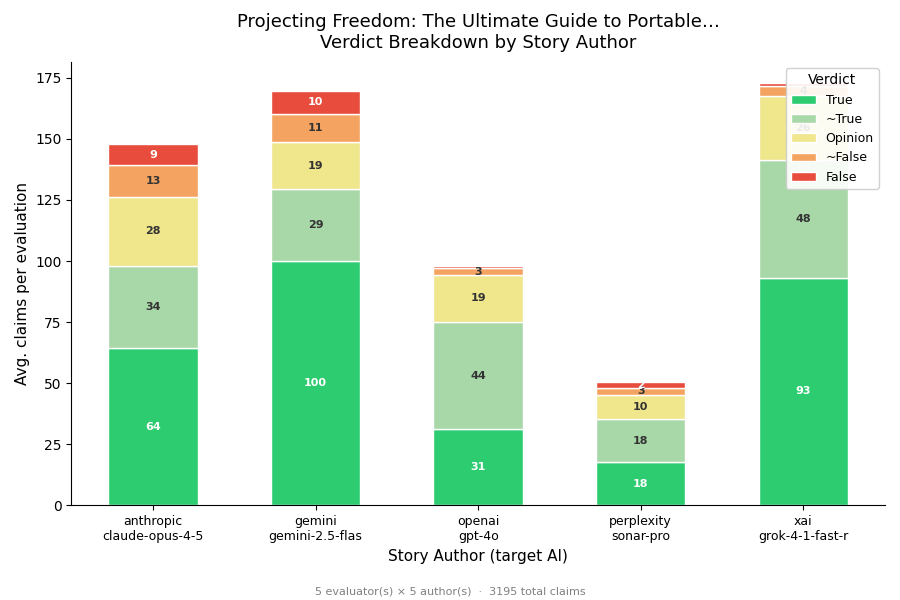
st-verdict --ai-caption projector_sonos_options.json — example caption (Gemini):
This chart presents a cross-AI fact-check on stories detailing RV and portable entertainment systems. XAI's Grok-4-1-fast-reasoning emerged as the most accurate AI author, with approximately 82% of its claims verified as True or ~True — significantly outperforming Anthropic's Claude-opus-4-5 at ~66%. Grok's superior performance stems from a high proportion of unequivocally True claims (54%) and a remarkably low False or ~False rate of just 3%, while Claude exhibited a combined inaccuracy rate of 15%.
| Option | Description |
|---|---|
file.json |
Path to the JSON container |
--cache |
Enable API cache (default: enabled) |
--no-cache |
Disable API cache |
-v, --verbose
|
Verbose output |
-q, --quiet
|
Minimal output |
| Option | Description |
|---|---|
--display |
Display chart on screen (default: on) |
--no-display |
Suppress on-screen display |
--file |
Save chart PNG to file (default: off) |
--path PATH |
Output directory for PNG (default: ./tmp/) |
| Option | Description |
|---|---|
--ai-title |
Generate a ≤10-word title → stdout |
--ai-short |
Generate a ≤80-word short caption → stdout (default: on when no other --ai-* flag is given) |
--no-ai-short |
Suppress the automatic short caption |
--ai-caption |
Generate a 100–160-word detailed caption → stdout |
--ai-summary |
Generate a 120–200-word summary → stdout |
--ai-story |
Generate an 800–1200-word narrative → stdout |
--agent AI |
AI provider for content generation (default: xai) |
Switches the AI from "summarise the chart" to "summarise the claims that fall on one side of the truth ledger" — or, with --what-is-missing, to identify what the report failed to cover at all. Aggregates per-claim verdicts and explanations across all fact-checkers in the container, then asks one AI to synthesize them into a focused report. Pair with any --ai-* flag to control level of detail; --ai-summary is auto-enabled if no detail flag is given.
| Option | Description |
|---|---|
--what-is-false |
Aggregate every claim marked false / partially_false and produce a focused breakdown of what is inaccurate or disputed |
--what-is-true |
Aggregate every claim marked true / partially_true and produce a focused breakdown of what is verified or supported |
--what-is-missing |
Identify what important aspects of the prompt the report failed to mention (omissions / coverage gaps) |
-s N, --story N
|
Story index to analyse with the lens (default: 1) |
The three lenses are mutually exclusive (and also exclusive with --how-to-fix below).
# Detailed breakdown of inaccurate claims (e.g. "is this fake news?")
st-verdict -s 1 --what-is-false --ai-summary subject.json

# Positive-evidence summary — what the report got right
st-verdict -s 1 --what-is-true --ai-caption subject.json

# Coverage-gap analysis — what the report failed to mention
st-verdict -s 1 --what-is-missing --ai-summary subject.json

# Long-form analysis suitable for sharing as feedback
st-verdict -s 1 --what-is-false --ai-story --no-display subject.json
Each lens analyses one story at a time (the AI author at index
N). Since cross-st 0.8.0 the default is the highest-scoring story perscore_authors()(composite Coverage / Completeness / Accuracy / Calibration); pass-s 1,-s 2, … to inspect a specific author. To compare across authors, run the command once per index. Override the scoring weights with--score-weights cov=…,comp=…,acc=…,cal=….
The lens reads story[N].fact[] entries — run st-cross first so multiple AIs have fact-checked the report. The more checkers that flagged the same claim, the stronger the signal in the resulting analysis. The --what-is-missing lens additionally reads the original prompt (data[0].prompt) and the report markdown so the AI can reason about what should be there but isn't.
See also: Showcase Workflows — copy-pastable transcripts for each lens.
After looking at the chart and the lens output, the natural next question is "so what do I do about it?" The recommendation lens asks the AI to read the score breakdown, the verdict mix, and (at --ai-summary / --ai-story detail levels) the report itself, then recommend exactly one next action. The recommendation is human-facing prose; st-verdict never auto-invokes the suggested tool.
| Option | Description |
|---|---|
--how-to-fix |
Recommend exactly one of: st-fix, st-bang -N, st-merge, or publish-as-is. Default detail level: --ai-short (single concrete recommendation sentence). |
The four candidate actions and when each is recommended:
| Recommendation | Triggered when |
|---|---|
st-fix subject.json |
Report is mostly sound but has clusters of false / partially_false claims |
st-bang -N subject.json |
Sample size too small (one story) or scores vary wildly across fact-checkers |
st-merge subject.json |
Multiple stories already present; combining their strongest sections beats any single one |
publish-as-is |
Per-author scores are high (avg ≥ 1.5) AND zero false / partially_false claims |
The output's last line always has the exact shape Recommendation: <command> — <reason>. so it is easy to spot in a terminal scrollback.
# One-line recommendation (default)
st-verdict -s 1 --how-to-fix subject.json

# Three-paragraph technical recommendation with alternatives considered
st-verdict -s 1 --how-to-fix --ai-summary subject.json

# Long-form recommendation analysis suitable for archival
st-verdict -s 1 --how-to-fix --ai-story --no-display subject.json
Architectural note: As of cross-st 0.7.0, all interpretive
--ai-*,--what-is-*, and--how-to-fixflags live here inst-verdict.st-factis now a pure verifier (it produces fact-check data;st-verdictinterprets it). This is the GATHER → VERIFY → INTERPRET division of responsibility.
Related: Three Stages Showcase Workflows st-cross st-heatmap st-analyze
Built on mmd_plot.py. Data comes from mmd_data_analysis.get_flattened_fc_data().