Choke
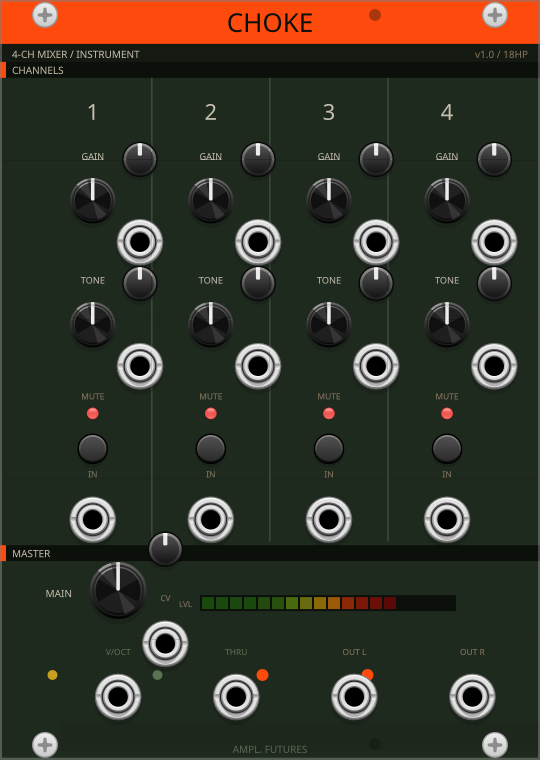
Four-channel mixer built as an instrument rather than a utility. Each channel has GAIN, a TONE lowpass and a MUTE button, and the pan positions are fixed — hard left, left-of-centre, right-of-centre, hard right — so where a signal sits in the stereo field is decided by which jack you patch. The MAIN stage saturates, so pushing a channel's GAIN past unity drives the master rather than simply making it louder.
The fixed panning is deliberate. It removes a decision and forces you to think about signal placement as arrangement.
- Add Choke. Patch a source into CH1 IN, and L OUT / R OUT to your interface.
- Defaults are already musical: GAIN 0.75 (unity), TONE 0.7, MAIN 0.8.
- You hear the source hard left — CH1's pan is fixed there.
- Patch a second source into CH4 IN. It arrives hard right, and you have stereo width without a panner.
- Push CH1 GAIN past 1.0. The MAIN tanh starts to saturate; the character changes rather than the level.
- Hit MUTE 1. The channel silences but keeps its place in the field.
CH1 IN ──► GAIN ──► TONE (LP blend) ──► [MUTE] ──► pan L    ──►┐
CH2 IN ──► GAIN ──► TONE             ──► [MUTE] ──► pan L−C  ──►┤
CH3 IN ──► GAIN ──► TONE             ──► [MUTE] ──► pan R−C  ──►┤► MAIN ─► tanh ─► L OUT
CH4 IN ──► GAIN ──► TONE             ──► [MUTE] ──► pan R    ──►┘                  R OUT

Fixed pan positions: CH1 = full L, CH2 = 0.33, CH3 = 0.67, CH4 = full R
Polyphonic inputs are summed to mono per channel.
V/OCT IN ──────────────────────────────────────────────────► V/OCT THRU
| Control | Range | Default | What it does |
|---|---|---|---|
| GAIN ×4 | 0–1.5× | 0.75 | Channel level. Unity sits at 0.75, so there is headroom above noon |
| TONE ×4 | 0–100% | 70% | Lowpass blend. 0 is dark, around 400 Hz; 100% is fully open |
| MUTE ×4 | button | off | Silences the channel and keeps its pan position |
| MAIN | 0–1.5× | 0.8 | Master level, followed by soft tanh saturation |
Each GAIN, each TONE and MAIN has an attenuverter (−1 to +1) and a CV input. The MUTE buttons do not.
| Port | Direction | Notes |
|---|---|---|
| CH1–4 IN | Input | Per-channel audio. Polyphonic signals are summed to mono |
| GAIN 1–4 CV | Input | One per channel, via its attenuverter |
| TONE 1–4 CV | Input | One per channel, via its attenuverter |
| MAIN CV | Input | Master level, via its attenuverter |
| L OUT / R OUT | Output | Stereo master, after saturation |
| V/OCT IN → THRU | In / Out | Pass-through |
Quad wall mix. Four DroneClone or String-Mass-Core voices into CH1–4, all GAIN 0.75, TONE 0.7, MAIN 0.8. The fixed spread gives immediate stereo width with nothing patched to achieve it.
Frequency stack. CH1 sub layer (TONE 30%, GAIN 0.9), CH2 mid wall (TONE 70%, GAIN 0.75), CH3 high shimmer (TONE 100%, GAIN 0.5), CH4 percussion (TONE 80%, GAIN 1.0). TONE becomes a per-channel filter instead of a global EQ.
Saturation pump. One or two channels at GAIN 1.3–1.5, MAIN at 0.6. Those channels clip into the MAIN tanh while the overall level stays controlled — the behaviour of a driven channel on a cheap no-input mixer.
Rhythmic mute grid. Pulse driving gates into the MUTE CV inputs. Channels drop in and out on a grid while the drone layers underneath stay constant.
| Module | Routing |
|---|---|
| DroneClone | Multiple instances into CH1–4 for a spread wall |
| DroneCore | A stack of four, one per channel, with per-voice gain and muting |
| Pulse | Gates into MUTE CV for rhythmic gating |
| Drift | SMOOTH → a TONE CV for a slow per-channel filter sweep |
| Collapse-Saturator | L/R OUT → IN when the MAIN saturation is not enough |
Wall-Conductor · Mass-Driver · Pulse · Playbooks
Full parameter spec: docs/modules/Choke.md