Pulse
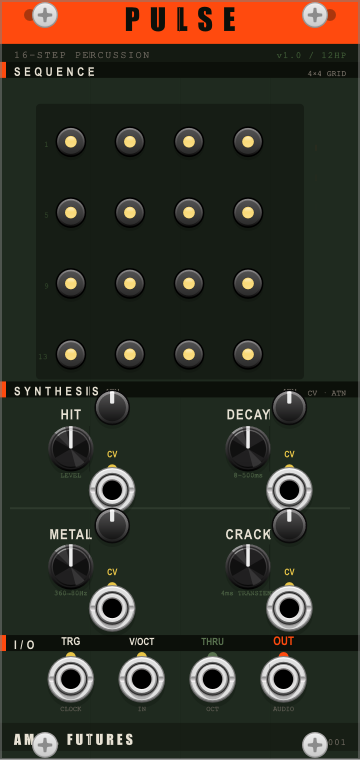
Sixteen-step noise percussion on a 4×4 grid. One voice, one sound, four knobs to shape it — white noise through a body filter, with a separate crack transient on the attack. There is no sample bank and no pitch: Pulse makes a single percussive noise event and lets you place sixteen of them in time. It exists to put a rhythmic edge against material that otherwise has none.
- Add Pulse. Patch a clock into TRG and OUT to your interface.
- Click some step buttons in the 4×4 grid. Lit steps fire; unlit ones pass.
- You hear a noise hit on each lit step, with the default HIT 75%, DECAY 30%, METAL 20%, CRACK 40%.
- Turn DECAY up. Hits stretch from a tick towards a wash — 8 ms at the bottom of the dial, half a second at the top.
- Turn METAL up. The body filter opens from 80 Hz towards 360 Hz and raw noise takes over — the hit moves from a thud to a hiss.
TRG IN (clock) ──► step counter, advances 0…15 and wraps
                          │
                   step lit? ──► fire: env = 1, crackEnv = 1
                          │
   white noise ──┬─ 1-pole LP ──► body    (METAL shifts 360 → 80 Hz)
                 ├─ raw × METAL ────────► grit
                 └─ raw × crackEnv × CRACK ► 4 ms transient
                          │
                 × exponential env (DECAY 8–500 ms) × HIT
                          │
                    2× tanh ──► OUT
V/OCT IN ─────────────────────────────────────────► V/OCT THRU
| Control | Range | Default | What it does |
|---|---|---|---|
| STEP ×16 | on / off | all off | 4×4 toggle grid. Green-red LED shows state and playhead |
| HIT | 0–100% | 75% | Output level of the hit, before the output saturator |
| DECAY | 0–100% | 30% | Envelope decay, 8 ms to 500 ms |
| METAL | 0–100% | 20% | Body filter and grit. Low is a dull thud at 360 Hz; high opens to 80 Hz and mixes in raw noise |
| CRACK | 0–100% | 40% | Level of the 4 ms transient burst on the attack |
HIT, DECAY, METAL and CRACK each have an attenuverter (−1 to +1) and a CV input. The step buttons do not.
METAL is worth understanding because it does two things at once: it lowers the body filter's corner and raises the amount of unfiltered noise in the mix. That is why it moves the sound from body to hiss rather than simply brightening it.
| Port | Direction | Notes |
|---|---|---|
| TRG | Input | Clock. Each trigger advances one step; lit steps fire |
| HIT / DECAY / METAL / CRACK CV | Input | One per knob, each via its attenuverter |
| OUT | Output | Audio, soft-clipped |
| V/OCT IN → THRU | In / Out | Pass-through, so Pulse can sit inline in a pitch chain |
Work clock. Steps 1, 5, 9, 13 lit — four on the floor. DECAY 20%, METAL 10%, CRACK 60%. A hard, dry pulse under a drone.
Broken grid. Steps 1, 4, 7, 11, 14 lit. DECAY 45%, METAL 40%. The pattern is sixteen long but never lands where a bar expects it to.
Noise wash. Most steps lit, DECAY 90%, METAL 80%, HIT 50%. The hits overlap into continuous noise rather than reading as rhythm.
Stochastic hits. Drift GATE → TRG instead of a clock, Drift RATE 60%. The grid advances irregularly, so the same sixteen steps produce a different rhythm every pass.
Gate source. Pulse is also a rhythm generator for other modules — use its clock to drive Swarm-Core TRG, or gate Choke MUTE inputs, so percussion and texture share a grid.
| Module | Routing |
|---|---|
| Drift | GATE → TRG for irregular, non-repeating triggering |
| Choke | Pulse into a channel, or its clock into MUTE for rhythmic gating |
| Swarm-Core | Share a clock so insect calls land on the percussion grid |
| Collapse-Saturator | OUT → IN; saturation thickens the noise body considerably |
| Wall-Conductor | OUT → channel input as the rhythmic layer under the wall |
Drift · Swarm-Core · Choke · Playbooks
Full parameter spec: docs/modules/Pulse.md