Street Grid Clock
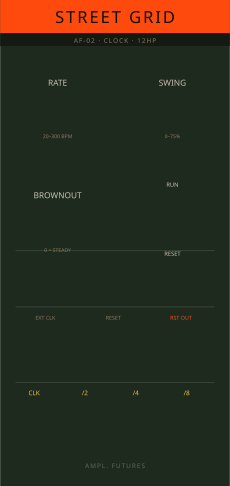
The Branca series had no clock. A patch built only from these modules could not generate its own time — you had to borrow one from another plugin. Street Grid Clock closes that gap: RATE, SWING and BROWNOUT, four divided outputs, and an external clock input for when you would rather be the follower.
BROWNOUT is the one that is not standard issue. It models a mains grid dipping under load — the clock sags and recovers, always slowing and never speeding up, so the patch drags behind the beat rather than running ahead of it.
Note: this page currently shows the flat panel export. A Rack-rendered screenshot will replace it once one has been taken, bringing it in line with the other module pages.
- Add Street Grid Clock and Pulse. Patch CLK → Pulse TRG, and Pulse OUT to your interface.
- Press RUN. Light a few steps on Pulse. You have rhythm with nothing borrowed.
- Turn RATE up. Tempo climbs exponentially — the dial runs 20 BPM to 300, with the middle of the range around 75.
- Raise SWING to about 50%. Odd-numbered pulses land late.
- Raise BROWNOUT. Every couple of seconds the grid sags and pulls back up.
- Patch /4 into Sitar-Grid CLOCK. Two related tempos, one source.
RATE ──► bpm = 20 × 15^rate          (20 → 300 BPM, exponential)
              │
EXT CLK IN ──► when patched, external edges drive the phase instead
              │
RUN ──────────► gates the whole clock
              │
BROWNOUT ──► random sag, about one every two seconds at full depth
             recovery ≈250 ms · deepest sag runs at 60% of nominal
             at exactly 0 the RNG is never consulted
              │
         phase accumulator
              │
SWING ──► odd pulses arrive late by SWING × 0.5 of the period
              │
     ┌────────┬────┴───┬────────┐
     ▼        ▼        ▼        ▼
   CLK       /2       /4       /8

RESET button / RESET IN ──► phase to zero ──► RESET OUT
| Control | Range | Default | What it does |
|---|---|---|---|
| RATE | 20–300 BPM | ≈59 BPM | Exponential. Most of the usable range sits in the lower half of the dial |
| SWING | 0–75% | 0 | Delays odd-numbered pulses by up to half a period |
| BROWNOUT | 0–100% | 0 | Sag frequency and depth. At zero the clock is exactly steady |
| RUN | toggle | — | Starts and stops |
| RESET | momentary | — | Phase to zero, and fires RESET OUT |
RATE, SWING and BROWNOUT each have an attenuverter (−1 to +1) and a CV input.
A sag that ran fast would be a wobble, and would push the patch ahead of the beat. Dragging behind it is the musical behaviour, so the effect is deliberately one-directional.
At exactly zero the random number generator is not consulted and the sag state is forced to zero, making the timing bit-identical to a clean clock. Not "nearly steady" — exactly steady. A clock you cannot trust at zero is not a clock.
| Port | Direction | Notes |
|---|---|---|
| RATE / SWING / BROWNOUT CV | Input | One per knob, each via its attenuverter |
| EXT CLK | Input | External clock. When patched it drives the phase instead of RATE |
| RESET | Input | Trigger — returns the phase to zero |
| CLK | Output | The main pulse |
| /2 · /4 · /8 | Output | Divided pulses, for polymetric layering |
| RESET | Output | Fires on reset, for chaining to other sequencers |
The patch master. CLK → Pulse TRG, /2 → Swarm-Core TRIG, /4 → Sitar-Grid CLOCK, /8 → Wall-Conductor COLLAPSE. Four related tempos from one module — percussion, texture, melody and structure, all locked.
Dragging grid. BROWNOUT 40%, SWING 0. The pulse is steady until it is not. Because sags only slow, the patch feels like it is being held back rather than falling apart.
Swung against straight. SWING 55% on CLK into Pulse, while /4 stays straight into Sitar-Grid. The percussion swings and the melodic line does not.
Locked randomness. CLK → Drift SYNC. Drift's random walk stops floating free and steps on the grid instead.
Following, not leading. A DAW clock or another module into EXT CLK. Street Grid Clock becomes a divider and swing processor for someone else's time.
| Module | Routing |
|---|---|
| Pulse | CLK → TRG. The primary destination |
| Swarm-Core | /2 → TRIG so insect calls sit against the percussion |
| Sitar-Grid | CLOCK, with RESET → RESET for phrase alignment |
| Drift | CLK → SYNC to lock the random walk to the grid |
| Wall-Conductor | /8 → COLLAPSE for structural events on a long cycle |
Pulse · Drift · Sitar-Grid · Playbooks
Full parameter spec: docs/modules/StreetGridClock.md