Model Discovery
Model discovery is the process by which Model Hotel learns about available models from configured providers. Discovery fetches model lists from provider APIs, enriches them with metadata from built-in catalogs and the models.dev community database, and upserts the results into the PostgreSQL database.

Model catalog with provider, pricing, context length, and enabled toggle columns
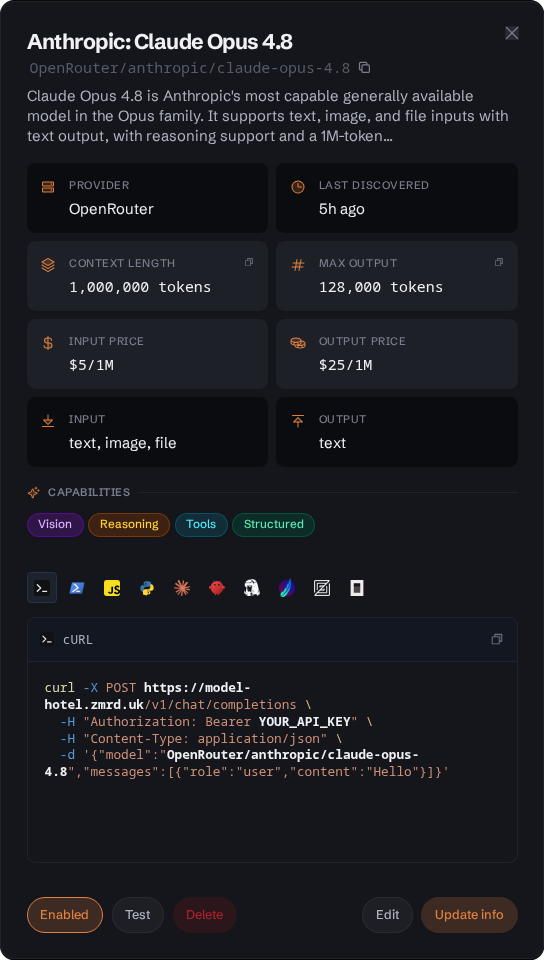
Model detail panel with configuration, pricing, capabilities, and test button
- Discovery Triggers
- Provider-Specific Discovery
- Models.dev Enrichment
- Model Metadata Fields
- Database Schema
- Model ID Construction
- Enabling/Disabling Models
- Model CRUD API
- Model Caching
Discovery runs are triggered by four mechanisms:
When discovery_on_startup is true (the default), the server runs discovery for all enabled providers immediately after boot. A 5-minute deduplication guard prevents redundant runs - if any provider's last_discovered_at is within 5 minutes of the current time, startup discovery is skipped entirely. This avoids double-discovery when the server is restarted quickly (e.g., during a rolling deploy).
if settingsRepo.GetBool(ctx, "discovery_on_startup", true) {
    // check if any provider was discovered within 5 minutes
    // if not, run discovery in a background goroutine
}When discovery_on_provider_create is true (the default), discovery is triggered immediately after a new provider is created. This trigger is client-side: after the POST /api/providers call succeeds, the frontend checks the setting and calls POST /api/providers/{id}/discover. For keyless providers (e.g., OpenCode Zen free models), this still works - the discovery service handles empty API keys.
// Frontend (Providers.tsx):
const shouldDiscover = settings?.discovery_on_provider_create !== "false";
if (shouldDiscover) {
    const result = await api.providers.discover(newProvider.id);
}A background goroutine runs discovery on a configurable interval (discovery_interval, default 6h). The timer reacts immediately to setting changes via a subscription channel - there is no need to wait for the current timer to expire when the interval is changed at runtime. Setting the interval to 0 (or "0s") disables periodic discovery entirely; the goroutine blocks on the settings subscription channel until a non-zero value arrives.
select {
case <-timerC:
    result := runDiscovery()
    publishDiscoveryEvent("Scheduled", result)
    interval = readInterval()
    applyInterval(interval)
case <-settingsSub.Events():
    newInterval := readInterval()
    if newInterval != interval { applyInterval(newInterval) }
case <-ctx.Done():
    return
}Two manual discovery endpoints are available:
| Endpoint | Method | Scope | Description |
|---|---|---|---|
/api/providers/{id}/discover |
POST | Single provider | Discover and import models for one provider |
/api/providers/discover-all |
POST | All providers | Discover and import models for every enabled provider; skips disabled providers |
Both endpoints upsert discovered models and re-sync failover groups for what they saw. They do not disable missing models: disabling requires two consecutive confirmed-missing scans, so a single on-demand click can never reach that threshold, and running the in-scan confirmation probes (up to ~70s of backoff) on a request would overrun the route's 60s HTTP timeout - which also made the HA config-sync import look like it failed. Miss-recording and disabling are therefore owned exclusively by the scheduled/startup background sweep - see Missing models: three layers of proof before a disable. When the background sweep does disable a model, its failover group is re-synced in the same scan so the model is pruned instead of lingering as a stale entry.
Both endpoints also return a diff describing what the scan changed - models added or re-enabled (with machine-readable reason codes new_model, reappeared) plus any failover groups updated as a result. (The background sweep's diff can also carry disabled entries with reason not_listed; manual scans never disable, so theirs will not.) It also reports updated models whose live pricing or context-length metadata moved since the previous scan: each entry carries per-field changes (codes input_price, output_price, input_price_cache, context_length, each with old/new numbers). Only fields the provider's own live API supplied this scan are compared (tracked via transient per-field live provenance), so catalog/models.dev backfills, flaky probes, and manual price edits never surface as spurious changes. The dashboard renders this diff as a post-scan summary modal after manual Discover / Discover All runs; an all-empty diff still confirms "scanned, nothing changed".
Scheduled/startup background discovery does not pop the modal (SSE events cover it). Instead, any changes it records are persisted to a discovery_changes store (migration 047) and surfaced as a count badge on the Models sidebar item; clicking the badge opens a summary modal of the recorded changes and acks the unseen rows server-side (clearing the badge). A discovery.changes_pending SSE event fires when a background scan records changes. See the API Reference for the GET /api/discovery/changes and POST /api/discovery/changes/ack endpoints.
{
  "discovered": 14,
  "models": [...],
  "diff": {
    "added": [{"model_id": "gpt-4o-2024-11", "reason": "new_model"}],
    "disabled": [{"model_id": "gpt-4o-2024-05", "reason": "not_listed"}],
    "updated": [
      {"model_id": "gpt-4o", "changes": [{"field": "input_price", "old": 2.5, "new": 2.0}]}
    ],
    "failover_updated_groups": [
      {"display_model": "gpt-4o", "removed_model_ids": ["uuid-old"]}
    ]
  }
}
In discover-all responses the same diff object appears per provider inside each results[] entry (omitted for providers whose scan failed).
Each provider type has its own discovery implementation in internal/provider/discovery_*.go. Provider type is auto-detected from the base URL hostname (and path, for OpenCode Go/Zen) via DetectProviderType. Unknown hosts default to OpenAI-compatible discovery.
Providers that expose a live model list and ship a built-in catalog are combined through a shared helper, mergeLiveAndCatalog (internal/provider/catalog_merge.go), instead of picking one source or the other. The merge has three rules:
- Union of models. The result is every model the live API returned plus every catalog model the API did not list. This surfaces models the provider keeps callable without advertising them in its listing endpoint (a freshly released GLM the listing hasn't caught up to, or older Grok models xAI keeps serving), and it means new models the provider adds are picked up automatically with no catalog edit.
-
Live wins per field. For a model present in both sources the live value is authoritative. The catalog only fills fields the live result left empty, nil, or a known placeholder (a
display_nameequal to themodel_id, or"[]"modalities). A stale catalog can therefore never mask fresh live data - at worst it supplies slightly outdated gap-fill. - Capabilities are OR-merged. A capability flag is enabled in the result if either source reports it.
models.dev enrichment runs after the merge and fills anything still empty, so the final precedence per field is live → catalog → models.dev → zero value. If the live fetch fails entirely (network, auth, 403/429 quota), the discoverer falls back to the pure catalog so discovery never goes dark.
Providers on the merge (union): Z.AI, xAI, DeepSeek, OpenCode Go, OpenCode Zen. OpenAI uses the same live-first model but backfill-only (no union) via backfillLiveFromCatalog, because discoverOpenAI is the fallback for unknown/custom hosts and must not attach catalog-only gpt-5.x models to them. Providers with a pricing-only catalog - Anthropic, Google AI Studio, Cohere - keep their own discoverers: the live API is already the rich model-list source and the catalog only backfills pricing, so there is nothing to union. Pure-live providers (NanoGPT, OpenRouter, Ollama, LM Studio, KoboldCPP, NeuralWatt) have no catalog.
The DetectProviderType function in internal/provider/discovery.go uses exact host matching and suffix matching:
| Hostname Pattern | Path Pattern | Provider Type |
|---|---|---|
api.openai.com, *.openai.com
|
- |
openai (fallback) |
api.anthropic.com, *.anthropic.com
|
- | anthropic |
api.deepseek.com, *.deepseek.com
|
- | deepseek |
api.nano-gpt.com, nano-gpt.com
|
- | nanogpt |
api.z.ai, z.ai, *.z.ai
|
- | zai-coding |
ollama.com, *.ollama.com
|
- | ollama-cloud |
opencode.ai, *.opencode.ai
|
/zen/go/ |
opencode-go |
opencode.ai, *.opencode.ai
|
/zen/ |
opencode-zen |
openrouter.ai, *.openrouter.ai
|
- | openrouter |
api.x.ai, x.ai, *.x.ai
|
- | xai |
generativelanguage.googleapis.com, *.googleapis.com
|
- | google |
api.cohere.com, api.cohere.ai, *.cohere.com, *.cohere.ai
|
- | cohere |
api.neuralwatt.com, neuralwatt.com
|
- | neuralwatt |
localhost, 127.0.0.1, ::1 (port 11434) |
- | ollama |
localhost, 127.0.0.1, ::1 (port 5001) |
- | koboldcpp |
localhost, 127.0.0.1, ::1 (port 1234) |
- | lmstudio |
| Any other host | - |
openai (fallback) |
Source files: discovery_openai.go, openai_catalog.go, catalog_merge.go
Method: Calls GET /v1/models, converts the listing to clean stubs (id + owner), and backfills matching models from the built-in openaiCatalog (the gpt-5.x family) via backfillLiveFromCatalog - not a union. discoverOpenAI is also the fallback for unknown/custom hosts, so the catalog must never add catalog-only models (that would attach phantom gpt-5.x models to a custom OpenAI-compatible provider); for real OpenAI the catalog is a subset of the live listing anyway. The ~110 uncatalogued models (gpt-4o, the o-series, etc.) are enriched by models.dev instead of the old fabricated empty entry.
- Models covered by the catalog receive full metadata: display name, description, context length, max output tokens, modality, input/output modalities, streaming/reasoning/tool-calling/structured-output/vision flags, pricing (including cache-hit pricing).
- Models not in the catalog pass through as clean stubs (
Streaming: true, empty modalities) for models.dev to fill.
Catalog fields provided:
| Field | Source |
|---|---|
| Display name | Catalog |
| Description | Catalog |
| Context length | Catalog |
| Max output tokens | Catalog |
| Modality | Catalog |
| Input/Output modalities | Catalog |
| Streaming | Catalog |
| Reasoning | Catalog |
| Tool calling | Catalog |
| Structured output | Catalog |
| Vision | Catalog |
| Input price / cache-hit price / output price | Catalog |
| Owned by | API (/v1/models) |
Source files: discovery_anthropic.go, anthropic_catalog.go
Method: Calls GET /v1/models?limit=100 with pagination (using after_id cursor) to list all models. The Anthropic API returns rich capability metadata per model. Pricing is then looked up from the built-in anthropicPricing catalog. Date-suffixed model IDs (e.g., claude-sonnet-4-5-20250514) are stripped to their base ID for catalog lookup.
API-provided fields:
| Field | Source |
|---|---|
| Display name | API (display_name) |
| Max input tokens (→ context length) | API (max_input_tokens) |
| Max output tokens | API (max_tokens) |
| Vision | API (capabilities.image_input.supported) |
| PDF upload | API (capabilities.pdf_input.supported) |
| Structured output | API (capabilities.structured_outputs.supported) |
| Modality | Derived from API capabilities (vision → "vision", else "text") |
| Input modalities | Derived from API capabilities (vision → ["text","image"], else ["text"]) |
| Streaming | Hardcoded true
|
| Tool calling | Hardcoded true
|
| Output modalities | Hardcoded []
|
Catalog-provided fields:
| Field | Source |
|---|---|
| Input price per million | Pricing catalog |
| Input price cache-hit per million | Pricing catalog |
| Output price per million | Pricing catalog |
Source files: discovery_nanogpt.go
Method: Calls GET /models?detailed=true - a single request returns complete model metadata. No dedicated catalog is used. The API provides all information directly.
All fields from API:
| Field | Source |
|---|---|
| Display name / name | API (name) |
| Description | API (description) |
| Context length | API (context_length) |
| Max output tokens | API (max_output_tokens) |
| Modality | API (architecture.modality) |
| Input modalities | API (architecture.input_modalities) |
| Output modalities | API (architecture.output_modalities) |
| Vision | API (capabilities.vision) |
| Video input | API (capabilities.video_input) |
| Audio input | API (capabilities.audio_input) |
| Reasoning | API (capabilities.reasoning) |
| Tool calling | API (capabilities.tool_calling) |
| Parallel tool calls | API (capabilities.parallel_tool_calls) |
| Structured output | API (capabilities.structured_output) |
| PDF upload | API (capabilities.pdf_upload) |
| Streaming | Hardcoded true
|
| Input price / output price | API (pricing.prompt, pricing.completion) |
| Subscription info | API (subscription.included, subscription.note) → stored in params
|
| Owned by | API (owned_by) |
Source files: discovery_deepseek.go, deepseek_catalog.go, catalog_merge.go
Method: Calls GET /models (OpenAI-compatible list endpoint), converts the listing to clean stubs, and merges them with the built-in deepseekCatalog via mergeLiveAndCatalog. The catalog backfills context length, max output, reasoning flag, and pricing (cache-miss maps to the standard input price; cache-hit is carried separately). The former hardcoded 128k/8k default for uncatalogued models was dropped - an unknown model is now a clean stub filled by models.dev (DeepSeek models are 1M/384K, so the old default was stale).
Catalog provides:
| Field | Source |
|---|---|
| Context length | Catalog |
| Max output tokens | Catalog |
| Reasoning | Catalog |
| Input price (cache miss) | Catalog |
| Input price (cache hit) | Catalog |
| Output price | Catalog |
Hardcoded / missing:
| Field | Value |
|---|---|
| Modality | Hardcoded "text"
|
| Input modalities | Hardcoded "[]"
|
| Output modalities | Hardcoded "[]"
|
| Streaming | Hardcoded true
|
| Tool calling | Hardcoded true
|
| Vision | Not set |
Source files: discovery_ollama.go
Method: Two-step discovery. First calls GET /api/tags to list all locally available models. Then, for each model, calls POST /api/show (with the model name) to retrieve detailed metadata. The /api/show calls run concurrently (max 5 parallel) with a 120-second overall timeout.
Fields from /api/show:
| Field | Source |
|---|---|
| Capabilities (tools, thinking, vision) | API (capabilities array) |
| Context length | API (model_info → *.context_length) |
| Model family (→ owned_by) | API (details.family) |
| Format | API (details.format) - not stored in model |
| Parameter size | API (details.parameter_size) - not stored in model |
| Quantization level | API (details.quantization_level) - not stored in model |
Derived from capabilities:
| Field | Logic |
|---|---|
| Tool calling |
"tools" in capabilities array |
| Reasoning |
"thinking" in capabilities array |
| Vision |
"vision" in capabilities array |
| Modality | Vision → "vision", else "text"
|
| Input modalities | Vision → ["text","image"], else ["text"]
|
Hardcoded / missing:
| Field | Value |
|---|---|
| Streaming | Hardcoded true
|
| Output modalities | Hardcoded "[]"
|
| Pricing | None (Ollama is local, no pricing) |
| Max output tokens | None |
| Structured output | Not set |
Source files: discovery_zai.go, zai_catalog.go, catalog_merge.go
Method: Fetches the live OpenAI-compatible model list from GET /models on the coding-plan base URL, then merges it with the built-in zaiCatalog via mergeLiveAndCatalog. The live listing supplies the authoritative model set and owned_by; the catalog backfills context length, max output, capability flags, and modality, and unions in catalog models the listing omits (a freshly released GLM, or the vision/turbo variants the coding plan serves but does not advertise). If the /models fetch fails, discovery falls back to the pure catalog.
Live API provides:
| Field | Source |
|---|---|
| Model list | API (GET /models) |
| Owned by | API (owned_by; "z-ai" normalized to "zhipu") |
Catalog backfills (live wins where present):
| Field | Source |
|---|---|
| Context length | Catalog |
| Max output tokens | Catalog |
| Reasoning | Catalog |
| Tool calling | Catalog |
| Structured output | Catalog |
| Modality | Catalog |
Derived from catalog modality:
| Field | Logic |
|---|---|
| Vision | modality == "vision" |
| Video input | modality == "vision" |
| Input modalities | Vision → ["text","image","video","file"], else ["text"]
|
Hardcoded / missing:
| Field | Value |
|---|---|
| Streaming | Hardcoded true (catalog entries) |
| Output modalities | Hardcoded "[]"
|
| Pricing | None |
Source files: discovery_opencode_go.go, opencode_go_catalog.go, opencode_catalog_types.go, catalog_merge.go
Method: Calls GET /models (OpenAI-compatible list endpoint), converts the listing to clean stubs, and merges them with the built-in catalog via mergeLiveAndCatalog - catalog backfills the metadata below, and newer models the catalog doesn't cover yet surface from live + models.dev. A 404 (endpoint gone / over-quota historically) falls back to the full catalog; other non-200s abort the scan so a transient outage can't disable live-only models. (Quota overrun does not gate the listing - it still returns 200.)
Catalog provides (full OpenCodeModelSpec):
| Field | Source |
|---|---|
| Display name | Catalog |
| Description | Catalog |
| Context length | Catalog |
| Max output tokens | Catalog |
| Modality | Catalog |
| Input modalities | Catalog |
| Output modalities | Catalog |
| Streaming | Catalog |
| Reasoning | Catalog |
| Tool calling | Catalog |
| Structured output | Catalog |
| Vision | Catalog |
| Input price / cache-hit price / output price | Catalog (all zero - subscription-based) |
Source files: discovery_opencode_zen.go, opencode_zen_catalog.go, opencode_catalog_types.go, catalog_merge.go
Method: For keyed providers, same as OpenCode Go - GET /models merged with the catalog via mergeLiveAndCatalog. For keyless providers (no API key), the merge is bypassed: only free (zero-priced) catalog models the live listing includes are returned, with no union, since a keyless caller must not be shown models it cannot reach.
The catalog and model conversion logic is shared with OpenCode Go via OpenCodeModelSpec and OpenCodeCatalogToModel. (OpenCode Zen rotates free models aggressively; stale delisted free/preview entries are pruned from the catalog rather than unioned in as dead models.)
Source files: discovery_xai.go, xai_catalog.go, xai_types.go, catalog_merge.go
Method: Live-plus-catalog merge via mergeLiveAndCatalog. The live model list is obtained with a tiered strategy, then merged with the catalog:
-
Funded accounts: Calls
GET /language-models- a proprietary endpoint that returns rich data including pricing (cents per 100M tokens, converted to USD/1M) and input/output modalities. These live fields are kept as-is. - No-access accounts (403/429): xAI returns 403 for unauthorized keys and 429 for accounts that have exhausted credits or reached spending limits. Discovery falls back to the pure static catalog in both cases.
-
Other failures / empty list: Falls back to
GET /v1/models(minimal OpenAI-compatible: id + owner).
The live result is then merged with the catalog. The catalog backfills the fields xAI's API does not report (context window, max output, reasoning flag, friendly display name) and unions in catalog grok models the listing endpoints don't advertise but that remain callable (verified: all catalog grok ids return 200). Live values always win - unlike the previous implementation, the catalog no longer overrides live data, and no placeholder description ("xAI language model (vX)") or hardcoded "text" modality is fabricated, so a real catalog description/modality is never masked.
Live API provides (from /language-models):
| Field | Source |
|---|---|
| Input modalities | API (input_modalities) |
| Output modalities | API (output_modalities) |
| Input price | API (prompt_text_token_price) - converted from cents/100M to USD/1M, set only when > 0 |
| Cache-hit price | API (cached_prompt_text_token_price) - converted |
| Output price | API (completion_text_token_price) - converted, set only when > 0 |
| Owned by | API (owned_by) |
| Streaming / Tool calling / Structured output | Hardcoded true
|
| Vision | Derived from API input modalities (image present) |
Catalog backfills (live wins where present):
| Field | Source |
|---|---|
| Display name | Catalog (live emits the raw id as a placeholder) |
| Description | Catalog |
| Context length | Catalog (API does not report it) |
| Max output tokens | Catalog (API does not report it) |
| Reasoning | Catalog (OR-merged into live capabilities) |
Pricing conversion: xAI reports prices in cents per 100 million tokens. Conversion: $per_1M = cents_per_100M / 100.
Source file: discovery_openrouter.go
Method: Calls GET /models to list available models from OpenRouter's unified API. Responses are parsed into OpenRouterModelsResponse which provides rich metadata per model.
API-provided fields:
| Field | Source |
|---|---|
| Display name | API (name) |
| Description | API (description) |
| Context length | API (context_length), falls back to top_provider.context_length
|
| Max output tokens | API (top_provider.max_completion_tokens) |
| Modality | API (architecture.modality) |
| Input modalities | API (architecture.input_modalities) |
| Output modalities | API (architecture.output_modalities) |
| Input price (per 1M tokens) | API (pricing.prompt) - converted from per-token |
| Cache-hit price (per 1M tokens) | API (pricing.input_cache_read) - converted from per-token |
| Output price (per 1M tokens) | API (pricing.completion) - converted from per-token |
| Owned by | Derived from model ID prefix (e.g., openai from openai/gpt-4.1) |
Capability mapping: OpenRouter models report supported_parameters which are mapped to capabilities:
| Parameter | Capability |
|---|---|
tools |
Tool calling |
reasoning |
Reasoning |
structured_outputs |
Structured output |
| (all models) | Streaming (hardcoded true) |
Model filtering: Models with IDs starting with ~ (auto-routing aliases) are skipped. Models whose output modalities exclude text or code (image-only, embedding-only) are also skipped.
Pricing conversion: OpenRouter reports prices as per-token strings (e.g., "0.000002"). These are converted to $/1M tokens by multiplying by 1,000,000.
Source files: discovery_google.go, google_catalog.go, google_types.go
Method: Uses Google's native Gemini API (GET /v1beta/models?key=KEY) for discovery, which provides rich metadata including context windows, max output tokens, supported generation methods, and thinking support. The base URL is configured for the OpenAI-compatible proxy endpoint (/v1beta/openai), but discovery internally converts to the native API URL.
Model IDs from the native API have a models/ prefix (e.g., models/gemini-2.5-flash) which is stripped for internal use.
API-provided fields (from /v1beta/models):
| Field | Source |
|---|---|
| Display name | API (displayName) |
| Description | API (description) |
| Context length | API (inputTokenLimit) |
| Max output tokens | API (outputTokenLimit) |
| Reasoning (thinking) | API (thinking) |
| Generation methods | API (supportedGenerationMethods) |
| Streaming | Derived (has generateContent method) |
Pricing catalog-provided fields:
| Field | Source |
|---|---|
| Input price per million | Pricing catalog |
| Input price cache-hit per million | Pricing catalog |
| Output price per million | Pricing catalog |
Derived from model name:
| Field | Logic |
|---|---|
| Vision | Name contains gemini-2, gemini-3, or gemma (excluding embedding/tts/live) |
| Tool calling | Not embedding/imagen/veo/lyria/aqa/tts/live |
| Structured output | Same as tool calling |
| Modality | Default text; image gen models get text+image output |
| Input modalities | Vision → ["text","image"], audio → ["text","image","audio","video"]
|
| Output modalities | Default ["text"]; image gen → ["text","image"], embedding → ["embedding"]
|
Model filtering: Only models supporting generateContent or embedContent are included. AQA-only models are excluded.
Auth: Discovery uses ?key=API_KEY query parameter (native API). Proxy uses Authorization: Bearer API_KEY (OpenAI-compatible endpoint). Google API keys are simple alphanumeric strings starting with AIzaSy....
Source files: discovery_cohere.go, cohere_catalog.go
Method: Calls GET /v1/models with pagination support to list all available models. The API returns model metadata including context length, pricing, and capabilities. Discovery filters out deprecated models (those marked with deprecated: true in the API response). Models are enriched with the built-in cohere_catalog which contains 10 models with detailed pricing information.
API-provided fields:
| Field | Source |
|---|---|
| Model ID | API |
| Display name | API (name) |
| Context length | API (context_length) |
| Max output tokens | API (max_output_tokens) |
| Pricing | API (pricing) |
| Tool calling capability | API (capabilities.tool_calling) |
| Structured output | API (capabilities.structured_output) |
| Vision | API (capabilities.vision) |
| Streaming | Hardcoded true
|
| Input modalities | Derived from capabilities |
| Output modalities | Hardcoded []
|
Capability mapping: Cohere API features array is mapped to capabilities:
-
tools→ tool calling -
json_mode→ structured output
Catalog provided fields:
| Field | Source |
|---|---|
| Input price per million | Catalog |
| Output price per million | Catalog |
| Cache-hit price | Catalog |
Host detection: api.cohere.com, api.cohere.ai, and all subdomains of cohere.com
Source files: discovery_lmstudio.go
Method: LMStudio is a local provider that exposes an OpenAI-compatible API at a predictable port (localhost:1234). Discovery detects this by port-based detection and fetches models via GET /v1/models. No built-in catalog is used.
Detection: Port-based detection on localhost:1234
Hardcoded / missing:
| Field | Value |
|---|---|
| Context length | Not set |
| Max output tokens | Not set |
| Pricing | None (local provider) |
| Capabilities | Not set |
| Modality | Not set |
Source files: discovery_koboldcpp.go
Method: KoboldCPP is a local provider that exposes an OpenAI-compatible API at localhost:5001. Discovery detects this by port-based detection and fetches models via GET /v1/models. No built-in catalog is used.
Detection: Port-based detection on localhost:5001
Hardcoded / missing:
| Field | Value |
|---|---|
| Context length | Not set |
| Max output tokens | Not set |
| Pricing | None (local provider) |
| Capabilities | Not set |
| Modality | Not set |
Source file: internal/provider/modelsdev.go
In addition to provider-specific discovery and built-in catalogs, Model Hotel can enrich models using the models.dev open-source model catalogue. This community-maintained database covers 40+ providers and provides pricing, context limits, capabilities, and modality data for thousands of models.
- On server startup, a blocking call in
main.gofetcheshttps://models.dev/api.jsonwith the default HTTP client (no explicit timeout). - The response is parsed into an in-memory index keyed by model ID.
- During every discovery run (after the provider-specific discovery function returns its model list), each model is passed through the enrichment layer.
-
EnrichModelfills only empty or zero-value fields - it never overwrites data already populated by the provider API or built-in catalog. - If the models.dev fetch fails (network error, timeout, invalid JSON), enrichment is silently disabled. Existing catalogue data is never at risk.
Models are matched by their model_id using progressive fallback:
-
Exact match -
gpt-4o→gpt-4o -
Strip date suffix -
gpt-4o-2024-08-06→gpt-4o -
Strip version suffix -
claude-sonnet-4-5-20250514→claude-sonnet-4-5 - Longest prefix match - finds the models.dev entry with the longest matching prefix
The LookupFuzzy function implements this logic, handling date patterns like YYYY-MM-DD, YYYYMMDD, and version suffixes.
| Field | Condition |
|---|---|
| Display name | Only if empty or same as model_id
|
| Context length | Only if nil/zero |
| Max output tokens | Only if nil/zero |
| Input price per million | Only if nil/zero |
| Output price per million | Only if nil/zero |
| Input price per million (cache hit) | Only if nil/zero |
| Reasoning capability | Only if false |
| Tool calling capability | Only if false |
| Structured output capability | Only if false |
| Vision capability | Only if false (mapped from attachment field) |
| Modality | Only if empty or default "text"
|
| Input modalities | Only if empty or default "[]"
|
| Output modalities | Only if empty or default "[]"
|
| Owned by / family | Only if empty |
Note: The modalityFromModelsDev function produces "audio", "multimodal", and "video" modalities from models.dev data, not just "text" and "vision".
| Variable | Default | Description |
|---|---|---|
MODELSDEV_ENABLED |
true |
Enable or disable models.dev enrichment. When false, the fetch is skipped entirely. |
Models.dev is particularly valuable for providers that lack built-in catalogs or have incomplete ones:
| Provider | Built-in Catalog | What models.dev adds |
|---|---|---|
| OpenAI (generic) | GPT-5.x family only | Pricing and specs for older GPT-4.x, o-series, and any new models |
| Anthropic | Pricing only | Capabilities, modalities, context limits for Claude models |
| DeepSeek | 2 models (v4 only) | Specs for older DeepSeek models and any not yet in the catalog |
| Ollama | None | Pricing, capabilities for well-known models available through Ollama |
| OpenRouter | None (API-driven) | Pricing and specs for any OpenRouter-hosted model not covered by the API |
| Any unknown provider | None | Full metadata for any model that exists in the models.dev database |
Each discovered model is stored in the models database table with the following fields:
| Field | Type | Description |
|---|---|---|
id |
UUID | Primary key (generated on discovery) |
provider_id |
UUID | Foreign key to the owning provider |
model_id |
string | Provider-unique model identifier (e.g., gpt-5.5, claude-sonnet-4-5) |
name |
string | Model name (often same as model_id) |
description |
string | Human-readable description |
display_name |
string | Friendly display name |
capabilities |
JSONB |
Capability struct serialized as JSON |
params |
JSONB | Provider-specific parameters (e.g., NanoGPT subscription info) |
modality |
string | Primary modality: "text", "vision", "audio", "video", or "multimodal"
|
input_modalities |
JSONB array | Input modality list (e.g., ["text","image"]) |
output_modalities |
JSONB array | Output modality list (e.g., ["text"] or []) |
context_length |
int (nullable) | Maximum context window in tokens |
max_output_tokens |
int (nullable) | Maximum output tokens |
input_price_per_million |
float (nullable) | Input price per million tokens (USD) |
input_price_per_million_cache_hit |
float (nullable) | Per-million-token price for cache hits (e.g., DeepSeek) |
output_price_per_million |
float (nullable) | Output price per million tokens (USD) |
owned_by |
string | Model creator/owner |
enabled |
bool | Whether the model is active for routing |
disabled_manually |
bool | Whether the model was disabled by a user (not discovery) |
created_at |
timestamptz | When the model was first discovered |
last_seen_at |
timestamptz | When the model was last seen during discovery |
provider_name |
string | Denormalized provider name (from JOIN) |
provider_enabled |
bool | Denormalized provider enabled state (from JOIN) |
The capabilities JSONB field stores a Capability struct with boolean flags:
{
  "streaming": true,
  "vision": false,
  "video_input": false,
  "audio_input": false,
  "reasoning": false,
  "tool_calling": false,
  "parallel_tool_calls": false,
  "structured_output": false,
  "pdf_upload": false
}
Not all providers populate every field. Unsupported flags are simply left as false.
CREATE TABLE IF NOT EXISTS models (
    id            UUID PRIMARY KEY DEFAULT gen_random_uuid(),
    provider_id   UUID REFERENCES providers(id) ON DELETE CASCADE,
    model_id      TEXT NOT NULL,
    display_name  TEXT,
    name          TEXT,
    description   TEXT,
    capabilities  JSONB,
    params        JSONB,
    modality      TEXT,
    input_modalities  JSONB,
    output_modalities JSONB,
    context_length    INTEGER,
    max_output_tokens INTEGER,
    input_price_per_million      REAL,
    input_price_per_million_cache_hit REAL,
    output_price_per_million     REAL,
    owned_by    TEXT,
    enabled     BOOLEAN DEFAULT true,
    disabled_manually BOOLEAN DEFAULT false,
    missing_scans INTEGER NOT NULL DEFAULT 0,
    created_at  TIMESTAMPTZ DEFAULT now(),
    last_seen_at TIMESTAMPTZ DEFAULT now(),
    UNIQUE(provider_id, model_id)
);
Indexes:
- Unique index on
(provider_id, model_id)- created implicitly by the UNIQUE constraint - No separate index on
provider_idalone is needed as the unique index covers it
Migrations:
-
001_init.sql- Initial table creation -
002_model_seen_and_settings.sql- Addedlast_seen_at,owned_by,context_length,input_price_per_million,output_price_per_million -
003_model_details.sql- Addedname,description,max_output_tokens,modality,input_modalities,output_modalities -
021_model_disabled_manually.sql- Addeddisabled_manuallycolumn -
054_model_missing_scans.sql- Addedmissing_scansconsecutive-miss counter
CREATE TABLE IF NOT EXISTS settings (
    key TEXT PRIMARY KEY,
    value TEXT NOT NULL,
    updated_at TIMESTAMPTZ DEFAULT now()
);
Default settings:
-
discovery_interval="6h" -
discovery_on_startup="true" -
discovery_on_provider_create="true"
Model IDs are provider-specific identifiers returned by the provider's API. They are used to uniquely identify a model within a provider's catalog.
Model IDs follow the format provided by each provider:
| Provider | Example Model IDs |
|---|---|
| OpenAI |
gpt-4o, gpt-4o-2024-08-06, o1-preview
|
| Anthropic |
claude-sonnet-4-5-20250514, claude-3-5-haiku-20241022
|
| DeepSeek |
deepseek-chat, deepseek-reasoner
|
| xAI |
grok-3, grok-3-mini
|
gemini-2.5-flash, gemini-2.0-flash (stripped from models/gemini-2.5-flash) |
|
| Ollama |
llama3.2:3b, gemma3:4b
|
| OpenRouter |
openai/gpt-4.1, anthropic/claude-3-5-sonnet
|
Model IDs are used in:
-
Database lookups -
GetByModelID()finds all enabled models with a given model ID across providers -
Failover groups - Models with the same
model_idfrom different providers can be grouped for failover -
Proxy requests - The proxy endpoint accepts model IDs in the format
{provider_name}/{model_id}for admin chat, or just{model_id}for virtual key auth
The unique constraint (provider_id, model_id) ensures that each provider can only have one entry per model ID. This composite key is also used for:
- Cache lookups (composite key cache in
internal/model/cache.go) - Upsert operations during discovery
When discovery upserts a model, it uses an ON CONFLICT strategy:
-
New models are inserted with
enabled = true. -
Existing models (matched by
provider_id + model_idunique constraint) are updated with all new metadata. Theenabledflag is set based on thedisabled_manuallyflag:- If
disabled_manually = false, the model is re-enabled (it may have been previously disabled byRecordMissingModelsbut is now back). - If
disabled_manually = true, the model stays disabled - the user's manual override is respected even if the model reappears in the provider API.
- If
-
last_seen_atis always updated tonow().
enabled = CASE WHEN models.disabled_manually = false THEN true ELSE models.enabled ENDA model absent from one listing is never disabled immediately. Discovery
requires three independent layers of evidence, so one DNS flap, transient 5xx,
or partial upstream listing cannot disable models (which, in an HA fleet,
would then propagate to every member). Only the scheduled/startup background
sweep applies these layers and disables; manual Discover scans just import
what they see (see Manual Discovery).
-
Transport retries. Every discovery HTTP call (listings and per-model
detail probes) retries transient network errors and 429/5xx responses up to
3 attempts with linear backoff and jitter. Ollama-family per-model
/api/showfailures no longer drop the model from the results either: the model was listed by/api/tags, so it is kept with default metadata. -
In-scan confirmation probes (
ConfirmMissingModels). If the listing is missing any previously enabled model, discovery re-runs the full listing up to 2 more times (after ~15s and ~45s backoff plus jitter) and takes the union of all probes' model IDs as the scan's membership. A model only counts as missing this scan if every probe missed it. If a confirmation probe itself fails, or if the confirmed-missing set is implausibly large (more than 5 models AND more than half the provider's enabled models - the mass-vanish guard, which emits adiscovery.suspect_scanwarning event), the whole scan is treated as suspect and records no misses at all. A provider that genuinely retires that many models would otherwise trip the guard on every scan and stay stale forever, so a per-providersuspect_scanscounter tracks consecutive mass-vanish scans; once it reaches 3 (and every 3 after), discovery raises a distinct high-severitydiscovery.bulk_removal_suspectedevent asking an operator to review and disable the retired models by hand. It never auto-disables on this signal - disabling half a provider's catalog is too destructive to do unattended when it fans out across an HA fleet. A healthy scan (the listing recovered) resets the counter to 0. -
Cross-scan miss streak (
RecordMissingModels). A confirmed miss increments the model'smissing_scanscounter. Only when the streak reaches 2 consecutive scans is the model disabled (enabled = false). Any sighting - a scheduled scan, a manual re-test, even a confirmation probe - resets the streak to 0.
RecordMissingModels returns the newly disabled models, which the discovery
handlers use to (a) re-sync the failover groups those models belonged to,
pruning their stale entries, and (b) report them in the scan's diff with
reason not_listed. Models missing but below the threshold are only logged
("pending"); they appear nowhere in the diff and stay fully routable.
Note: RecordMissingModels sets enabled = false but does not set disabled_manually = true. This means the model will be automatically re-enabled on the next discovery run if it reappears. On the Models page, discovery-disabled models (enabled = false, disabled_manually = false) show a tooltip on the status badge: "Not listed by the provider since {date}" (based on last_seen_at).
Miss recording can only run after a successful listing, and it is skipped entirely when the discovered list is empty, when the pre-scan snapshot could not be read, or when any model upsert failed - a provider outage, auth error, or DB hiccup aborts the scan before anything is counted missing, so "disabled by discovery" always means "the provider repeatedly responded and did not list this model".
In summary:
-
Auto-disabled models (removed from the provider API) have
disabled_manually = falseand are re-enabled if they reappear. -
Manually disabled models have
disabled_manually = trueand stay disabled even if the model reappears in the provider API.
Users can manually enable or disable a model via:
PATCH /api/models/{id}
Content-Type: application/json

{"enabled": false}
This sets both enabled and disabled_manually:
-
enabled = false,disabled_manually = true- model is disabled and stays disabled across discovery runs. -
enabled = true,disabled_manually = false- model is re-enabled and will stay enabled.
The Update endpoint also supports editing: display_name, context_length, max_output_tokens, input_price_per_million, and output_price_per_million.
| Scenario | enabled |
disabled_manually |
Behavior on next discovery |
|---|---|---|---|
| New model discovered | true |
false |
Normal |
| Model disappears from API | false |
false |
Will be re-enabled if it reappears |
| User manually disables | false |
true |
Stays disabled even if it reappears |
| User manually re-enables | true |
false |
Normal |
GET /api/models?provider_id={uuid}Returns all models, optionally filtered by provider ID.
Response:
[
  {
    "id": "uuid",
    "model_id": "gpt-4o",
    "name": "gpt-4o",
    "display_name": "GPT-4o",
    "provider_id": "uuid",
    "provider_name": "OpenAI",
    "capabilities": "{\"streaming\":true,\"vision\":true}",
    "modality": "vision",
    "input_modalities": "[\"text\",\"image\"]",
    "output_modalities": "[\"text\"]",
    "context_length": 128000,
    "enabled": true,
    "created_at": "2024-01-01T00:00:00Z",
    "last_seen_at": "2024-01-01T00:00:00Z"
  }
]PATCH /api/models/{id}
Content-Type: application/json
{
"display_name": "Custom Name",
"context_length": 64000,
"max_output_tokens": 4096,
"input_price_per_million": 2.5,
"output_price_per_million": 10.0,
"enabled": true
}All fields are optional. Updates the model and returns the updated record.
Validation:
-
display_name: 1-128 characters -
context_length: 256-2,000,000 -
max_output_tokens: 1-128,000 -
input_price_per_million: 0-1000 -
output_price_per_million: 0-1000
DELETE /api/models/{id}Removes the model record entirely from the database. Deleted models are not tracked - if discovery runs again and the model is still available at the provider, it will be re-discovered as a new entry with a new UUID.
Response: 204 No Content
POST /api/models/{id}/testTests a model by making a minimal chat completion request ("Respond only with 'Hi'") and returns latency metrics.
Request: No body required.
Response:
{
  "success": true,
  "ttft_ms": 150,
  "duration_ms": 450,
  "response": "Hi"
}
Or on error:
{
  "success": false,
  "duration_ms": 5000,
  "error": "connection timeout"
}
The test request is logged to request_logs table with full timing breakdown.
The internal/model/cache.go module provides in-memory caching for model lookups with a 5-minute TTL.
-
UUID cache -
GetCachedByUUID(id)- Returns a single model by its UUID -
Model ID cache -
GetCachedByModelID(modelID)- Returns all models with a given model ID (across providers) -
Composite key cache -
GetCachedByCompositeKey(providerID, modelID)- Returns a model by provider + model ID
| Function | Description |
|---|---|
cacheModelByUUID(model) |
Cache a single model by UUID |
cacheModelsByModelID(modelID, models) |
Cache multiple models by model ID string |
cacheModelByCompositeKey(providerID, modelID, model) |
Cache by composite key |
GetCachedByUUID(id) |
Lookup by UUID |
GetCachedByModelID(modelID) |
Lookup by model ID |
GetCachedByCompositeKey(providerID, modelID) |
Lookup by composite key |
InvalidateModelCache() |
Clear all cache entries (called on every write) |
WarmModelCache(models) |
Populate cache with a slice of models |
The cache is invalidated on every write operation:
-
Upsert()- Called during discovery -
SetEnabled()- Manual enable/disable -
Update()- Partial updates -
DeleteByID()- Model deletion -
RecordMissingModels()- Miss-streak recording / threshold disable
This ensures cache consistency at the cost of cache hit rate during active discovery runs.
The table below summarizes what each provider type supplies during model discovery:
| Provider | Context Length | Pricing | Capabilities | Modalities | Source |
|---|---|---|---|---|---|
| OpenAI | Catalog | Catalog | Catalog | Catalog | Live API + catalog (merge) |
| Anthropic | API | Catalog | API | API | Live API + catalog |
| DeepSeek | Catalog | Catalog | Catalog | Catalog | Live API + catalog (merge) |
| Google AI Studio | API | Catalog | API | API | Live API + catalog |
| xAI | Catalog | API | Catalog | API | Live API + catalog (merge) |
| Cohere | API | Catalog | API | API | Live API + catalog |
| NanoGPT | API | API | API | API | Live API |
| Z.AI | Catalog | - | Catalog | Catalog | Live API + catalog (merge) |
| OpenCode Go | Catalog | Catalog | Catalog | Catalog | Live API + catalog (merge) |
| OpenCode Zen | Catalog | Catalog | Catalog | Catalog | Live API + catalog (merge) |
| Ollama | API | - | API | API | Live API |
| Ollama Cloud | API | - | API | API | Live API |
| LMStudio | API | - | API | API | Live API |
| KoboldCPP | API | - | - | - | Live API |
| NeuralWatt | models.dev | models.dev | models.dev | models.dev | OpenAI-compatible GET /v1/models (no dedicated discovery; enriched via models.dev) |
Some providers offer supplementary APIs that are accessible outside of model discovery:
| Provider | Endpoint | API | Description |
|---|---|---|---|
| NanoGPT | GET /usage |
GetNanoGPTUsage |
Account usage: daily/weekly token counts, image limits, subscription status |
| Z.AI | GET /api/monitor/usage/quota/limit |
GetZAIQuota |
Quota limits and usage per model |
| DeepSeek | GET /user/balance |
GetDeepSeekBalance |
Account balance (total, granted, topped-up) |
| OpenRouter |
GET /api/v1/credits, GET /api/v1/key
|
GetOpenRouterBalance |
Account credits, rate limits, usage limits, free tier status |
| Ollama Cloud | POST /api/me |
GetOllamaCloudAccount |
Account information |
| NeuralWatt | GET /quota |
GetNeuralWattQuota |
Quota/balance (a 404 means a free-tier key with no quota endpoint - treated as "no data", not an error) |
These are exposed via:
-
GET /api/providers/{id}/usage- for NanoGPT, Z.AI, OpenRouter, and NeuralWatt -
GET /api/providers/{id}/balance- for DeepSeek -
POST /api/providers/refresh-quotas- refreshes usage/balance for all supported providers
Quota/balance fetches use a circuit breaker with 5 consecutive failure threshold and 5-minute cooldown.
- Failover & Hotel Routing - How discovered models are grouped for automatic failover
- Security - Provider key encryption and virtual key hashing
- Home - Architecture overview and feature summary