Repository navigation
Tasks
A task in Tisty is not a line you cross out. It is a small tree: the steps, the journal, the files and the documents that grew around it while you worked. Finishing it does not prune it — it goes to the archive whole.
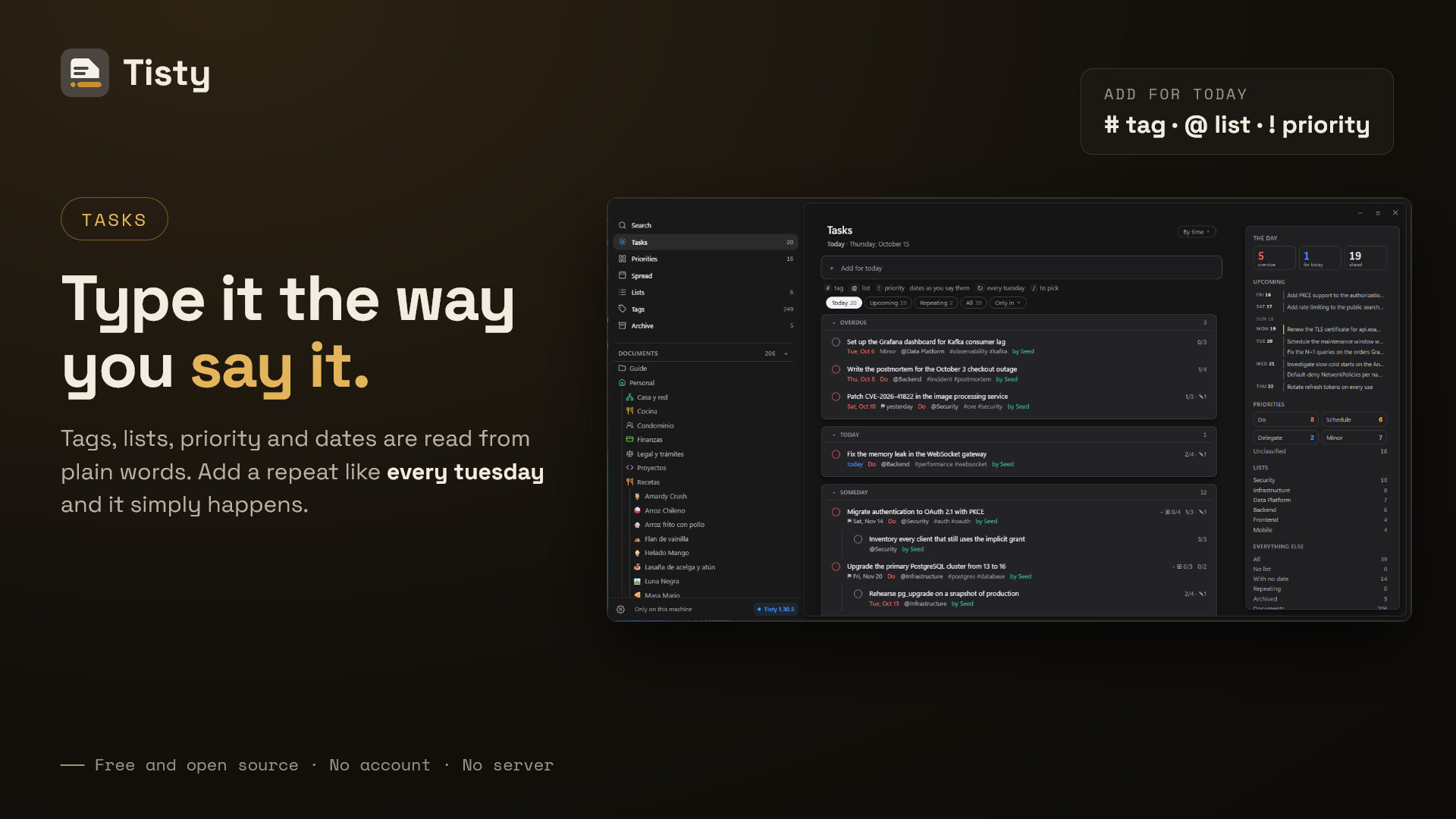
There is no form to fill in. Type the whole sentence in the bar at the top, and Tisty pulls the day, the list and the priority out of it as you go — and shows you what it understood before anything is saved, as chips you can correct with one click.
| You write | It understands |
|---|---|
tomorrow 10am |
a day and a time |
on friday |
the next one coming |
every tuesday |
something that comes back |
#home |
a tag: what it is about |
@work |
a list: where it happens |
!schedule |
a quadrant: do, schedule, delegate or minor |
If a part stays plain, it belongs to the title. What Tisty cannot read it leaves alone rather than guess. The full reference is in Natural language.
Try:
Rina's booster 3 october !do #healthWalk Rina every morningGo through the report on friday @work
Press Ctrl + Shift + Space wherever you are, and a small window opens for one task. Enter files it, Esc closes it, and you carry on with what you were doing. If another program already holds that shortcut, Tisty takes another one and tells you which in Settings.
- Today — what is due, overdue included. Overdue sits at the top, in red.
- Upcoming — what is coming.
- Repeating — what comes back on its own.
- All — everything open, unfiltered.
There is no prize for emptying the list.
The window has three columns at most: what you are looking at, the list, and the task you opened. Where the window is wide enough, a column tells you the day — overdue, today, ahead, the four quadrants with their counts, the lists and tags in use — counting your whole store, and every figure is a way in.
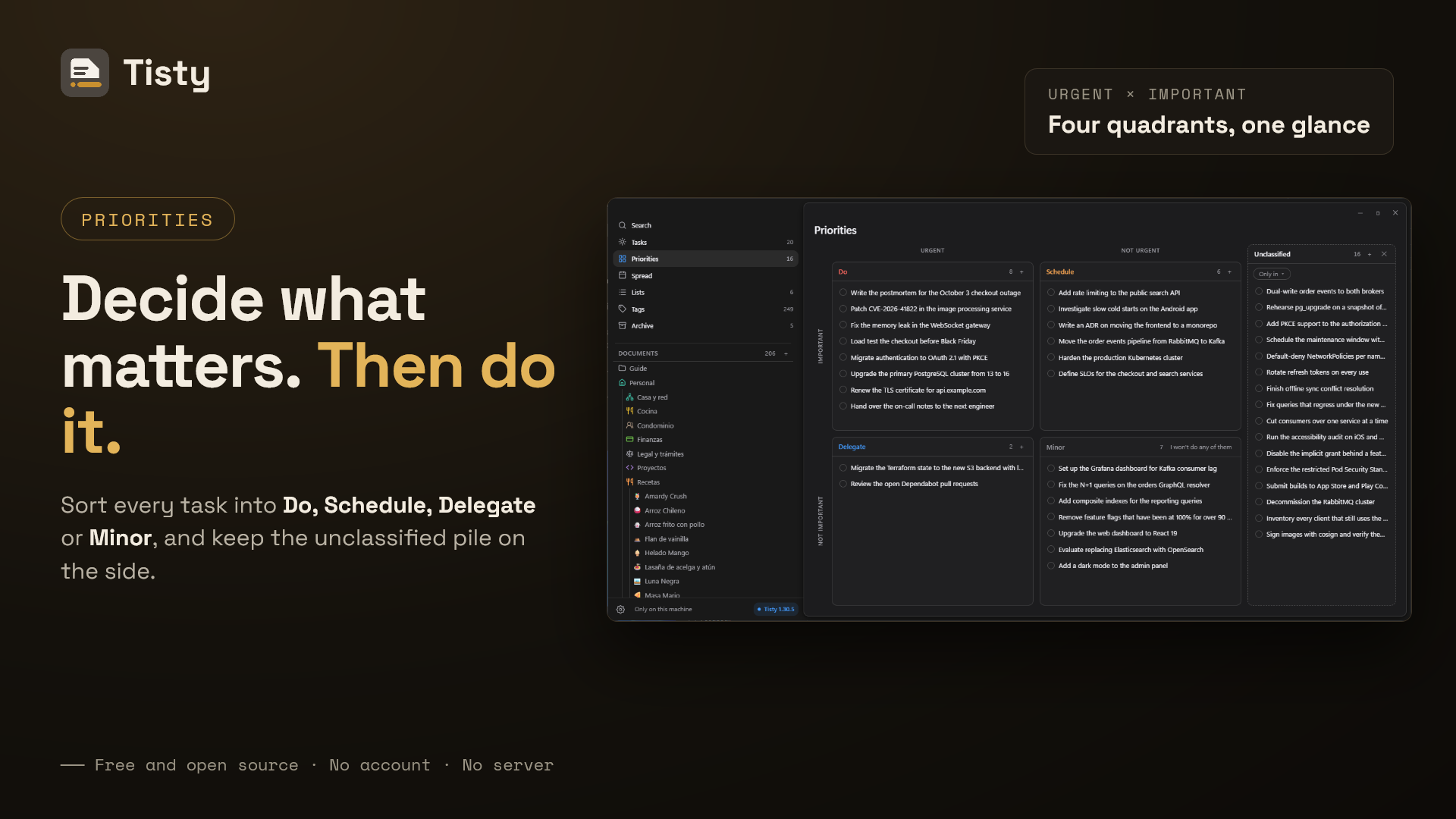
Two questions, four boxes: whether it is pressing, and whether it matters.
| Quadrant | Meaning | Type |
|---|---|---|
| Do | urgent and important — today | !do |
| Schedule | important, no rush — give it a date before it turns urgent |
!schedule (or !decide, its old name) |
| Delegate | pressing, but not yours to carry | !delegate |
| Minor | neither — one button drops the lot when you are sure | !minor |
Drag a task into its quadrant, or type it. Each quadrant has a + that opens the quick capture with that quadrant already set. Whatever nobody has placed waits in a tray beside them, without nagging.
The quadrants are not a scale, so !1 means nothing and stays in the title. !urgent alone is not a quadrant either — it fits both do and delegate.
Two ways of sorting that do not compete:
- A list says where it happens:
@home,@work. A task belongs to one. - A tag says what it is about:
#health,#shopping. A task carries as many as you like.
Tags are shared with documents: the Tags screen shows the tasks under a tag and the documents beneath them.
A task opens beside the list, not on top of it: dates, list, tags, priority, a description and a journal in Markdown, steps you tick one at a time, and whatever files you dropped on it. Opened to the whole page, it gains a column with its own trail — how long it has been open, how much is done, and every change it has been through.
A deadline is different from a plan: before, due, by and until open one. See Natural language.
A step is a line, a hundred characters at most. When one needs more — a description, a journal of its own — turn it into a task with ↗, and it becomes a part of the task it came from.
- A task with parts shows ▣ 3/7 where its steps would count, and its parts fold beneath it.
- Elsewhere, each part names its whole with ⌂.
- Under a task's steps, Parts takes a new one on its own line, and Part of another… finds the task it belongs to by name. Let it go detaches a part.
- Closing a task with parts still open asks you to let them go in the same breath, and undo brings them back.
-
Ctrl/⌘+Entercompletes the task you are on. It goes to the archive with everything it holds. - Dropping puts it aside without doing it: it lands in the archive too.
Tasks an assistant claims are done wait under To confirm — see What an assistant may do.
Tisto is Tisty's beaver, the one with a pencil behind its ear. It keeps you company in three places:
- Writing a task: once you have typed a few characters in the bar, it peeks over it and looks at what you write.
- Quick capture: it sits in a corner of the small window.
- Finishing a task: it gives you a thumbs up beside Done. Only for whole tasks you finish yourself: not for parts, not for tasks that repeat, and not for what an assistant closes.
It never covers anything, and it leaves on its own. To work without it, turn off Let Tisto peek in in Settings → General.