Repository navigation
Datapack Guide
The rules Material Nexus works from are datapack data, under data/<namespace>/material_nexus/. A
pack, a datapack or another mod can add files, or replace a shipped one by using the same id in a
pack loaded later. Changes apply on /reload.
| Folder | Says |
|---|---|
forms/ |
which tag folders and item names make a form, and how forms convert into each other |
recipe_formats/ |
where a mod's recipes keep their items, so they can be rewritten |
process_templates/ |
how to write a machine's recipe when there is none to copy |
presets/ |
ready-made pack-wide settings |
materials/ |
other names of a material |
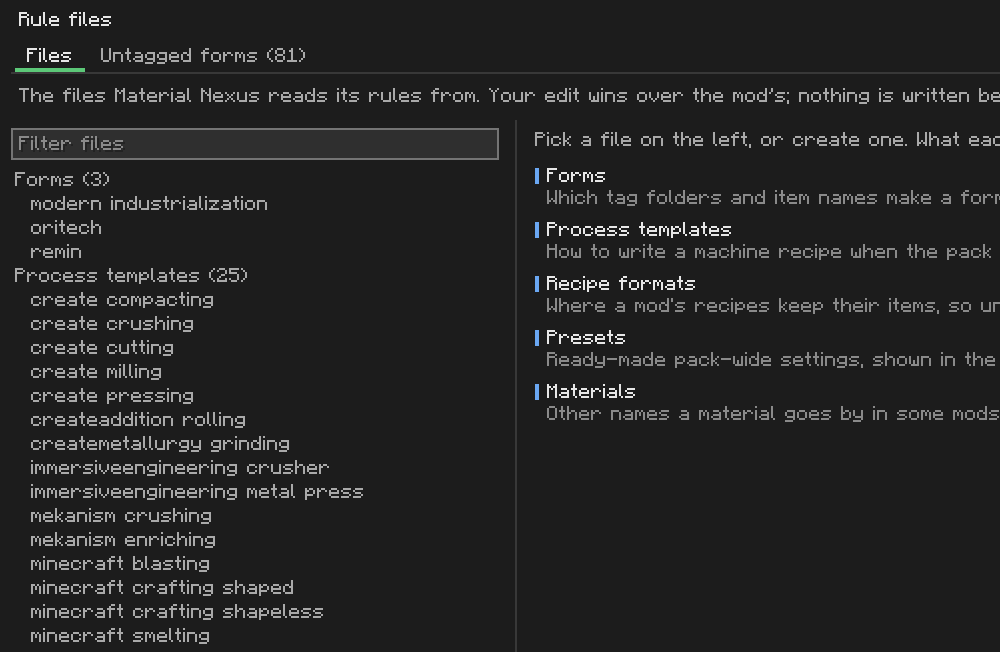
The Rule files view (under Advanced) lists every one of these files, grouped by kind, with where the version in use comes
from. Editing one saves your version in config/materialnexus/policies/data/ (a datapack named
materialnexus_user, loaded on top), as a change to apply; Back to original removes your version.
Your edits are decoded before being written, and the history keeps them.
{
  "folders": { "ore_chunks": "ore_chunk" },
  "patterns": { "double_ingot": ["modern_industrialization:{material}_double_ingot"] },
  "relations": [{ "from": "tiny_dust", "to": "dust" }],
  "remove_relations": [{ "from": "dust", "to": "ingot" }],
  "remove_folders": ["sheetmetals"]
}-
folders: a convention tag folder and the form it holds (c:ore_chunks/<material>). Adds to the built-in ones or remaps one. -
remove_folders: folders no longer read, built-in ones included; that form disappears from the pack view. -
patterns: item ids of a form mods leave untagged;{material}stands for a material some tag already knows. A match counts as evidence for that form; nothing is added to the game's tags. -
relations/remove_relations: conversions checked by the Missing tab and the report.
Built-in folders: ores, raw_materials, storage_blocks, ingots, nuggets, gems, dusts, tiny_dusts, dirty_dusts, clumps, shards, crystals, plates, sheetmetals, rods, gears, wires, double_ingots, large_plates, curved_plates, bolts, rings, blades, rotors, drill_heads, fine_wires. Built-in relations: nugget and ingot, ingot and block, raw and raw block, raw to ingot, dust to ingot, gem and block. Shipped pattern files: Modern Industrialization, Oritech, Realistic Minerals.
The Untagged forms tab of Rule files and the end of the report list name shapes worth declaring.
{ "types": ["othermod:grinder", "othermod:press"], "outputs": ["product", "byproducts"] }types: the recipe types this format describes. outputs: the top-level keys holding the items a
recipe produces. With a format, Material Nexus rewrites those recipes (outputs and inputs) when they
involve an alternative; without one, they are listed as "not handled yet" and left untouched.
One file per machine:
{
  "machine": "immersiveengineering:metal_press",
  "forms": {
    "rod": { "mold": "immersiveengineering:mold_rod" },
    "plate": { "mold": "immersiveengineering:mold_plate" }
  },
  "recipe": {
    "type": "immersiveengineering:metal_press",
    "energy": 2400,
    "input": { "basePredicate": "${input}", "count": "${in}" },
    "mold": "${mold}",
    "result": { "basePredicate": { "item": "${output_item}" }, "count": "${out}" }
  }
}| Field | |
|---|---|
machine |
the recipe type routes name |
prefer |
true: use the template before trying to copy a recipe |
forms |
variables per output form; a template with forms only serves those forms |
patterns |
shaped crafting patterns by input count: {"3": ["#", "#", "#"]}
|
recipe |
the recipe, with placeholders |
Placeholders: ${input} (the input form's tag, else its kept item), ${inputs} (that ingredient
repeated in times), ${in}, ${out}, ${pattern}, ${output_item}, ${output_tag},
${material}, ${form}, and the form's variables. A key "${input}" merges the ingredient into
its object: { "amount": "${in}", "${input}": "" } for stacks written that way.
A filled template is kept only if reading it back gives the exact ratio and the game decodes it.
A partial global.json:
{ "mod_priority": ["mekanism", "minecraft"], "conversion_recipes": ["ingot", "nugget"] }Its name and description come from the lang keys materialnexus.preset.<id> and
materialnexus.preset.<id>.desc. Using a preset sets the fields it defines and keeps the others.
{ "id": "aluminum", "aliases": ["aluminium"] }Tags named after an alias (c:ingots/aluminium) are discovered as the declaring material. Aliases
are never guessed from names. Shipped: aluminium as aluminum.