Repository navigation
Process Rules
Unifying makes every mod agree on which copper rod exists. A process rule decides how a copper rod is made: by which machines, from which form, at what ratio, for every material at once.
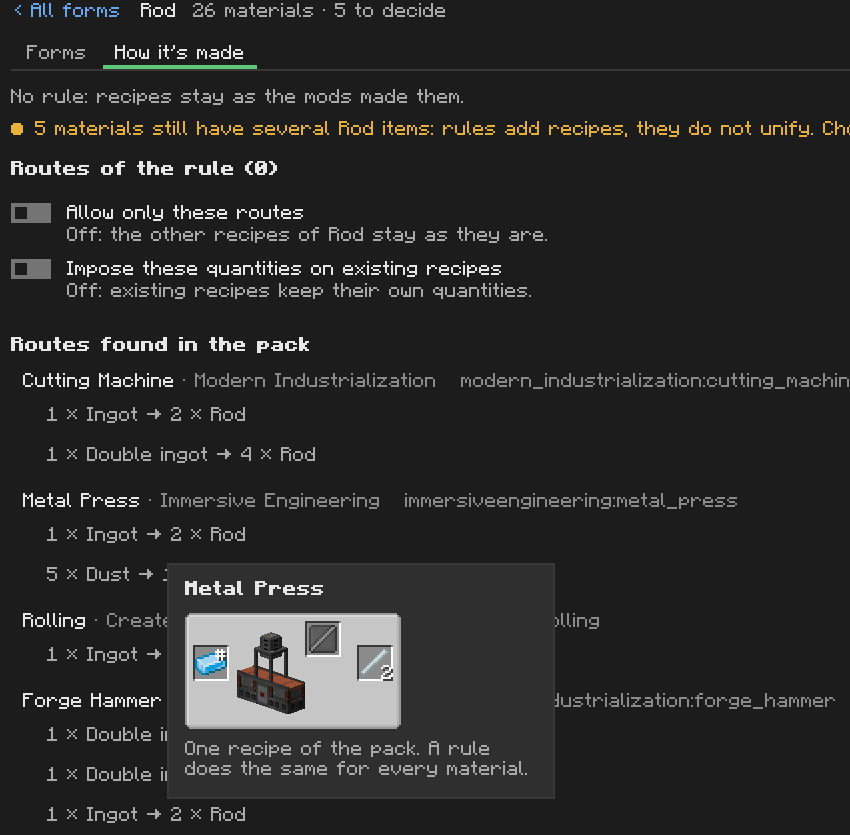
Open Forms, click a form's name, then the How it's made tab.
- Routes of the rule: each route with its machine, how many items of which form go in, and how many come out. − and + change the quantities, Remove drops the route.
- Routes found in the pack: what the recipes of the pack already do for that form, grouped by machine (Metal Press: 1 × Ingot → 2 × Rod). Add puts one in the rule. Hover a route to see one recipe of the pack that follows it, drawn by JEI or EMI.
-
Allow only these routes (
exclusive): recipes making this form in any other way are disabled. -
Impose these quantities on existing recipes (
enforce_ratio): a recipe of a route machine with other quantities is replaced by one with the quantities of the rule. Without it, only missing routes are added. - A warning says how many materials still have several items for the form: a rule adds recipes, it does not unify. Choose the kept item first.
The rule is a change to apply like any other; the review lists every recipe it generates or disables.
For each material having the form and its input form, each route of the rule:
- By example: Material Nexus looks for a recipe of that machine that already makes this form from that input for another material (the material's own recipe first when replacing it). It copies it and swaps every reference to that material: tags for tags, items for the kept item, conditions included. Then it sets the counts.
-
By template: when no recipe can be copied (or the template says
prefer), a process template for that machine is filled in (Datapack Guide). - Checked: the written recipe is read back. If the counts are not exactly the rule's ratio (a shaped pattern, a count stored somewhere unknown), the next example is tried; with none left, the route is listed as unsupported. Then the game must decode it, or it is listed as invalid and not written.
Nothing is guessed: a route that cannot be written exactly is shown, not approximated.
Generated recipes have ids like materialnexus:process/rod/copper/ingot/1/2/immersiveengineering/metal_press.
In global.json, per form, for every material:
"processes": {
  "rod": {
    "routes": [
      { "machine": "immersiveengineering:metal_press", "input": "ingot", "in": 1, "out": 2 },
      { "machine": "minecraft:crafting_shaped", "input": "ingot", "in": 2, "out": 4 }
    ],
    "exclusive": true,
    "enforce_ratio": true
  }
}
in and out are 1 to 64. A material file can override the rule for one of its forms with
"forms": { "rod": { "process": { ... } } }; "routes": [] switches the rule off for that material.
Shipped templates (used when there is nothing to copy): vanilla shaped and shapeless crafting, smelting, blasting, stonecutting; Create pressing, cutting, milling, crushing, compacting; Create Crafts & Additions rolling; Create Metallurgy grinding; Immersive Engineering metal press and crusher; Modern Industrialization compressor, macerator, wiremill, cutting machine, packer, forge hammer; Mekanism crushing and enriching; Oritech pulverizer, grinder and assembler. Any other machine works by example as soon as the pack has one recipe of it for that form.