Repository navigation
Plugin Force Field Builder
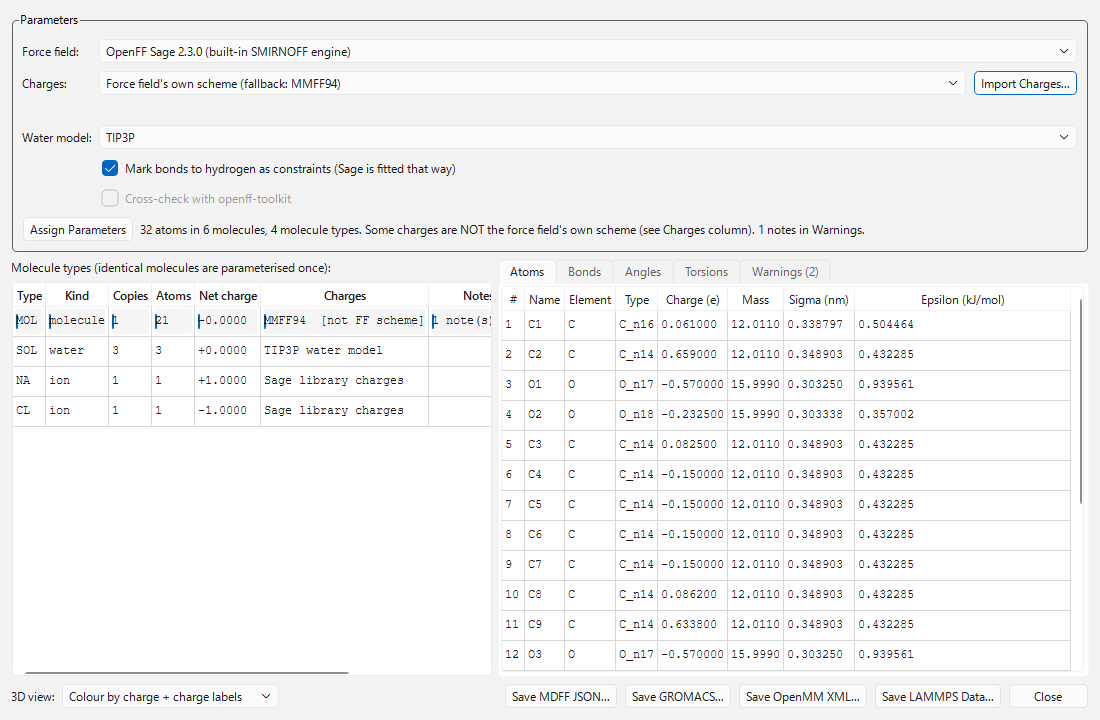
Force Field Builder assigns molecular-mechanics force-field parameters to the current structure and writes them out for MD: GROMACS .top/.itp, OpenMM ForceField XML, LAMMPS data, and the neutral moleditpy-mdff JSON read by the MoleditPy MD input generators. The default path needs nothing beyond MoleditPy: the bundled OpenFF Sage 2.3.0 is applied by a built-in SMIRNOFF engine, and proteins get the bundled Amber ff14SB residue by residue.
| Repository | moleditpy_force_field_builder |
| Author | HiroYokoyama |
| Supported OS | Windows, macOS, Linux, WSL |
| Supported Python | >=3.10, <3.15 |
| Supported MoleditPy | >=5.0.0, <6.0.0 |
| First-party plugin license | LGPL-3.0-or-later; bundled Sage under CC-BY-4.0, ff14SB parameters public domain |
| Menu location | MD ▸ Force Field Builder... |
| Extra dependencies | none; optional openff-toolkit, openff-nagl, openmmforcefields, acpype, AmberTools, xtb
|
See Official Plugins for the full catalogue, and MD System Builder for the whole MD workflow.
-
OpenFF Sage 2.3.0 without extra packages: bonds, angles, proper and improper torsions and van der Waals parameters from the SMIRNOFF
.offxml, matched with RDKit SMARTS (MDL aromaticity, last match wins, as in the OpenFF toolkit). Withopenff-toolkitinstalled, the assignment is compared term by term with the toolkit and any difference is listed under Warnings. - Amber ff14SB for proteins (0.2.0): a molecule made of standard amino-acid residues is parameterised from the ff14SB residue templates, including the N- and C-terminal forms, HIE / HID / HIP, ASH, GLH, LYN, CYX / CYM and the ACE / NME caps. Templates are matched on the bond graph, so hydrogen names do not matter and the protonation state is read from the hydrogens present. See Proteins.
-
GAFF / GAFF2 through
acpype(antechamber), and GAFF 2.11 throughopenmmforcefields, when those are installed. - Water and ions from tables: TIP3P, SPC/E and OPC3 water; Sage library charges and Lennard-Jones parameters for monatomic ions.
Identical molecules (same graph and atom order) share one molecule type and are counted. MoleditPy's 3D conversion puts every hydrogen after all heavy atoms, which mixes the molecules of a multi-molecule system; the plugin offers to reorder the atoms molecule by molecule (undoable) before it assigns parameters.
- The force field's own scheme: for Sage, OpenFF NAGL AM1-BCC charges when
openff-naglis installed, otherwise AM1-BCC from AmberToolssqm. - Gasteiger, MMFF94, GFN2-xTB (
xtb). -
Imported from a QM result: ORCA, Gaussian, Q-Chem, Psi4 or xtb output, PySCF Calculator JSON, xtb
--json, mol2 or a plain list. When a file holds several charge sets (RESP, CHELPG / Merz-Kollman ESP, MBIS, CM5, Hirshfeld, NPA, Loewdin, APT, Mulliken), the importer asks which to use, ESP-fitted charges first. -
RESP with AmberTools: a Gaussian job run with
Pop=MK IOp(6/33=2)is fitted with two-stage RESP by antechamber when AmberTools is onPATH. - A charge file may cover one molecule only: its charges go to every molecule with the same atom count and element order (a ligand computed alone, then solvated).
- Imported and xTB charges are averaged over symmetry-equivalent atoms, keeping the total; this can be switched off.
Charges that are not the force field's own scheme are marked [not FF scheme] in the table and the output.
A protein, with its water and ions, is parameterised in one build:
- Open the PDB file and prepare it with MD System Builder ▸ Protein, which adds the hydrogens for pH 7, the disulfide bonds and missing heavy atoms, and sets the formal charges. A PDB file that already has every hydrogen and its S-S bonds (
CONECT) can be used directly. - Solvate it, then press Assign Parameters.
Every block of amino-acid residues becomes one molecule type named PROTEIN, with the charges of ff14SB itself; the charge method chosen in the dialog applies to the other molecules. The PDB atom names are kept, and the molecule type's force_field is Amber ff14SB (proteins) (OpenMM Script Generator hands such types to OpenMM's amber14-all.xml). Ligands, water and ions in the same system get Sage and the water model as usual. A cysteine whose sulfur has neither a hydrogen nor a disulfide bond is an error rather than a guess.
ff14SB has no CMAP and no virtual sites, so the result is complete in every output format. It was checked against AmberTools 25: on crambin and protein G (2IGD), a GROMACS run of the plugin's topology and of the tleap + ParmEd one agree within 0.003 kJ/mol for every term, and on the test peptide every energy term matches sander to 0.002 kcal/mol. Only the standard residues are covered; modified residues, nucleic acids and metal centres are not.
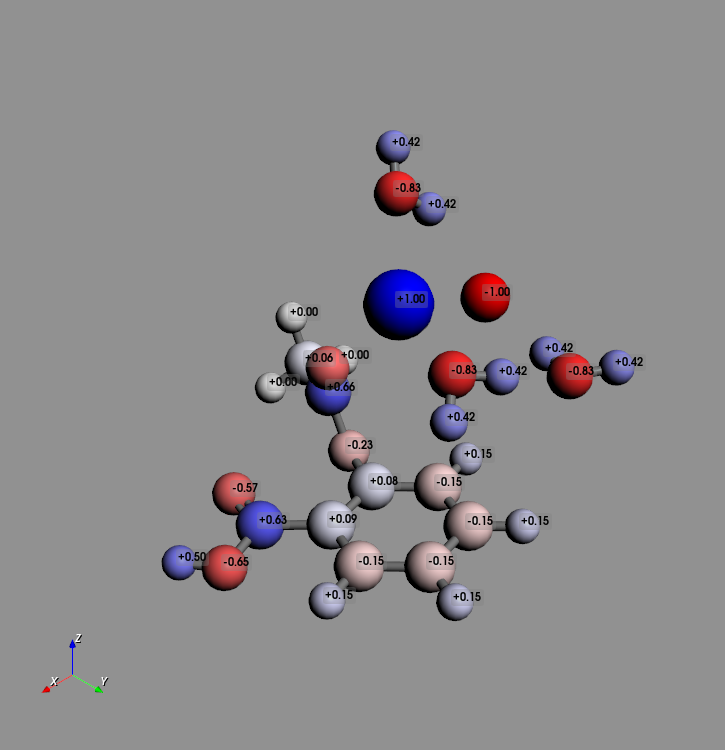
- Colour the atoms by charge, or show charge or atom-type labels, in MoleditPy's 3D view.
- Charges, sigma, epsilon (applied across the atom type) and every bond, angle and torsion can be edited in the tables; edits are marked as hand-made in the warnings.
- Terms with no Sage match fall back to UFF-derived values and are listed; missing proper torsions are reported.
- Settings and the assigned (and edited) parameters are saved with the MoleditPy project.
-
moleditpy-mdff JSON (
*.mdff.json): the hand-off file for GROMACS Input Generator, LAMMPS Input Generator and OpenMM Script Generator. GROMACS units (nm, kJ/mol, degrees, e, amu);molecule_typeswith atoms, bonds, angles, torsions, constraints and SETTLE, and asystemlist placing them on the atoms of the molecule. The full specification is in the repository README. -
GROMACS:
topol.topwith[ atomtypes ]and[ molecules ], and one.itpper molecule type. - OpenMM ForceField XML: one atom type per atom, so every bonded term is exact.
-
LAMMPS data:
units real,atom_style full, harmonic bonds and angles, torsions asdihedral_style fourier.
- Build or open the system and convert it to 3D (hydrogens explicit); for a protein, prepare it in MD System Builder first.
- Open
MD ▸ Force Field Builder..., choose the force field, charge method and water model, and press Assign Parameters. - Check the molecule types, the per-atom table and the Warnings tab; edit values if needed.
- Save the MDFF JSON and load it in an MD input generator, or save GROMACS, OpenMM XML or LAMMPS files directly.
OPC is a 4-site model that version 1 of the mdff format cannot describe; the 3-site OPC3 is offered instead. Sage is fitted with bonds to hydrogen constrained, so keep "Mark bonds to hydrogen as constraints" on for production runs. Virtual sites, polarisable force fields, CMAP and Urey-Bradley terms are not supported, so protein force fields with CMAP (ff19SB, CHARMM36m) are not offered.
- Official Plugins — the full plugin catalogue
- MD System Builder
- GROMACS Input Generator, LAMMPS Input Generator, OpenMM Script Generator
This page documents Force Field Builder v0.2.2, and was last updated on 2026-11-27. See REGISTRY/plugins.json for the current version.