Repository navigation
Plugin GAMESS Result Analyzer
GAMESS Result Analyzer reads GAMESS (US) output (.log, .out) and presents it as analysis windows: orbitals, vibrational modes, spectra, charges and optimisation paths. It works beside the MoleditPy window: pick an orbital, a normal mode or an optimisation step, and MoleditPy's 3D view follows. The parsers and the orbital engine are checked against real output from GAMESS 2024 R2.
This plugin is an independent project, not affiliated with or endorsed by the Gordon Group at Iowa State University; you need your own copy of GAMESS to produce the files it reads.
| Repository | moleditpy_gamess_result_analyzer |
| Author | HiroYokoyama |
| Supported OS | Windows, macOS, Linux, WSL |
| Supported Python | >=3.9, <3.15 |
| Supported MoleditPy | >=5.0.0, <6.0.0 |
| First-party plugin license | LGPL-3.0-or-later |
| Menu location |
.log / .out opener + Extensions ▸ GAMESS Result Analyzer
|
| Extra dependencies | RDKit, PySide6, matplotlib, Pillow |
See Official Plugins for the full catalogue.
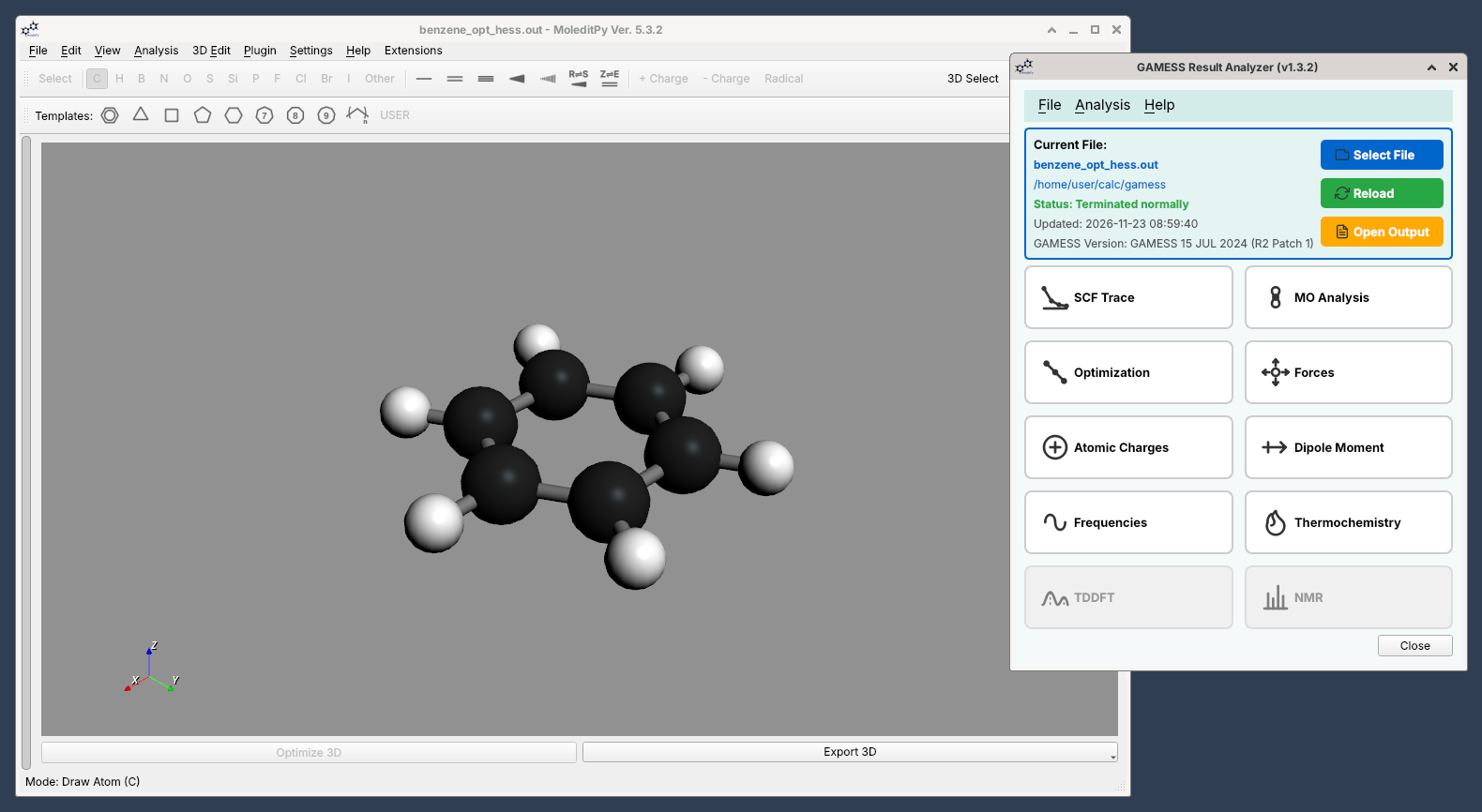
The main window has one button per analysis, enabled when the output holds the data.
- SCF trace: energy against iteration for every SCF in the job (RHF, UHF, ROHF).
- Molecular orbitals: energy levels with HOMO/LUMO marked, and 3D isosurfaces for restricted and unrestricted wavefunctions, s to g shells. Up to four orbitals side by side in Compare MOs.
- Optimisation: energy against step, with animation and GIF export.
- Forces: gradients for each geometry.
-
Atomic charges: Mulliken, Lowdin, and fitted ESP charges from
$ELPOT/$PDC. - Dipole moment as a vector on the structure.
-
Frequencies: normal modes with IR intensities, and Raman activities from
RUNTYP=RAMAN, animated. - Thermochemistry: ZPE, enthalpy, Gibbs energy and entropy term.
- TD-DFT: excited states with simulated absorption spectra.
- NMR: GIAO shieldings, with a stick spectrum.
- Bond analysis: Mayer bond orders.
- Post-HF energies: MP2, SCS-MP2, CCSD and CCSD(T); dispersion corrections.
.log and .out are shared with other programs, so the header is checked first and another program's output goes on to the plugin that handles it.
| Analysis | Input |
|---|---|
| All orbitals in 3D |
$CONTRL NPRINT=7 $END, and a single-point job |
| Fitted ESP charges |
$ELPOT IEPOT=1 WHERE=PDC OUTPUT=BOTH $END with $PDC PTSEL=CHELPG CONSTR=CHARGE $END
|
| Frequencies | RUNTYP=HESSIAN |
| Raman |
RUNTYP=RAMAN with $HESS and $DIPDR from the Hessian's punch file |
| TD-DFT |
TDDFT=EXCITE with DFTTYP
|
| NMR |
RUNTYP=NMR, on one core; RHF only |
| CCSD and CCSD(T) |
CCTYP= with $SYSTEM MEMDDI above zero |
The MO window has a button that copies the orbital keyword to the clipboard. GAMESS Input Generator Pro writes these inputs.
moleditpy -r gamess_result_analyzer parse job.log                 # summary
moleditpy -r gamess_result_analyzer parse job.log --json -s thermal -s frequencies
moleditpy -r gamess_result_analyzer xyz job.log -o final.xyz      # final structure
moleditpy -r gamess_result_analyzer xyz job.log --all -o path.xyz # every step
No editor and no Qt window is opened (MoleditPy 5.3.0 or later; python -m gamess_result_analyzer ... also works from the folder that contains the plugin).
These follow from what GAMESS prints:
- No J couplings, so NMR shows sticks without multiplets.
- TD-DFT reports length-gauge oscillator strengths only: no velocity gauge and no CD.
- No NBO tables, and no relaxed-scan view (GAMESS has no scan keyword).
- After an optimisation, GAMESS repeats only the occupied and a few virtual orbitals at the final geometry; run a single point with
NPRINT=7to see all of them.
Every feature is covered by a real GAMESS job in the repository's tests; the orbitals are checked for orthonormality on a real-space grid, and water at RHF/6-31G(d) is compared with Gaussian 16.
- Official Plugins — the full plugin catalogue
- GAMESS Input Generator Pro, Gaussian Result Analyzer, ORCA Result Analyzer
This page documents GAMESS Result Analyzer v1.3.2, and was last updated on 2026-11-26. See REGISTRY/plugins.json for the current version.