Repository navigation
Plugin MD System Builder
MD System Builder builds periodic systems for molecular dynamics: prepare a protein from a PDB file, set the cell, pack molecules into it, solvate with water and ions, and edit the cell. It is the first of the plugins that take a drawn molecule or a PDB file to ready-to-run GROMACS, LAMMPS or OpenMM input inside MoleditPy, and it needs nothing beyond MoleditPy itself.
| Repository | moleditpy_md_system_builder |
| Author | HiroYokoyama |
| Supported OS | Windows, macOS, Linux, WSL |
| Supported Python | >=3.10, <3.15 |
| Supported MoleditPy | >=5.0.0, <6.0.0 |
| First-party plugin license | LGPL-3.0-or-later |
| Menu location |
MD ▸ MD System Builder... (dock panel with five tabs) |
| Extra dependencies | none |
See Official Plugins for the full catalogue.
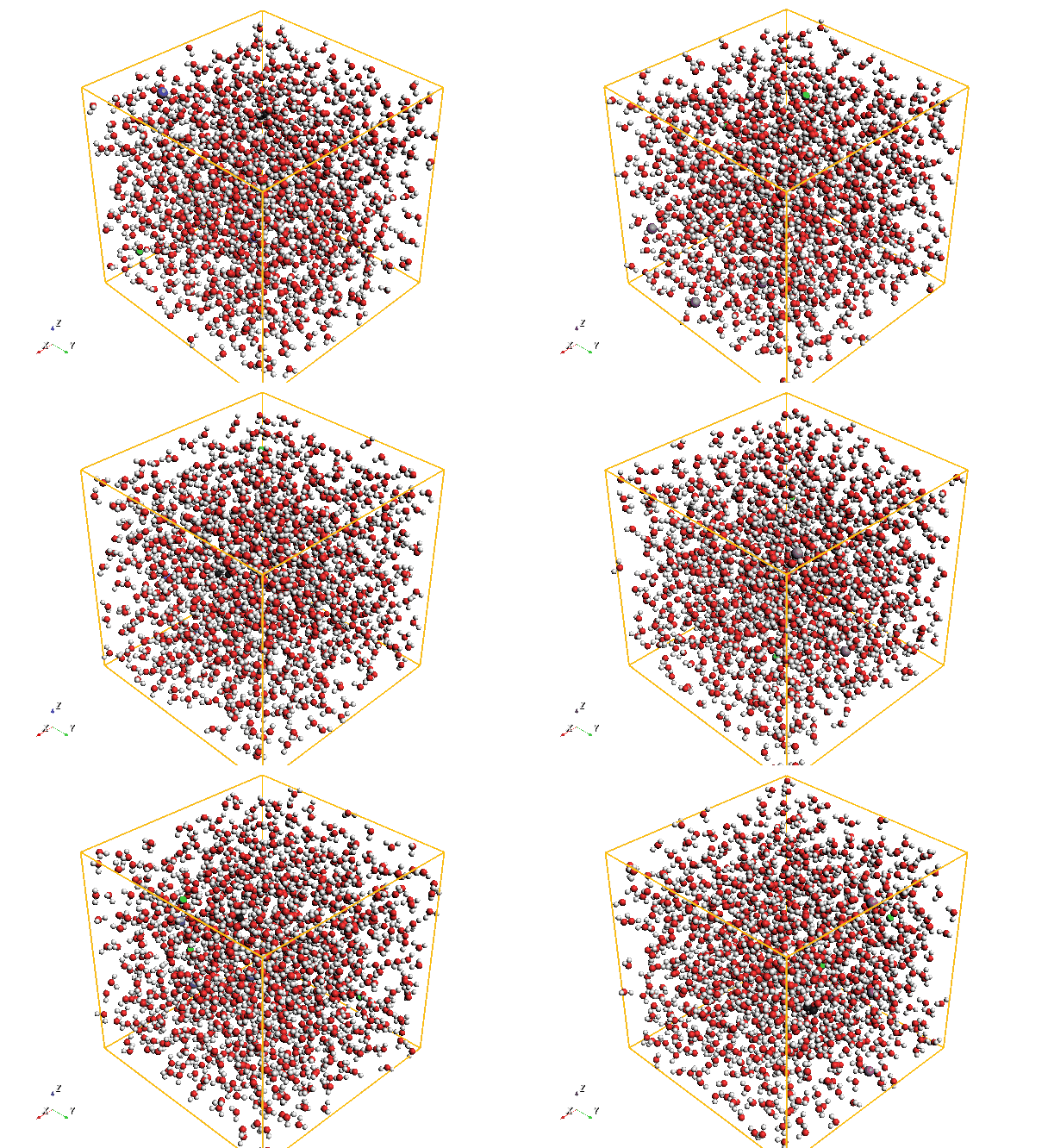
Tutorial with screenshots: acetate in water, from drawing to a GROMACS run and the analysis of its trajectory — on the web page or on GitHub.
  draw or open the solute (or a PDB file)
           |
  1  MD System Builder           protein prep, cell, packing, water and ions
           |
  2  Force Field Builder         parameters and charges  ->  system.mdff.json
           |
  3  GROMACS Input Generator     conf.gro, topol.top, .itp, .mdp, run.sh
     LAMMPS Input Generator      data file, in script
     OpenMM Script Generator     run_<name>.py, PDB, ForceField XML

  Large System Viewer            draws every step of it (required)
  Trajectory Analysis            RDF, MSD, RMSD, Rg ... after the run
| Plugin | Role |
|---|---|
| MD System Builder | protein preparation, periodic cell, packing, solvation with ions |
| Large System Viewer | displays the built system (required: a solvated box reaches tens of thousands of atoms) |
| Force Field Builder | parameters and charges, *.mdff.json
|
| GROMACS Input Generator, LAMMPS Input Generator, OpenMM Script Generator | one per MD engine |
| Trajectory Analysis | analysis after the run |
The cell travels between the plugins as the moleditpy_cell molecule property and the force field as the moleditpy-mdff JSON, so each step also works on its own.
Prepares a protein opened from a PDB file for MD with Amber ff14SB, which Force Field Builder then applies (0.2.0):
- Hydrogens for pH 7: every hydrogen is rebuilt from the residue templates, so a file with all, some or no hydrogens gives the same result. Lys, Arg, Asp, Glu and the chain ends are charged. Histidines take the state chosen under Histidine (HIE, HID or HIP) unless the file names them HID / HIE / HIP or has their ring hydrogens; residues named ASH, GLH, LYN or CYM keep that state.
- Chain ends and breaks: residues closer than 2.0 Å (C to N) form one chain; a gap starts a new chain with charged ends. A missing terminal OXT is added.
- Disulfides: cysteines whose sulfurs are closer than 2.5 Å are joined (CYX).
- Missing heavy atoms are added from the template, fitted on the atoms that are there.
- Alternate locations: only the first copy of a duplicated atom is kept.
- Water and other groups: crystal waters are removed by default; ions, ligands and additives are kept unless Remove other groups is checked.
A report lists residues, chains, added hydrogens and atoms, histidine states, disulfides, breaks, removed groups and the net charge. Checked on crambin and protein G with their hydrogens removed: the rebuilt hydrogens lie within 0.03 Å (median) of the deposited ones, tleap reads the result without warnings, and a solvated lysozyme (27,936 atoms) prepared this way ran through minimisation, NVT, NPT and MD in GROMACS.
- Box: set the cell from lengths and angles, three vectors, the atoms' bounding box plus padding (optionally cubic), or the CIF Viewer structure; or clear it. Atoms can be moved to the centre.
- Pack: Packmol-like random packing in numpy. Components from the current molecule, SMILES (3D-embedded with RDKit) or MOL/SDF/XYZ/PDB files; counts, or counts from a target density with mole ratios; a minimum distance checked across periodic boundaries; random orientations with a reproducible seed; an optional fixed solute; per-component regions (inside or outside a sphere or slab); a retry limit that reports what was placed.
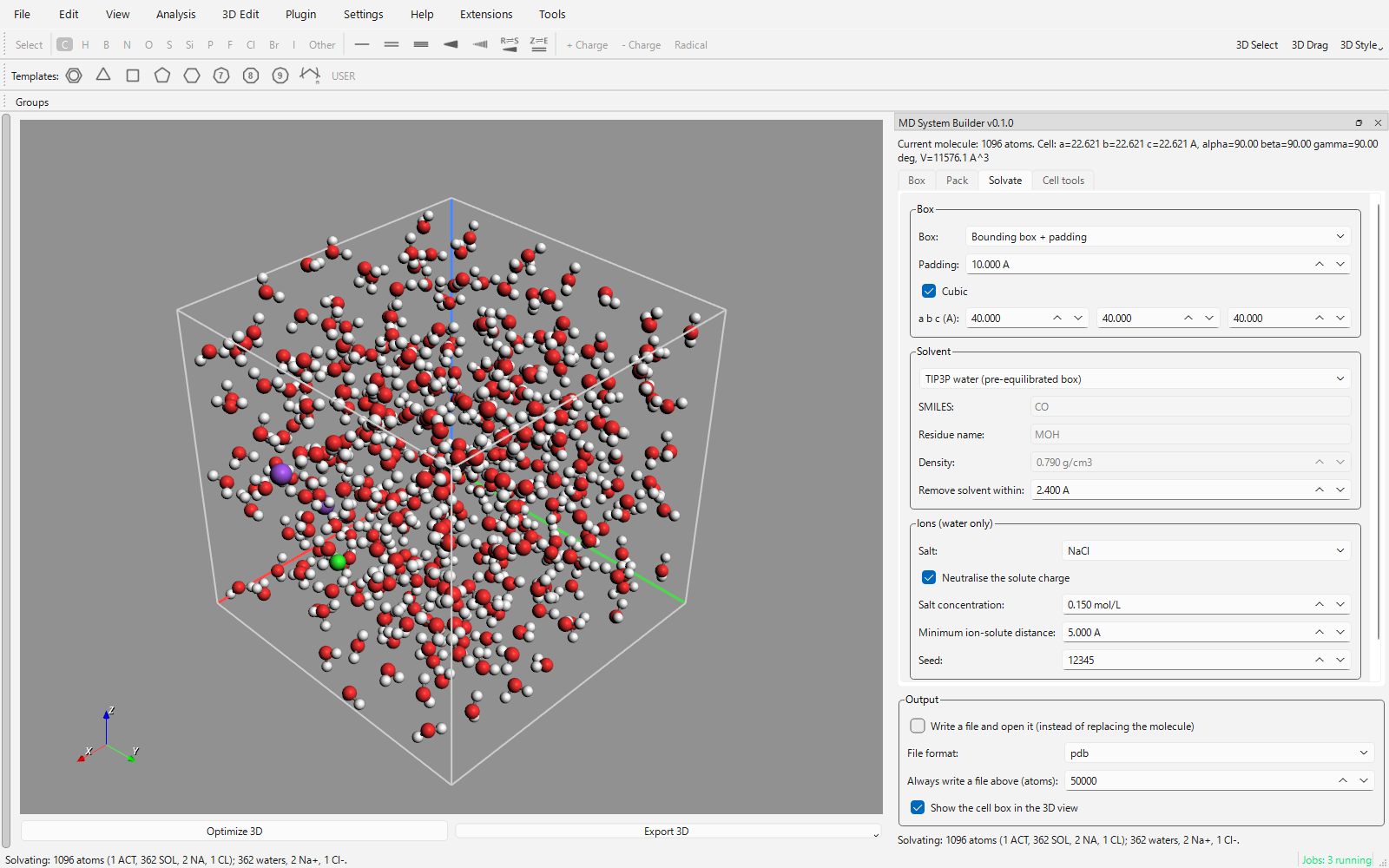
- Solvate: a box around the solute, explicit lengths or the existing cell. Water from a pre-equilibrated TIP3P box tiled into the cell (triclinic included; 0.97-1.00 g/cm³), or any SMILES molecule at a given density. Solvent within 2.4 Å of the solute is removed. Na⁺/Cl⁻ or K⁺/Cl⁻ neutralise the solute and reach a salt concentration, placed at least 5 Å from the solute and from each other.
- Cell tools: centre, wrap (by atom or molecule), unwrap broken molecules, supercells, scaling the cell (cell only, every atom, or rigid molecules), and conversion to an equivalent orthorhombic cell. The cell is drawn as a box in the 3D view.
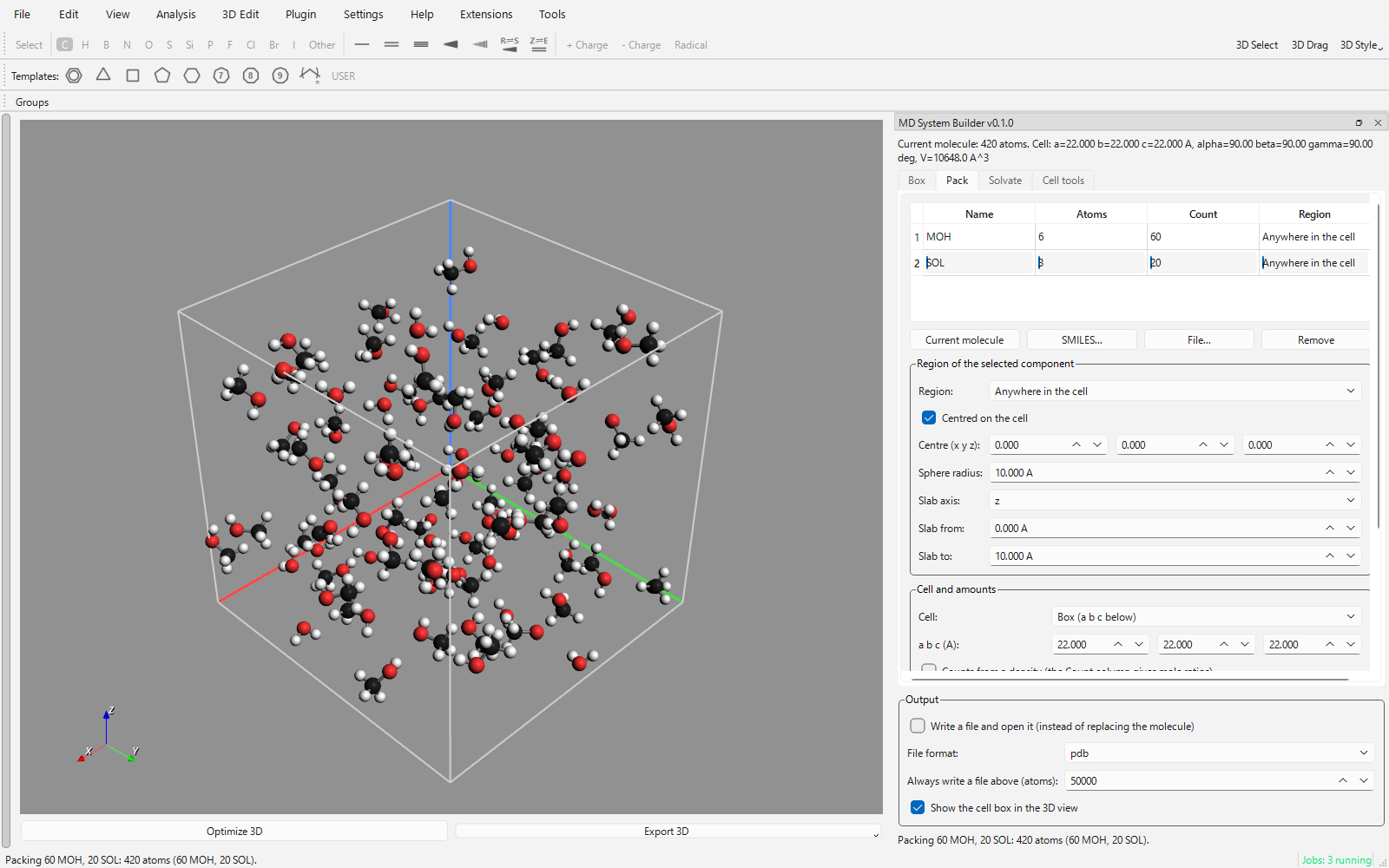
The result replaces the current molecule as one undo step, with PDB residue information so identical molecules can be counted downstream. With Write a file and open it, or always above a size limit (default 50,000 atoms), the system is written as PDB (with CRYST1), GRO or extended XYZ and opened through File ▸ Open, where Large System Viewer takes it. Long jobs run in the background with a progress bar and Cancel.
The cell is kept in the moleditpy_cell property ({"lattice": [[...],[...],[...]], "origin": [...], "pbc": [...]}, Å). MoleditPy drops molecule properties on undo and project save, so the plugin tags each undo state with its cell and saves the cell in the project.
- Draw or open the solute and convert it to 3D with explicit hydrogens; for a protein, open the PDB file and press Prepare Protein.
- Solvate (or Pack a mixture); check the box in Large System Viewer.
- Assign the force field in Force Field Builder and save
system.mdff.json. - Write the input with the GROMACS, LAMMPS or OpenMM generator, run it, and analyse the trajectory with Trajectory Analysis.
- Official Plugins — the full plugin catalogue
- Force Field Builder, Large System Viewer, Trajectory Analysis
- GROMACS Input Generator, LAMMPS Input Generator, OpenMM Script Generator
This page documents MD System Builder v0.2.2, and was last updated on 2026-11-27. See REGISTRY/plugins.json for the current version.