Repository navigation
Capacitor
Capacitors come in many types, and each type is marked differently. This tab decodes the markings on ceramic, film, SMD, tantalum, and electrolytic capacitors, and converts between pF, nF, and µF.
| Unit | Symbol | In farads |
|---|---|---|
| Picofarad | pF | 10⁻¹² |
| Nanofarad | nF | 10⁻⁹ |
| Microfarad | µF | 10⁻⁶ |
1 µF = 1,000 nF = 1,000,000 pF. Most codes are in picofarads, and the tool shows the answer in pF, nF, and µF.
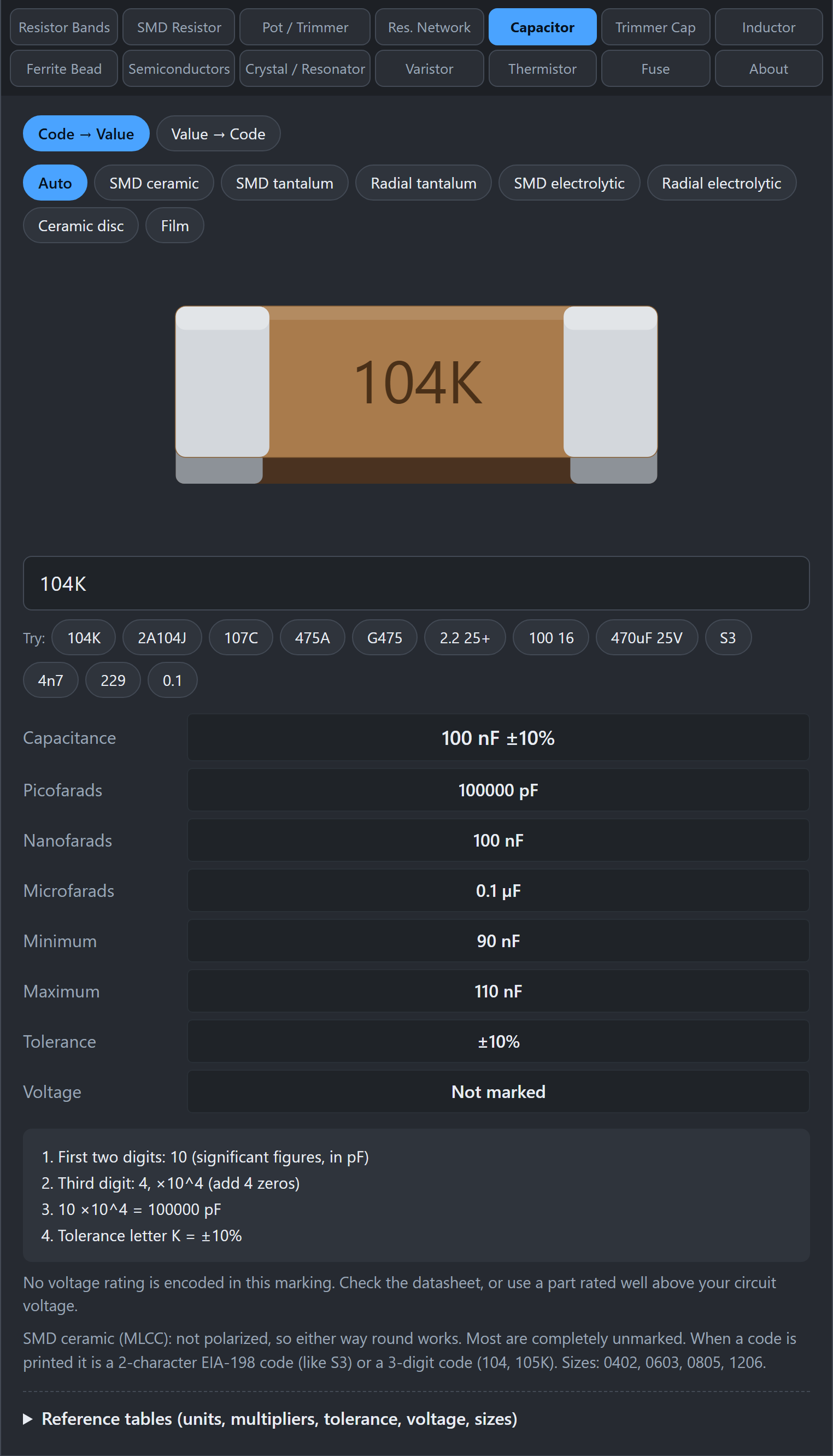 Pick the capacitor type, type the marking, and read the value, tolerance, and voltage.
- Click Capacitor. Leave Code → Value selected.
- Choose the type pill that matches your part, or leave it on Auto: SMD ceramic, SMD tantalum, Radial tantalum, SMD electrolytic, Radial electrolytic, Ceramic disc, or Film. The picture and the polarity notes change with the type.
- Type the marking.
- Read Capacitance, the conversions, Tolerance, Voltage, and the working.
To go the other way, click Value → Code and type something like 100nF, 0.1uF, or 4.7pF. You get the code to look for.
The first two digits are the value in pF and the third is the number of zeros.
-
104= 10 followed by four zeros = 100,000 pF = 100 nF = 0.1 µF. -
223= 22,000 pF = 22 nF. -
105= 1,000,000 pF = 1 µF. - If the third digit is 8 the multiplier is x0.01, and 9 means x0.1. So
229is 2.2 pF.
A letter after the digits gives the tolerance. 104K is 100 nF ±10%.
| Letter | Tolerance |
|---|---|
| B | ±0.1 pF |
| C | ±0.25 pF |
| D | ±0.5 pF |
| F | ±1% |
| G | ±2% |
| H | ±3% |
| J | ±5% |
| K | ±10% |
| M | ±20% |
| P | +100% / −0% |
| Z | +80% / −20% |
Some parts add a two-character voltage code in front. 2A104J is 100 nF, ±5%, 100 V, because 2A means 100 V. The tool's reference tables list all the voltage codes (for example 1H = 50 V, 1E = 25 V, 2E = 250 V).
A unit letter can replace the decimal point. 4n7 is 4.7 nF, 4p7 is 4.7 pF, and u47 is 0.47 µF.
Tiny ceramic and tantalum chips sometimes use a letter and a digit. The letter is the value from a table and the digit is the power of ten, in pF. S3 is S = 4.7, times 10³ pF, so 4.7 nF. The letters are case sensitive. The full letter table is in the tool's reference section.
 107C is a tantalum capacitor: 100 µF at 16 V. The + mark shows the positive end.
-
Capacitance code first, voltage letter after:
107C= 100 µF, C = 16 V.475A= 4.7 µF, A = 10 V.226V= 22 µF, V = 35 V. -
Voltage letter first:
G475= 4.7 µF at 4 V. - A second line, if there is one, is a lot or date code and can be ignored.
- Voltage letters: e = 2.5 V, G = 4 V, J = 6.3 V, A = 10 V, C = 16 V, D = 20 V, E = 25 V, V = 35 V, T or H = 50 V.
Large capacitors have room for the value, so they print it. Examples: 100uF 25V, 470uF 25V 105°C (the last number is the temperature rating), 100 16 (100 µF, 16 V), 2.2 25+ (2.2 µF, 25 V, + marks the positive lead).
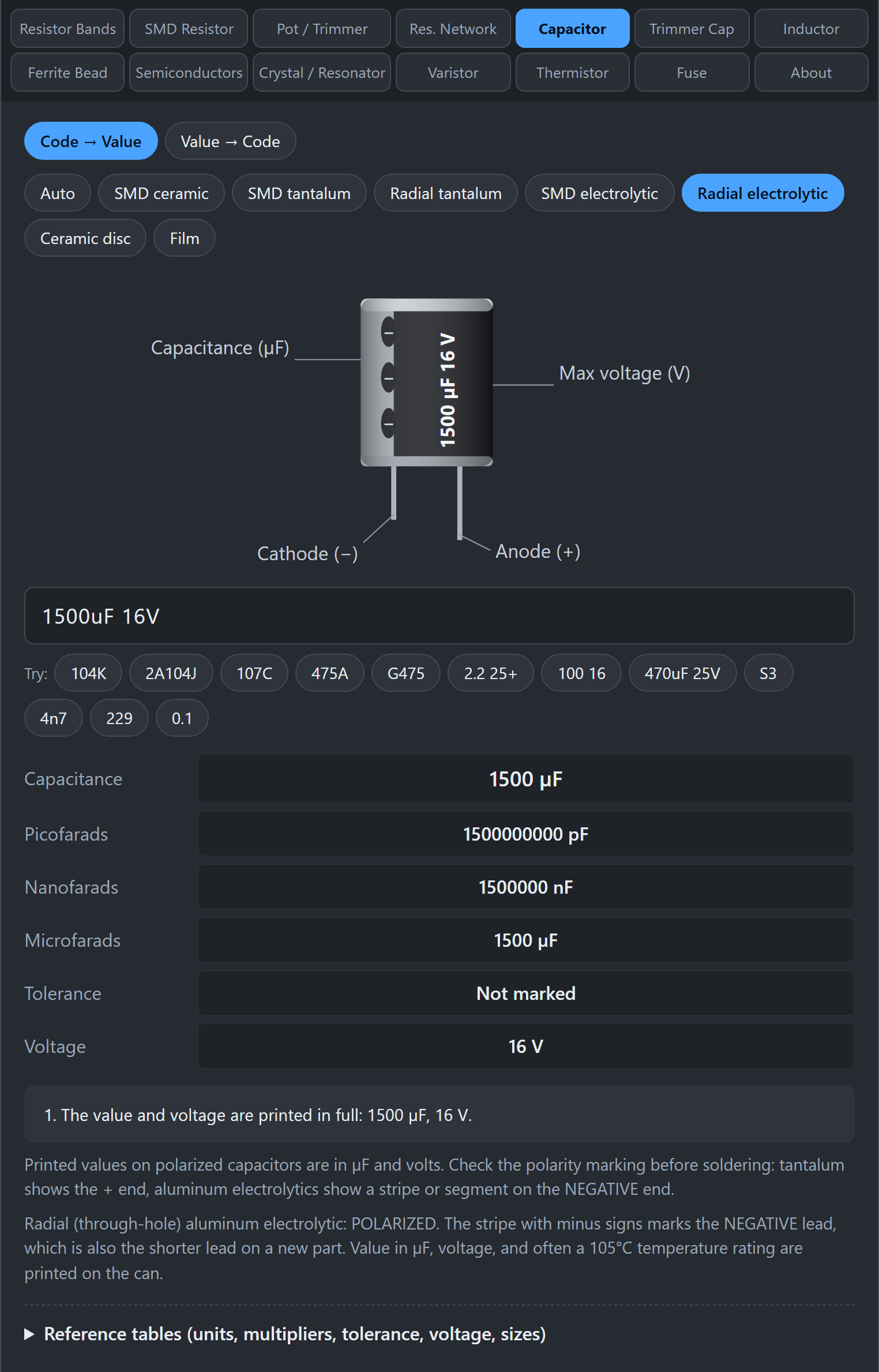 On a radial electrolytic, the stripe with minus signs marks the cathode (negative), which is also the shorter lead.
Ceramic and film capacitors are not polarized, so either way round works. The others are polarized and reversing them can destroy them:
- Tantalum (SMD): the stripe or bevel marks the positive end.
- Radial tantalum: a + is printed next to the positive lead.
- Aluminum electrolytic: the stripe (SMD: the dark bar or tinted segment on top) marks the negative end. On a new leaded part, the shorter lead is negative.
The tool draws each type with these markings labeled.
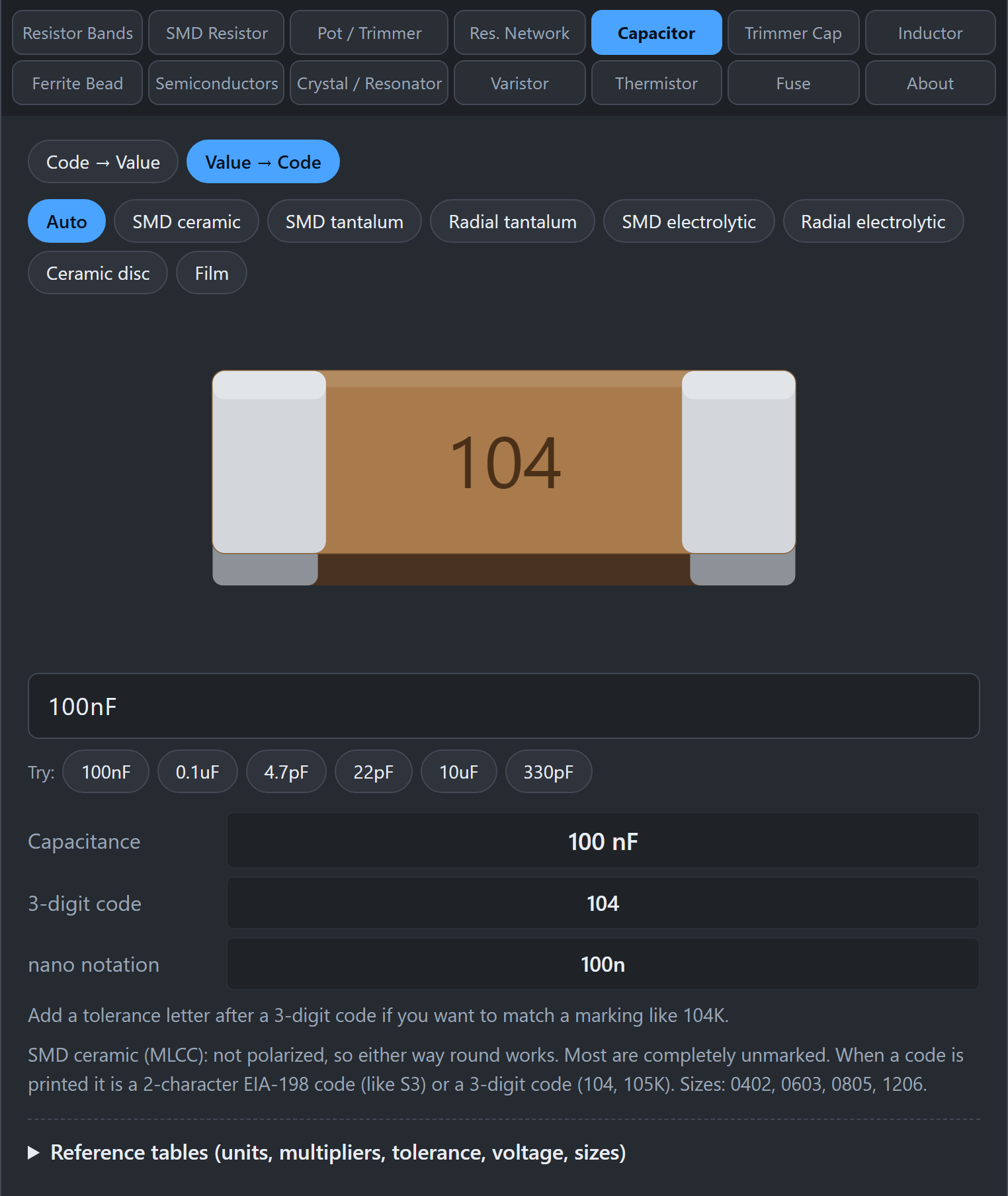 Value → Code mode turns 100nF into the marking 104.
-
107Ccould be two things. ACafter three digits can be a ceramic tolerance (±0.25 pF) or a tantalum 16 V code. The tool treats it as tantalum when the value is 1 µF or larger. Choose a type to force it. -
Bare
100 16. Two plain numbers are read as µF and volts, because that is how printed electrolytics look. A 3-digit number not ending in 0 with a voltage, like104 50, is read as a ceramic code plus 50 V. - Most SMD ceramics are unmarked. If there is no print, measure it with a capacitance meter.
-
Lowercase
ain EIA-198. The DigiKey table lists it as 2.6, while some others show 2.5. The tool tells you when it seesa.