Repository navigation
Resistor Bands
This tab reads the colored stripes on through-hole resistors and works in reverse too.
A resistor is too small to print "4,700 ohms" on it, so manufacturers paint stripes. Each color stands for a number. You read the stripes in order, like digits, and the last stripes tell you a multiplier and how precise the value is.
| Color | Digit | Multiplier | Tolerance | Temp. coefficient |
|---|---|---|---|---|
| Black | 0 | x1 | 250 ppm/K | |
| Brown | 1 | x10 | ±1% | 100 ppm/K |
| Red | 2 | x100 | ±2% | 50 ppm/K |
| Orange | 3 | x1k | 15 ppm/K | |
| Yellow | 4 | x10k | 25 ppm/K | |
| Green | 5 | x100k | ±0.5% | 20 ppm/K |
| Blue | 6 | x1M | ±0.25% | 10 ppm/K |
| Violet | 7 | x10M | ±0.1% | 5 ppm/K |
| Grey | 8 | x100M | ±0.05% | 1 ppm/K |
| White | 9 | x1G | ||
| Gold | x0.1 | ±5% | ||
| Silver | x0.01 | ±10% |
A resistor with no tolerance stripe is ±20%.
| Bands | Stripes mean |
|---|---|
| 3 | digit, digit, multiplier (tolerance is ±20%) |
| 4 | digit, digit, multiplier, tolerance |
| 5 | digit, digit, digit, multiplier, tolerance |
| 6 | digit, digit, digit, multiplier, tolerance, temperature coefficient |
More digits mean a more precise resistor. Five and six band resistors are usually 1% or better.
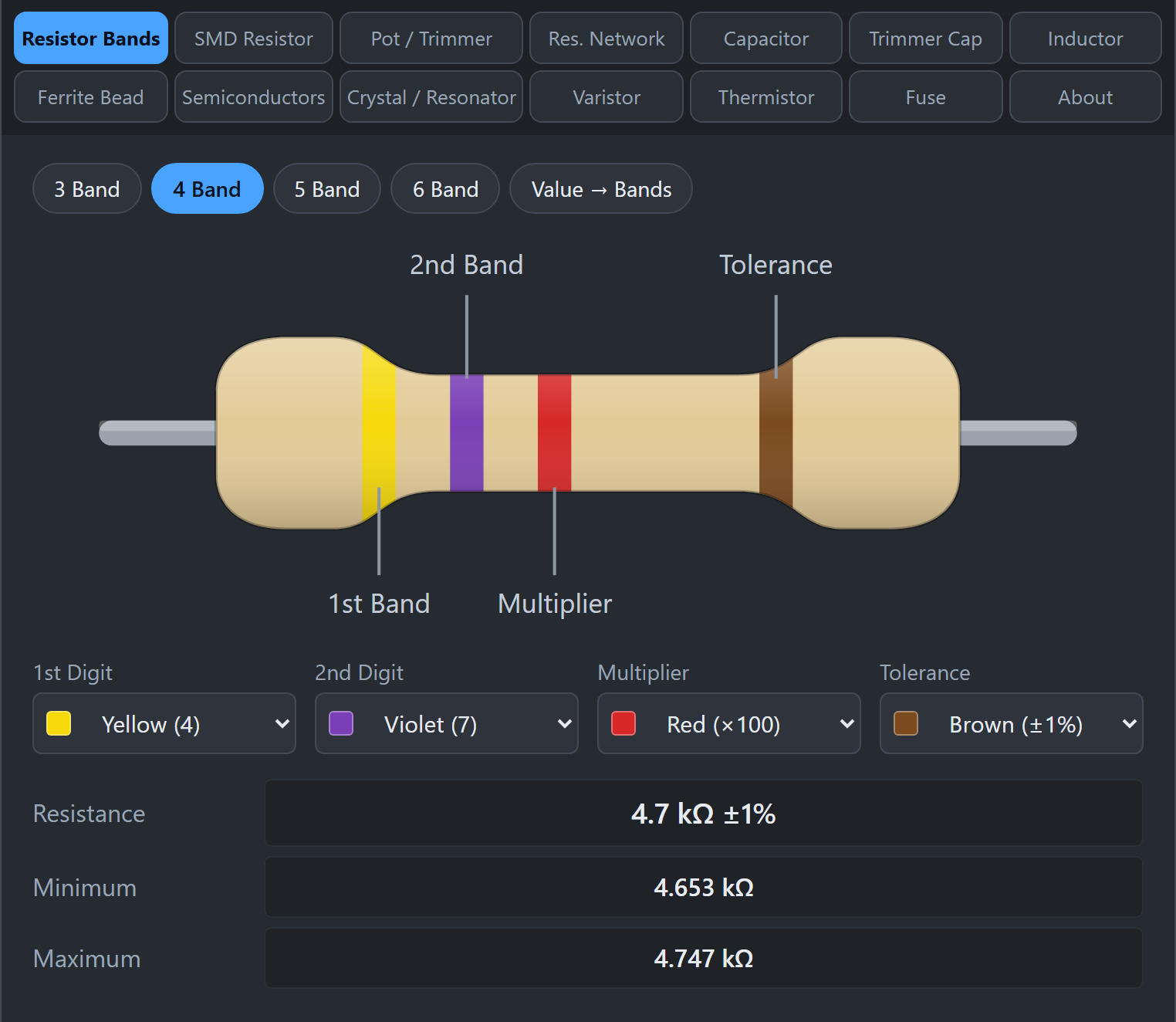 Each band is labeled on the picture (1st Band, 2nd Band, Multiplier, Tolerance), and the results show the value and its range.
- Choose 3 Band, 4 Band, 5 Band, or 6 Band at the top.
- Set each dropdown to the color on your resistor, starting from the end where the stripes are closest together.
- Read Resistance, Minimum, and Maximum. Minimum and Maximum show the range the real resistor can fall in because of its tolerance. A 6-band resistor also shows its Temperature coefficient.
The picture updates as you pick colors, with each band labeled (1st Band, 2nd Band, Multiplier, Tolerance, and so on).
Example, 4 band: yellow, violet, red, brown. Digits 4 and 7, multiplier x100, so 4,700 ohms, which is 4.7 kΩ. Brown means ±1%. Range 4.653 kΩ to 4.747 kΩ.
Example, 6 band: green, blue, black, orange, violet, red. Digits 5, 6, 0, multiplier x1k, so 560 kΩ. Violet means ±0.1%. Red means 50 ppm/K.
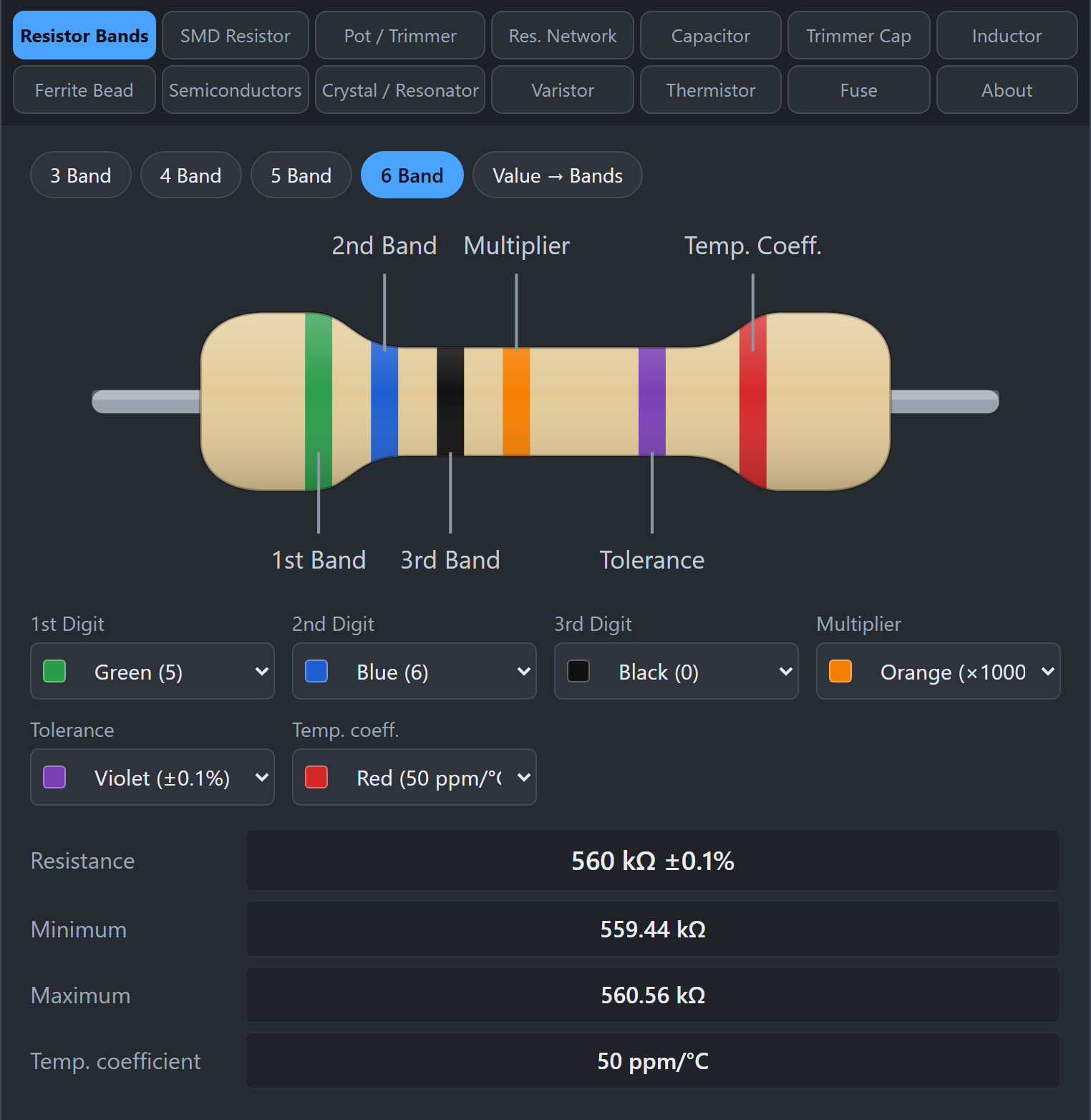 A 6-band resistor (green, blue, black, orange, violet, red) is 560 kΩ ±0.1% at 50 ppm/K.
It says how much the resistance drifts when the temperature changes. 50 ppm/K means that for each degree of temperature change, the resistance changes by 50 parts per million. Most projects never need to think about it. It matters in precision measurement circuits.
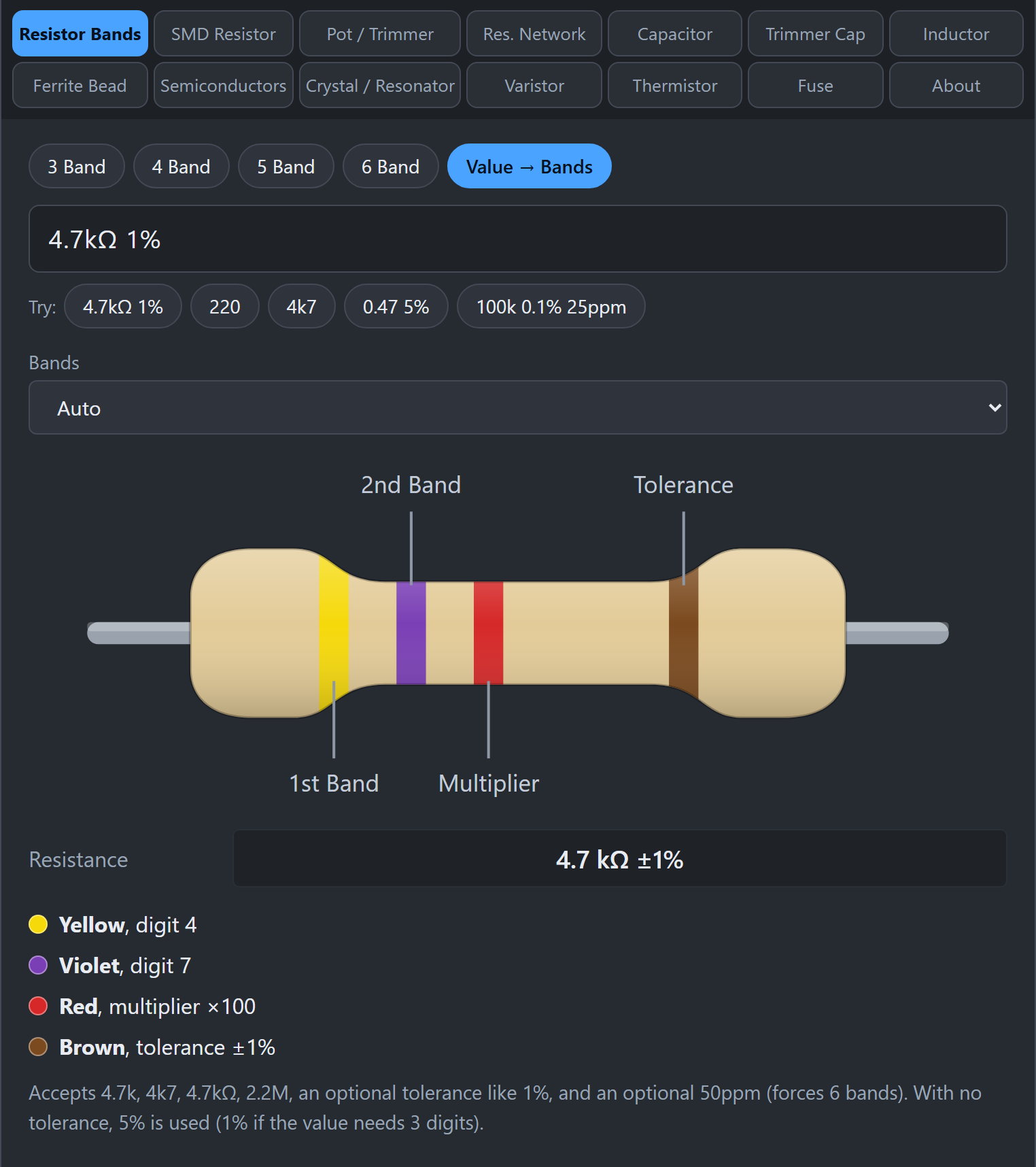 Value → Bands mode turns 4.7kΩ 1% into its four colored bands and lists them in order.
- Click Value → Bands.
- Type a value, for example
4.7kΩ 1%,4k7,220, or2.2M. Add a tolerance like1%if you want one. Add50ppmto get a 6-band resistor. - Choose Auto for the band count, or force 3, 4, 5, or 6.
The tool picks 4 bands when the value needs two digits and the tolerance is 1, 2, 5, or 10 percent. It switches to 5 bands for three-digit values like 4.72 kΩ, or for tolerances of 0.1, 0.25, or 0.5 percent. If you give no tolerance, it assumes 5 percent (1 percent when the value needs three digits).
0 gives a single black band, which marks a zero-ohm jumper.
- Which end is the start? Read from the end where the stripes are closer together. The tolerance stripe sits slightly apart.
- Gold and silver as a multiplier. In the third position of a 4-band resistor they mean x0.1 and x0.01, so brown, black, gold is 1 Ω, not 10.
- Colors age. Red can look like orange and brown can look like black on an old part. When in doubt, check the value with a meter.
- Out of range. The bands can express about 0.1 Ω up to the gigaohms. The tool will tell you if your value is outside that.
SMD Resistor for printed numbers on chip resistors, and Pot and Trimmer for adjustable ones.