Repository navigation
Ferrite Bead
A ferrite bead is a small part that blocks high-frequency noise on a power or signal line. At low frequencies and DC it acts almost like a plain wire, but at high frequencies it behaves like a resistor and turns the noise into a tiny amount of heat.
A bead is rated by its impedance at 100 MHz, not by its DC resistance. When a code is printed, it works like a resistor code.
-
601= 60 x 10 = 600 Ω at 100 MHz. -
121= 12 x 10 = 120 Ω at 100 MHz. -
600R= 600 Ω at 100 MHz.
Most small SMD beads are unmarked, so this tab is most useful for printed codes and for part numbers such as Murata's BLM series.
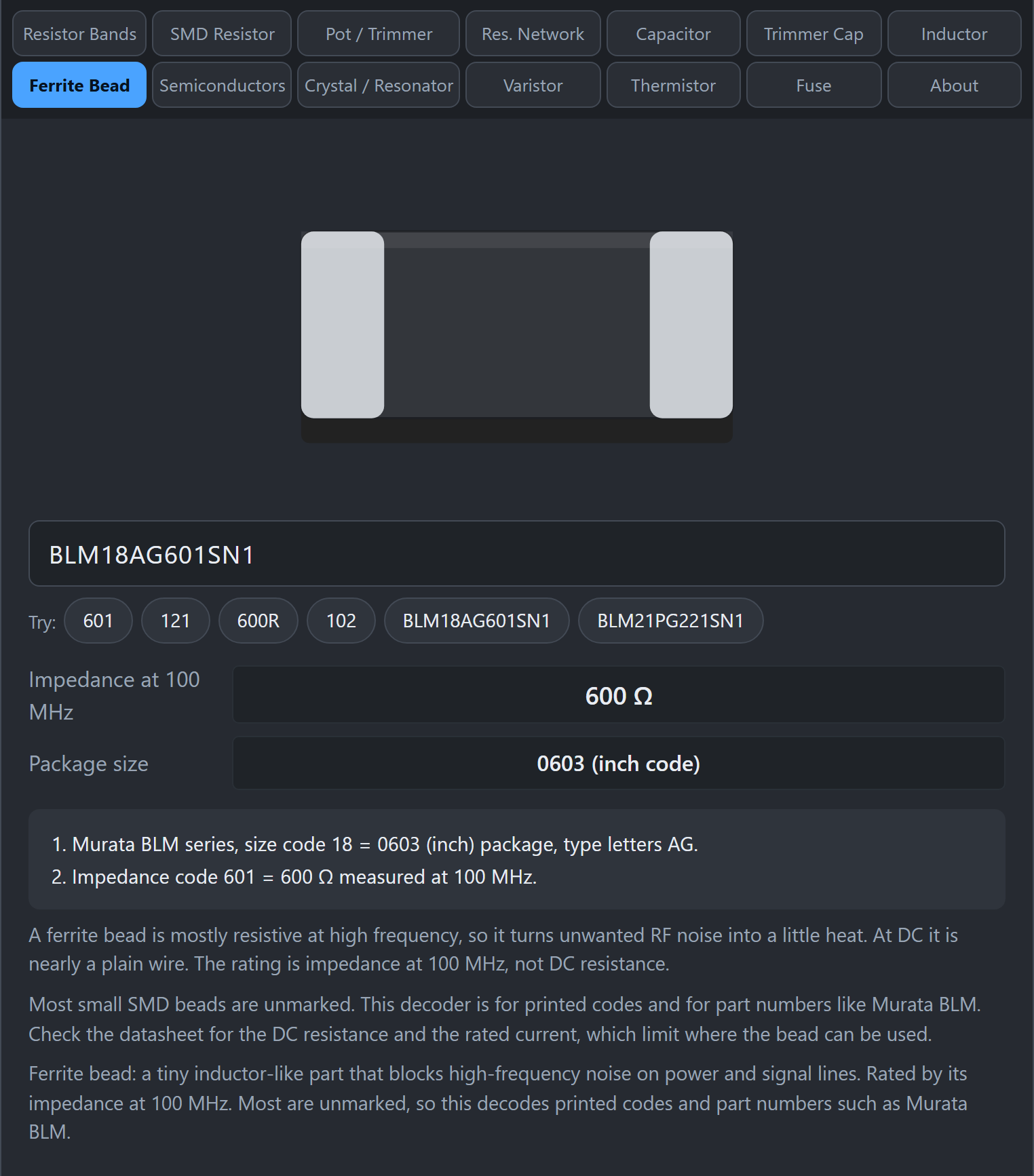 A Murata BLM18AG601SN1 is a 0603 bead with 600 Ω impedance at 100 MHz.
- Click Ferrite Bead.
- Type the code or part number, for example
601,121,600R,BLM18AG601SN1, orBLM21PG221SN1. - Read Impedance at 100 MHz and, for BLM parts, the Package size.
Take BLM18AG601SN1:
- BLM: Murata chip ferrite bead.
- 18: the size code, here the 0603 package. Confirmed codes: 15 = 0402, 18 = 0603, 21 = 0805, 41 = 1806. If the tool does not know a size code, it tells you to check the datasheet.
- AG: the type letters (series and characteristics).
- 601: 600 Ω at 100 MHz.
- SN1 and any trailing letters: other options and packaging. Look these up in the Murata datasheet.
- Do not pick a bead only by impedance. Check the DC resistance and the rated current in the datasheet. A bead that is too small can overheat on a power rail.
- Different from an inductor. A bead is meant to lose energy at high frequency. An inductor is meant to store it.
- Impedance changes with frequency. The 100 MHz figure is a reference point, not the value at every frequency.