Repository navigation
Thermistor
A thermistor is a resistor whose resistance changes a lot with temperature. There are two kinds.
- NTC (negative temperature coefficient): resistance drops as the temperature rises. Used for temperature sensing and for limiting the surge current when a power supply switches on.
- PTC (positive temperature coefficient): resistance jumps up sharply above a certain temperature. Used as a self-resetting fuse and in heaters.
The marking is usually the resistance at 25 °C.
-
103= 10 x 1,000 = 10 kΩ at 25 °C (the most common value for sensors). -
502= 5 kΩ. -
103AT-2is a Semitec part: 10 kΩ at 25 °C, with a B value of 3435 K. -
NTC 10K B3950means 10 kΩ at 25 °C and a beta of 3950 K. -
10D-9is a large inrush limiter: 10 Ω at 25 °C, 9 mm disc.
The B value (beta) describes how steeply the resistance changes with temperature. A higher B means a bigger change.
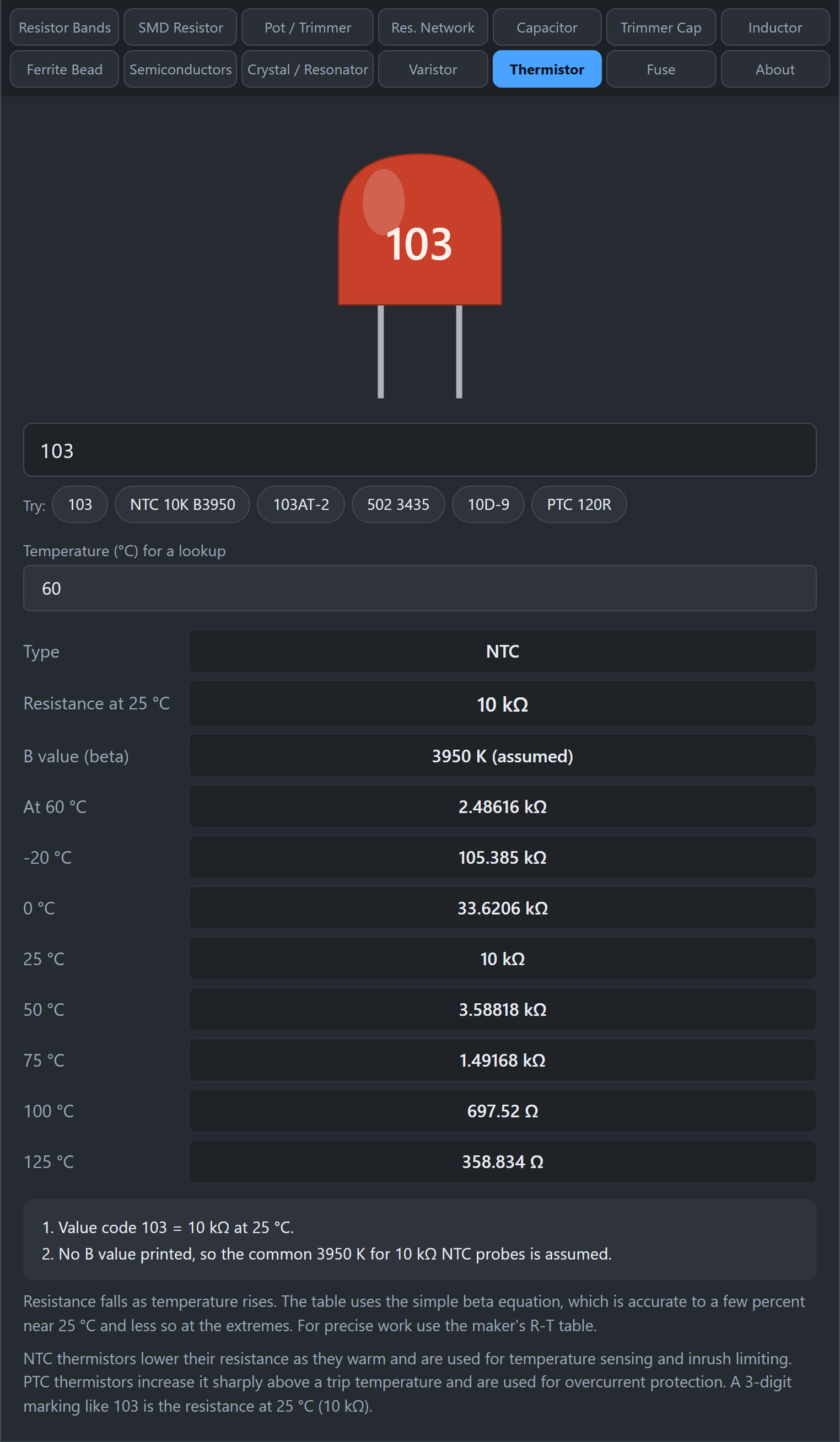 A 10 kΩ NTC (103) with beta 3950 reads about 2.49 kΩ at 60 °C, with a table for other temperatures.
- Click Thermistor.
- Type the marking, for example
103,NTC 10K B3950,103AT-2,502 3435,10D-9, orPTC 120R. - Enter a temperature in °C to look up the resistance at that temperature (for example 60).
- Read the type, resistance at 25 °C, B value, the lookup, and a table of resistance from −20 to 125 °C.
It uses the beta equation: R(T) = R25 x e^(B x (1/T − 1/298.15)), with temperatures in kelvin. For a 10 kΩ, B 3950 sensor, that gives about 2.49 kΩ at 60 °C. The beta equation is accurate to a few percent near room temperature and less so at the extremes. For precise work, use the maker's resistance-temperature table.
-
No B value? For a plain NTC like
103, the tool assumes 3950 K, the common value for 10 kΩ sensor probes, and says so. A different part can have a different B (a 103AT-2 is 3435 K). - PTC markings. The number is the cold resistance at 25 °C. PTC behavior depends on the part's trip temperature, so the tool does not give a curve.
-
Inrush limiters get hot. A part like
10D-9heats up in use and lowers its resistance. Mount it clear of other components. - A thermistor is not a thermometer by itself. You need a circuit (usually a voltage divider and an ADC) and a conversion like the one above.