Repository navigation
Resistor Networks
A resistor network (or resistor array) packs several matching resistors into one part. You see them as a single row of pins (SIP), two rows (DIP), or a small SMD chip. They save space when you need many identical resistors, such as pull-ups on a bus.
The value is usually a 3-digit code, the same as SMD resistors: the first two digits are the value and the third is the number of zeros. 103 is 10 kΩ per resistor. A 4-digit code works the same way with three significant digits, so 1002 is 10 kΩ.
Some parts also carry a tolerance letter (F = ±1%, G = ±2%, J = ±5%, K = ±10%, and so on), for example A103G is 10 kΩ at ±2%. A leading letter such as A often marks the circuit type, but the letters vary between makers.
- Bussed: one end of every resistor connects to a shared common pin. This is pin 1, marked with a dot or stripe. It is the usual choice for pull-up or pull-down arrays.
- Isolated: each resistor has its own two pins, such as pins 1 and 8 on an 8-pin part. It behaves like separate resistors in one package.
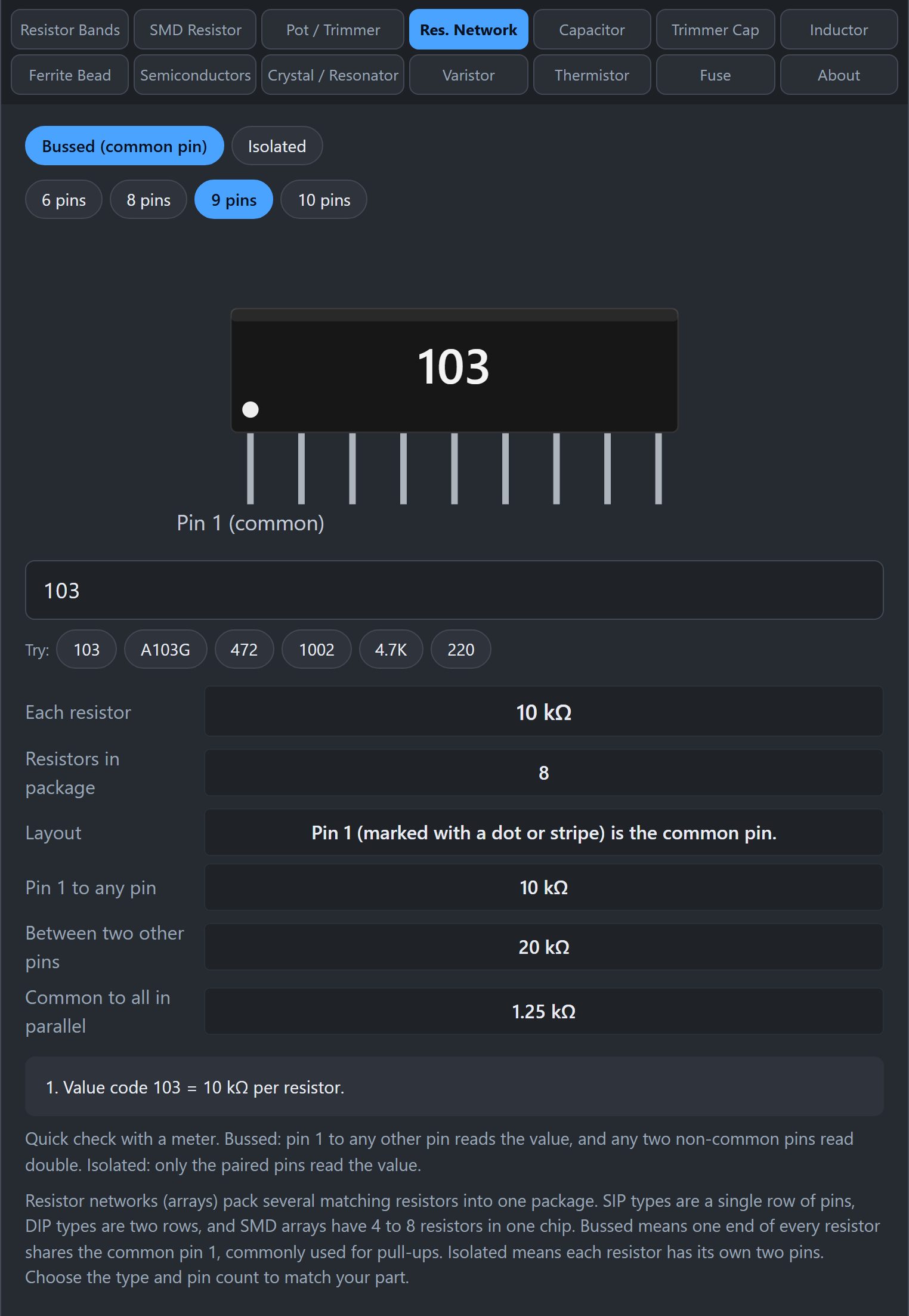 Choose bussed or isolated and the pin count. The results include what to expect with a meter.
- Click Res. Network.
- Choose Bussed or Isolated, and the pin count (6, 8, 9, or 10 pins) to match your part.
- Type the marking, for example
103,472, orA103G. - Read Each resistor, Resistors in package, and the layout notes. For bussed parts you also get the readings to expect with a meter.
Bussed network with value R:
- Pin 1 to any other pin reads R.
- Any two non-common pins read 2R (the signal passes through two resistors).
- If you tie all the other pins together, the common pin to that bundle reads R divided by the number of resistors.
Isolated network: only the paired pins read R, and every other combination is open.
If your meter readings do not match, you probably have the other type, or a different value.
- Pin 1 matters. Pin 1 is marked with a dot or a stripe. On a bussed network it is the common pin, so putting the part in backwards changes the circuit.
- Pin count versus resistor count. A 9-pin bussed SIP has 8 resistors, because one pin is the common. An 8-pin isolated part has 4.
- The tool cannot see inside. The circuit type is your choice, because the markings do not always say. Use the meter test to be sure.