Repository navigation
Crystals and Resonators
This tab reads the markings on parts that set the beat of a circuit: crystals, ceramic resonators, oscillators, and ceramic filters. It also gives you the frequency in every unit, how long one cycle is, and what the frequency is usually used for.
| Part | Passive or active | Accuracy | Needs |
|---|---|---|---|
| Crystal | Passive | High (about ±10 to ±50 ppm) | An oscillator circuit and two load capacitors |
| Ceramic resonator | Passive | Lower (about ±0.5%) | Often nothing extra (3-pin types have built-in capacitors) |
| Oscillator (XO) | Active | Good | Power and ground only, gives a ready clock |
| MEMS oscillator | Active | Good | Power and ground only, very shock resistant |
Passive means the part needs a circuit around it to oscillate. Active means it has the circuit inside and just needs power.
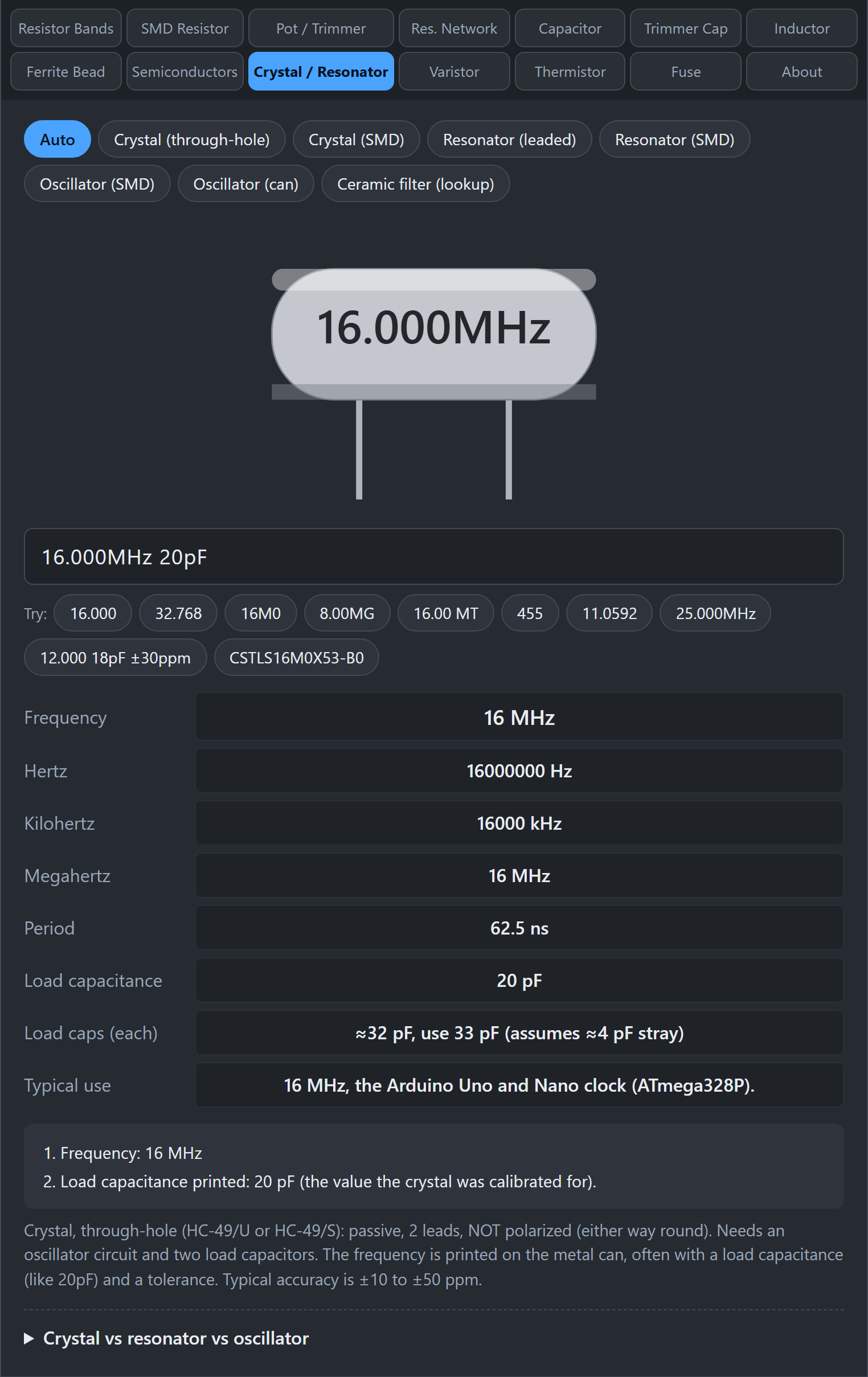 A crystal marked 16.000MHz 20pF shows its frequency in every unit, its period, and suggested load capacitors.
- Click Crystal / Resonator.
- Choose the part type, or leave it on Auto: Crystal (through-hole), Crystal (SMD), Resonator (leaded), Resonator (SMD), Oscillator (SMD), Oscillator (can), or Ceramic filter (lookup).
- Type the marking, for example
16.000,32.768,16M0, or16.000MHz 20pF ±30ppm. - Read Frequency in Hz, kHz, and MHz, the Period, and Typical use.
-
Plain frequency:
16.000is read as 16 MHz.32.768is read as 32.768 kHz (the standard watch crystal).455is read as 455 kHz. -
Unit as a decimal point:
16M0is 16.0 MHz and4M096is 4.096 MHz.32K768is 32.768 kHz. -
Frequency plus series code:
8.00MGis 8 MHz with a series or tolerance code.16.00 MTis 16 MHz with the letters printed by the maker. -
Extra details:
20pFis the load capacitance the crystal was calibrated for.±30ppmis the stability. The tool shows how far off the frequency can be, in Hz. -
Murata resonator part numbers:
CSTLS16M0X53-B0reads as a 3-terminal leaded resonator with built-in capacitors at 16 MHz.
A crystal oscillates at its rated frequency only when it sees the load capacitance it was made for. If a load of 20 pF is printed, you add two capacitors, one from each crystal pin to ground. The tool uses the common formula, assuming about 4 pF of stray capacitance from the board:
each capacitor = 2 x (load capacitance − stray capacitance)
For 20 pF that is 2 x (20 − 4) = 32 pF, so use the nearest standard value, 33 pF.
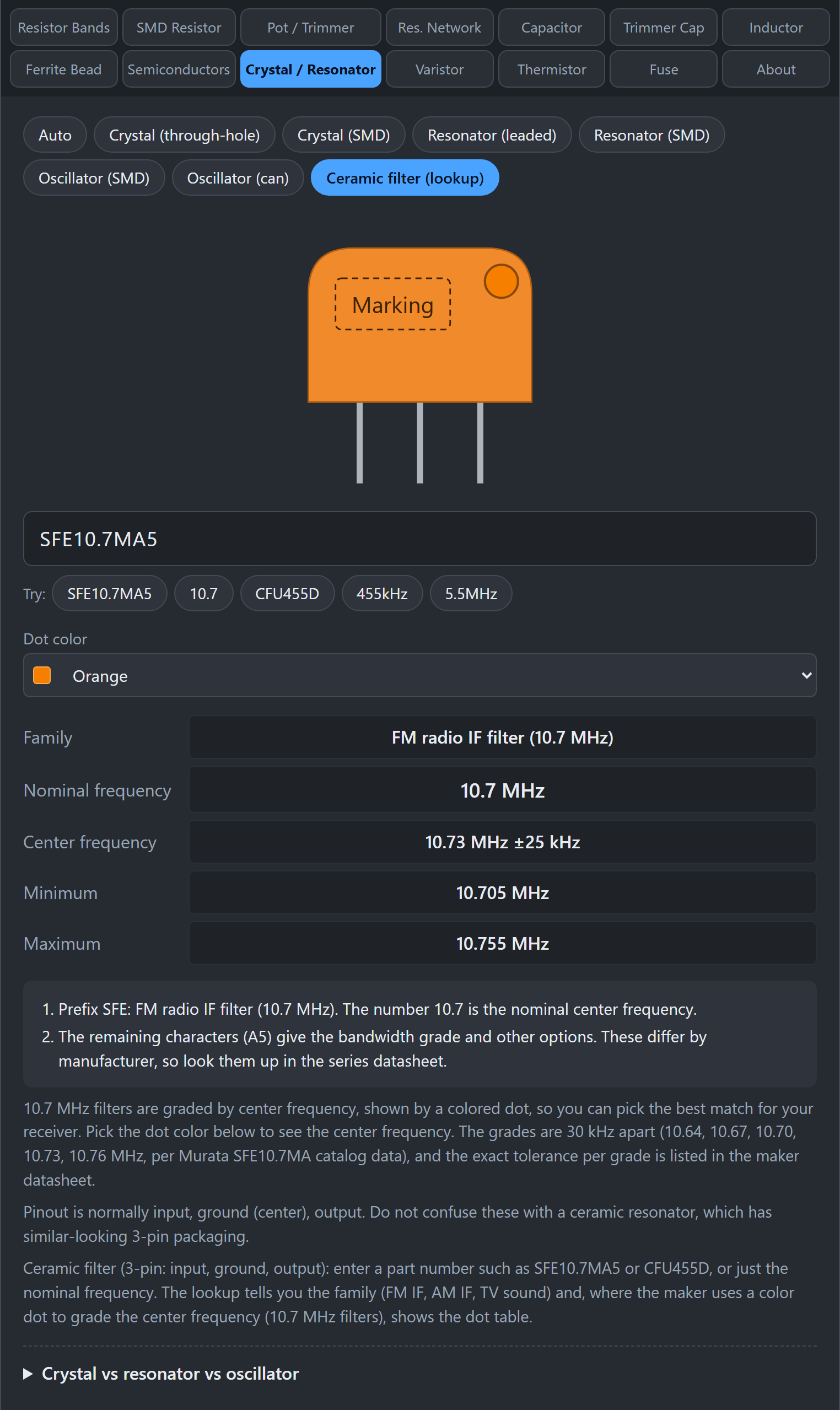 The ceramic filter lookup identifies the family and, for 10.7 MHz filters, maps the dot color to the center frequency.
Ceramic filters are 3-pin parts used in radios. Choose Ceramic filter (lookup) and type either a part number such as SFE10.7MA5 or CFU455D, or a nominal frequency such as 10.7, 455kHz, or 5.5MHz. The tool tells you the family: FM IF (10.7 MHz), AM IF (455 kHz), or TV sound IF (4.5 to 6.5 MHz range), and the center frequency.
For 10.7 MHz filters, a colored dot marks the center frequency grade, so you can choose the dot color to see it: black 10.64 MHz, blue 10.67, red 10.70, orange 10.73, and white 10.76 MHz.
- Crystal: two pins, not polarized. Either way round works.
- SMD crystal (4 pad): use the two diagonal pads. The other two are case ground or not connected. A dot marks pin 1.
- Ceramic resonator (3 pin): the middle pin is ground. The outer two are interchangeable.
- Oscillator (SMD, 4 pad): a dot marks pin 1, counted counter-clockwise. A common pinout is 1 enable (or not connected), 2 ground, 3 output, 4 supply. Some makers differ, so check the datasheet.
- Oscillator (can): a corner dot or notch marks pin 1. Full size: 1 enable, 7 ground, 8 output, 14 supply. Half size: 1 enable, 4 ground, 5 output, 8 supply.
- No unit printed. The tool guesses: small numbers are MHz, 32.768 is kHz, and numbers in the hundreds are kHz. It shows the assumption in the working.
- Series letters are not decoded. Letters after the frequency are maker codes. Check the maker's datasheet for the meaning.
- Date codes on oscillators are not decoded. They are manufacturer specific.
- Ceramic filter dots depend on the family. The dot table applies to 10.7 MHz filters. Other families use other grades.