-
Notifications
You must be signed in to change notification settings - Fork 1
en Getting Started
Arthur MCP turns an existing API, database, or set of prompts into a governed Model Context Protocol server that AI clients like Claude Desktop, Cursor, or ChatGPT can call. This guide walks through the full path from a fresh instance to an AI client calling your first tool. For a deeper look at any individual feature, see the pages linked in each step or the full index on Home.
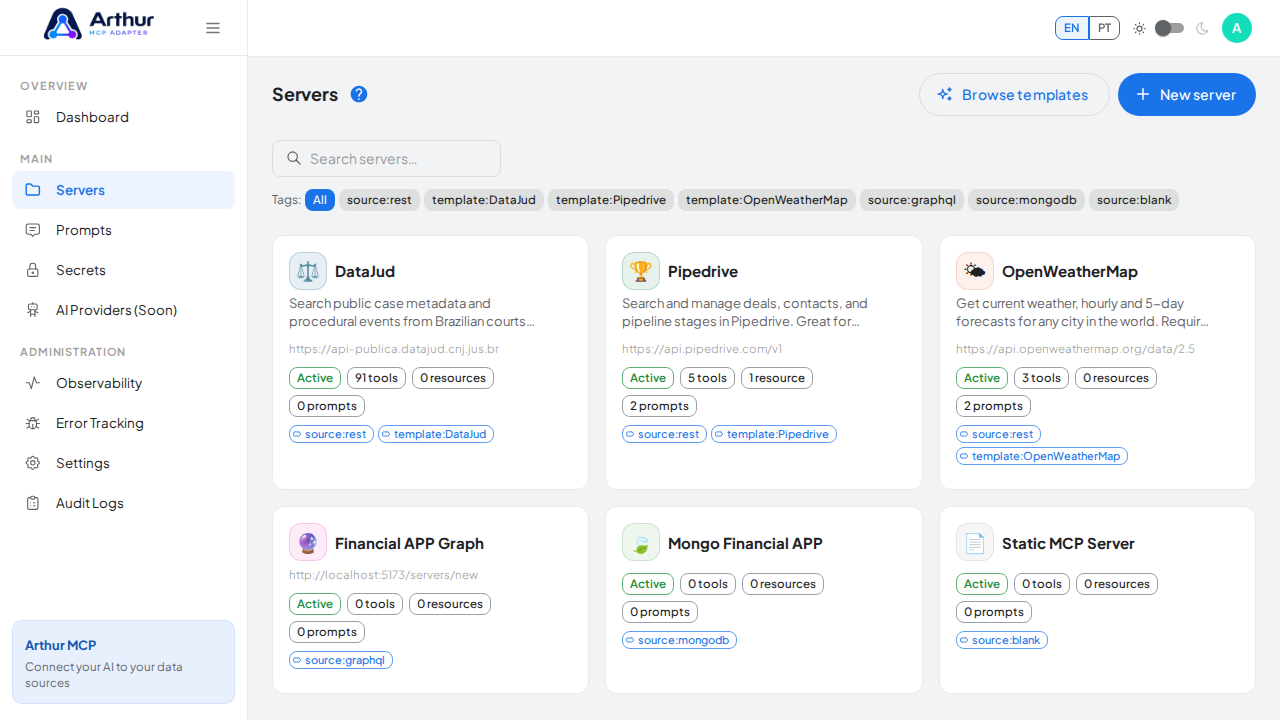
Open the Arthur screen that visually supports “Getting Started with Arthur MCP”.
Looking to install and run Arthur MCP itself? See the Quick Start section in the README. This guide assumes the app is already running and you're opening it in a browser.
Arthur MCP uses Supabase for authentication, by email rather than username.
- Open the app and go to Sign Up.
- Enter your email and a password, then submit.
- If email confirmation is enabled on the instance, check your inbox and click the confirmation link before logging in.
- Log in with the same email and password.
The first account created on a fresh instance is an Administrator with every permission. Later accounts get whatever role an admin assigns them — see Step 8.
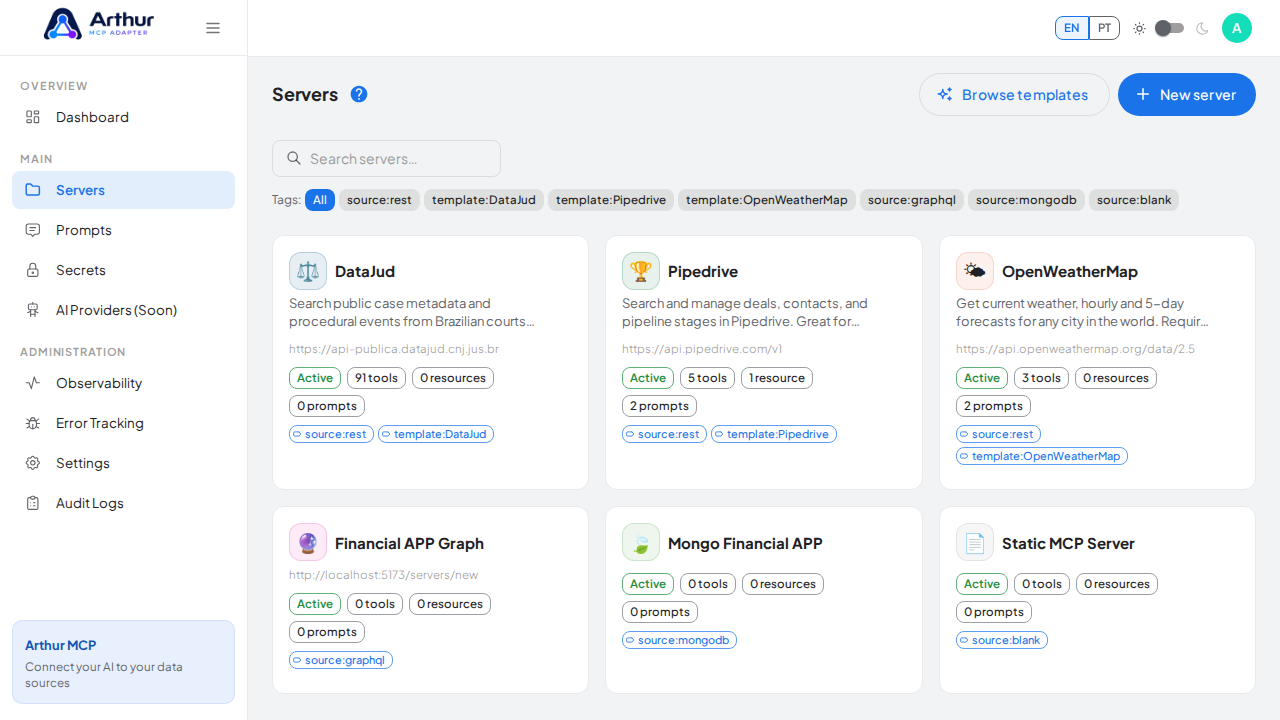
Every Server in Arthur wraps one data source and gets its own MCP endpoint. From the Dashboard, click New Server and pick one path:
- From a template — browse the Templates gallery (69+ ready-made APIs: GitHub, Stripe, Slack, Notion, and more). Pick one, name your server, paste a credential if the API needs one, and Arthur creates the server with every tool pre-defined. Some templates (JSONPlaceholder, PokéAPI, Open-Meteo) need no credentials, so you can try this step with zero setup.
- From an OpenAPI/Swagger spec or Postman collection — upload the file. Arthur reads every operation and generates one Tool per endpoint automatically.
- From scratch — create an empty server and add Tools by hand when you need full control over what's exposed.
Confirm success: the new server opens on its Connect tab, and the Tools tab shows a badge with the number of generated tools (0 if you started from scratch). Learn more: MCP Server Management, REST API Template Gallery.
Open the server and work through its tabs:
- Tools — the actions the AI can call. Edit a tool's name, description, or JSON Schema input/output so it reads clearly to an AI client, not just to a human. Delete anything you don't want exposed.
- Resources — read-only data the AI can pull into context. Static resources hold fixed content you write once; dynamic resources call a live REST endpoint at read time.
-
Prompts — reusable instruction templates using
{{argumentName}}placeholders. Link a prompt from the shared library at/prompts, or write one directly on the server.
Each Tool, Resource, and Prompt can be individually enabled or disabled — disabled items disappear from both the AI client and the public documentation page. Learn more: Dynamic Tools, Resources, Prompts.
If your data source needs an API key, token, or password, don't paste it directly into a server field. Go to Secrets, create a named secret, and reference it anywhere with {{secret:NAME}} — in the server's upstream auth config, headers, or query params. Secret values are stored separately from metadata and never appear in list views; revealing a value requires its own permission. Learn more: Secrets and Authentication.
Before handing a server to an AI client, test it yourself:
- Open a Tool and use its built-in test panel to call it directly and inspect the response.
- Use the AI View tab to see the server exactly as an AI client will.
Fix anything that fails here first — it's much faster to debug from inside Arthur than from inside an AI client's chat window.
Open the server's Connect tab. It shows the MCP endpoint URL in the form https://your-host/mcp/{serverUri}, plus:
-
Access Keys — if the server needs auth, create a named key. Clients send it as the
authheader (recommended) or?auth=query parameter. - OAuth Client — for AI clients that authenticate via OAuth 2.0 (like ChatGPT), configure either an Arthur-managed client or your own external OAuth/OIDC provider.
Copy the connection URL (and key, if configured) into your AI client's MCP server settings. Confirm success: the AI client lists your server's tools, resources, and prompts. Learn more: Secrets and Authentication.
From the Connect tab, generate a public share link. Anyone with the link sees a Swagger-style documentation page — every enabled tool, resource, and prompt with their schemas — without needing an Arthur account. No credentials or secret values are ever included on this page. To revoke a link, change the server's share slug; the old link stops working immediately. Learn more: Public MCP Swagger Pages.
Go to Roles & Permissions to manage access beyond the default Administrator role. Three other built-in roles cover most teams, or create a custom role if they don't fit yours. Learn more: Roles and Permissions.
Audit Logs record who changed what, Observability shows live health and metrics, and Error Tracking forwards runtime failures to your existing provider. Learn more: Audit Logs, Observability, Error Tracking.
Bring the Servers area into the viewport for a focused, semantic screenshot.
- Compose several tools into one multi-step call with Chains.
- Rename core vocabulary (Server, Tool, Resource...) to match your team's language — see Multi-Language and Terminology.
- Connect your own LLM providers under AI Providers.
- Browse the full feature index on Home.
Arthur MCP Wiki
Home · Getting Started · FAQ
⚙️ Features
Servers & Tools
Security & Access
Platform
Operations
Coming Soon
📚 Guides (46)
Connect AI Clients
Security & Access
- Configure API Credentials
- Configure Secrets
- Create a Custom Role
- Generate an Access Key
- Protect a Server with an Access Key
- Rotate the JWT Signing Secret
- Share a Server Publicly (and Revoke Access)
- Store and Reference a Secret
Harness & Limits
- Configure Execution Hooks
- Configure Input Constraints
- Configure Multi-Tenant Parameters
- Configure Output Filtering
- Configure Request Limit
- Configure Response Limits
- Configure Retry Policy
- Configure Timeout Settings
- Configure Tool Restrictions
- Set Global Request Headers
Platform & Operations
- Configure AI Providers
- Connect an Error Tracking Provider
- Enable Error Alerts
- Import the Grafana Dashboard
- Set Up Error Alerts
Tools, Resources & Prompts
- Add HTML Output to a Tool
- Add a Resource
- Build a Chain
- Create Prompts
- Create a Resource
- Create a Tool
- Create an HTML Template in a Resource
- Create and Link a Prompt
- Return an HTML Template from a Tool
- Test a Tool
- Use AI-Assisted Tool Generation
Servers & Import
🔌 API Integrations (230)
AI (28)
- AI/ML API
- Anthropic (Claude)
- Chatwith
- Clarifai
- Cohere
- CustomGPT.ai
- Dialogflow
- Eden
- ElevenLabs
- Gladia
- Groq
- HOL Registry Broker
- Hugging Face
- Imagga
- Irisnet
- MessengerX.io
- Mistral AI
- NLP Cloud
- OpenAI
- Perplexity AI
- Perspective
- Replicate
- Roboflow Universe
- Stability AI
- Summarize Text with AI
- Together AI
- Unplugg
- WolframAlpha
Animals (19)
Anime (14)
Anti-Malware (10)
Art & Design (23)
Books (16)
Business (27)
Calendar (14)
Cloud Storage & File Sharing (10)
Communication (9)
Continuous Integration (5)
Data (15)
Database (3)
Development (8)
E-commerce (5)
Government & Legal (1)
Music & Media (5)
Testing (2)
✨ Prompt Templates (90)
Analysis (6)
Code (9)
Customer Support (6)
Data Extraction (6)
DevOps (5)
Education (5)
Finance (5)
HR & Recruiting (5)
Legal (4)
Product Management (5)
Research (5)
Sales (5)
SEO & Marketing (5)
Social Media (5)
Summarization (6)
💡 Concepts (37)
Connect AI Clients
Security & Access
- Do I Have Swagger Documentation for My MCP Routes?
- How Do Access Keys Work?
- Should I Have a Separate Access Key per AI Client?
- What Are Access Keys For?
- What Are Secrets For?
- What Is API Credentials For?
- What Is API Credentials?
- What Is the "Share the MCP Swagger Documentation" Feature?
- What Do I Do with the QR Code on the Share Page?
Harness & Limits
- What Are Multi-Tenant Parameters For?
- What Are Response Limits For?
- What Is Execution Hooks For?
- What Is Execution Hooks?
- What Is Input Constraints For?
- What Is Input Constraints?
- What Is Output Filtering For?
- What Is Output Filtering?
- What Is Request Limit For?
- What Is Request Limit?
- What Is Retry Policy For?
- What Is Retry Policy?
- What Is Timeout Settings For?
- What Is Timeout Settings?
- What Is Tool Restrictions For?
- What Is Tool Restrictions?
Platform & Operations
Tools, Resources & Prompts
Servers & Import
Início · Primeiros Passos · FAQ
⚙️ Funcionalidades
Servidores & Ferramentas
- Gerenciamento de Servidores MCP
- Galeria de Templates de API REST
- Ferramentas Dinâmicas
- Cadeias
- Recursos
- Prompts
Segurança & Acesso
Plataforma
Operações
Em Breve
📚 Guias (46)
Conectar Clientes de IA
Segurança & Acesso
- Armazenar e Referenciar um Segredo
- Configurar Credenciais da API
- Configurar Secrets?
- Criar um Papel Personalizado
- Gerar uma Access Key?
- Rotacionar o Segredo de Assinatura JWT
Harness & Limites
- Configurar Execution Hooks?
- Configurar Input Constraints?
- Configurar Limites de Resposta
- Configurar Output Filtering?
- Configurar Parâmetros Multi-Tenant
- Configurar Request Limit?
- Configurar Retry Policy?
- Configurar Timeout Settings?
- Configurar Tool Restrictions?
- Definir Cabeçalhos Globais de Requisição
Plataforma & Operações
- Conectar um Provedor de Rastreamento de Erros
- Configurar AI Providers?
- Configurar Alertas de Erro
- Habilitar os Error Alerts?
- Importar o Dashboard do Grafana
Ferramentas, Recursos & Prompts
- Adicionar Saída HTML a uma Ferramenta
- Adicionar um Recurso
- Construir uma Cadeia
- Criar Meus Prompts?
- Criar e Vincular um Prompt
- Criar um Resource?
- Eu Crio um Template de HTML em um Resource?
- Criar uma Tool?
- Retornar um Template HTML em uma Tool?
- Testar uma Ferramenta
- Usar Geração de Ferramentas Assistida por IA
Servidores & Importação
- Compartilhar um Servidor Publicamente (e Revogar o Acesso)
- Deixar Meu Servidor Disponível Apenas em Alguns Dias e Horários?
- Criar um Servidor a partir de um Template
- Criar um Slug
- Gerenciar o Slug do Seu Servidor
- Importar uma Coleção do Postman
- Importar uma Especificação OpenAPI
- Pausar e Reativar um Servidor
- Proteger um Servidor com uma Chave de Acesso
- Reimportar uma Especificação de API Atualizada
🔌 Integrações de API (230)
AI (28)
- AI/ML API
- Anthropic (Claude)
- Chatwith
- Clarifai
- Cohere
- CustomGPT.ai
- Dialogflow
- Eden
- ElevenLabs
- Gladia
- Groq
- HOL Registry Broker
- Hugging Face
- Imagga
- Irisnet
- MessengerX.io
- Mistral AI
- NLP Cloud
- OpenAI
- Perplexity AI
- Perspective
- Replicate
- Roboflow Universe
- Stability AI
- Summarize Text with AI
- Together AI
- Unplugg
- WolframAlpha
Animals (19)
Anime (14)
Anti-Malware (10)
Art & Design (23)
Books (16)
Business (27)
Calendar (14)
Cloud Storage & File Sharing (10)
Communication (9)
Continuous Integration (5)
Data (15)
Database (3)
Development (8)
E-commerce (5)
Government & Legal (1)
Music & Media (5)
Testing (2)
✨ Templates de Prompt (90)
Analysis (6)
Code (9)
Customer Support (6)
Data Extraction (6)
DevOps (5)
Education (5)
Finance (5)
HR & Recruiting (5)
Legal (4)
Product Management (5)
Research (5)
Sales (5)
SEO & Marketing (5)
Social Media (5)
Summarization (6)
💡 Conceitos (37)
Conectar Clientes de IA
Segurança & Acesso
- Como Funcionam as Access Keys?
- Tenho uma Documentação de Swagger para as Minhas Rotas MCP?
- O que É API Credentials?
- O que É a Funcionalidade "Share the MCP Swagger Documentation"?
- Para que Serve API Credentials?
- O que Eu Faço com o QR Code do Share the MCP Swagger Documentation?
- Para que Servem as Access Keys?
- Para que Servem as Secrets?
- Devo Ter uma Access Key para Cada Cliente de IA que Eu Integrar?
Harness & Limites
- O que É Execution Hooks?
- O que É Input Constraints?
- O que É Output Filtering?
- O que É Request Limit?
- O que É Retry Policy?
- O que É Timeout Settings?
- O que É Tool Restrictions?
- Para que Serve Execution Hooks?
- Para que Serve Input Constraints?
- Para que Serve Output Filtering?
- Para que Serve Retry Policy?
- Para que Serve Timeout Settings?
- Para que Serve Tool Restrictions?
- Para que Serve o Request Limit?
- Para que Servem os Multi-Tenant Parameters?
- Para que Servem os Response Limits?
Plataforma & Operações
- Para que Serve a Aba de Activity Log?
- Para que Servem AI Providers?
- Para que Servem os Error Alerts?
Ferramentas, Recursos & Prompts
Servidores & Importação