-
Notifications
You must be signed in to change notification settings - Fork 1
en How to Configure API Credentials
API Credentials are what Arthur attaches to every outgoing request when it calls your upstream API on behalf of a tool call. This is separate from Access Keys and OAuth Client, which protect incoming calls from an AI client to your MCP server — API Credentials is the outgoing side.
Prerequisites: a server already created, pointing at an upstream API.
-
Open the server and go to its Guard Rails tab (this is where API Credentials lives, despite the name of the tab).
Open the capture server used by this procedure.
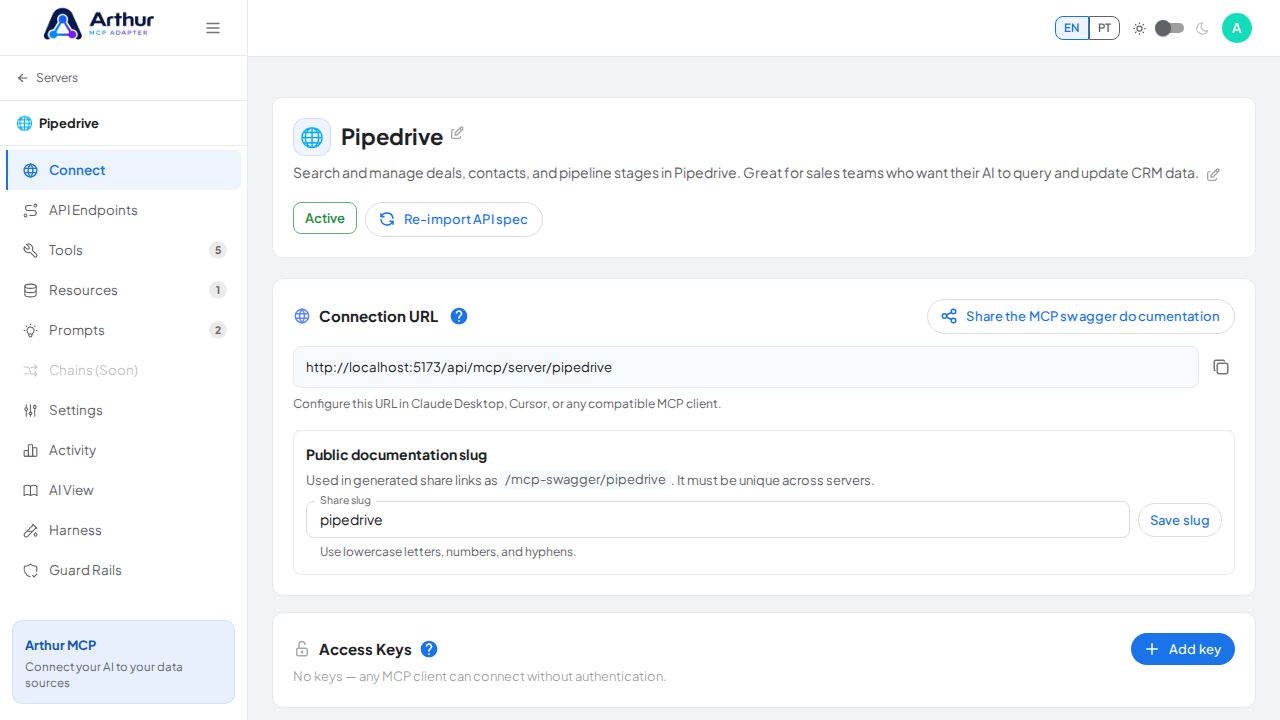
Open the Guard Rails tab where the configuration is managed.
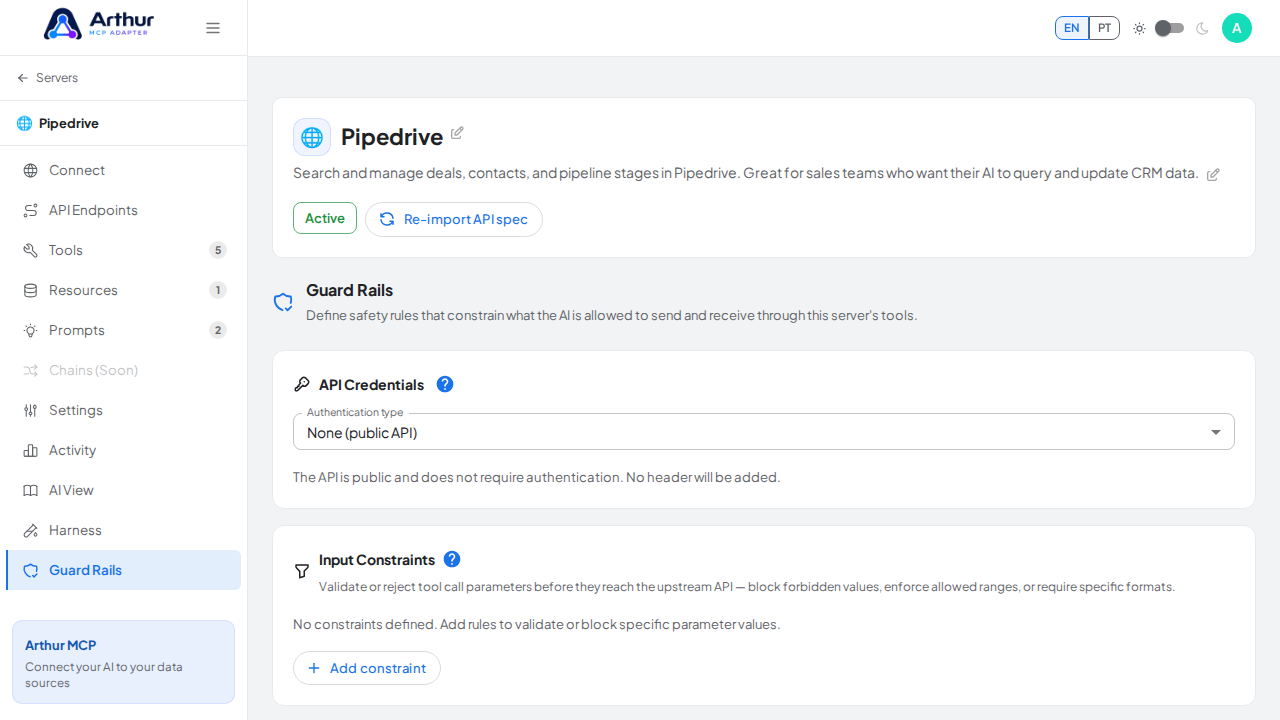
Bring the API Credentials panel into view.
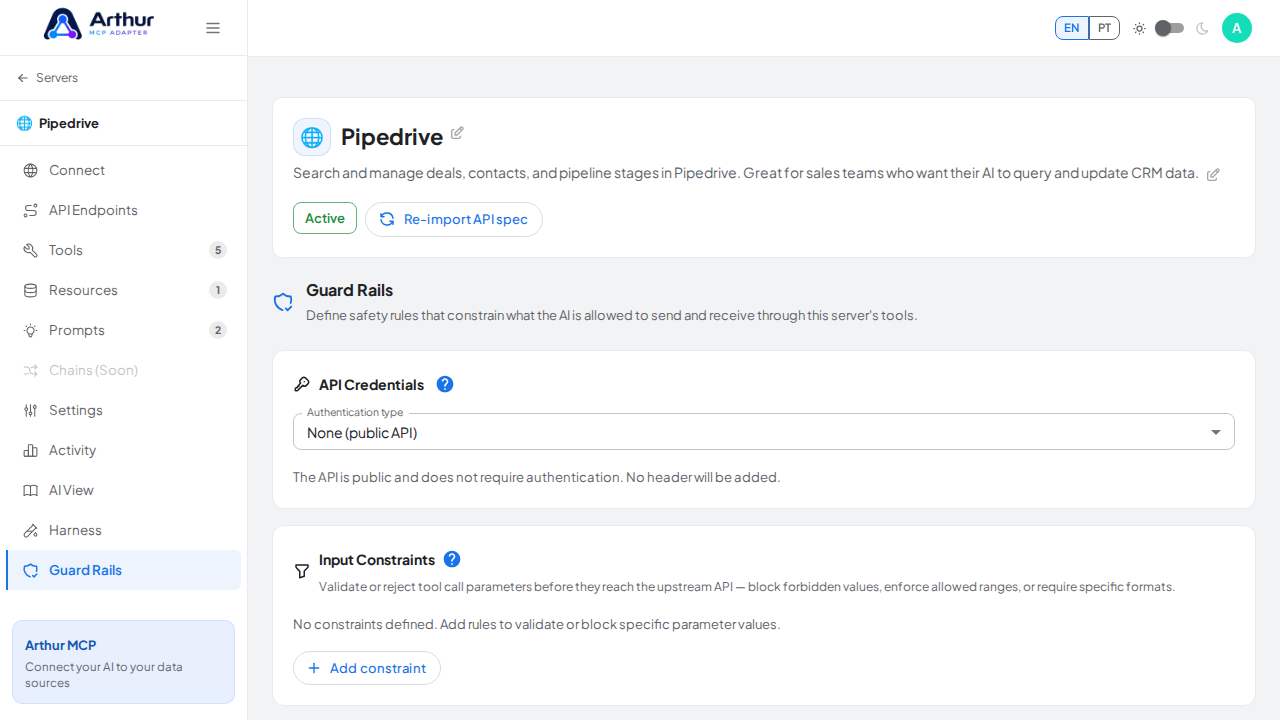
-
Choose the authentication type your upstream API expects:
-
Bearer Token — a single token sent as
Authorization: Bearer <token>. - API Key — a parameter name and value, sent as either a header or a query parameter.
- Basic Auth — a username and password.
- OAuth2 Client Credentials — a token URL, client ID, client secret, and optional scope; Arthur fetches and refreshes the access token for you.
- Custom headers — one or more arbitrary header name/value pairs.
- None — no authentication added to upstream calls.
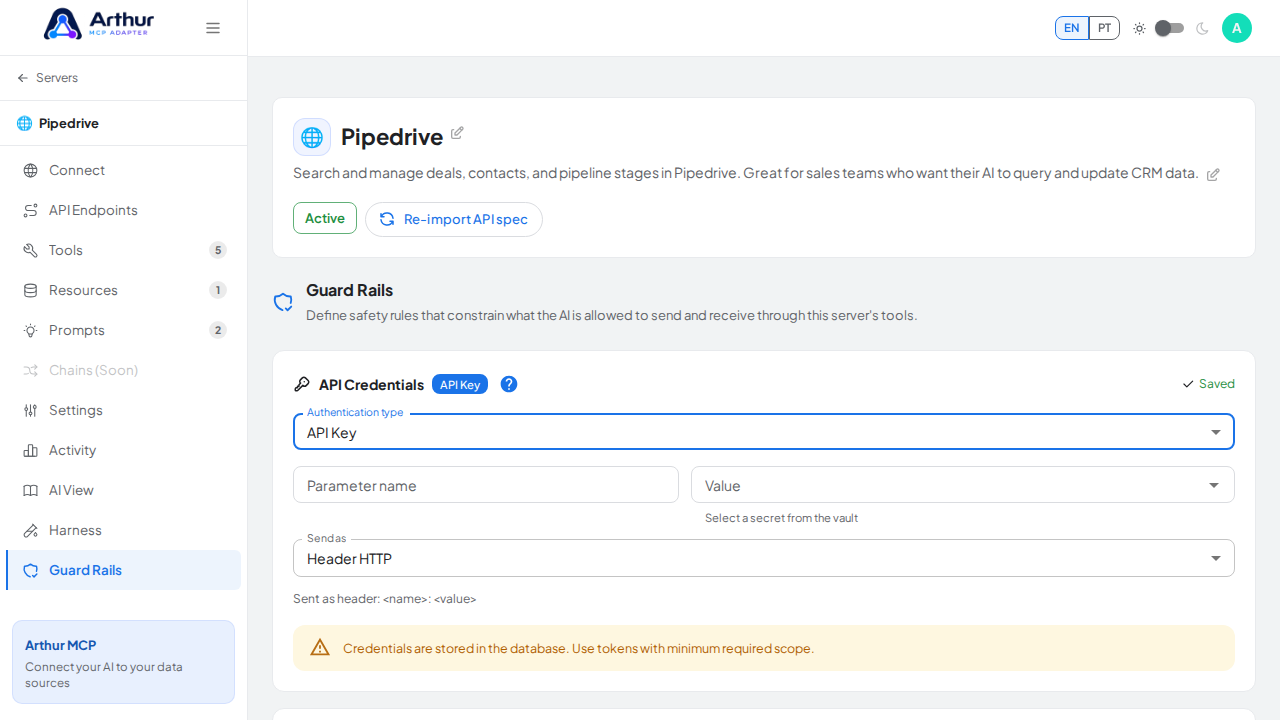
Open the upstream API authentication type list.
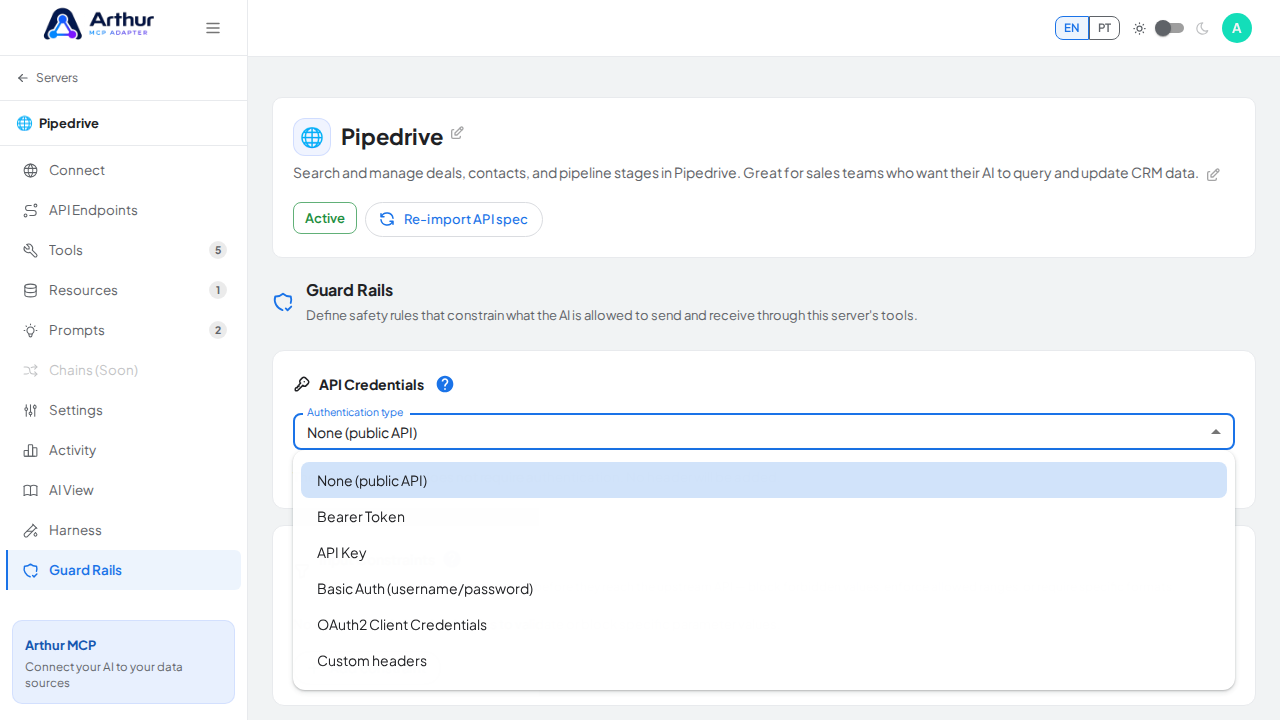
Select API Key to reveal its name, value, and transport fields.
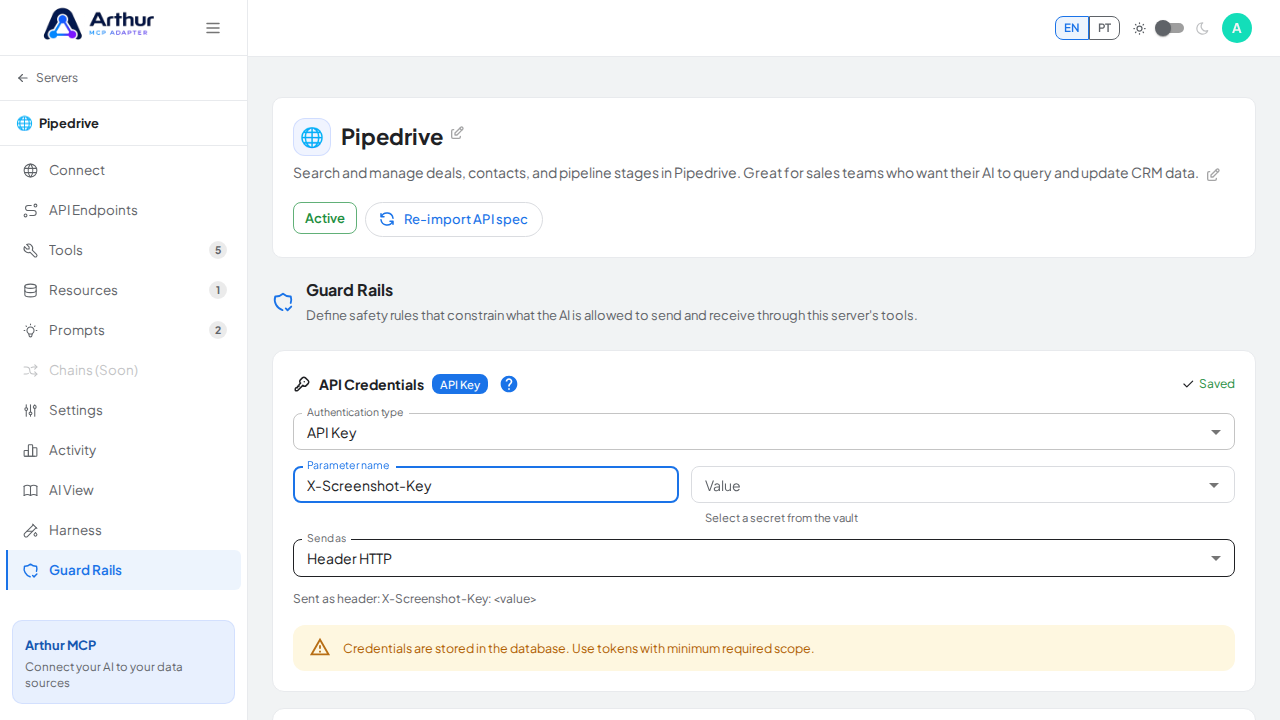
Set the parameter name sent to the upstream API.
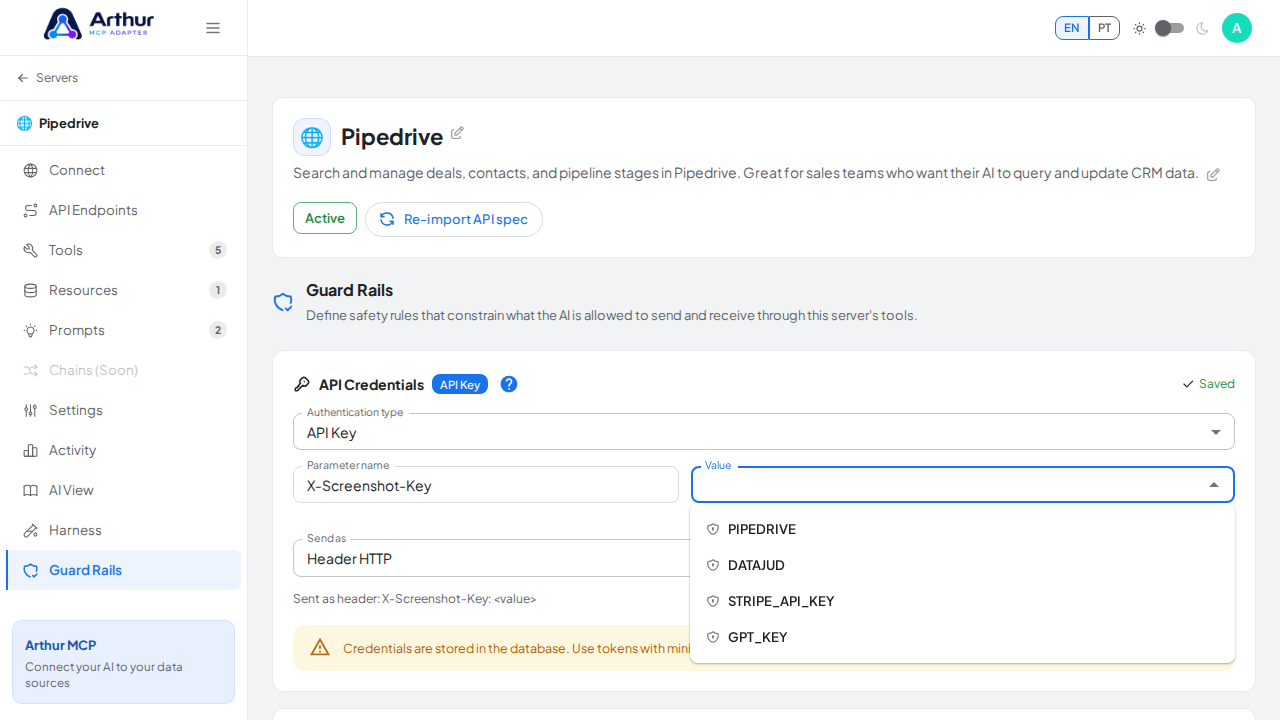
Open the available Secrets list without exposing values in the flow.
-
Bearer Token — a single token sent as
-
For any value field, reference a stored Secret with
{{secret:NAME}}instead of typing the raw value.Highlight the first available Secret reference.
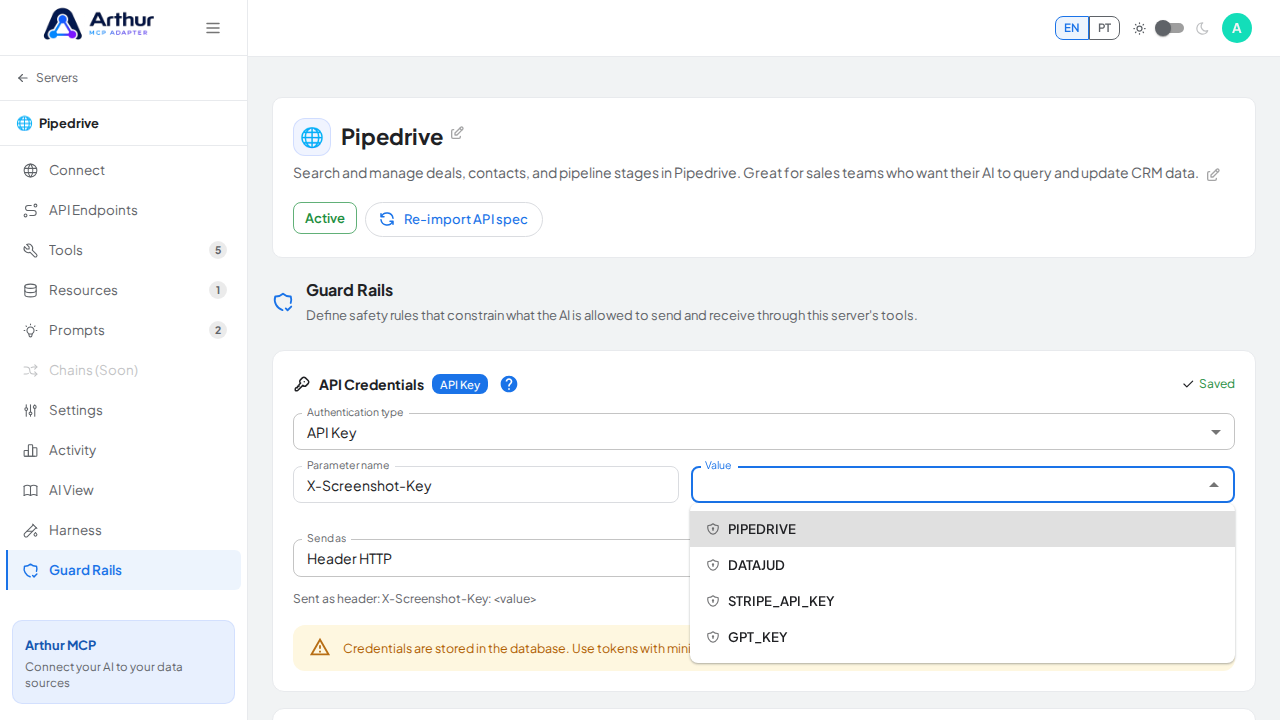
Select the Secret reference for the credential.
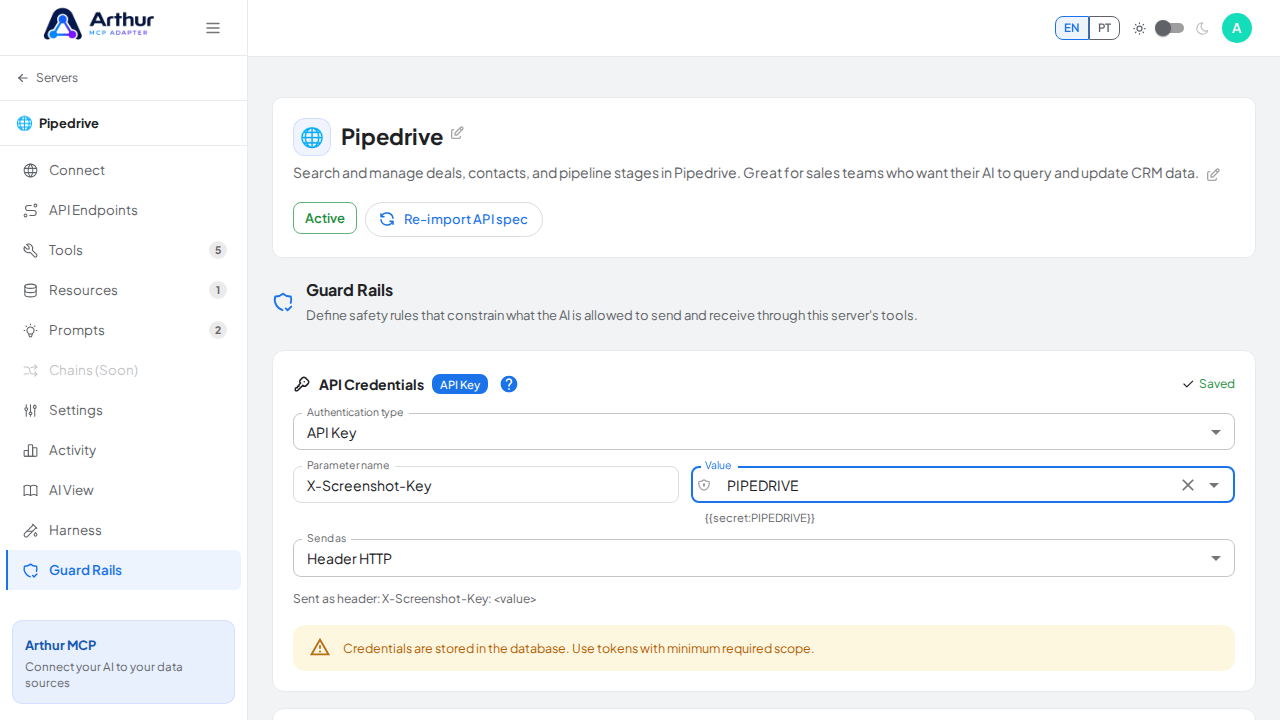
Open the API Key transport options.
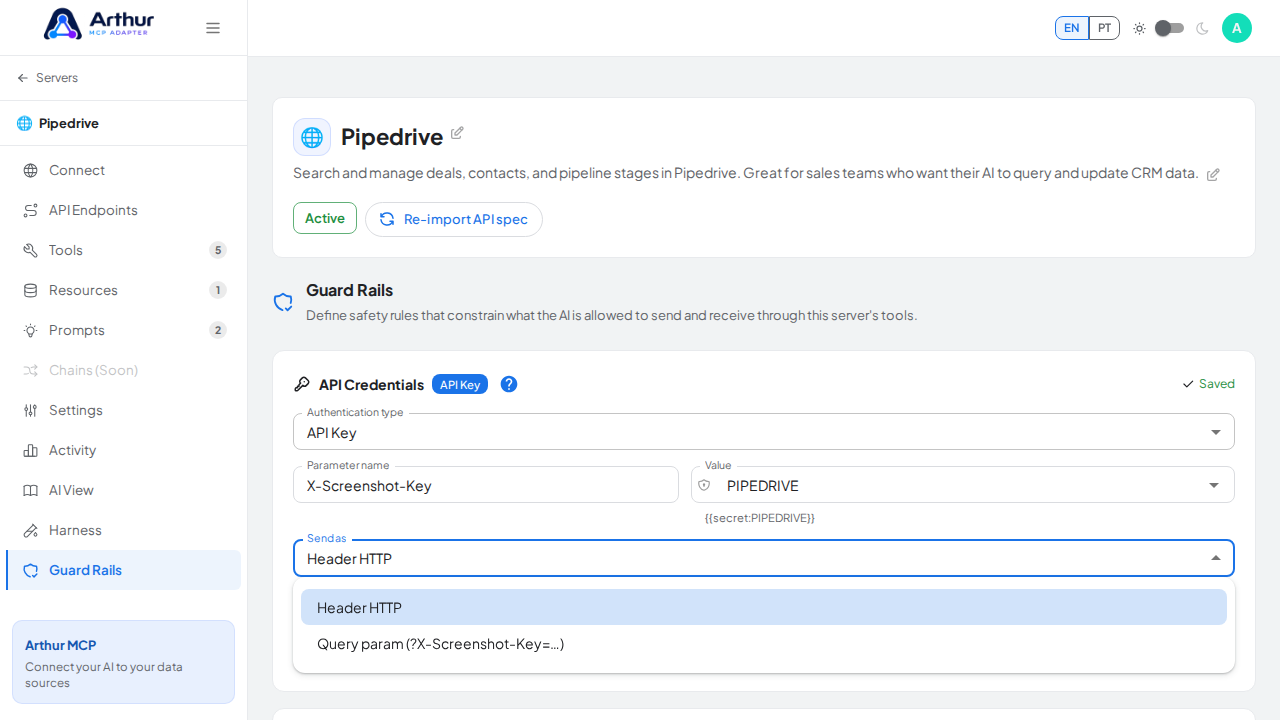
Configure the key as a query parameter to demonstrate the header alternative.
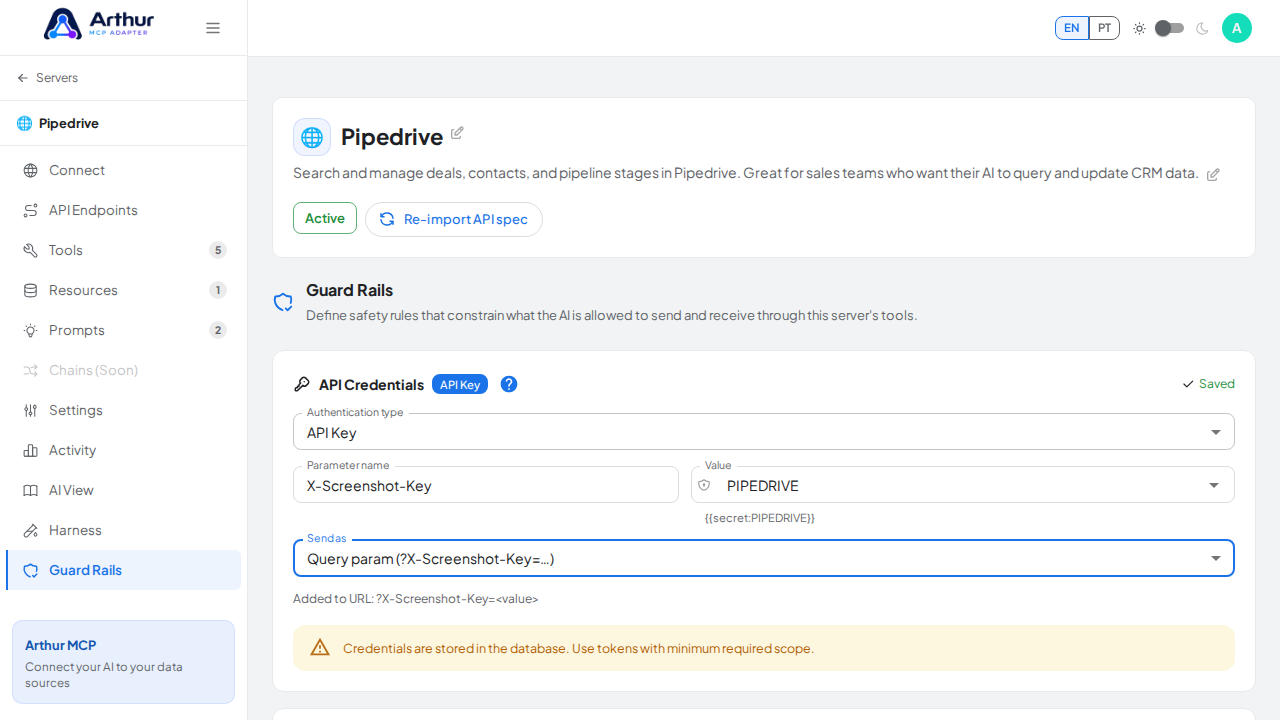
-
Save.
Reopen the authentication list to restore the fixture.
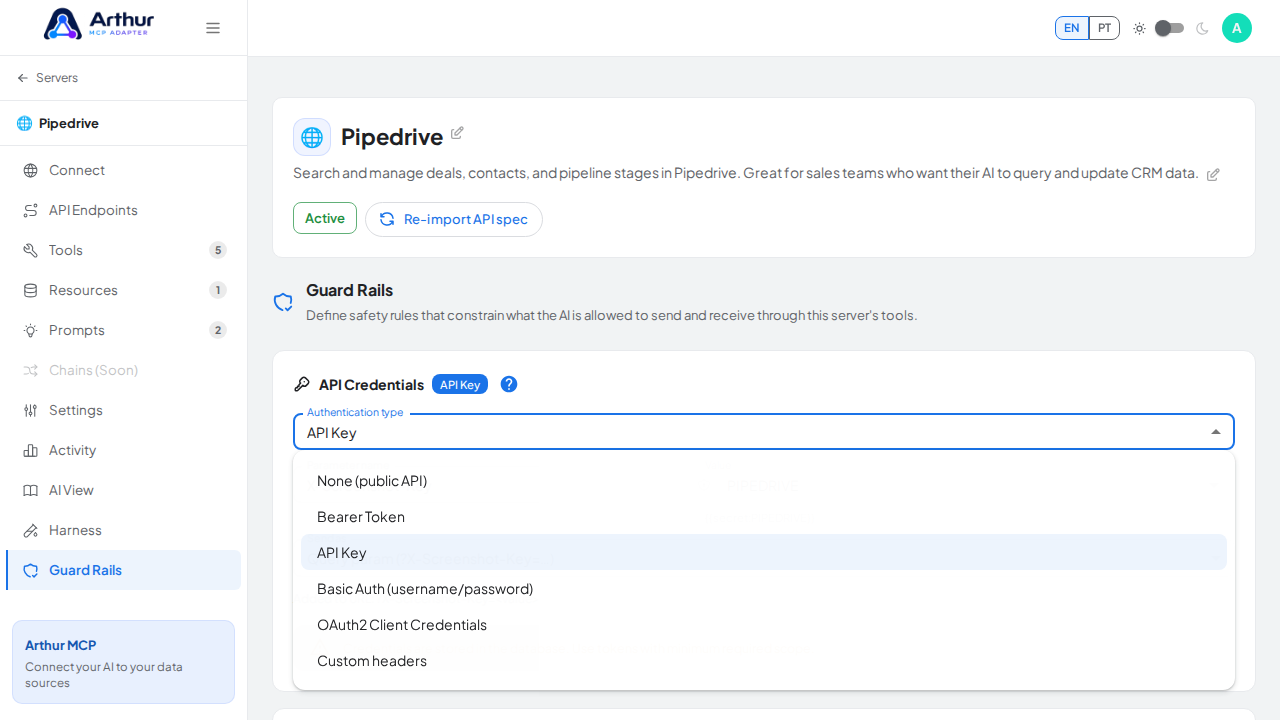
Return to None and remove the temporary credential from the capture server.
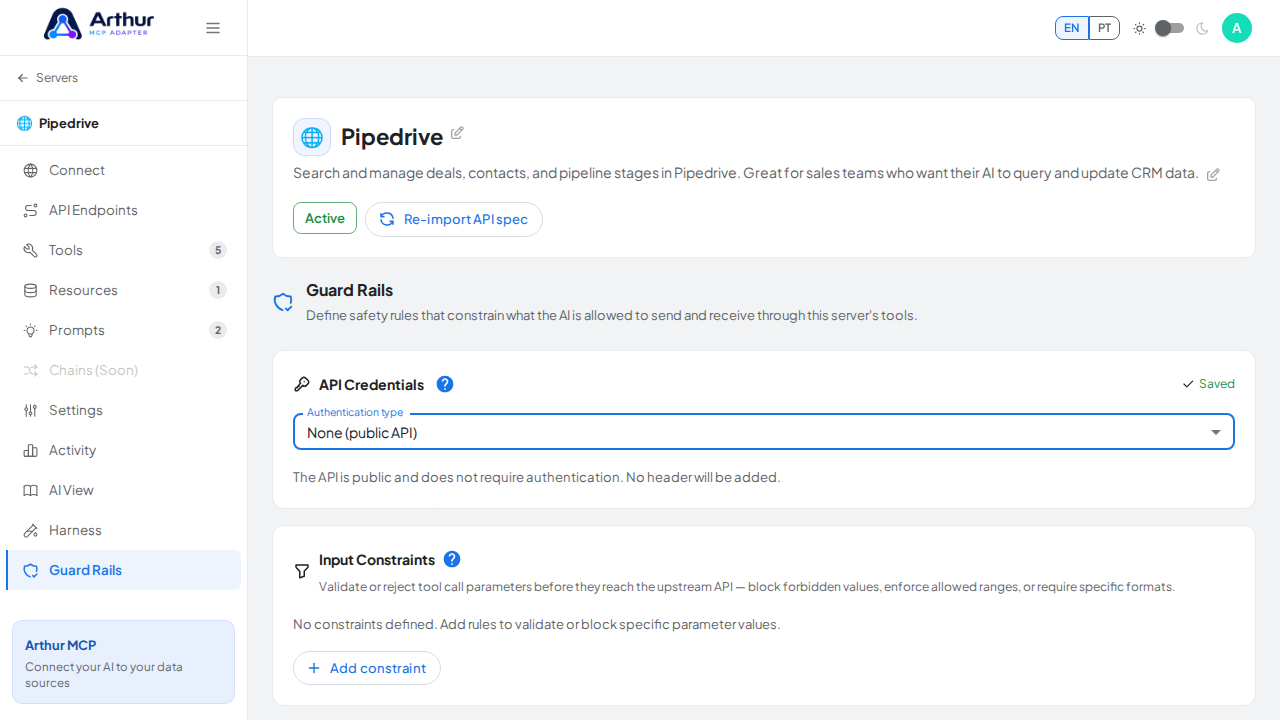
Test a tool on the server — the request Arthur sends upstream now carries the configured credentials, and calls that previously failed with a 401/403 from your API should succeed.
- Don't confuse this with the Connect tab's Access Keys or OAuth Client — those authenticate the AI client calling your MCP server, not Arthur calling your upstream API. See Secrets and Authentication.
- The AI client never sees these credentials — they're attached server-side, invisible to the MCP contract.
Arthur MCP Wiki
Home · Getting Started · FAQ
⚙️ Features
Servers & Tools
Security & Access
Platform
Operations
Coming Soon
📚 Guides (46)
Connect AI Clients
Security & Access
- Configure API Credentials
- Configure Secrets
- Create a Custom Role
- Generate an Access Key
- Protect a Server with an Access Key
- Rotate the JWT Signing Secret
- Share a Server Publicly (and Revoke Access)
- Store and Reference a Secret
Harness & Limits
- Configure Execution Hooks
- Configure Input Constraints
- Configure Multi-Tenant Parameters
- Configure Output Filtering
- Configure Request Limit
- Configure Response Limits
- Configure Retry Policy
- Configure Timeout Settings
- Configure Tool Restrictions
- Set Global Request Headers
Platform & Operations
- Configure AI Providers
- Connect an Error Tracking Provider
- Enable Error Alerts
- Import the Grafana Dashboard
- Set Up Error Alerts
Tools, Resources & Prompts
- Add HTML Output to a Tool
- Add a Resource
- Build a Chain
- Create Prompts
- Create a Resource
- Create a Tool
- Create an HTML Template in a Resource
- Create and Link a Prompt
- Return an HTML Template from a Tool
- Test a Tool
- Use AI-Assisted Tool Generation
Servers & Import
🔌 API Integrations (230)
AI (28)
- AI/ML API
- Anthropic (Claude)
- Chatwith
- Clarifai
- Cohere
- CustomGPT.ai
- Dialogflow
- Eden
- ElevenLabs
- Gladia
- Groq
- HOL Registry Broker
- Hugging Face
- Imagga
- Irisnet
- MessengerX.io
- Mistral AI
- NLP Cloud
- OpenAI
- Perplexity AI
- Perspective
- Replicate
- Roboflow Universe
- Stability AI
- Summarize Text with AI
- Together AI
- Unplugg
- WolframAlpha
Animals (19)
Anime (14)
Anti-Malware (10)
Art & Design (23)
Books (16)
Business (27)
Calendar (14)
Cloud Storage & File Sharing (10)
Communication (9)
Continuous Integration (5)
Data (15)
Database (3)
Development (8)
E-commerce (5)
Government & Legal (1)
Music & Media (5)
Testing (2)
✨ Prompt Templates (90)
Analysis (6)
Code (9)
Customer Support (6)
Data Extraction (6)
DevOps (5)
Education (5)
Finance (5)
HR & Recruiting (5)
Legal (4)
Product Management (5)
Research (5)
Sales (5)
SEO & Marketing (5)
Social Media (5)
Summarization (6)
💡 Concepts (37)
Connect AI Clients
Security & Access
- Do I Have Swagger Documentation for My MCP Routes?
- How Do Access Keys Work?
- Should I Have a Separate Access Key per AI Client?
- What Are Access Keys For?
- What Are Secrets For?
- What Is API Credentials For?
- What Is API Credentials?
- What Is the "Share the MCP Swagger Documentation" Feature?
- What Do I Do with the QR Code on the Share Page?
Harness & Limits
- What Are Multi-Tenant Parameters For?
- What Are Response Limits For?
- What Is Execution Hooks For?
- What Is Execution Hooks?
- What Is Input Constraints For?
- What Is Input Constraints?
- What Is Output Filtering For?
- What Is Output Filtering?
- What Is Request Limit For?
- What Is Request Limit?
- What Is Retry Policy For?
- What Is Retry Policy?
- What Is Timeout Settings For?
- What Is Timeout Settings?
- What Is Tool Restrictions For?
- What Is Tool Restrictions?
Platform & Operations
Tools, Resources & Prompts
Servers & Import
Início · Primeiros Passos · FAQ
⚙️ Funcionalidades
Servidores & Ferramentas
- Gerenciamento de Servidores MCP
- Galeria de Templates de API REST
- Ferramentas Dinâmicas
- Cadeias
- Recursos
- Prompts
Segurança & Acesso
Plataforma
Operações
Em Breve
📚 Guias (46)
Conectar Clientes de IA
Segurança & Acesso
- Armazenar e Referenciar um Segredo
- Configurar Credenciais da API
- Configurar Secrets?
- Criar um Papel Personalizado
- Gerar uma Access Key?
- Rotacionar o Segredo de Assinatura JWT
Harness & Limites
- Configurar Execution Hooks?
- Configurar Input Constraints?
- Configurar Limites de Resposta
- Configurar Output Filtering?
- Configurar Parâmetros Multi-Tenant
- Configurar Request Limit?
- Configurar Retry Policy?
- Configurar Timeout Settings?
- Configurar Tool Restrictions?
- Definir Cabeçalhos Globais de Requisição
Plataforma & Operações
- Conectar um Provedor de Rastreamento de Erros
- Configurar AI Providers?
- Configurar Alertas de Erro
- Habilitar os Error Alerts?
- Importar o Dashboard do Grafana
Ferramentas, Recursos & Prompts
- Adicionar Saída HTML a uma Ferramenta
- Adicionar um Recurso
- Construir uma Cadeia
- Criar Meus Prompts?
- Criar e Vincular um Prompt
- Criar um Resource?
- Eu Crio um Template de HTML em um Resource?
- Criar uma Tool?
- Retornar um Template HTML em uma Tool?
- Testar uma Ferramenta
- Usar Geração de Ferramentas Assistida por IA
Servidores & Importação
- Compartilhar um Servidor Publicamente (e Revogar o Acesso)
- Deixar Meu Servidor Disponível Apenas em Alguns Dias e Horários?
- Criar um Servidor a partir de um Template
- Criar um Slug
- Gerenciar o Slug do Seu Servidor
- Importar uma Coleção do Postman
- Importar uma Especificação OpenAPI
- Pausar e Reativar um Servidor
- Proteger um Servidor com uma Chave de Acesso
- Reimportar uma Especificação de API Atualizada
🔌 Integrações de API (230)
AI (28)
- AI/ML API
- Anthropic (Claude)
- Chatwith
- Clarifai
- Cohere
- CustomGPT.ai
- Dialogflow
- Eden
- ElevenLabs
- Gladia
- Groq
- HOL Registry Broker
- Hugging Face
- Imagga
- Irisnet
- MessengerX.io
- Mistral AI
- NLP Cloud
- OpenAI
- Perplexity AI
- Perspective
- Replicate
- Roboflow Universe
- Stability AI
- Summarize Text with AI
- Together AI
- Unplugg
- WolframAlpha
Animals (19)
Anime (14)
Anti-Malware (10)
Art & Design (23)
Books (16)
Business (27)
Calendar (14)
Cloud Storage & File Sharing (10)
Communication (9)
Continuous Integration (5)
Data (15)
Database (3)
Development (8)
E-commerce (5)
Government & Legal (1)
Music & Media (5)
Testing (2)
✨ Templates de Prompt (90)
Analysis (6)
Code (9)
Customer Support (6)
Data Extraction (6)
DevOps (5)
Education (5)
Finance (5)
HR & Recruiting (5)
Legal (4)
Product Management (5)
Research (5)
Sales (5)
SEO & Marketing (5)
Social Media (5)
Summarization (6)
💡 Conceitos (37)
Conectar Clientes de IA
Segurança & Acesso
- Como Funcionam as Access Keys?
- Tenho uma Documentação de Swagger para as Minhas Rotas MCP?
- O que É API Credentials?
- O que É a Funcionalidade "Share the MCP Swagger Documentation"?
- Para que Serve API Credentials?
- O que Eu Faço com o QR Code do Share the MCP Swagger Documentation?
- Para que Servem as Access Keys?
- Para que Servem as Secrets?
- Devo Ter uma Access Key para Cada Cliente de IA que Eu Integrar?
Harness & Limites
- O que É Execution Hooks?
- O que É Input Constraints?
- O que É Output Filtering?
- O que É Request Limit?
- O que É Retry Policy?
- O que É Timeout Settings?
- O que É Tool Restrictions?
- Para que Serve Execution Hooks?
- Para que Serve Input Constraints?
- Para que Serve Output Filtering?
- Para que Serve Retry Policy?
- Para que Serve Timeout Settings?
- Para que Serve Tool Restrictions?
- Para que Serve o Request Limit?
- Para que Servem os Multi-Tenant Parameters?
- Para que Servem os Response Limits?
Plataforma & Operações
- Para que Serve a Aba de Activity Log?
- Para que Servem AI Providers?
- Para que Servem os Error Alerts?
Ferramentas, Recursos & Prompts
Servidores & Importação