Repository navigation
Lossless Analysis
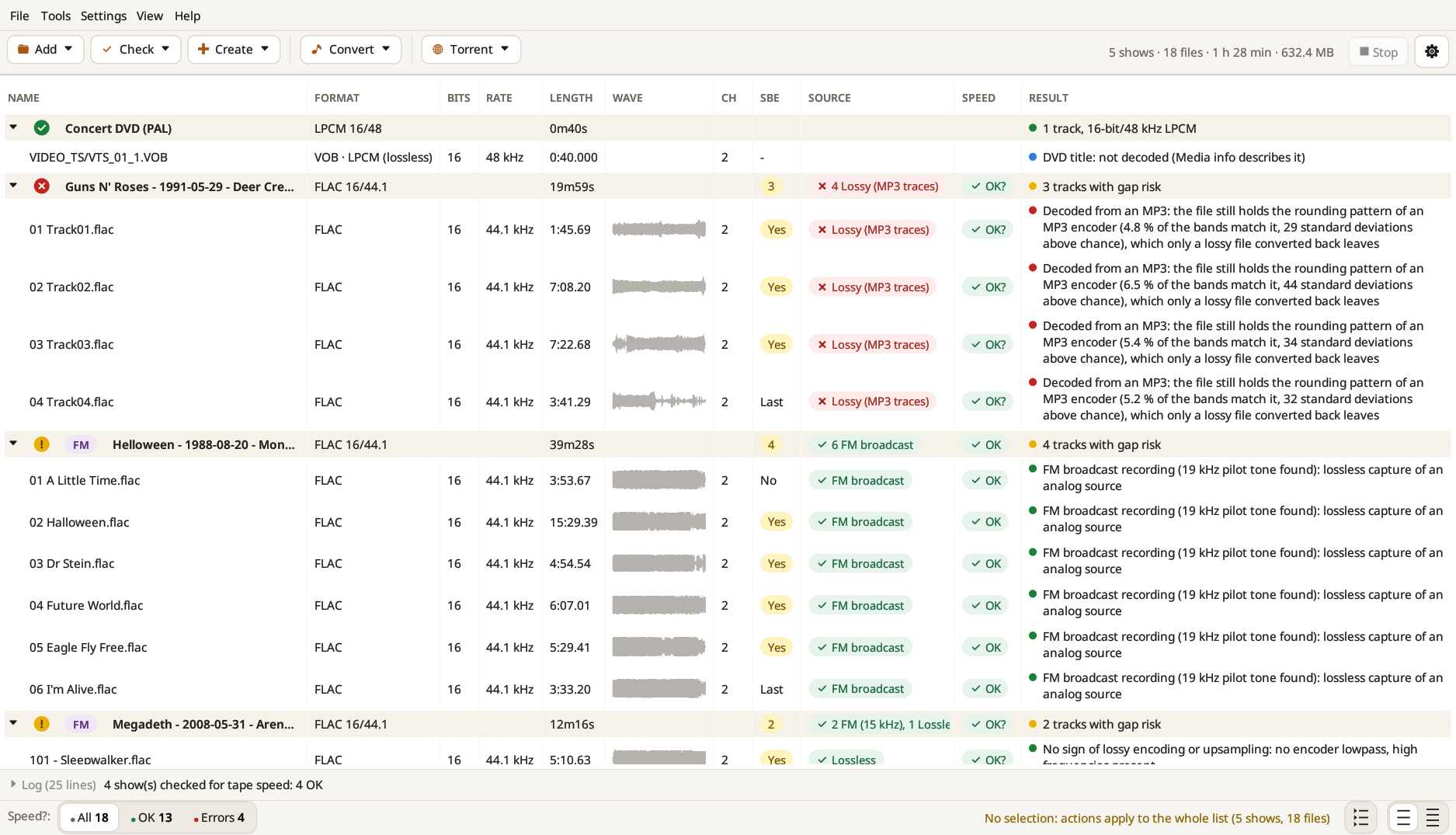
Lossless? checks whether a "lossless" file really comes from a lossless source. It spots MP3, AAC and Opus transcodes, upsampled audio, fake 24-bit and lossyWAV, and it recognises FM broadcasts instead of wrongly calling them lossy. The verdict goes to the Source column; when it depends on a cutoff, the frequency is shown with it ("Unsure 20.7 kHz", "Lossy 16.0 kHz").
The verdicts are honest about what can and cannot be told:
| Verdict | What it means |
|---|---|
| Lossless | No encoder lowpass, high frequencies present: no sign of lossy encoding or upsampling |
| Likely lossless | No encoder lowpass and no MP3 coding traces, but little treble above 15 kHz, where an encoder's lowpass shows best |
| Lossless (upsampled) | No sign of lossy encoding, but no real content above 22–24 kHz: a 44.1 or 48 kHz source in a hi-res file |
| Lossless (16-bit in 24) | No sign of lossy encoding, but not true 24-bit: the extra bits carry nothing |
| FM broadcast | Recorded off air: the 19 kHz stereo pilot tone is there |
| FM (15 kHz) | A lowpass at the FM limit, with hiss above it and no encoder holes: a lossless capture of a broadcast |
| 15 kHz lowpass | A steep lowpass at 15 kHz: typical of FM, but also of a low-bitrate MP3 |
| Unsure | A lowpass where an MP3 at 320 kbps (or an AAC or Opus at a high bitrate) would cut, but some recorders' anti-alias filters also cut there |
| Unclear | Almost no content above 15 kHz (common with audience and analog-tape recordings), so encoder traces cannot be seen |
| Lossy? | A brick-wall lowpass where an MP3/AAC at about 128 kbps cuts, but without encoder holes; a digital lowpass filter (some remasters) looks the same. Also given when the music stops under the noise-shaped dither of a conversion to 16-bit, which hides the lowpass |
| Lossy? (Opus) | The treble is a single signal panned between the channels, as Opus codes it at moderate bitrates (YouTube, streaming) |
| Lossy | A lowpass with encoder holes below it: a lossy source, likely or with high confidence |
| Lossy upstream | Encoder holes below the lowpass, with steady noise above it that came later: a program that was lossy-coded before an analog stage (a radio's digital link, a sound card) |
| Lossy (MP3 traces), (AAC traces), (Opus traces) | Decoded from an MP3, an AAC or an Opus stream: the file still holds the encoder's rounding pattern |
| Lossy (lossyWAV) | Processed by lossyWAV: the lowest bits are zeroed block by block |
| Lossy (MP3), Lossy (AAC)… | A lossy file by its format; it is measured anyway |
A spectrum alone cannot prove a 320 kbps transcode. So on top of the usual spectral measurements, Bootleg Toolbox analyses the sound again with an MP3 encoder's own filter bank, at every possible position. A file decoded from an MP3 falls back onto the encoder's rounding grid in many bands, far above the other positions, even at 320 kbps; genuine audio stays around 2 %, at no particular position. The same kind of search for AAC and Opus (the codec of YouTube) is slower: it runs by itself on the doubtful verdicts (Lossy?, Unsure, 15 kHz lowpass), and on every file if you tick it in Settings.
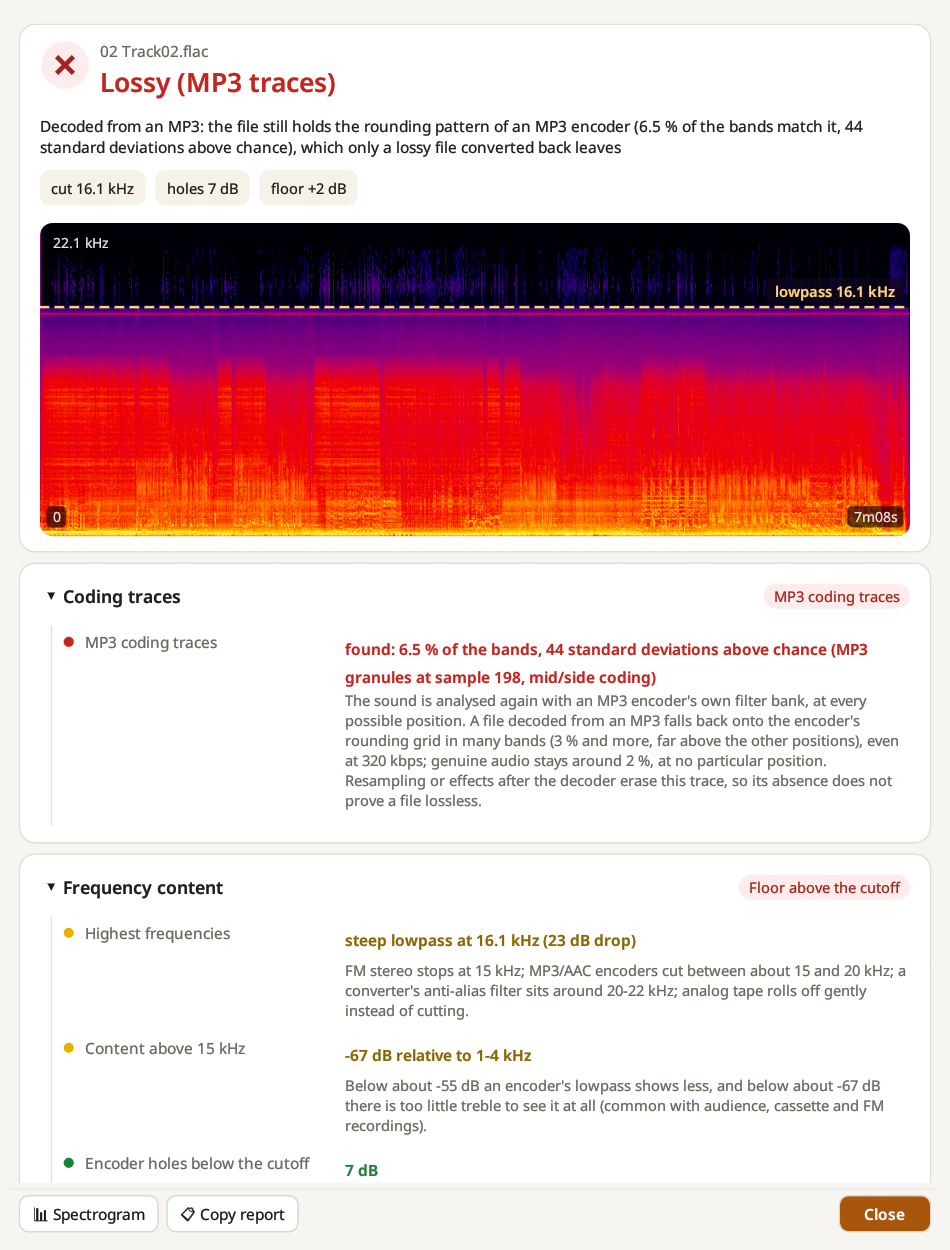
Click a verdict in the Source column to open its report. At the top, the verdict, a one-sentence explanation and the key figures ("cut 16.1 kHz", "holes 7 dB"). Then the track's spectrogram, with the lowpass found drawn on it as a dashed line: the verdict can be seen, not only read.
Here, a track decoded from an MP3: the treble stops dead at 16.1 kHz, and the MP3 traces settle it: 6.5 % of the bands match an MP3 encoder's rounding grid, 44 standard deviations above chance.
The measurements follow in three cards, folded when there is nothing unusual in them and open when something is worth a look. Each measurement has its value, colored by how suspicious it is, and a short note on what is normal for each kind of source.
Coding traces
- MP3, AAC and Opus coding traces: the share of bands (or frames, for Opus) that fall onto the encoder's rounding grid. Genuine audio stays around 2 %, "within the normal range"; a file decoded from a lossy one shows far more, at one particular position.
- Zeroed low bits (lossyWAV): the mark lossyWAV leaves when it discards detail to make smaller FLAC files.
Frequency content
- Highest frequencies: whether there is a brick-wall lowpass, and where. FM stereo stops at 15 kHz, MP3/AAC encoders cut between about 15 and 20 kHz, a converter's anti-alias filter sits around 20–22 kHz, and analog tape rolls off gently.
- Content above 15 kHz: how much treble is left, compared with the 1–4 kHz band. Below about -67 dB there is too little to see an encoder at all.
- Encoder holes below the cutoff: perceptual encoders switch the top bands on and off from frame to frame; FM and analog sources don't.
- Floor above the cutoff and Floor at 18–19.5 kHz: a lossy file converted back leaves digital silence there, while a tuner or sound card adds steady hiss after any encoder.
- Treble roll-off (called Edge of the lowpass when there is a cutoff): how fast the level falls. Encoders and digital filters drop by hundreds of dB per octave; tape, microphones and analog filters by tens.
- Hi-res content, for files at 88.2 kHz and above: whether there is real content above 22–24 kHz.
Stereo, FM and bits
- 19 kHz FM stereo pilot: if the tone is there, the show was recorded off air, and its exact frequency measures the tape speed.
- Tone near 15.6 kHz: a TV set's line frequency: the show was probably simulcast on TV, or a TV set was near the recorder.
- Stereo width: how far the difference channel sits below the sum; concert mixes usually sit 4 to 10 dB below, and 20 dB or more is nearly mono.
- Bit depth and Bits really used, for 24-bit files: whether the extra bits carry anything.
The Reasoning card walks through the verdict step by step. Copy report puts it all on the clipboard, ready to paste into a forum post or a message to the person who sent you the show. Spectrogram opens the track's full spectrogram.
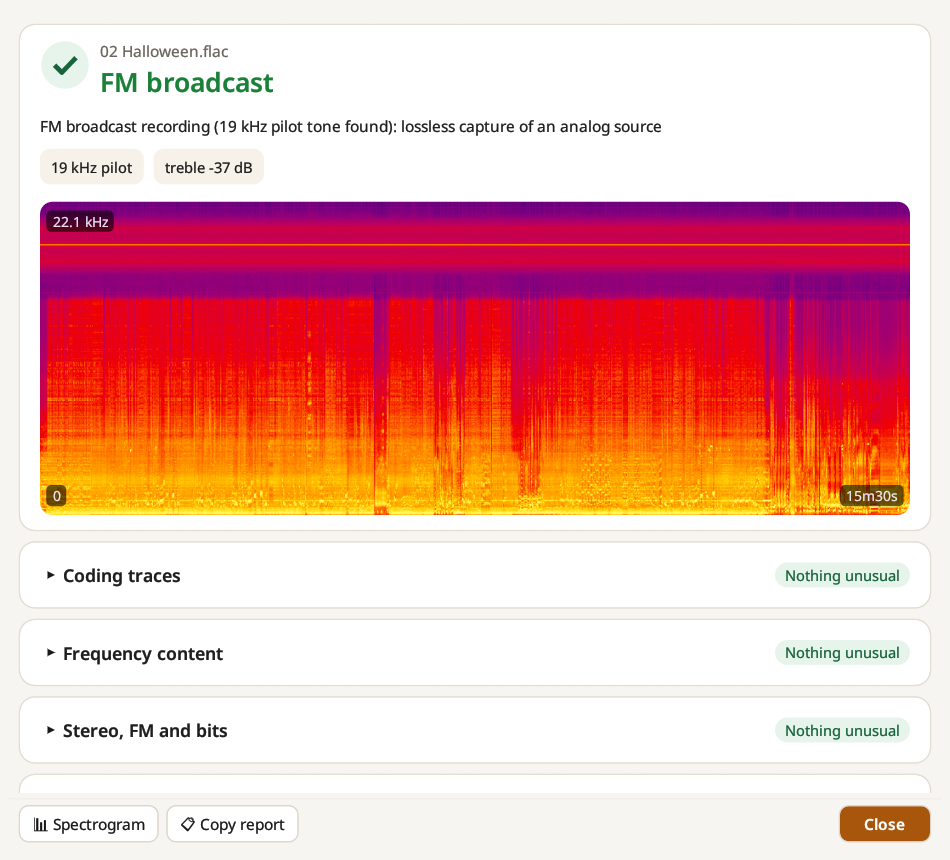
And a track recorded off air: the 19 kHz pilot tone shows as a thin line near the top of the spectrogram, and every card says "Nothing unusual".
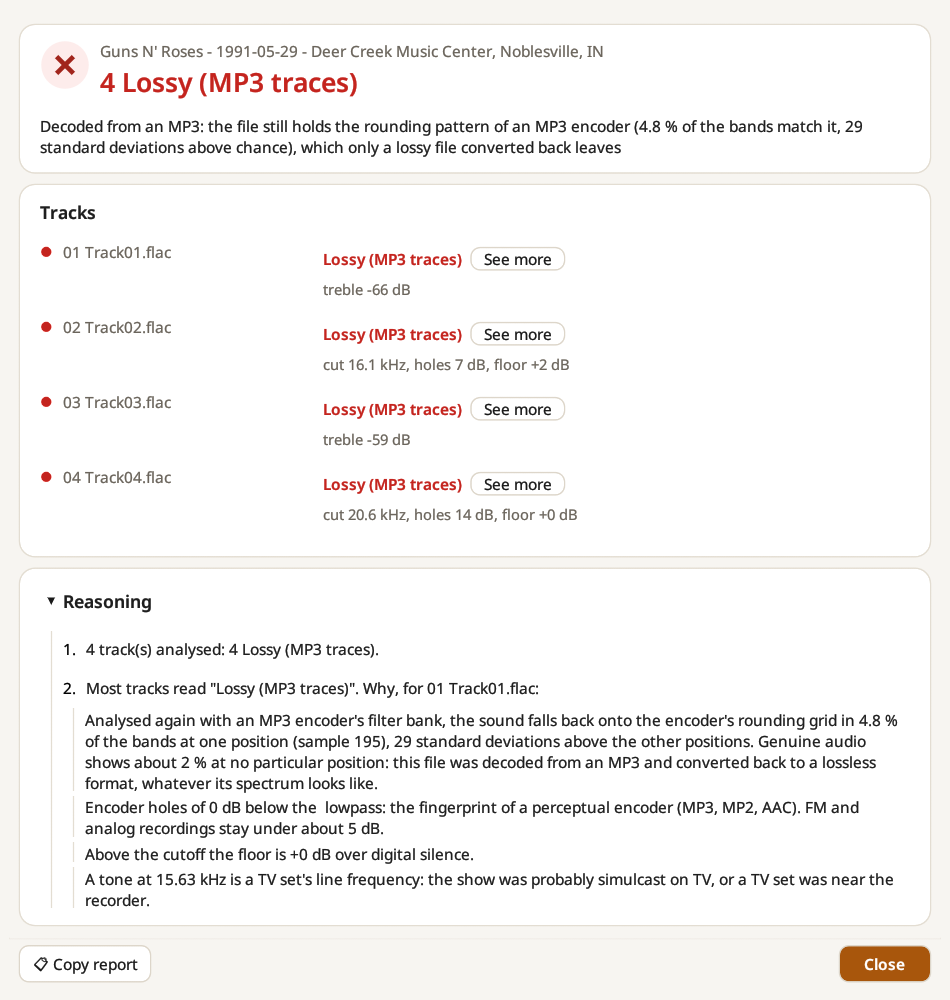
Click the verdict on a show line to get the analysis of the whole show: every track with its verdict, its key figures and a See more button, then the reasoning ("4 track(s) analysed: 4 Lossy (MP3 traces)") with the explanation for a typical track.